How Universal Talent Passports Extend the Learner–School Relationship
Most educational relationships are organized around enrollment.
A learner applies, enters a program, completes courses, receives a credential, and graduates. The institution retains the official record. The learner carries the experience into the rest of their life.
But learning does not begin at enrollment or end at graduation.
People arrive with experience from previous schools, employment, community participation, independent learning, military service, family responsibilities, and personal projects. After leaving, they continue developing through careers, relationships, professional education, service, and life transitions.
The school may have helped shape that journey, but it usually loses the connection needed to continue supporting it.
A Universal Talent Passport can change the relationship.
TalentPass gives each learner a living, portable source of truth that connects learning, experience, evidence, credentials, relationships, and goals across time. Passport Pages can create permission-based connections through which schools continue issuing value, offering opportunities, and supporting growth.
Instead of a relationship defined by one period of enrollment, the learner and institution can become lifelong partners.
Product availability note: This article describes both capabilities available in TalentPass today and longer-term applications Gobekli is developing with institutional partners. Visit our Product Availability page to see what is currently available, being tested, in development, or part of our future direction.
The current relationship has an expiration date
Educational institutions build a deep understanding of learners while they are enrolled.
Faculty see how students think and create. Advisors learn about their goals and challenges. Career services help connect learning with employment. Student organizations reveal interests and leadership. Projects and internships demonstrate how learners apply knowledge.
Much of this understanding remains with individual people or inside separate systems.
At graduation:
- The transcript becomes largely static.
- Projects may disappear into old learning platforms.
- Advising relationships end.
- Credentials become separated from the experiences surrounding them.
- The learner must reconstruct their story for employers and future schools.
- The institution relies on occasional surveys and alumni outreach to understand what happened next.
The relationship changes from continuous participation to periodic contact.
A Universal Talent Passport provides a way to preserve continuity without requiring the institution to maintain a permanent, comprehensive profile of the learner.
The person carries the continuity forward.
1. Begin with what the learner already brings
A learner does not arrive as an empty record.
They may bring:
- Previous education
- Employment
- Certifications
- Military experience
- Volunteer service
- Creative work
- Community leadership
- Family responsibilities
- Independent learning
- Cultural and lived experience
- Existing skills and relationships
- Personal interests and goals
Traditional admissions and enrollment systems capture only some of this context.
TalentPass can help learners organize what they already know, have experienced, and hope to pursue before or during entry into a new program.
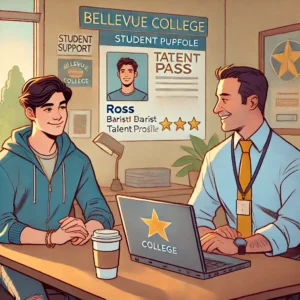
The learner may choose to share relevant parts of that understanding with an advisor, admissions team, prior-learning evaluator, mentor, or program leader.
This gives the relationship a stronger starting point.
The school sees more than an application and transcript. The learner begins with greater recognition of the value they already possess.
2. Connect learning as it happens
During enrollment, valuable learning is distributed across many settings:
- Courses
- Projects
- Laboratories
- Research
- Internships
- Apprenticeships
- Campus employment
- Student organizations
- Athletics
- Performances
- Community service
- Peer relationships
- Mentoring
Each experience may be recorded differently. Some appear on a transcript. Some generate credentials. Others remain inside a portfolio, departmental system, faculty member’s memory, or the learner’s own recollection.
TalentPass gives the learner a place to connect these experiences over time.
They can document:
- What they did
- What role they played
- What they created
- Which capabilities they developed
- What evidence exists
- What feedback they received
- How the experience connected with their goals
- What they want to explore next
This makes reflection and self-understanding part of learning—not an activity postponed until graduation.
3. Make advising a continuous process of meaning-making
Advising often focuses on immediate decisions:
- Which course should I take?
- Am I meeting program requirements?
- Which internship should I pursue?
- What should I do after graduation?
These decisions become more useful when connected to a learner’s broader experience.
Pythia, the private AI guide within TalentPass, is designed to help learners reflect on their experiences, recognize patterns, organize evidence, and prepare for conversations.
The learner can decide what they want to share with an advisor or mentor.
This can help advising move beyond isolated transactions and toward a continuing process:
- The learner has an experience.
- They reflect on what happened.
- They connect it to their capabilities and goals.
- They discuss relevant context with an advisor or mentor.
- They make a more informed next decision.
- The new experience becomes part of the growing record.
The passport supports continuity between conversations. The advisor remains the human partner who helps the learner interpret possibilities and make choices.
4. Connect credentials with the experiences that give them meaning
Schools issue trusted recognition throughout the learner journey:
- Degrees
- Certificates
- Microcredentials
- Digital badges
- Comprehensive Learner Records
- Competency records
- Program milestones
- Experiential-learning recognition
- Co-curricular achievements
These records are important, but their value grows when the learner can connect them to what they actually experienced.
A project-management credential may connect to a team project. A research badge may connect to methods, findings, and a faculty relationship. A leadership credential may connect to student service, employment, or community work.
TalentPass is designed to receive and organize trusted records alongside the learner’s experiences, evidence, and reflections.
The school confirms what it recognized.
The learner preserves what that achievement meant and how it became useful.
5. Prepare for the transition out of school before it arrives
The transition from education into work is often compressed into the final months of a program.
Learners suddenly need to:
- Build a résumé
- Prepare a portfolio
- Identify relevant skills
- Explain projects
- Find references
- Practice interviews
- Search for opportunities
- Translate learning into employer language
A Universal Talent Passport allows that preparation to develop throughout the educational experience.
When the learner is ready to pursue an internship, job, apprenticeship, additional education, or other opportunity, they can draw from their larger source of truth to create a purpose-specific profile.
That profile can emphasize the experiences, capabilities, credentials, evidence, and goals relevant to the opportunity without exposing everything in the passport.
The school can help the learner make those connections before graduation rather than asking them to reconstruct years of development at the end.
6. Let the learner carry the relationship forward
When a learner leaves, their TalentPass remains with them.
They can continue adding:
- Employment
- Projects
- Professional learning
- New credentials
- Leadership
- Community participation
- Accomplishments
- Relationships
- Career transitions
- Changing interests and goals
The school’s records and experiences remain connected to what happens next.
This creates continuity without giving the institution automatic access to the alumnus’s life.
The learner decides whether to maintain a connection and what information to share.
That distinction is essential.
A lifelong relationship should not mean lifelong institutional visibility into everything a person does. It should mean the institution continues creating enough value that the learner chooses to remain connected.
7. Give learners reasons to return
A school can continue supporting people throughout their lives.
As work and technology change, former learners may need:
- New technical skills
- AI-related learning
- Industry credentials
- Career-transition programs
- Leadership development
- Professional communities
- Mentoring
- Short courses
- Coaching
- Advanced education
- Opportunities to teach or contribute
Through a permission-based Passport Page relationship, an institution could eventually offer opportunities informed by the context a learner chooses to share.
An alumnus exploring a new field may receive relevant learning. A professional developing leadership capability may discover a certificate or mentoring community. A graduate with specialized expertise may be invited to support current learners.
The institution remains relevant because it continues helping the person move forward.
8. Turn the relationship into a two-way exchange
Traditional educational relationships tend to flow primarily in one direction during enrollment:
The institution teaches, assesses, and issues records.
A lifelong relationship can become more reciprocal.
The institution can contribute:
- Learning
- Credentials
- Mentoring
- Community
- Recognition
- Resources
- Opportunities
- Professional connections
Learners and alumni can contribute:
- Experience
- Mentoring
- Employer relationships
- Industry insight
- Community connections
- Project opportunities
- Feedback
- Teaching
- Professional expertise
Passport Pages can provide infrastructure for these permission-based exchanges.
The purpose is not to turn every interaction into data collection.
It is to help each side understand what it can offer and what would create value for the other.
9. Learn from learner journeys—with consent
Schools need to understand what happens after learning.
They want to know:
- How programs connect to careers
- Which experiences matter in practice
- Where learners face difficult transitions
- Which capabilities employers value
- What alumni need to learn next
- How industries and roles are changing
- Where programs and partnerships could improve
A Universal Talent Passport does not automatically provide this intelligence to the institution.
Individuals own and control their TalentPass. Any information returned to the school must be shared intentionally and governed responsibly.
With appropriate consent, privacy protections, and participation, TalentSync could eventually help institutions learn from aggregated patterns across learner journeys and relationships.
That intelligence could inform:
- Program design
- Advising
- Career services
- Employer partnerships
- Continuing education
- Credential development
- Alumni programming
- Institutional strategy
The institution gains a better understanding of long-term impact. Learners retain agency over their records and participation.
A relationship across the learner’s life
The learner–school relationship can be understood across five stages:
Before enrollment
The learner begins with a source of truth about what they already know, have experienced, and hope to pursue.
During learning
Courses, projects, relationships, credentials, and growth connect within the learner’s passport.
At transition
The learner creates relevant profiles for employment, additional education, apprenticeships, or other opportunities.
After graduation
The passport continues growing as the person works, learns, contributes, and changes direction.
Throughout life
The institution remains connected by continuing to provide useful learning, community, credentials, mentoring, recognition, and opportunity.
At every stage, the learner retains control.
From a student record to a lifelong learning relationship
A school traditionally maintains the official record of what a learner completed.
A Universal Talent Passport gives the learner something different: continuity across everything that came before, happened during, and followed the educational experience.
TalentPass becomes the learner-controlled source of truth.
TalentSync helps the institution understand its programs, relationships, capabilities, and needs.
Passport Pages create trusted connections between them.
Together, they can transform education from a time-limited transaction into a lifelong partnership—one in which learners and institutions continue helping each other understand, adapt, and grow.