How Universal Talent Passports Can Support Better Student Outcomes
Student outcomes are often measured through enrollment, grades, retention, completion, and employment.
These measures matter. But they do not fully describe whether a learner understands what they are learning, can connect it to experience, knows how they are growing, or feels prepared to navigate what comes next.
Students also need to develop:
- Self-understanding
- Agency
- Confidence
- Evidence of what they can do
- Connections between learning and opportunity
- The ability to make informed decisions
- A foundation for continued growth after graduation
A Universal Talent Passport can support these outcomes by giving each learner a living, portable source of truth about their experiences, capabilities, evidence, credentials, relationships, and goals.
TalentPass does not automatically improve retention, academic performance, completion, or employment. Those outcomes depend on teaching, advising, resources, relationships, institutional practices, opportunity, and many other factors.
What it can do is strengthen the conditions that help learners participate more actively in their own development—and give educators better context when learners choose to share it.
Product availability note: This article describes both capabilities available in TalentPass today and longer-term applications Gobekli is developing with institutional partners. Visit our Product Availability page to see what is currently available, being tested, in development, or part of our future direction.
Students experience more learning than conventional records can show
A transcript documents courses, credits, and grades.
It does not usually reveal:
- What the learner created
- Which problems they solved
- How they contributed to a group
- What they learned through employment
- Where they demonstrated leadership
- How their interests changed
- Which relationships shaped their growth
- What evidence supports their capabilities
- How they applied learning outside the classroom
- What they hope to do next
Important learning may happen through courses, but also through projects, research, internships, campus employment, student organizations, service, athletics, creative work, family responsibilities, and community participation.
When these experiences remain disconnected, students may struggle to recognize how much they have developed or explain it to others.
A Universal Talent Passport helps the learner bring these experiences together.
1. Help students understand what they are learning
Students are often told which learning outcomes a course or program is designed to develop.
That does not mean they automatically understand how those outcomes are appearing within their own work.
A learner may complete a group project without recognizing the communication, planning, negotiation, research, technical, and problem-solving capabilities involved. They may succeed in a campus job without connecting that experience to customer service, reliability, leadership, or operational judgment.
TalentPass helps learners reflect on experiences by asking questions such as:
- What did I do?
- What responsibility did I carry?
- What was difficult?
- What did I contribute?
- What did I learn?
- Which capabilities did I use or develop?
- What evidence can I preserve?
- How might this experience matter later?
This turns learning from something that happens to the student into something the student can recognize and build upon.
2. Make growth visible across time
Learning is not always obvious while it is happening.
A student may develop gradually through repeated practice, feedback, mistakes, new responsibilities, and increasingly complex work. Conventional records tend to preserve final results rather than the journey that produced them.
A Universal Talent Passport can help learners connect experiences over time.
They can see:
- How an early interest became deeper expertise
- How repeated activities strengthened a capability
- How feedback changed their approach
- How classroom learning became useful in practice
- How new relationships created opportunities
- How one experience prepared them for another
- Where they are continuing to struggle or grow
Visible progress can help students develop a more realistic understanding of themselves.
It shows that capability is not simply something people either possess or lack. It develops through experience, effort, support, reflection, and time.
3. Connect learning across courses and experiences
Students often experience education as a collection of separate requirements.
One course may not clearly connect with another. Academic learning may remain disconnected from internships, work, service, or personal projects. Capabilities developed in one setting may not be recognized in another.
TalentPass gives the learner a place to connect these experiences around themselves.
The Talent Tree provides a shared structure for exploring dimensions such as:
- Technical skills
- Human skills
- Motivations
- Interests
- Passions
- Leadership
- Stewardship
- Reputation
- Relationships
- Personal journey
- Agency
- Potential
The Talent Tree is not a grade or score.
It helps learners recognize patterns that may extend across different parts of their education and life.
A student may see that research, campus employment, and volunteer service all developed different aspects of the same capability. Another may discover that an interest appearing across several courses points toward a future pathway.
These connections make fragmented learning more coherent.
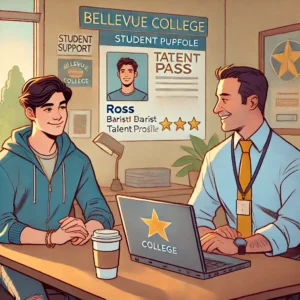
4. Prepare students for stronger advising conversations
Advisors are often expected to guide students using limited information.
They may see academic progress and program requirements but know less about:
- The learner’s prior experience
- Interests and motivations
- Work and family responsibilities
- Capabilities developed outside school
- Meaningful projects
- Career uncertainty
- Personal goals
- Barriers affecting the next step
TalentPass gives the learner a private environment for building this understanding.
Before meeting with an advisor, the student can use Pythia—the private AI guide within TalentPass—to reflect on experiences, identify questions, and decide what context would be helpful to share.
The student might prepare a profile focused on:
- Experiences relevant to a possible major
- Evidence for a prior-learning conversation
- Interests connected to internships
- Capabilities they want to develop
- Goals for the next semester
- Questions about a possible career pathway
This does not give advisors automatic access to the learner’s full passport.
It helps the student enter the conversation better prepared and share the information they believe is relevant.
5. Strengthen learner agency and decision-making
Students make consequential decisions throughout education:
- Which program should I pursue?
- Should I change direction?
- Which course or experience would help me grow?
- Am I ready for an internship?
- What kind of work interests me?
- Should I continue my education?
- What support do I need?
- What do I want my learning to make possible?
These decisions are difficult when the learner has only a fragmented understanding of themselves.
A Universal Talent Passport can help the student connect past experience with future choices.
It does not determine the correct pathway or tell the learner who they should become. Instead, it provides context for more informed reflection:
- What patterns are appearing?
- Which experiences have been most meaningful?
- Where is the strongest evidence of capability?
- What environments support growth?
- What possibilities deserve further exploration?
- What remains unknown?
The goal is not perfect certainty.
It is greater agency—the ability to participate meaningfully in decisions about one’s own learning and future.
6. Help students preserve evidence before it disappears
Students create valuable work throughout their education:
- Research
- Presentations
- Designs
- Reports
- Performances
- Code
- Experiments
- Team projects
- Capstones
- Community work
- Internship deliverables
Much of this evidence disappears into learning-management systems, old devices, or forgotten folders after a course ends.
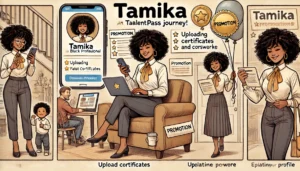
TalentPass encourages learners to preserve appropriate evidence while the experience is still recent.
They can connect an artifact with:
- The assignment or experience
- Their individual contribution
- The capabilities demonstrated
- Feedback received
- The outcome
- Reflection on what they learned
This gives future advisors, mentors, educators, and employers more than an unsupported list of skills.
It also helps the student remember the process behind the final product.
7. Build career preparation throughout the educational journey
Career preparation is often concentrated near graduation.
Students are asked to create résumés, portfolios, and professional narratives after years of relevant experiences have already passed.
A Universal Talent Passport allows that preparation to happen continuously.
As students learn and grow, they can accumulate the source material needed to pursue:
- Internships
- Apprenticeships
- Employment
- Graduate education
- Scholarships
- Research opportunities
- Professional networks
- Community leadership
When an opportunity appears, the student can create a purpose-specific profile emphasizing the most relevant experiences, evidence, capabilities, credentials, and goals.
The passport does not guarantee a better job or internship.
It helps learners represent themselves more clearly and enter the opportunity process with stronger evidence and greater confidence.
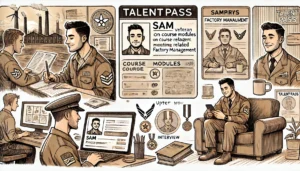
8. Recognize prior, informal, and nontraditional learning
Not every student enters education through the same pathway.
Adult learners, transfer students, veterans, working learners, career changers, and others may bring significant experience that formal records do not fully represent.
A Universal Talent Passport can help them document:
- Previous employment
- Military service
- Industry training
- Independent learning
- Certifications
- Community leadership
- Entrepreneurship
- Volunteer service
- Prior projects
- Transferable capabilities
Person-authored information should not automatically be treated as verified or awarded academic credit.
But it can give the learner a clearer way to organize relevant evidence and prepare for conversations about placement, support, career planning, or prior-learning assessment.
This helps institutions begin with a better understanding of what the learner brings rather than focusing only on what remains to be completed.
9. Expand recognition without claiming to eliminate inequity
Traditional educational and employment systems often favor people who already know how to present themselves.
Students with established networks, polished résumés, access to prestigious experiences, or familiarity with professional language may find it easier to make their capabilities visible.
TalentPass cannot eliminate the structural inequalities that shape education and opportunity.
But it can help more learners:
- Recognize capabilities developed through different experiences
- Preserve evidence of their work
- Learn language for describing their contributions
- Build profiles that go beyond pedigree
- Carry trusted records between systems
- Participate more actively in advising and career preparation
A passport can expand visibility and agency.
Institutions must still ensure that students have equitable access to meaningful learning, support, technology, relationships, and opportunities.
10. Give trusted credentials more context
Schools issue important records of student achievement:
- Degrees
- Certificates
- Digital badges
- Microcredentials
- Comprehensive Learner Records
- Competency records
- Experiential-learning recognition
- Other Learning and Employment Records
These records become more useful when students can connect them to the experiences and evidence surrounding them.
A credential can confirm what the institution recognized.
The learner can add context:
- Why they pursued it
- What they did
- How they applied the learning
- Which projects demonstrate it
- How it connects with future goals
TalentPass helps trusted institutional records become parts of a living learner journey rather than isolated achievements.
11. Carry learning and growth beyond graduation
Student success should not end with program completion or first employment.
Graduates will continue:
- Changing roles
- Learning new technologies
- Developing expertise
- Earning credentials
- Navigating disruptions
- Building relationships
- Pursuing new goals
- Contributing to communities
Because TalentPass belongs to the individual, it can continue growing after the learner leaves the institution.
The school can remain connected through continuing education, mentoring, alumni communities, credentials, employer relationships, and other opportunities.
The student outcome is not simply a completed degree.
It is the capacity to continue learning, adapting, and directing one’s development throughout life.
12. Help institutions learn from outcomes responsibly
Institutions need better ways to understand how learning connects with long-term outcomes.
They may want to learn:
- Which experiences students find most valuable
- Where learners encounter difficult transitions
- How classroom learning is applied
- What alumni need next
- Which capabilities are becoming more important
- Where advising or support could improve
- How programs connect with employment and community contribution
A Universal Talent Passport does not automatically provide this information to the institution.
Students and alumni own their TalentPass and decide what they share.
With appropriate consent, governance, privacy protections, and sufficient participation, TalentSync could eventually help schools learn from permissioned and aggregated patterns across learner journeys.
That intelligence could support program improvement while preserving learner agency.
The passport supports outcomes by strengthening the learner
Universal Talent Passports should not be presented as a technology that automatically produces better grades, retention, completion, or employment.
Student outcomes emerge from a much larger environment:
- Effective teaching
- Strong relationships
- Financial and practical support
- Accessible programs
- Meaningful learning
- Good advising
- Safe communities
- Relevant opportunities
- Institutional commitment
TalentPass contributes by helping the learner connect these experiences into a source of truth they can understand and use.
It can help students:
- Recognize what they are learning
- See growth over time
- Connect learning across settings
- Prepare for advising
- Make more informed choices
- Preserve evidence
- Represent themselves for opportunities
- Carry trusted credentials
- Navigate transitions
- Continue growing after graduation
That is how a Universal Talent Passport can support better student outcomes: not by replacing educators, advisors, or institutions, but by helping every learner participate more fully in understanding and shaping their own development.