How Universities Can Partner with Employers Through Universal Talent Passports
Universities and employers share an interest in helping people move successfully from learning into meaningful work.
But they often approach that goal through different systems, language, and incentives.
Universities organize learning through courses, programs, credentials, projects, and academic outcomes. Employers organize work through jobs, responsibilities, workflows, teams, and business needs. Students stand between them, expected to translate what they learned into language an employer can understand.
That translation is usually compressed into a résumé, transcript, application, and interview.
Important context gets lost:
- What the learner actually did
- How academic learning was applied
- What they contributed to projects
- Which capabilities they developed through work
- What evidence supports their claims
- Where they still need to grow
- What the employer’s work actually requires
- How the educational experience could improve
A Universal Talent Passport can create a stronger bridge.
TalentPass gives each learner a living, portable source of truth about their experiences, capabilities, evidence, credentials, relationships, and goals. TalentSync helps organizations develop a clearer understanding of their work, roles, teams, capabilities, and needs.
Connected through permission-based Passport Pages, learners, universities, and employers can exchange trusted context without placing the person’s complete history under institutional or employer control.
This creates the foundation for partnerships built around continuous learning—not just recruiting.
Product availability note: This article describes both capabilities available in TalentPass today and longer-term applications Gobekli is developing with institutional and employer partners. Visit our Product Availability page to see what is currently available, being tested, in development, or part of our future direction.
The learner currently carries the burden of translation
A student may complete a strong academic program and still struggle to explain how it prepared them for work.
A course title does not reveal the projects completed inside it. A grade does not show the learner’s role in a team. A degree does not communicate every tool, method, relationship, decision, or applied capability developed along the way.
Employers face the other side of the problem.
A job description may list responsibilities and qualifications without explaining:
- What the work actually involves
- Which activities matter most
- Where judgment is required
- Which capabilities can be developed on the job
- How the role is changing
- What evidence would demonstrate readiness
- Which requirements are truly necessary
The student attempts to connect two incomplete descriptions.
A better partnership requires each side to describe its reality more clearly—and give the learner an active role in connecting them.
1. Help students show learning in context
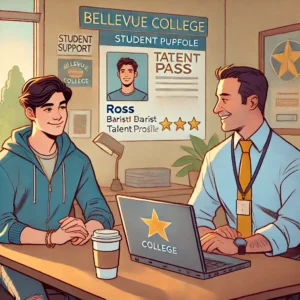
Universal Talent Passports allow students to connect formal learning with the experiences and evidence surrounding it.
A student can document:
- Course projects
- Research
- Laboratories
- Capstones
- Internships
- Apprenticeships
- Campus employment
- Volunteer service
- Student leadership
- Creative work
- Relevant employment
- Independent learning
For each experience, the student can preserve what they did, which role they played, what they created, what evidence exists, and what they learned.
This gives employers a richer view when the student chooses to share a relevant profile.
Instead of expecting an employer to infer capability from a degree or course title, the learner can show how learning became action.
2. Help employers describe opportunities more clearly
The quality of a partnership depends on the clarity of the opportunity.
If an internship or entry-level role is described through generic requirements and familiar credentials, students may struggle to understand what the employer actually needs. Universities may also have difficulty preparing learners or recommending appropriate experiences.
TalentSync’s recruiter functionality is designed to help employers move from a conventional job description toward a clearer Opportunity Profile.
An Opportunity Profile can explore:
- The purpose of the role
- Activities involved
- Required and developable capabilities
- Important relationships
- Evidence that may demonstrate readiness
- Conditions under which the work occurs
- What the person is expected to learn
- How the role may evolve
This does not eliminate employer judgment or hiring responsibility.
It creates a better starting point for learners, educators, career professionals, and employers to understand the opportunity together.
3. Create stronger internship and apprenticeship experiences
Internships and apprenticeships should be more than temporary placements.
They are opportunities for learners to apply education, develop new capabilities, receive feedback, and understand professional environments.
A Universal Talent Passport can help connect the experience before, during, and after the placement.
Before the experience
The learner can prepare a profile showing relevant projects, evidence, interests, credentials, and goals.
The employer can clarify the work, expectations, activities, and learning opportunities.
The university can help both sides establish an appropriate starting point.
During the experience
The learner can reflect on responsibilities, relationships, challenges, and growth without recording confidential employer information.
Mentors and supervisors can provide appropriate feedback through established processes.
After the experience
The learner can document what they contributed and learned, connect suitable evidence, and carry the experience forward.
The employer or university may issue a credential, endorsement, or other trusted recognition when appropriate.
The experience becomes part of a continuing learner journey rather than an isolated résumé line.
4. Make co-op and work-based learning more coherent
Co-op programs and extended work-learning models involve movement between academic and professional settings.
The value of each rotation increases when the learner can connect it to what came before and what should happen next.
TalentPass can help the learner preserve:
- Previous academic preparation
- Goals for the placement
- Activities performed
- Capabilities developed
- Feedback received
- Evidence that can be shared
- Questions raised by the experience
- Priorities for the next academic or work term
The university and employer receive only the information shared for the program’s legitimate purposes.
This can support more meaningful reflection and coordination without creating a permanent joint profile controlled by either organization.
5. Connect employer feedback with curriculum dialogue
Employers frequently say that graduates need different or stronger capabilities.
Universities may question whether those statements reflect enduring changes in work, the needs of one company, or unclear hiring expectations.
A Human Intelligence Layer can create a more grounded conversation.
Instead of relying only on lists of requested skills, partnerships can explore:
- Which activities are changing
- Where AI is altering the work
- Which capabilities matter in practice
- What new employees are expected to learn
- Where graduates appear well prepared
- Which experiences help learners transition successfully
- Where expectations differ across employers
- What evidence demonstrates readiness
Individual TalentPass records should not be mined without consent to evaluate programs or learners.
But permissioned, aggregated patterns—combined with direct dialogue among learners, educators, and employers—could help partnerships understand how learning and work are changing together.
The purpose is not to let employers dictate curriculum.
It is to give educators better context for deciding how programs should respond.
6. Recognize learning that happens through work
Employers are also learning providers.
People develop through:
- Onboarding
- Projects
- Supervision
- Mentoring
- Apprenticeships
- Technical training
- Cross-functional work
- Leadership responsibilities
- New systems and workflows
Universities can help employers recognize and connect this learning to broader educational pathways.
Employer-issued credentials, endorsements, or records of achievement can become part of the learner’s TalentPass when appropriate. Universities can evaluate whether particular experiences connect to programs, continuing education, or formal recognition through their own established academic processes.
This creates a more continuous relationship between education and employment.
Learning does not stop when someone enters work, and employment does not erase the value of the educational relationship.
7. Build more meaningful career fairs and recruiting events
Traditional career fairs frequently create brief, high-volume interactions.
Students arrive with résumés. Employers describe organizations and open positions. Both sides attempt to determine fit through short conversations.
TalentPass can help students prepare more intentionally.
A networking or job application profile can communicate:
- Relevant experiences
- Projects
- Evidence
- Credentials
- Interests
- Goals
- Questions
- The types of opportunities the learner wants to explore
Employers can provide clearer information about the work and pathways they offer.
This does not need to become automated matching or ranking.
The immediate value is better conversation. Students have more to discuss than their major and graduation date. Employers can respond to relevant experiences and interests rather than relying only on familiar résumé signals.
8. Support employer-sponsored learning and workforce development
Employer partnerships extend beyond recruiting students.
Organizations need help developing current employees as work, technology, and skill requirements change. Universities can provide:
- Continuing education
- Short courses
- Certificates
- Microcredentials
- Leadership development
- Technical training
- Career-transition programs
- Customized learning
- Research-informed professional development
TalentPass can help employees carry learning and credentials into their broader professional journeys.
TalentSync can help employers understand changing work and development needs.
Together, they could help universities and employers design learning around clearer problems while giving employees ownership of the resulting records and growth.
The institution becomes a long-term learning partner rather than only a source of new graduates.
9. Activate alumni as the bridge between education and work
Alumni understand both sides of the relationship.
They know the institution’s programs and culture. They also understand how learning is used—or not used—inside actual organizations.
Universal Talent Passports can help alumni participate as:
- Mentors
- Hiring managers
- Industry advisors
- Guest educators
- Project sponsors
- Internship hosts
- Professional-community leaders
- Continuing learners
- Connectors between employers and academic programs
Through permission-based participation, alumni can share selected experiences, interests, and expertise without exposing their complete professional history.
This can make employer partnerships more relational and durable.
10. Create opportunities for research and innovation
Some of the strongest university–employer partnerships form around shared problems rather than recruiting.
Employers may need help understanding emerging technology, redesigning work, developing new capabilities, or solving industry and community challenges. Universities bring research, faculty expertise, student talent, learning design, and convening power.
TalentPass can help students and faculty create relevant profiles for projects they choose to pursue.
TalentSync can help employers articulate the work, expertise, relationships, and capabilities involved.
This could support stronger connections around:
- Applied research
- Sponsored projects
- Innovation challenges
- Product development
- Community partnerships
- AI transformation
- Workforce redesign
- Experiential education
The passport is not a research-management system. It helps make the people and capabilities surrounding the opportunity more understandable.
11. Protect learner agency in every partnership
A stronger university–employer partnership must not come at the cost of learner control.
Students should not be required to expose their complete histories to employers or institutions. They should understand:
- What information is being requested
- Why it is relevant
- Who can access it
- How it will be used
- Whether participation is optional
- How long access lasts
- What decisions may be influenced
- How they can correct or withdraw information
TalentPass is designed as the learner-controlled side of the relationship.
The student creates profiles for particular purposes and shares information intentionally.
Universities and employers remain responsible for fair, transparent, and lawful decisions. A passport should provide better context—not become an automated score, permanent surveillance record, or hidden screening system.
A practical partnership model
University–employer collaboration can develop in stages.
Stage 1: Better-prepared learners and clearer opportunities
Students build TalentPass profiles. Employers improve how they describe internships, jobs, and projects. Career teams help the two sides communicate.
Stage 2: Connected work-based learning
Universities and employers incorporate permission-based profiles, reflection, feedback, evidence, and trusted recognition into internships, apprenticeships, co-ops, and projects.
Stage 3: Passport Page relationships
Institutions and employers create trusted connections through which they can issue credentials, offer opportunities, provide resources, and request information learners intentionally share.
Stage 4: A shared Human Intelligence Layer
TalentPass and TalentSync support a continuous feedback loop among learners, educators, employers, and AI-enabled systems.
The ecosystem can begin understanding how learning, work, capabilities, and opportunities are changing—while individuals retain meaningful ownership and control.
From talent pipeline to learning ecosystem
Students are not products moving from universities into employers.
They are people learning across both environments.
Universities contribute knowledge, development, credentials, relationships, and reflection. Employers contribute real work, experience, mentoring, feedback, and opportunity. Learners connect these experiences into lives and careers that continue changing long after either program or job ends.
Universal Talent Passports create continuity around the person.
TalentPass helps learners understand and represent themselves.
TalentSync helps universities and employers better understand their organizations, work, and needs.
Passport Pages create permission-based connections between them.
Together, they can transform university–employer partnerships from periodic recruiting relationships into learning ecosystems that help people, institutions, and work continuously improve together.