Artificial intelligence is becoming part of the systems that shape work, learning, healthcare, finance, public services, hiring, education, and daily decision-making.
But AI does not become trustworthy simply because it is powerful.
AI systems depend on data: the claims they receive, the records they analyze, the patterns they learn from, the permissions they respect, and the context they are given. If that foundation is incomplete, inaccurate, biased, unverifiable, or disconnected from human reality, AI can scale confusion instead of understanding.
That is why Verifiable Credentials matter.
Verifiable Credentials are digital records that allow a trusted issuer to make a claim about a person, organization, achievement, qualification, license, experience, or other subject in a way that can be checked. They help answer basic but essential questions:
In an AI-powered world, these questions become foundational.
A more ethical AI future will require more than better models. It will require better trust infrastructure around the human context those models use.
AI systems rely on data to generate recommendations, make predictions, classify information, identify patterns, automate workflows, and support decisions.
That data may include education records, employment history, credentials, licenses, work experience, health information, performance signals, identity attributes, skills, goals, relationships, or evidence of capability.
When the data is trustworthy, AI can be more useful.
When the data is unreliable, AI can produce outcomes that are inaccurate, unfair, invasive, or difficult to challenge.
Poor-quality data can lead to:
This is especially important when AI systems influence opportunities, recognition, care, employment, learning, or access to resources.
The question is not only whether AI can process data.
The question is whether the data deserves to be trusted.
Photo placement: keep the current “trustworthy data / AI decision-making” image under this section.
Verifiable Credentials provide a way to represent claims with clearer provenance and stronger integrity.
A credential may say that a person completed a course, earned a certification, held a role, contributed to a project, received a license, demonstrated a skill, or participated in a verified experience.
The value is not just that the credential is digital.
The value is that the claim can be checked.
A Verifiable Credential usually involves three roles:
This structure supports a more trustworthy digital ecosystem because claims are not floating around as isolated text. They are tied to issuers, subjects, cryptographic integrity, and verification methods.
In the context of AI, this can help separate unsupported assertions from evidence-backed information.
One of the most important ideas behind Verifiable Credentials is that trust and privacy should work together.
A person should not always have to reveal a full record just to prove one fact.
For example, someone may need to prove they are over a certain age without revealing their full birthdate. A worker may need to prove they hold a required certification without exposing unrelated personal information. A learner may need to share a relevant achievement without handing over an entire transcript.
Verifiable Credential ecosystems can support more selective, purpose-specific sharing.
That matters for human-centered AI.
If AI systems are going to use personal, educational, professional, or organizational data, people and institutions need stronger ways to control what is shared, with whom, for what purpose, and under what conditions.
Ethical AI is not just about accurate data.
It is also about appropriate data.
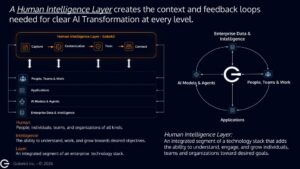
Gobekli’s work is centered on the Human Intelligence Layer: a trusted, living layer of context that helps people, organizations, systems, and AI understand human experience, capability, judgment, growth, evidence, and change.
Verifiable Credentials are one important part of that foundation.
They help make human context more trustworthy, portable, and useful. But they are not the whole picture.
A credential can verify that something happened. It may not fully explain why it mattered, what someone learned, how they applied it, what relationships shaped it, or what potential it revealed.
That is why Verifiable Credentials become more powerful when connected with richer human intelligence:
In Gobekli’s ecosystem, TalentPass helps individuals build and control a living record of their talent, experiences, capabilities, and evidence. TalentSync helps organizations build shared understanding across people, teams, work, capabilities, and needs.
Verifiable Credentials help make parts of that intelligence more trusted and interoperable.
Verifiable Credentials can support ethical AI in several important ways.
They improve data authenticity.
AI systems can reason from claims that have clearer issuers, provenance, and verification paths.
They support accountability.
When a claim is used in a decision, it becomes easier to understand where the claim came from and whether it was appropriate to use.
They reduce unnecessary data exposure.
Selective sharing can help people prove what is needed without revealing unrelated information.
They strengthen user agency.
Credentials can be held and shared by individuals, giving people more control over their own records.
They support interoperability.
Standards-based credentials can move across systems, reducing dependence on closed platforms and disconnected databases.
They create better AI context.
AI tools can become more useful when they are grounded in trusted, permissioned, evidence-backed information.
The result is not perfect AI.
But it is a stronger foundation for AI systems that need to make or support decisions involving people.

Verifiable Credentials can support many AI-enabled systems where trust, privacy, evidence, and accountability matter.
AI-enabled platforms often need to know whether a person meets a specific requirement: age, identity, authorization, eligibility, membership, or access rights.
Verifiable Credentials can help confirm necessary facts without requiring platforms to collect or store more personal information than they need.
This can make identity workflows more privacy-preserving and less dependent on repeated document uploads or centralized data collection.
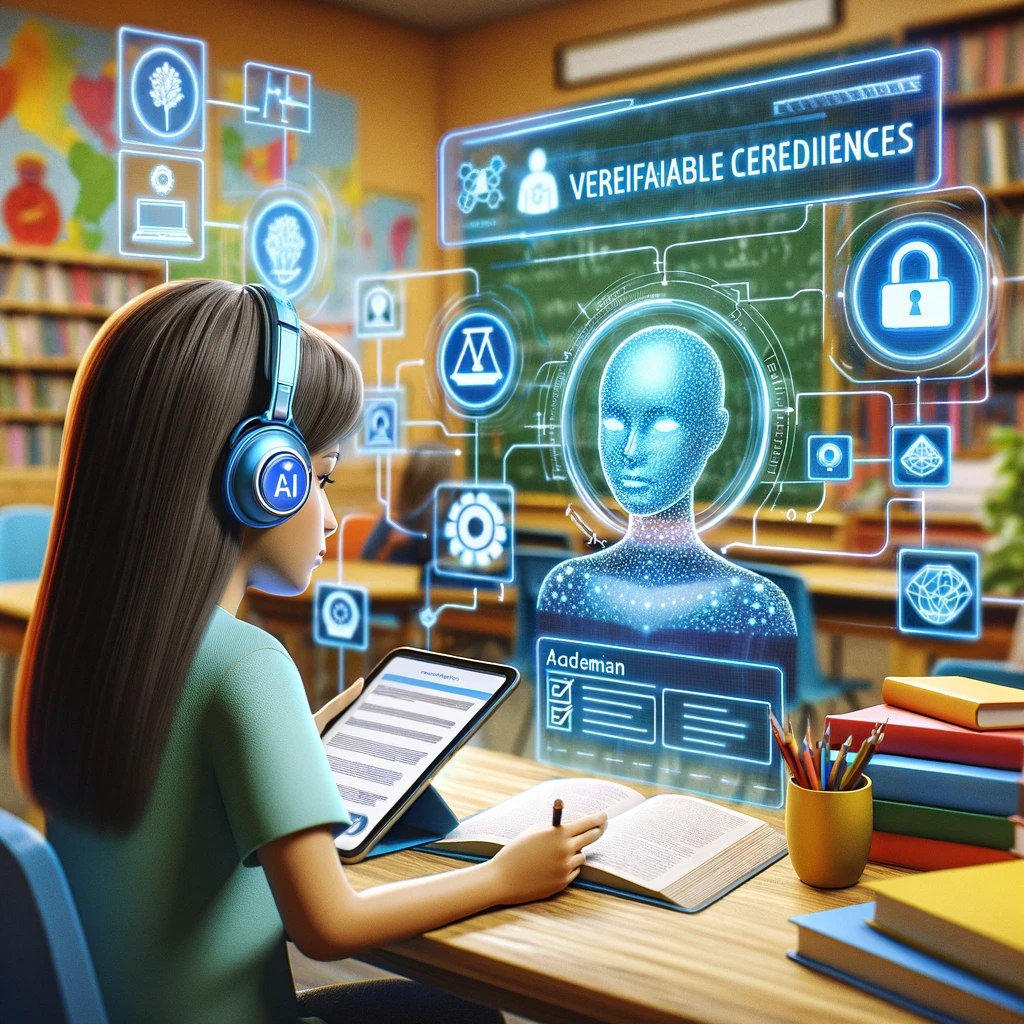
In education, Verifiable Credentials can help learners carry trusted evidence of degrees, certificates, courses, projects, internships, competencies, and achievements.
AI systems can then support more personalized guidance, pathway recommendations, admissions workflows, transfer processes, and career navigation using credentials that are easier to verify.
This is especially important as learning happens across schools, online programs, work-based learning, military service, community programs, and informal experiences.
Employers, licensing bodies, industry associations, and training providers all issue records that can affect opportunity.
Verifiable Credentials can make qualifications easier to check and harder to falsify.
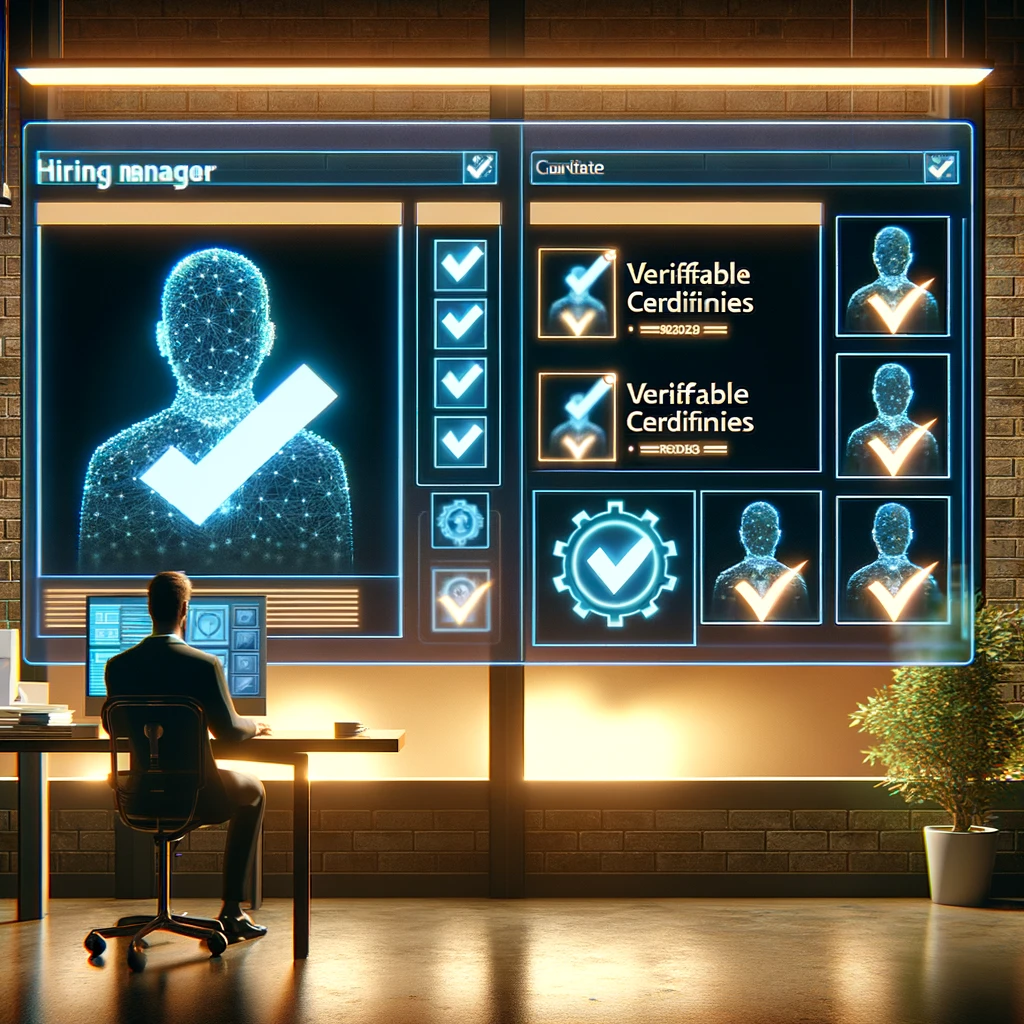
AI systems used in hiring, compliance, staffing, or professional development can benefit from verified claims rather than relying only on resumes, self-reported profiles, or keyword matching.
In organizations, Verifiable Credentials can support a more trusted understanding of employee skills, certifications, achievements, role readiness, and learning.
When connected to a broader Human Intelligence Layer, they can help AI tools support internal mobility, development planning, workforce planning, team design, and succession decisions with better evidence.
The goal is not to reduce employees to credentials.
The goal is to connect trusted credentials with richer context about work, growth, contribution, and potential.
AI is increasingly used to manage supply chains, assess risk, verify compliance, and trace products.
Verifiable Credentials can help confirm product origin, certifications, inspections, handling, sustainability claims, or supplier qualifications.
This allows AI systems to reason from more trustworthy provenance data, especially in industries where safety, ethics, authenticity, or regulatory compliance matter.
Healthcare AI depends on sensitive information where privacy, accuracy, and authorization are critical.
Verifiable Credentials can support consent-based sharing of health records, provider credentials, insurance information, certifications, or patient permissions.
Used carefully, this can help AI systems provide more personalized support while respecting privacy and data governance requirements.
Verifiable Credentials are promising, but they are not magic.
Their impact depends on thoughtful implementation, ecosystem adoption, standards alignment, governance, and trust.
Important challenges include:
A credentialed future is not automatically an equitable future.
The design choices matter.
Verifiable Credentials should expand agency, portability, recognition, and trust. They should not make people more trackable, more reducible, or more dependent on institutions to define their worth.
As AI becomes more embedded in everyday systems, society will need stronger ways to verify claims, preserve privacy, trace provenance, and respect individual control.
Verifiable Credentials can help create that foundation.
They can make digital records more trustworthy. They can help people carry evidence across systems. They can help organizations reduce fraud and improve decision-making. They can help AI tools work from better context.
But the larger opportunity is not simply technical.
The larger opportunity is human.
A future built on Verifiable Credentials, Learning and Employment Records, and human-centered AI can help people show what they know, what they have done, what they are learning, and what they are ready to contribute.
It can help institutions and employers make better decisions.
It can help AI systems become more accountable, more useful, and more aligned with human goals.
That is why Verifiable Credentials are not just a digital identity tool.
They are part of the trust infrastructure for a more human-centered AI future.
This article describes Gobekli’s product vision and related future-state use cases. Current product capabilities, availability, and implementation options may differ as TalentPass, TalentSync, Passport Pages, Pythia, and related features continue to develop. For the latest status, see our Product Availability page.