
Plan the Workforce and Leadership Pipeline
Build readiness before critical roles become critical gaps.
See the work, capabilities, and leaders your organization will need next—and create pathways that prepare people before the need becomes urgent.
TalentSync connects business priorities, workforce signals, individual evidence, and changing work into a living view of workforce readiness.
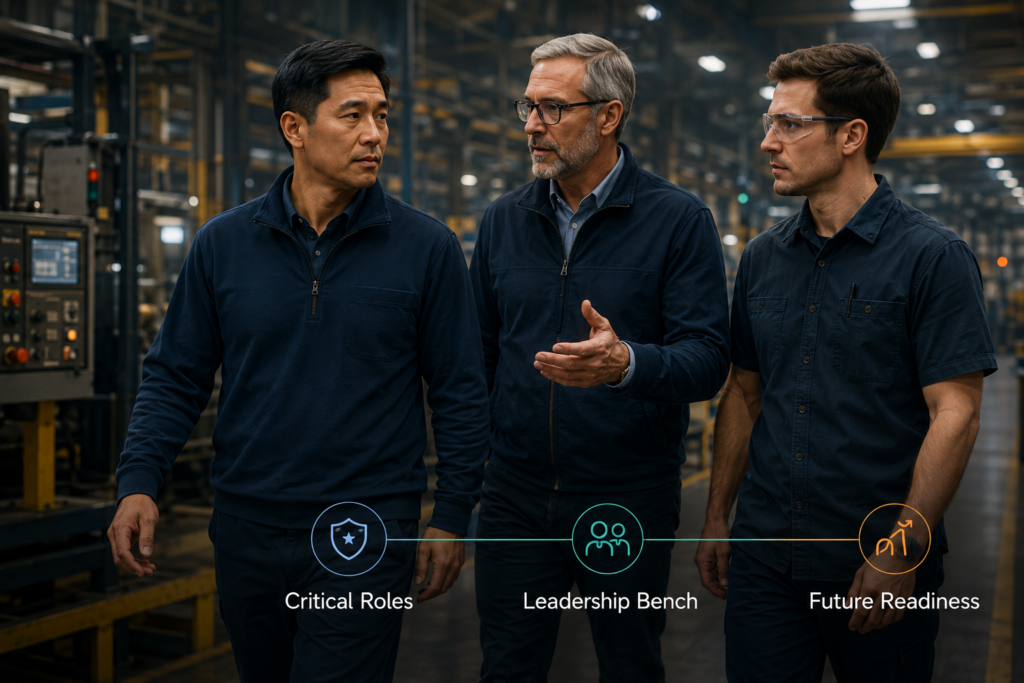
Summit Has a Workforce Plan—But Not a Living View of Readiness
Summit Manufacturing is expanding across multiple locations while experienced supervisors, technical specialists, and plant leaders approach retirement.
HR can track headcount, vacancies, retirement eligibility, training, and existing succession plans. But those records do not reveal whether Summit has enough people prepared to perform its most important future work.
Leadership still cannot confidently see where critical knowledge is concentrated, how strong the succession bench really is, or which people could become ready with the right opportunities.
Lorem ipsum dolor sit amet, consectetur adipiscing elit. Ut elit tellus, luctus nec ullamcorper mattis, pulvinar dapibus leo.
Lorem ipsum dolor sit amet, consectetur adipiscing elit. Ut elit tellus, luctus nec ullamcorper mattis, pulvinar dapibus leo.
What Summit Can See
- Current headcount by role and location
- Vacancies and time-to-fill
- Retirement eligibility by year
- Training completions and compliance
- Open requisitions and job postings
What Remains Hidden
- Readiness of successors for critical roles
- Depth and quality of the leadership bench
- Emerging capability and skill gaps
- Attrition risk within high-impact roles
- Pathways that could prepare future leaders
Summit knows where its workforce stands today. It cannot yet see whether it will have the workforce and leadership capacity its strategy will require tomorrow.
That is the gap TalentSync helps close.
Build a Living Workforce Intelligence Layer
TalentSync connects workforce data with the changing work, capabilities, evidence, aspirations, and business priorities that traditional planning systems cannot fully capture.
Instead of relying on static succession lists and annual workforce forecasts, Summit gains a continuously updated understanding of the roles that matter, the people who could grow into them, and the gaps that still require action.
Critical Roles
Identify where workforce risk could become business risk.
Connect strategic priorities, operational dependencies, changing responsibilities, and workforce conditions to determine which roles require the greatest attention.
Leadership Bench
See who is ready, who is developing, and where the bench is thin.
Evaluate potential successors through demonstrated capabilities, relevant experience, aspirations, mobility, and evidence—not reputation or nomination alone.
Future Gaps
Understand what the organization may need before the shortage arrives.
Compare future work and capability demand with the internal pipeline to reveal where Summit should develop, redeploy, hire, redesign work, or use AI.
Together, these views turn workforce planning from a periodic forecast into a living system for building organizational readiness.
1. Identify the Work and Roles That Matter Most
Not every vacancy creates the same level of risk. Summit begins by understanding which work is most important to its strategy—and which roles would be hardest to replace or rebuild.
TalentSync connects business priorities, operational dependencies, workforce conditions, and changing responsibilities to create a clearer view of critical-role risk.
Summit can:
- Map roles to essential workflows and business outcomes
- Identify where knowledge and decision-making are concentrated
- See exposure from retirement, attrition, and long hiring timelines
- Understand how AI and automation may change future role requirements
- Separate routine staffing needs from risks requiring early action
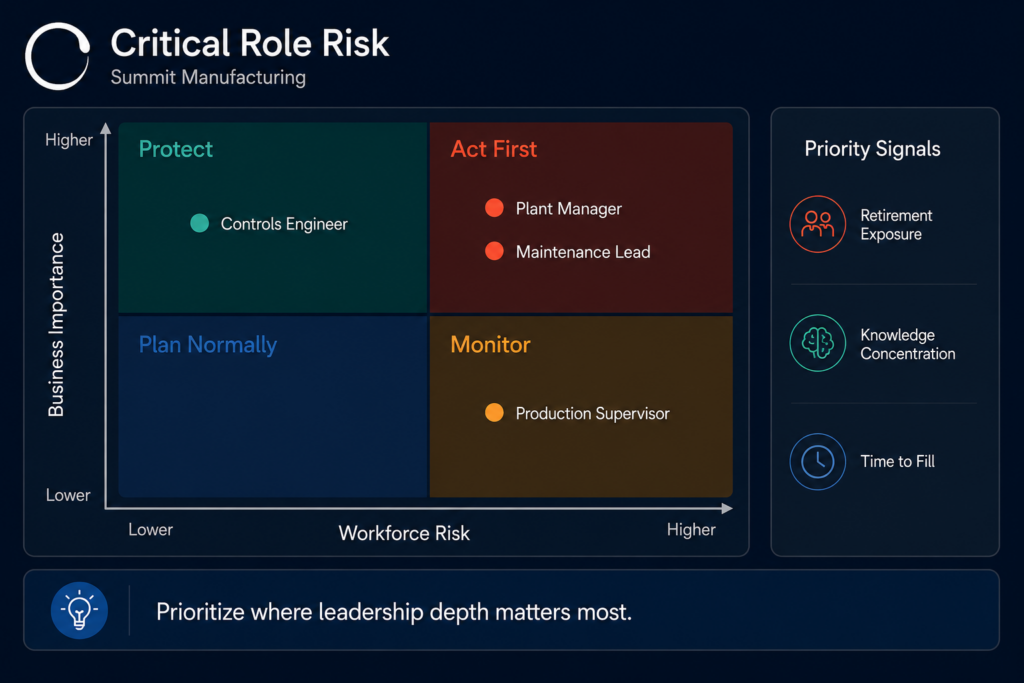
The analysis reveals that plant managers and maintenance leaders combine high business importance with significant workforce risk. Other roles may be difficult to fill but less operationally critical—or highly important with a more stable internal pipeline.
Summit can now prioritize where leadership depth, knowledge transfer, and development pathways are needed most.
2. See the Strength of the Leadership Bench
Evaluate potential successors through demonstrated capabilities, relevant experience, aspirations, and evidence—not nomination alone.
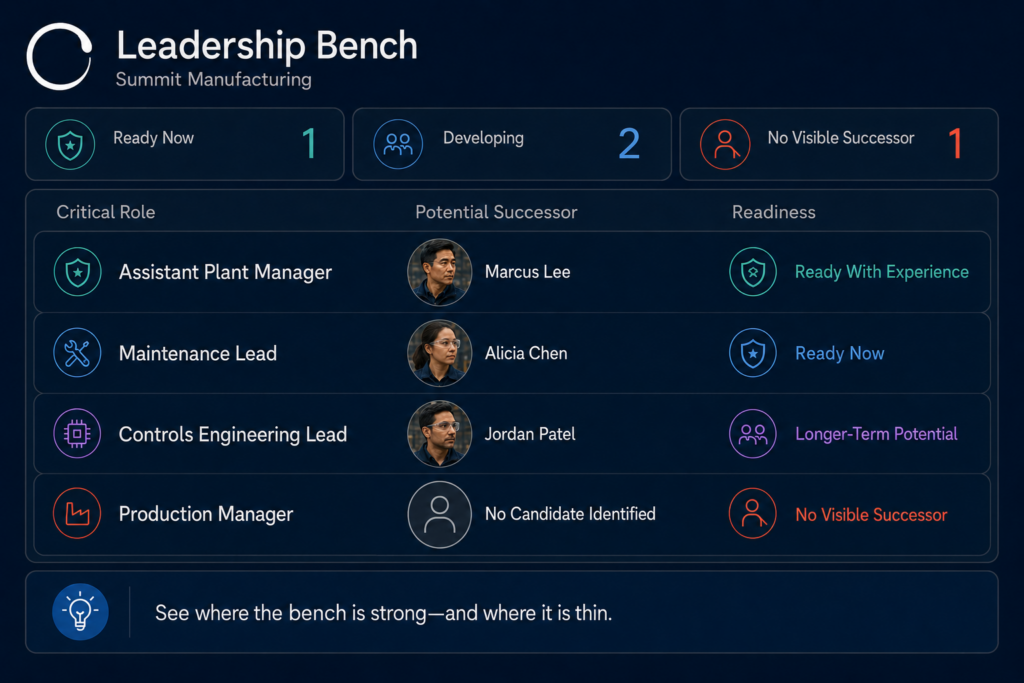
TalentSync helps Summit distinguish between:
- Ready now
- Ready with experience
- Longer-term potential
- No visible successor
Marcus’s operational leadership makes him a possible candidate for greater responsibility. TalentSync also shows the broader experience he needs before Summit can confidently determine his readiness.
Summit can see where the bench is strong, where it is thin, and where focused development is needed.
3. Build Evidence-Based Successor Pathways
Succession planning becomes useful when it changes what happens next.
Summit and Marcus create a practical pathway built around the experiences required for broader plant leadership:
- Lead a cross-functional stretch assignment
- Work with an experienced plant leader
- Gain operational exposure at another location
- Review new evidence and reassess readiness

The pathway combines real work, mentoring, focused development, and reflection.
Marcus grows through meaningful contribution while Summit builds greater confidence in its leadership pipeline.
4. Model Workforce Scenarios and Close Gaps
Summit’s future workforce needs will change with expansion, retirement, attrition, automation, and new business priorities.
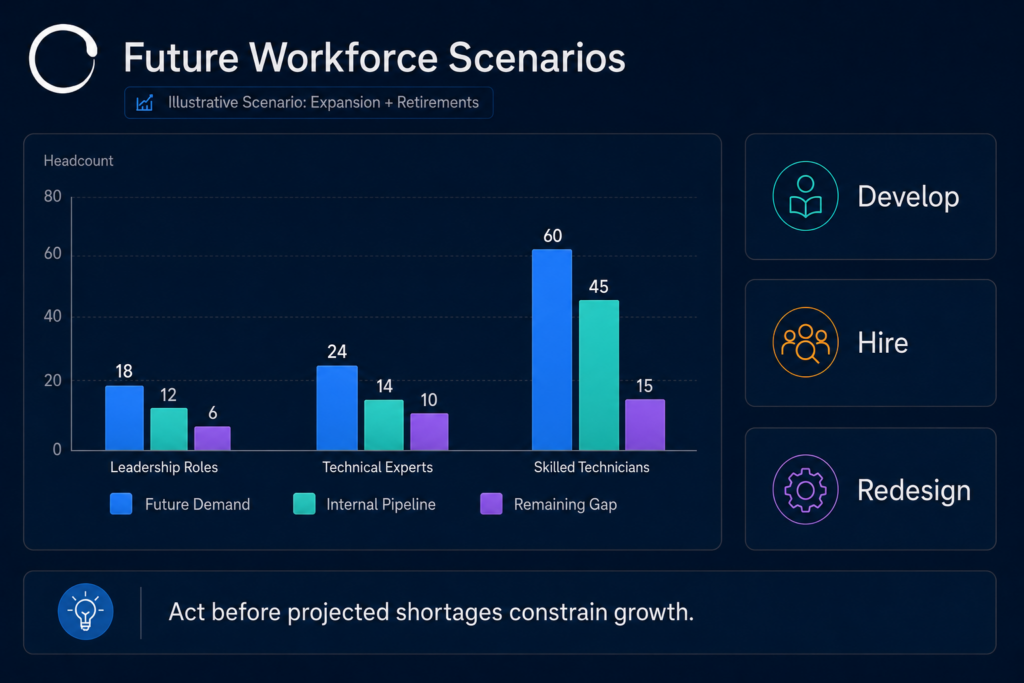
TalentSync compares expected demand with the strength of the internal pipeline across different scenarios.
Summit can see where to:
- Develop or redeploy existing employees
- Accelerate knowledge transfer
- Recruit external talent
- Redesign roles and workflows
- Use AI to augment the workforce
Leaders can act before projected shortages become operational constraints.
5. Keep the Pipeline Current
Workforce plans quickly become outdated when they are reviewed only once a year.
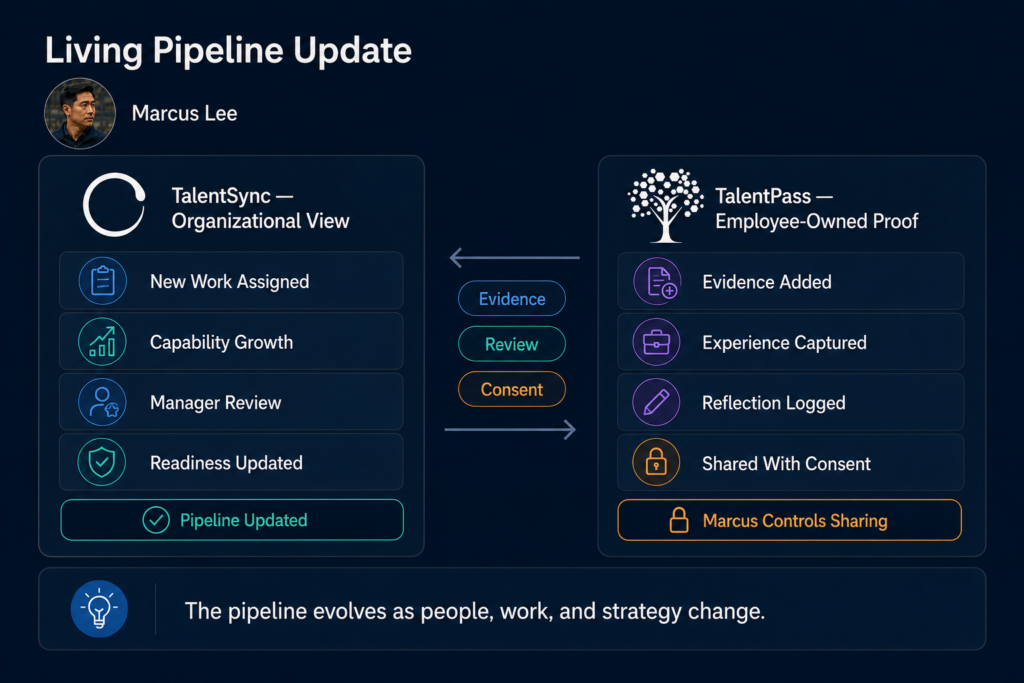
TalentSync connects new work, capability growth, manager feedback, and changing business needs to Summit’s workforce plan. TalentPass gives Marcus an employee-owned record of the experiences and evidence supporting his growth.
As new information becomes available:
- Readiness views can be reviewed and updated
- Development pathways can adjust
- Emerging successors can become visible
- Workforce scenarios can be reassessed
Summit’s pipeline evolves as its people, work, and strategy change.
Marcus Grows Into Plant Leadership
Before
Maintenance Supervisor
A trusted technical leader focused on equipment reliability, maintenance operations, and team performance.
After
Assistant Plant Manager
A broader operational leader responsible for coordinating people, production, reliability, and continuous improvement.
Marcus’s progression is supported by demonstrated work, targeted experience, manager review, and his own interest in the opportunity.
Summit gains a prepared leader while Marcus gains a visible pathway to greater responsibility.
A Stronger Pipeline Creates Value for Everyone
Operational Continuity
Protect performance through leadership transitions and workforce change.
Leadership Readiness
Develop future leaders before critical positions become vacant.
Lower Workforce Risk
Identify capability and succession gaps before they disrupt operations.
Internal Advancement
Create visible pathways for people to grow into greater responsibility.
Focused Development
Invest in the experiences and capabilities the organization actually needs.
Better-Informed Hiring
Recruit for the gaps the internal pipeline cannot fill.
Knowledge Transfer
Capture and share critical expertise before it leaves the organization.
Workforce Adaptability
Respond more effectively to changing work, technology, and business priorities.
Workforce Planning Becomes a Living System
1. Understand
See the work, roles, capabilities, risks, and readiness across the organization.
2. Prepare
Build leadership depth, transfer knowledge, and create development pathways.
3. Act
Make informed decisions about development, mobility, hiring, work redesign, and AI.
4. Adapt
Update the plan as people grow, evidence changes, and business needs evolve.
Each cycle gives Summit a clearer view of what it needs, who may be ready, and where to act next.