
LER & TRUSTED WORKFORCE INFRASTRUCTURE WORKSHOP MODULE
Security, Procurement & Integration Readiness
Connect the selected exchange to the reviews, technical dependencies, purchasing questions, tests, and responsible owners needed to make an informed deployment decision.
Does this sound familiar?
The demonstration works, but the deployment path is unclear
Partners have seen a promising example without identifying the environments, permissions, integrations, and support needed to operate it.
Security questions arrive after commitments
Teams discuss launch dates before reviewers understand which information moves, who can access it, or how responsibilities are divided.
Procurement is working from a different scope
Purchasing teams receive a broad product description while operational partners expect specific functions, connections, support, and deliverables.
“There is an API” becomes the integration plan
A connection is assumed possible without confirming access, supported operations, field behavior, limits, or the work required on either side.
Testing covers only the successful example
The planned exchange has no agreed response to unavailable services, incomplete records, duplicate requests, access errors, or interrupted delivery.
No one owns the final readiness decision
Individual teams complete their work, but unresolved dependencies and review conditions have no clear route to a deployment decision.
What are security, procurement, and integration readiness?
Security readiness concerns whether the selected exchange is described clearly enough for the responsible teams to examine its risks, controls, evidence, and unresolved questions.
Procurement readiness concerns whether the proposed purchase or agreement accurately reflects the required scope, responsibilities, dependencies, and acceptance conditions.
Integration readiness concerns whether participating systems can support the required information flows and whether the necessary implementation work has accountable owners.
Testing connects those expectations to observable behavior before partners rely on the exchange.
This module brings those questions together around one selected use case so the initiative can progress toward an informed deployment decision.
A use case needs a reviewable implementation scope.
A compelling demonstration can show why an exchange might be useful.
Deployment requires a more specific account of what will operate, where, and under whose responsibility.
Reviewers need to understand the information involved and the controls being proposed.
Purchasing teams need to know which commitments the agreement should cover.
Implementation teams need confirmed dependencies and testable expectations.
The workshop organizes those needs into a practical brief that responsible teams can assess and complete.
Where readiness can become disconnected
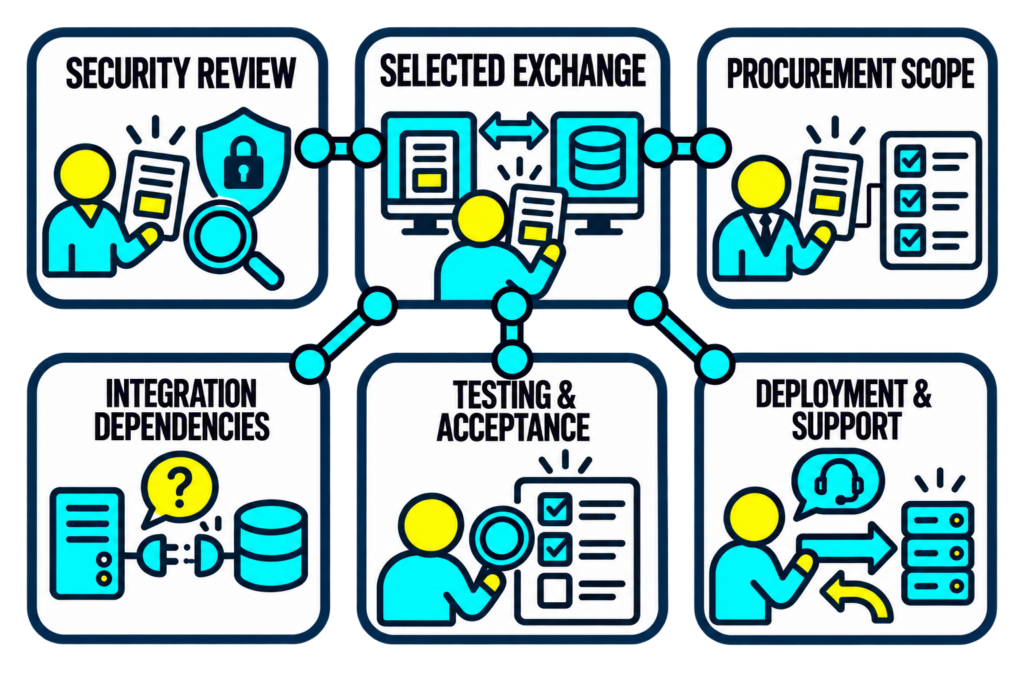
The selected exchange
Intended benefit
Participating organizations
Information flows
Receiving workflow
Implementation boundaries
Security review
Information and access
System responsibilities
Relevant control evidence
Incident and support routes
Unresolved review questions
Procurement scope
Required capabilities
Included deliverables
Partner contributions
Service expectations
Acceptance and exit questions
Integration dependencies
Source and receiving systems
Supported interfaces
Access prerequisites
Data behavior
Technical ownership
Testing and deployment
Representative scenarios
Failure and exception handling
Acceptance conditions
Readiness decision
Rollback and support
The review focuses on what the selected exchange needs. It does not assume that every participating organization uses the same review process or purchasing requirements.
How this module helps
Make the scope reviewable
Describe the information flow, participating systems, intended behavior, and boundaries in terms the responsible teams can examine.
Surface dependencies early
Identify access, technical, organizational, and purchasing conditions that affect implementation.
Define evidence and tests
Clarify which questions require documentation, demonstration, testing, or a decision by an authorized reviewer.
Assign deployment responsibility
Connect unresolved items, acceptance conditions, and operational handoffs to accountable owners.
A successful demonstration leaves implementation questions to answer.
A demonstration may use prepared records, temporary access, or a simplified receiving process.
The planned deployment may involve different environments, permissions, volumes, and responsibilities.
The workshop identifies those differences before partners treat the demonstration as a deployment commitment.
Example: “The connection worked in the demo. Why can’t we launch?”
A partnership demonstrates a record exchange using sample information.
The proposed launch requires access to a source system managed by another organization.
That organization has not confirmed the interface, reviewed the access request, or assigned the implementation work.
Partners document the dependency, identify the responsible reviewers, and revise the deployment sequence around what still needs confirmation.
Questions to review together
What exactly will the selected exchange do, and which systems and organizations are involved?
What information, access, responsibilities, and supporting evidence do the responsible reviewers need?
Which capabilities, deliverables, contributions, and service expectations need to be explicit?
Which interfaces, environments, permissions, and data behaviors must be confirmed?
What must be demonstrated, including when the exchange encounters an exception or failure?
Who decides whether to proceed, what conditions remain, and who supports or stops the exchange after launch?
What needs to connect?
The intended use
The practical task and benefit the implementation should support.
The information flow
What moves, between which systems, through which access arrangement, and for what purpose.
The review requirements
The questions, evidence, and decisions assigned to security and other responsible reviewers.
The purchasing commitments
The capabilities, deliverables, responsibilities, and conditions reflected in the proposed agreement.
The integration work
The confirmed interfaces, dependencies, environments, and owners needed to build the exchange.
The deployment evidence
The test results, resolved conditions, handoffs, and decisions needed before operational use.
When readiness depends on assumptions
Partners may move toward deployment without a shared account of the work required.
- Product descriptions substitute for an implementation scope.
- Security reviewers receive incomplete information flows.
- Purchasing commitments omit partner dependencies.
- Interface availability is assumed.
- Tests cover only the expected successful path.
- Unresolved conditions carry forward without an owner.
The initiative can accumulate commitments before the responsible teams have enough information to assess them.
When readiness is explicit
Partners can see what is confirmed and what still requires work.
- The selected exchange has a defined scope.
- Review questions have responsible owners.
- Proposed commitments reflect actual dependencies.
- Required interfaces and access are checked.
- Tests include exceptions and recovery behavior.
- Deployment conditions and support handoffs are documented.
The group has a clearer basis for proceeding, narrowing the scope, or resolving remaining conditions.
A practical example
A workforce coalition wants to connect a training provider’s records to a receiving organization’s review process.
The workshop begins with the agreed information flow and intended receiving use.
Partners identify the source system, receiving environment, and intermediary services involved.
They list the access prerequisites and distinguish confirmed interfaces from connections still requiring investigation.
The security review brief identifies the information involved, proposed access, responsible organizations, and evidence reviewers need.
The procurement discussion clarifies the required deliverables and which implementation contributions belong to each partner.
The group defines test scenarios for a successful presentation, an unavailable source, and a record that cannot be interpreted as expected.
Partners identify how users receive an explanation and how support teams investigate each exception.
They assign ownership of unresolved conditions and define who can authorize deployment or require further work.
The resulting brief connects review, purchasing, implementation, and testing without treating the workshop as approval to launch.
Review evidence should match the proposed exchange.
A vendor may provide documentation about its platform or operating practices.
Participating organizations still need to determine which evidence addresses their selected use and what additional questions remain.
The workshop identifies the information reviewers need to make that assessment.
It distinguishes available documentation from claims or controls that require confirmation.
Partners assign follow-up to the appropriate organization.
That gives reviewers a concrete starting point without representing general documentation as approval of a particular deployment.
Procurement commitments and integration work need the same scope.
An agreement may describe a connection without specifying what either side must provide.
Technical teams may discover that access, configuration, or source-system changes are outside the proposed deliverables.
The workshop makes those contributions explicit.
Partners identify what is included, what depends on another party, and what remains to be scoped.
They also define how completion will be evaluated.
That helps purchasing and implementation teams work from the same expectations.
WORKSHOP MODULE 11
Security, Procurement & Integration Readiness
This module is a focused minicourse and working session within the LER & Trusted Workforce Infrastructure Workshop.
Your team learns to distinguish a useful exchange concept from its review, purchasing, integration, testing, and deployment requirements, then applies those distinctions to a selected implementation.
The work produces a reviewed starting point for dependencies, responsible decisions, acceptance conditions, and a supporting product configuration.
What this module can address
The selected scope may include:
The workshop selects the readiness questions that materially affect the defined exchange.
- The implementation boundary and intended behavior.
- Participating systems and information flows.
- Security review questions and evidence needs.
- Access prerequisites and responsible approvers.
- Required capabilities and purchasing scope.
- Partner contributions and excluded work.
- Interfaces, environments, and technical dependencies.
- Data handling and exception behavior.
- Representative tests and acceptance conditions.
- Deployment decisions and unresolved conditions.
- Rollback, incident, and support handoffs.
- Implementation sequencing and responsible owners.
What kinds of responses might emerge?
The response depends on the gaps uncovered in the selected example.
A clearer implementation scope
Describe what the exchange will do, which systems it involves, and what remains outside the proposed deployment.
A focused review packet
Organize the information flow, access questions, responsibilities, and evidence needed by the responsible reviewers.
A more complete procurement brief
Clarify capabilities, deliverables, partner contributions, service expectations, and acceptance questions.
A confirmed dependency map
Identify required interfaces, access, environments, and technical work, distinguishing confirmed conditions from assumptions.
A practical test and deployment outline
Specify representative scenarios, exception handling, readiness decisions, and operational handoffs.
A focused configuration brief
Connect the required behavior, integrations, controls, responsibilities, and unresolved conditions to a subsequent implementation scope.
Some responses may involve clearer documentation or assigned ownership. Others may require technical investigation, revised purchasing scope, specialist review, or a smaller initial deployment.
What we review together
The selected implementation
The use case, intended behavior, participating organizations, and scope boundaries.
Information and access
The records involved, movement between systems, access prerequisites, and responsible owners.
Review evidence
Available documentation, unanswered questions, and decisions requiring authorized reviewers.
Procurement expectations
Required capabilities, deliverables, partner contributions, support, and acceptance conditions.
Integration and testing
Interfaces, environments, dependencies, representative scenarios, and exception behavior.
Deployment and support
Readiness ownership, unresolved conditions, rollout, rollback, and operational handoffs.
The working exercise
Turn one exchange into a reviewable deployment brief.
Choose a selected use case that partners are considering for implementation.
STEP 1
Define the implementation boundary
Describe the intended behavior, participating systems, information involved, and excluded work.
STEP 2
Map dependencies
Identify the interfaces, environments, access, and partner contributions needed to make the exchange work.
STEP 3
Assign review questions
List the evidence and decisions required from security, technical, purchasing, and other responsible teams.
STEP 4
Align the commitments
Connect required deliverables and service expectations to the proposed scope and identify unresolved obligations.
STEP 5
Define the tests
Specify successful and exceptional scenarios, expected responses, and evidence of completion.
STEP 6
Establish the deployment decision
Assign ownership of remaining conditions, authorization to proceed, support handoffs, and the response if deployment must pause or reverse.
The exercise produces a reviewed readiness, dependency, and deployment brief for the selected example.
CONNECTING THE WORKSHOP TO A POSSIBLE GOBEKLI SETUP
Give the proposed configuration a practical implementation path.
The workshop can help define how a subsequent Gobekli implementation would support the selected exchange across TalentPass, TalentSync, Passport Pages, and participating systems.
Depending on confirmed scope and product availability, the configuration brief may describe:
- The selected use case and implementation boundary.
- Required product capabilities.
- Participating systems and information flows.
- Access prerequisites and responsible organizations.
- Interfaces and integration dependencies.
- Security review questions and supporting evidence.
- Deliverables and partner contributions.
- Test scenarios and acceptance conditions.
- Deployment, rollback, and support responsibilities.
- Unresolved conditions and implementation sequencing.
The workshop clarifies the proposed scope and confirmation work before deployment commitments are made.
Specific security controls, documentation, hosting arrangements, interfaces, service commitments, implementation effort, and commercial terms must be confirmed separately against current product availability and partner requirements.
SCOPE AND BOUNDARIES
A focused readiness review for the selected exchange.
The module begins with the use case defined through Workforce Infrastructure Direction.
It connects the proposed implementation to review, purchasing, technical, testing, and deployment responsibilities.
It does not automatically establish or deliver:
- Security approval or authorization to operate.
- A certification or standards-conformance determination.
- A legal opinion or procurement authorization.
- Confirmation of every vendor or partner claim.
- Guaranteed compatibility with existing systems.
- A fixed implementation price or delivery date.
- Completed penetration testing or production integration.
- Approval to exchange live information or deploy.
Authorized representatives of the participating organizations remain responsible for their reviews and decisions.
Questions about information-use authority, accessibility, receiving acceptance, and continuing operational ownership connect to their respective modules when they affect the selected use case.
What should you bring?
A description of the selected exchange and the systems expected to participate are enough to establish a practical starting point.
Include people who understand the operational need and the relevant review or implementation processes. Existing documentation is useful even when it is incomplete.
Helpful starting materials
- The selected use case and intended benefit.
- A description of participating organizations.
- A proposed information-flow diagram.
- Source and receiving system details.
- Available interface documentation.
- Known access or environment prerequisites.
- Relevant security review questions.
- Available vendor or platform documentation.
- Draft purchasing scope or service expectations.
- Partner implementation responsibilities.
- Existing test or acceptance requirements.
- Deployment and support contacts.
Use representative information and appropriately redacted materials. The workshop does not require production credentials, private keys, or live system access.
What can you leave with?
An implementation and dependency map
The selected scope, participating systems, required connections, prerequisites, and responsible owners.
A review and procurement brief
Questions, evidence needs, deliverables, contributions, and conditions requiring confirmation.
A test and deployment outline
Representative scenarios, expected behavior, acceptance conditions, and readiness decision responsibilities.
A configuration and handoff brief
Required product behavior, implementation sequencing, unresolved items, support, and rollback responsibilities.
These outputs begin with the example reviewed during the module. Final scope depends on the modules selected, available inputs, and the exchange established through Workforce Infrastructure Direction.
Where might the work lead next?
Fragmented Systems & Source Responsibilities
Clarify which systems supply the selected information, who maintains it, and which connections the exchange actually needs.
Individual Control, Permissions & Data-Use Boundaries
Confirm the proposed purposes, sharing arrangements, recipient responsibilities, and retention questions that implementation must reflect.
Shared Governance, Funding & Operational Sustainability
Establish the continuing ownership, resources, partner responsibilities, and change processes needed after deployment.
These modules extend different parts of the work. Selection depends on the problem and decision established through Workforce Infrastructure Direction.
Frequently asked questions
Questions organizations ask before beginning.
It addresses the gap between a promising exchange and a deployment that responsible teams are prepared to review, purchase, implement, test, and support.
The foundation identifies the selected exchange, intended benefit, organizations, and receiving use. Those choices establish which readiness questions and dependencies matter.
It is a focused readiness exercise that identifies security review questions, evidence needs, and responsible owners. A complete security assessment is a separate scope.
No. It organizes the information and unresolved conditions needed for authorized representatives to make their own deployment decisions.
Yes. Their involvement can help connect the operational requirements to purchasing scope, deliverables, partner contributions, and acceptance conditions.
The module can clarify requirements and questions relevant to those choices. Vendor selection and purchasing authorization remain with the responsible organization.
The workshop can identify the likely systems and assign confirmation tasks. The implementation scope remains provisional where important dependencies are unresolved.
Not by itself. Partners still need to confirm the supported operations, access, data behavior, environments, constraints, and work required on each side.
The module can examine a smaller arrangement if it supports the selected purpose. It should make the manual work, limitations, and support responsibilities explicit.
Bring available information relevant to the proposed exchange and the receiving organizations’ review questions. The workshop identifies missing evidence rather than assuming one standard packet answers every review.
Identify which organization owns each requirement, how it affects the selected exchange, and what evidence or decision is needed. Differences become explicit dependencies or scope questions.
The selected behavior and meaningful exceptions. Examples may include unavailable systems, incomplete information, access failures, repeated requests, and the response users and support teams should receive.
It can review available results and define representative scenarios and acceptance questions. Building test environments and conducting detailed technical tests require a separately confirmed scope.
Partners can examine whether to narrow the scope, change the sequence, use an appropriate alternative, or postpone deployment. The responsible decision owner confirms the response.
Partners need to know who responds when the exchange behaves unexpectedly and what happens if it must pause. The module identifies those responsibilities before operational reliance begins.
The outputs can inform product scope, connections, review evidence, implementation responsibilities, tests, and support in a subsequent Gobekli configuration. Specific capabilities, commitments, and integrations must be confirmed separately.
Partners can complete reviews, confirm dependencies, align purchasing scope, and carry out the agreed testing and implementation work. Deployment proceeds through the participating organizations’ authorized decision processes.
CONNECT THE USE CASE TO A REVIEWABLE DEPLOYMENT PLAN
Make clear what must be confirmed before the exchange goes live.
Security, Procurement & Integration Readiness helps your team connect the proposed benefit to practical dependencies, review evidence, testable commitments, and accountable implementation.
Begin with Workforce Infrastructure Direction, then combine the modules that address the questions your participating organizations need to resolve.