
LER & TRUSTED WORKFORCE INFRASTRUCTURE WORKSHOP
Make Workforce Information Useful, Trusted, and Easier to Exchange.
Your organizations hold valuable information about learning, experience, credentials, and opportunities. Progress becomes difficult when systems cannot exchange that information with clear meaning, appropriate permissions, and dependable support.
Build a practical plan around one exchange use case. Clarify what needs to move, who needs to understand it, which decisions it supports, and what will keep the arrangement working.
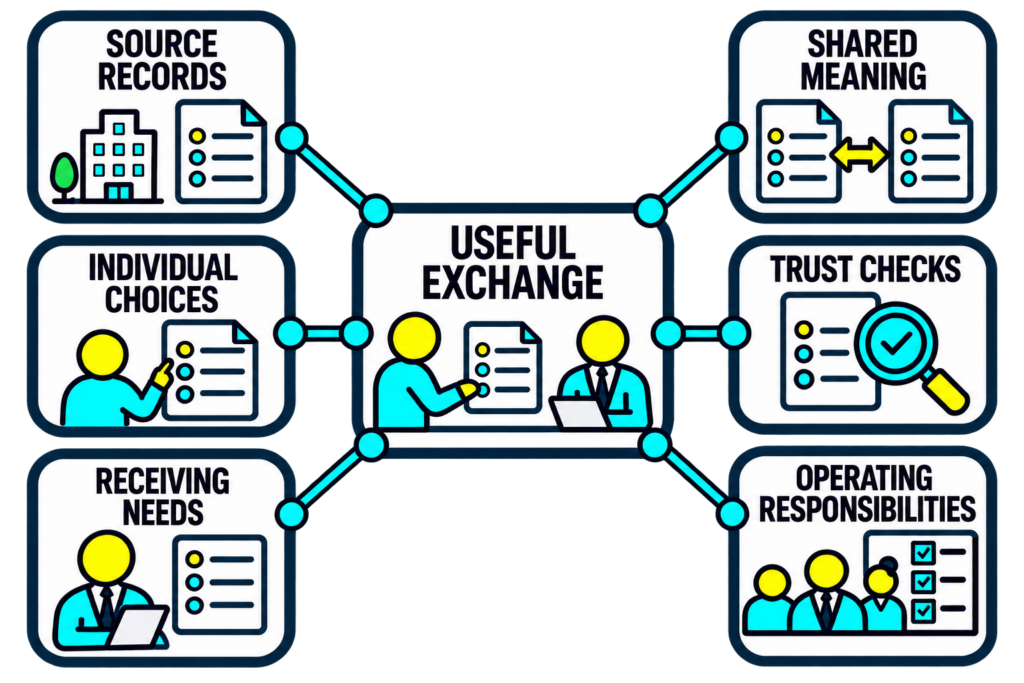
Connected platforms. Unresolved trust and adoption.
The initiative starts with technology before a useful exchange
Partners discuss wallets, credentials, or connections without establishing which person or organization needs to use what information for a particular purpose.
Records cannot be confidently connected to the right person
Accounts, identifiers, and matching arrangements leave uncertainty about whose information is being exchanged or how mistakes will be corrected.
Shared fields do not carry shared meaning
Systems exchange data, but organizations interpret activities, credentials, status, or requirements differently.
Verification leaves important questions unanswered
A record can be checked technically while its source, claim, evidence, status, or relevance to the receiving decision remains unclear.
People cannot understand or manage the sharing arrangement
The purpose, recipient, access, retention, and available choices are difficult to explain or operate consistently.
Issued records are not becoming useful at the destination
People receive credentials or records, but employers, providers, or agencies lack a clear process for requesting, accepting, and using them.
Pilots depend on work nobody has agreed to maintain
Connections function during a demonstration, while support, corrections, security review, updates, and partner onboarding remain unresolved.
Adoption and operating responsibility have no durable home
The initiative lacks clear ownership, continuing resources, service expectations, or a review process as partners and systems change.
A useful exchange needs more than a technical connection.
A learning and employment record, or LER, carries information about a person’s learning, experience, achievements, or qualifications. Its usefulness depends on what it communicates and how another person or organization can interpret and use it.
An issuer may provide a credential. A person may retain and present it. A receiving organization may verify it and consider it within a defined process.
Each participant has different responsibilities. Systems and standards support the exchange, while people and organizations establish its purpose, interpretation, authority, and operating arrangements.
Trusted workforce infrastructure connects these elements around a real use case so an exchange can be understood, supported, and maintained.
To make that arrangement workable, your organization or partnership may need to examine:
- Which exchange and decision are in scope.
- Who issues, holds, presents, receives, or relies on the information.
- Which existing systems remain responsible for source records.
- How identity and account access will work.
- What terms and relationships need shared meaning.
- What evidence and source context a claim should retain.
- How issuance, verification, correction, and status are handled.
- What people can choose to share and what recipients may do with it.
- How people access, move, and use their records.
- What receiving organizations need to accept and interpret them.
- Which technical, security, and procurement questions need resolution.
- Who operates, funds, supports, and reviews the arrangement over time.
Trusted workforce infrastructure connects useful information to an understandable purpose, appropriate authority, and accountable operation.
Start with the exchange your organizations need to make workable.
The LER & Trusted Workforce Infrastructure Workshop is configured around a selected exchange use case and a decision the participating organizations need to make.
Every engagement begins with the required Workforce Infrastructure Direction foundation. The group then selects the modules that address its most important questions about sources, identity, meaning, trust, individual control, adoption, implementation, or sustainability.
Each selected module combines a short practical lesson with an applied exercise using a bounded example. Participants examine the current arrangement, distinguish confirmed capabilities from assumptions, and identify actions they can carry forward.
Required
1. Establish the Workforce Infrastructure Direction
Define the exchange use case, intended benefit, participants, receiving decision, available evidence, responsibilities, and boundaries of the engagement.
Choose 2–3
2. Select the Problem Modules
Examine the records, identity, shared meaning, verification, permissions, portability, acceptance, technical readiness, or operating questions that matter most.
Outcome
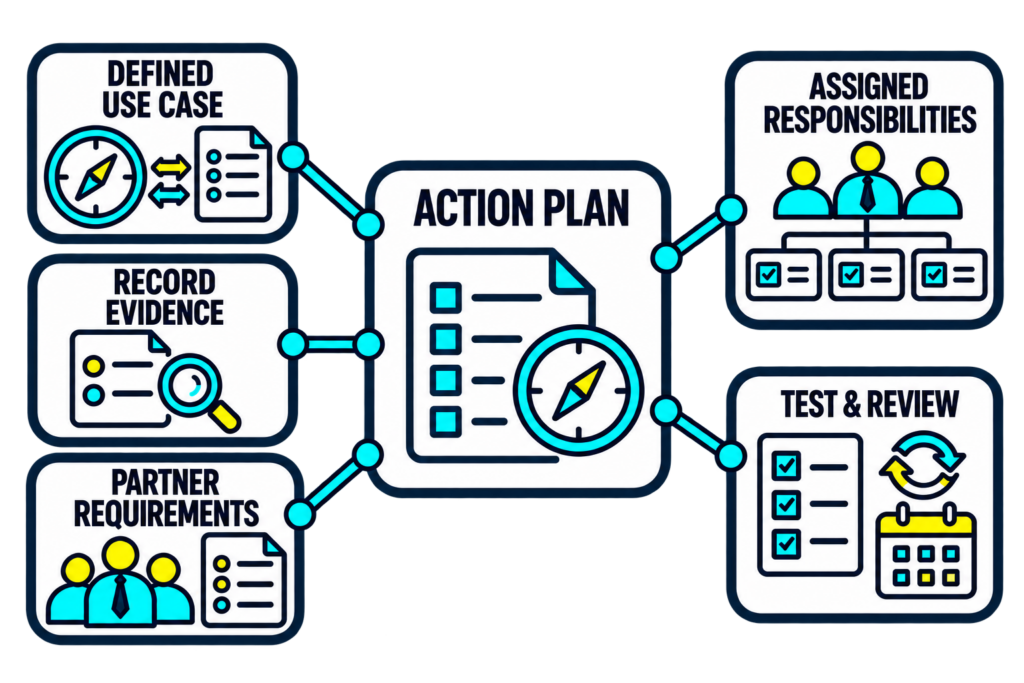
3. Build a 30–90 Day Infrastructure Action Plan
Leave with priorities, decision owners, partner dependencies, validation tasks, readiness questions, review points, and a starting configuration brief.
A typical engagement combines the required foundation with two or three problem modules. Your organization does not need to complete all 12.
A state technology office, agency, initiative sponsor, or shared-service coalition can convene the work. Preparation establishes which organizations need to participate and which decisions remain outside the authority of those attending.
The consultation establishes the appropriate format, preparation, participants, and fee.
Make the exchange more workable for everyone involved.
For state CIOs, CDOs, and shared-service leaders
Clarify how a selected use case fits existing systems, source responsibilities, security processes, procurement decisions, and sustainable operating arrangements.
For workforce and education technology leaders
Connect records and platforms to the meaning, permissions, support, and receiving workflows needed for useful exchange.
For LER initiative sponsors and coalitions
Move from a broad ambition or pilot to defined acceptance criteria, partner responsibilities, adoption tasks, and decisions about continuation.
For issuers, employers, and receiving organizations
Clarify what information you provide or use, what you need to trust and interpret it, and which changes participation requires.
Explore the 12 LER & Trusted Workforce Infrastructure Workshop Modules
The modules examine the different conditions behind an exchange that people and organizations can use responsibly.
Choose the modules that address your selected decision. Each produces a practical working brief and identifies the records, relationships, controls, or operating arrangements a future Gobekli configuration would need.
ESTABLISH PURPOSE, SOURCES, IDENTITY, AND SHARED MEANING
Workforce Infrastructure Direction
Define the exchange use case, intended benefit, participating organizations, receiving decision, available evidence, responsibilities, and boundaries the workshop should address. (Required foundation)
Fragmented Systems & Source Responsibilities
Trace relevant information across existing systems to clarify authoritative sources, responsibilities, update routes, and which connections the selected exchange actually needs.
Identity, Account Access & Record Matching
Examine how people and organizations are identified, access accounts, recover access, and resolve matching uncertainty so records are connected to the appropriate subject.
Shared Definitions & Semantic Interoperability
Clarify the meaning of selected terms, fields, relationships, and status values so exchanged information can be interpreted appropriately across organizations.
ESTABLISH RECORD TRUST, INDIVIDUAL CONTROL, AND PORTABILITY
Record Quality, Evidence & Provenance
Examine the completeness, accuracy, supporting evidence, source history, and correction routes needed to interpret selected records without overstating their claims.
Credential Issuance, Verification & Status
Clarify how credentials are issued, checked, updated, expired, or revoked, including what verification establishes and which judgments remain with the receiving organization.
Individual Control, Permissions & Data-Use Boundaries
Clarify what information people choose to present, the authority and purpose for other exchanges, recipient responsibilities, retention, and the practical limits of withdrawal or downstream control.
Wallet Portability, Accessibility & Assisted Use
Examine how people receive, find, present, move, and recover their records across supported arrangements, including accessibility and assistance that preserves appropriate individual control.
ENABLE ACCEPTANCE, RESPONSIBLE USE, AND SUSTAINED OPERATION
Employer & Institutional Acceptance
Define what receiving organizations need to request, interpret, and use selected records within real workflows so issuance can lead to practical adoption.
AI Context, Human Review & Decision Boundaries
Clarify how AI may assist with selected records, what evidence and uncertainty must remain visible, and which interpretations, decisions, and correction routes require accountable human review.
Security, Procurement & Integration Readiness
Connect the selected use case to security review, technical dependencies, procurement questions, testing, and implementation responsibilities before partners commit to deployment.
Shared Governance, Funding & Operational Sustainability
Establish decision rights, service ownership, continuing resources, support, partner onboarding, change review, and exit arrangements needed to sustain the selected exchange.

The right response depends on what prevents useful exchange.
Define
Make the exchange, intended benefit, information, and receiving decision specific enough to examine.
Reconcile
Clarify source responsibilities, identity uncertainty, definitions, and conflicting interpretations.
Substantiate
Connect claims to appropriate evidence, provenance, status, and verification limits.
Bound
Establish purposes, permissions, recipient responsibilities, and appropriate information-use limits.
Enable
Make receiving, presenting, accessing, and interpreting records more workable for people and organizations.
Integrate
Identify the connections, technical dependencies, tests, and operating responsibilities the use case requires.
Operate
Assign service ownership, support, correction, update, and continuing resource responsibilities.
Adapt
Review adoption, changed requirements, partner needs, and operating evidence so the arrangement can improve.
A technically valid record, an accurate claim, an accepted credential, an authorized exchange, and a useful decision are different things. The workshop examines which conditions the selected use case needs.
How the workshop comes together
-
1
Free Discovery Call Identify the exchange challenge, intended use case, participating organizations, and decision your organization or partnership needs to make. -
2
Focused Intake & Direction Agree on the selected example, relevant records and systems, available materials, decision authority, dependencies, and modules needed to examine it. -
3
Collaborative Workshop Learn the review method, apply it to the selected exchange, and develop practical responses with clear responsibilities and validation tasks. -
4
Infrastructure Action Plan Bring the findings into an assigned 30–90 day plan with partner decisions, readiness questions, adoption tasks, review points, and a starting configuration brief.
What you can leave with
Workforce Infrastructure Decision Foundation
A shared definition of the use case, intended benefit, receiving decision, participants, boundaries, and criteria for a useful result.
Exchange & Source Responsibility Map
An account of the information, systems, issuers, holders, recipients, and source responsibilities relevant to the selected exchange.
Trust & Interpretation Requirements
The identity, meaning, evidence, verification, and status questions that must be resolved for appropriate use.
Individual Control & Use-Boundary Brief
Defined sharing purposes, available choices, recipient responsibilities, access arrangements, and limits requiring further review.
Acceptance & Adoption Plan
Practical changes addressing how people and receiving organizations enter, understand, and use the arrangement.
Readiness & Operating Responsibility Plan
Assigned technical, security, implementation, support, correction, and governance questions, with responsible owners.
Starting Gobekli Configuration Brief
An outline of the records, organizational context, individual sharing arrangements, source connections, authorized views, and review responsibilities worth maintaining.
30–90 Day Infrastructure Action Plan
Sequenced actions, responsible owners, dependencies, confirmation tasks, test conditions, and decisions about continuation.
Final outputs depend on the selected modules, available information, participants, and question established through Workforce Infrastructure Direction.
The workshop creates a practical starting point within that scope. Detailed architecture, legal review, procurement, security assessment, integration, and ongoing operation continue through the appropriate processes afterward.
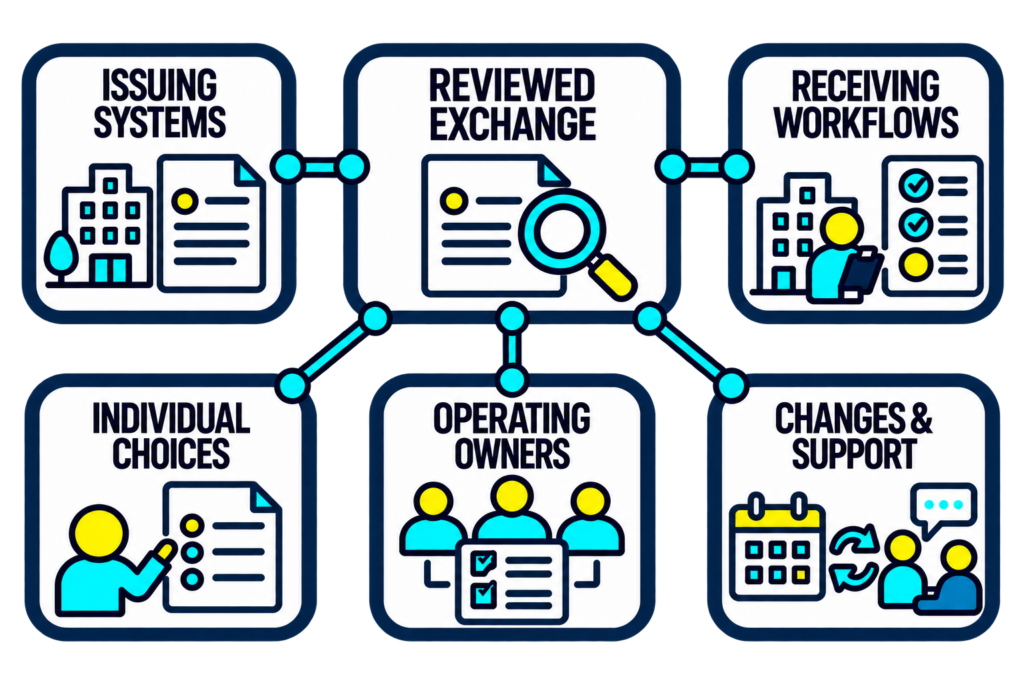
Build the exchange around useful information and accountable operation.
We help technology leaders, agencies, issuers, employers, and shared-service partners examine what a selected exchange needs to accomplish and what will make it workable.
The work should clarify the next decision, preserve the responsibilities of participating organizations, and identify what people need to understand and control.
Use-case focused
Begin with a real exchange and receiving decision. Define what successful use would look like before extending the technical scope.
Clear about trust
Distinguish identity, source authority, evidence, verification, status, and acceptance. Identify what each check establishes and what it leaves unresolved.
Respectful of individual control
Make sharing arrangements understandable and practical. Identify the information actually needed and the responsibilities attached to receiving it.
Designed for operation
Name who supports users, corrects records, maintains connections, reviews changes, funds ongoing work, and responds when the arrangement fails.
When the workshop reveals something worth maintaining
Keep the exchange useful after the pilot ends.
A workshop may reveal that reliable exchange depends on context scattered across source systems, credential records, partner agreements, technical documentation, and receiving workflows.
A potential Gobekli configuration could connect relevant organizational context through TalentSync with individual records and chosen sharing through TalentPass. Passport Pages could form part of the presentation and source-connection arrangements appropriate to the use case.
The starting point is the exchange examined during the workshop: what information matters, who maintains it, what people choose to present, how a recipient interprets it, and who keeps the arrangement working.
Workshop Findings
Identify the use case, records, source responsibilities, trust questions, individual choices, receiving workflow, and operating gaps that need attention.
Gobekli Setup
Scope appropriate record and experience structures, organizational requirements, source connections, presentation arrangements, authorized views, and review responsibilities.
Ongoing Review
Maintain the context needed to respond when records change, systems are updated, recipients alter requirements, people need assistance, or adoption falls short.
Worked example: making a learning record useful in an employer’s process
A workforce agency and an education provider want participants to present a record of completed preparation to selected employers.
The provider can supply completion information, but the partners have not established which claims the record should make or how employers would use it.
The workshop begins with one receiving decision: understanding whether an applicant has completed the selected preparation and what that preparation involved.
Partners examine source responsibility, identity, record meaning, supporting evidence, status, and the employer’s review process.
They also define how a person would receive and present the record, what assistance would be available, and where questions or corrections should go.
The configuration brief could describe the relationship among preparation activities, completion records, evidence, employer expectations, and responsible contacts.
TalentPass could help participating individuals organize relevant records and experience they choose to share.
TalentSync could support participating organizations in maintaining appropriate context about requirements, records, sources, and review responsibilities.
Passport Pages could support a scoped presentation route. Where suitable and available, Pythia could help people explain experience or help authorized reviewers prepare questions, with source context and human review retained.
The arrangement would not require unrestricted access to participant records. Any separate reporting or interagency exchange would need its own purpose, authority, and boundaries.
Partners would test whether the record can be received, interpreted, and used in the selected workflow. Issuance volume alone would not establish successful adoption.
A Gobekli setup is an optional continuation. Workshop outputs remain useful independently of product adoption.
The configuration described here includes potential capabilities. Current availability, supported formats, interoperability, integration work, and any required development would be confirmed during scoping. Existing source systems and organizations can retain their responsibilities.
Frequently asked questions
Questions organizations ask before beginning.
It is a configurable, facilitated workshop that helps organizations make a selected learning and employment record exchange useful, understandable, and operable.
Every engagement begins with Workforce Infrastructure Direction and applies selected problem modules to a bounded example. The result is a practical action plan with accountable next steps.
It is designed for state CIOs and CDOs, workforce and education technology leaders, LER initiative sponsors, agencies, and shared-service coalitions.
Issuers, employers, providers, community partners, and other receiving organizations can participate where their information, workflows, or decisions are relevant.
Yes. A sponsoring organization can begin by clarifying the use case, relevant partners, evidence gaps, and decisions it needs to prepare.
The workshop distinguishes work it can do directly from arrangements that require other organizations to participate or agree.
No. The workshop can begin with a proposed use case, an existing manual exchange, or a pilot that needs a clearer route to adoption.
The selected example should be specific enough to examine who needs what information and how it will be used.
No. Every engagement begins with the required Workforce Infrastructure Direction foundation.
A typical workshop then includes two or three modules selected around the use case and decision the group wants to address.
The workshop can clarify requirements and questions that inform those decisions.
It does not assume that one format, wallet, vendor, or architecture fits every use case. Technical selection and procurement remain separate decisions with the appropriate owners.
Begin with one exchange and the decision it needs to support.
Useful materials may include sample records, source-system descriptions, field definitions, existing workflows, partner roles, sharing arrangements, technical constraints, pilot feedback, and receiving requirements. Redacted or synthetic examples can often support the initial review.
Verification can establish particular facts about a credential, depending on the methods and information available. It does not automatically establish every underlying claim or its relevance to a receiving decision.
The workshop separates technical checks from evidence quality, issuer authority, interpretation, and acceptance.
They may involve different purposes and arrangements. A person choosing to present a record is not automatically authorizing every other use of the same information.
The workshop identifies which exchanges rely on individual choice, which require other authority, and what recipients must understand and maintain. Required legal determinations remain with the responsible organizations.
Yes. A selected module examines how people receive, find, present, move, and recover records within the proposed arrangement.
It also considers assistance and accessibility, including who provides support and how helpers avoid assuming inappropriate control over personal records.
The workshop examines a real receiving workflow: what information is requested, how it is received, who interprets it, and what decision it can support.
It identifies changes and testing needed at the destination. Issuing records or connecting systems is not treated as proof that recipients can use them.
No. It identifies relevant requirements, questions, dependencies, and responsible reviewers.
Formal assessments, legal determinations, procurement, agreements, and deployment approval remain with the appropriate organizations and specialists.
That workshop examines a person’s route through services, including discovery, intake, referrals, support, and transitions.
This workshop examines the records, identity, systems, trust, permissions, and operating arrangements behind a selected exchange. A service journey can provide its concrete use case.
That workshop connects employer demand, available talent, preparation capacity, and partner commitments around a regional initiative.
This workshop examines the infrastructure needed to exchange and maintain useful information for a defined purpose. It does not determine an industry strategy or establish employer demand.
Your group leaves with a scoped response and a 30–90 day action plan. Next steps may include validating a receiving workflow, confirming source responsibilities, reviewing permissions, testing an exchange, or establishing operating ownership.
Gobekli software is optional. Where the findings identify information and relationships worth maintaining, the configuration brief becomes the starting point for a separate implementation conversation.
TURN AN EXCHANGE AMBITION INTO A WORKABLE ARRANGEMENT
Give people and partners a clearer basis for trusting the exchange.
Connect useful records, understandable meaning, appropriate control, receiving workflows, and operating responsibilities around the use case you want to advance.
Begin with Workforce Infrastructure Direction, then select the modules that address the decisions and dependencies that matter most.
Let’s Start with the Exchange You Need to Make Work.
Tell us which workforce information challenge you are addressing, who needs to participate, and what must become clearer before the work can move forward.
During a free discovery call, we will clarify the use case, identify relevant decision owners and partners, and discuss the workshop scope that fits.
