
AN AI TRANSFORMATION WORKSHOP MODULE
AI Governance & Accountability:
How to Clarify Who Owns What
AI is entering organizational workflows faster than many organizations can define who approves it, who operates it, who reviews its outputs, or who responds when something goes wrong.
The problem is not simply that the organization lacks AI policies. It is that ownership, decision rights, oversight, evidence, and escalation remain disconnected from the work AI is changing.
Does this sound familiar?
AI is approved, but no one owns the outcome
A tool or pilot receives permission to proceed without identifying who is responsible for the workflow, output quality, decisions, or consequences.
Policies do not explain what employees should do
General principles exist, but employees still cannot tell what is allowed, what requires review, or when they should stop and ask for help.
Responsibility is divided across functions
Business, technology, data, legal, risk, procurement, and security teams each own part of the issue, but no one can see the complete decision.
Human oversight is undefined
The organization says a person remains involved without clarifying what that person must review, what evidence they need, or what authority they possess.
Exceptions and escalation paths are unclear
Employees encounter uncertain outputs, sensitive situations, unusual cases, or changing conditions without knowing who should decide what happens next.
Governance either blocks everything or controls too little
Broad approval processes slow useful work, while decentralized decisions create inconsistent boundaries, documentation, oversight, and accountability.
What is AI governance?
AI governance is the organizational system of decision rights, responsibilities, boundaries, evidence, oversight, and escalation used to guide how AI is selected, introduced, operated, reviewed, changed, and stopped.
It can include policies, standards, committees, controls, approval processes, documentation, monitoring, and specialist review. But governance is not limited to formal rules or a centralized governance body.
AI operates inside workflows involving people, data, systems, vendors, judgment, and organizational consequences. Effective governance must therefore connect each AI-enabled activity to the people responsible for the work, the decisions AI influences, the conditions under which it may operate, and the evidence required to continue.
Governance does not mean that every AI decision must be centralized. It means that authority and responsibility are distributed deliberately enough for people to know what they can decide, what they must document, what requires review, and when an issue must be escalated.
The problem is not a missing policy.
It is missing operating accountability.
A policy can establish organizational principles, prohibited uses, approval expectations, or broad responsibilities. It cannot by itself determine how accountability should function inside every AI-enabled workflow.
To govern AI in practice, leaders need to connect each use to:
- The organizational outcome it is intended to influence
- The workflow and people affected
- The capability the AI provides
- The data and systems it accesses
- The decisions or actions it influences
- The person responsible for the workflow
- The person responsible for the AI-enabled activity
- The review and oversight required
- The boundaries within which the AI may operate
- The evidence that must be maintained
- The exceptions requiring escalation
- The specialists whose judgment may be needed
- The authority to change, pause, or stop the use
Without these connections, accountability may exist only in theory. A workflow owner may assume the technology team is responsible for outputs. The technology team may assume the business function owns how those outputs are used. A reviewer may be assigned without the time, information, expertise, or authority required to intervene.
Governance becomes real when responsibility is attached to decisions and work.
How AI accountability becomes fragmented
Teams introduce AI to solve practical problems
Departments, vendors, technology teams, and employees begin using AI to improve specific tasks, decisions, services, or workflows.
Approval focuses on the tool or project
The organization reviews procurement, technology, security, or pilot requirements without fully assigning responsibility for ongoing work and outcomes.
Decisions spread across functions
Different teams become responsible for data, technology, workflow performance, review, risk, and specialist questions without a shared view of how their decisions connect.
Gaps appear when conditions change
An output fails, an exception emerges, the use expands, the model changes, or consequences become more significant—and no one knows who has the authority or responsibility to respond.
Why an AI policy is not enough
An AI policy is an important foundation. It can communicate organizational principles, establish expectations, define prohibited behavior, and identify activities requiring approval.
But a policy answers only one question:
What does the organization generally expect?
Operational governance must answer several more.
Who is accountable for the activity, service, decision, or organizational outcome being changed by AI?
Who is responsible for ensuring that the capability operates within its approved purpose, boundaries, and conditions?
Which inputs, outputs, decisions, exceptions, or consequences require human attention—and what evidence must be available to that reviewer?
Which decisions can the workflow owner, manager, employee, product team, or technology team make without additional approval?
Which exceptions, changes, consequences, complaints, incidents, or uncertainties must move to another authority or qualified specialist?
What documentation, usage information, quality measures, decisions, approvals, changes, incidents, or review results are needed to support accountability?
Without these answers, governance can become a set of principles that everyone supports but no one can consistently apply.
What leaders need to see clearly
Who owns each consequential decision
Identify the people or functions authorized to approve, operate, review, change, pause, escalate, and stop an AI-enabled use.
Where accountability is divided
Reveal decisions that depend on several teams, unclear handoffs, conflicting assumptions, or responsibilities that have not been assigned.
Which boundaries matter most
Focus attention on the uses, decisions, data, actions, populations, and consequences requiring stronger limits, evidence, oversight, or specialist review.
Whether governance can respond to change
Understand what happens when a model, vendor, workflow, dataset, scale, consequence, or operating condition changes after initial approval.
AI governance should be distributed without becoming fragmented.
People closest to the work often understand its practical conditions better than a centralized committee. They need enough authority to use judgment, adapt responsibly, and respond to everyday operating questions.
The goal is not to route every decision through one governance body. It is to distribute authority while preserving shared boundaries, evidence, visibility, and escalation.
Useful distributed accountability
Well-designed governance can support:
- Decisions made close to the work
- Clear responsibility for workflow outcomes
- Faster resolution of ordinary questions
- Practical boundaries employees can understand
- Ownership that continues after initial approval
- Evidence collected through normal operations
- Appropriate adaptation when conditions change
- Specialist attention focused where it is needed
- Greater participation in responsible AI use
These benefits depend on people knowing the limits of their authority and the conditions requiring escalation.
Fragmented governance
Poorly connected governance can create:
- Conflicting policies or interpretations
- Repeated or duplicative approvals
- Unowned workflow consequences
- Review without authority to intervene
- Responsibility divided across teams
- Inconsistent documentation and evidence
- Exceptions handled informally
- Material changes that bypass review
- Governance that appears only after an incident
- Overly broad controls applied to low-consequence work
- Significant uses receiving insufficient attention
These conditions make it difficult for employees to act confidently or for leaders to determine whether accountability is functioning.
The goal is not maximum control.
It is to place the right decisions, boundaries, evidence, and escalation paths around the work that matters.
WORKSHOP MODULE DETAILS
How to Manage AI Governance & Accountability
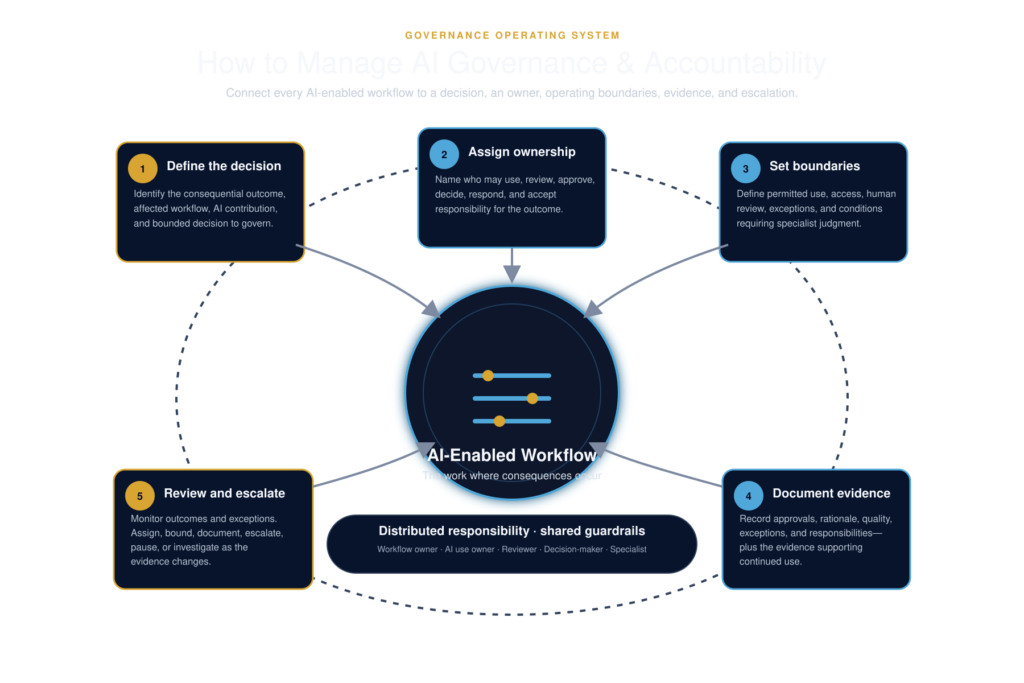
This module examines how ownership, decision rights, boundaries, evidence, oversight, and escalation operate around a bounded AI-enabled workflow.
Participants connect governance responsibilities to real work, organizational outcomes, data, systems, people, and decisions. The purpose is not to create a generic policy or make legal, privacy, security, compliance, or other professional determinations. It is to clarify how the organization should recognize, assign, document, and escalate the decisions surrounding the selected workflow.
- Identify the consequential decisions surrounding an AI use
- Clarify workflow and AI-use ownership
- Map decision rights across involved functions
- Define practical operating boundaries
- Specify meaningful human involvement
- Identify evidence and documentation needs
- Reveal responsibility and escalation gaps
- Distinguish operational questions from specialist questions
- Clarify authority to change, pause, or stop a use
- Develop an evidence-backed governance response
What should happen to the pilot next?
A promising pilot should not be scaled automatically—or extended indefinitely.
The organization needs to determine what the pilot has established, which operating conditions remain unresolved, and what kind of progression the available evidence supports.
Assign
Establish clear ownership and authority Identify who owns the workflow, AI-enabled use, review, decision, evidence, escalation, and authority to change or stop the activity.
Bound
Define permitted use and operating conditions Clarify what the AI may do, what it may access, where a person must remain involved, and which conditions fall outside the approved use.
Document
Make decisions and evidence visible Establish the approvals, purposes, responsibilities, evidence, changes, reviews, exceptions, and operating information that must be recorded.
Escalate
Route consequential questions to the right authority Define which exceptions, changes, impacts, incidents, complaints, or unresolved questions require leadership or qualified specialist review.
Pause or Investigate
Do not proceed without resolving a material uncertainty Pause or limit the activity when ownership, authority, evidence, boundaries, consequences, or specialist determinations remain too unclear for responsible operation.
These categories do not determine whether an AI use is legally compliant, secure, private, ethical, or otherwise professionally acceptable. They organize the governance questions and evidence requiring decisions by the organization and, where appropriate, qualified specialists.
What should an AI governance review examine?
The decision
What consequential decision, action, output, or organizational outcome is influenced by the AI-enabled activity?
The owner
Who is accountable for the workflow, AI use, review, evidence, exceptions, and consequences—and what authority does each person possess?
The boundary
What is permitted, prohibited, conditional, reviewable, or outside the authority of the people operating the workflow?
The evidence
What demonstrates that the use remains within its purpose, conditions, approvals, quality expectations, responsibilities, and escalation requirements?
What to bring into the conversation
You do not need a finished AI governance framework or a complete inventory of every organizational policy.
We begin with the policies, approvals, workflow information, responsibilities, and observations your organization already has. The workshop then helps distinguish established authority from assumptions, informal practices, missing decisions, and questions requiring specialist review.
Useful inputs may include:
- Known AI policies, principles, standards, or guidance
- The bounded AI use, tool, model, agent, feature, or pilot
- Workflow or process documentation
- Existing approval or intake materials
- Known owners and participating functions
- Roles and responsibility documents
- Relevant data and system information
- Vendor or procurement information
- Human review and oversight expectations
- Existing quality or performance measures
- Documentation and monitoring practices
- Known exceptions, incidents, complaints, or concerns
- Change-management or release processes
- Escalation procedures
- Existing legal, privacy, cybersecurity, compliance, procurement, or other specialist findings
- Employee and manager observations
- Open ownership or decision-rights questions
The goal is not to develop an enterprise-wide AI governance framework in one session. The Decision Foundation establishes the consequential outcome, affected workflow, and bounded governance decision the module should examine.
What this module can help clarify
Who owns what
Identify responsibility for the workflow, AI-enabled use, outputs, review, decisions, evidence, exceptions, and consequences.
Which decisions can be made where
Clarify local authority, cross-functional decisions, leadership approvals, and questions requiring qualified specialist review.
What boundaries and evidence are needed
Define the operating conditions, human involvement, documentation, review, monitoring, and change visibility the workflow requires.
Where to assign, bound, document, escalate, pause, or investigate
Organize the available evidence into a practical governance response around the selected workflow.
Final outputs depend on the modules selected and the decision established through the workshop’s required Decision Foundation.
Where might the work lead next?
Weak AI accountability frequently overlaps with invisible adoption, fragmented portfolios, and pilots whose ownership or operating requirements remain unresolved. A governance review may reveal that another problem must be addressed alongside decision rights and oversight.
Shadow AI & Invisible Work
Reveal unofficial AI use, undocumented workflows, employee-created workarounds, and governance decisions occurring outside formal visibility.
AI Tool Sprawl
Connect governance responsibilities to tools, models, agents, embedded features, data, integrations, vendors, ownership, and portfolio decisions.
Escaping AI Pilot Purgatory
Clarify the ownership, boundaries, support, evidence, and operating decisions required for a promising pilot to progress responsibly.
Questions leaders ask before booking.
AI governance is the organizational system of decision rights, responsibilities, boundaries, evidence, oversight, and escalation used to guide how AI is selected, introduced, operated, reviewed, changed, and stopped.
It may include policies, standards, committees, controls, approvals, documentation, monitoring, and specialist review. Effective governance also connects those mechanisms to the real workflows, people, data, systems, decisions, and consequences affected by AI.
Governance is therefore broader than a written policy or centralized review body. It includes how accountability functions during ordinary operations.
No single function can usually own every aspect of AI governance.
Leadership may establish organizational direction and authority. Business or workflow owners may remain accountable for outcomes and operating decisions. Technology and data teams may own systems, models, access, and technical performance. Other functions may own procurement, security, privacy, legal, compliance, finance, workforce, or specialist determinations.
The important question is not which department owns “AI” in the abstract. It is whether each consequential decision has an identified owner, appropriate authority, necessary evidence, and a clear escalation path.
No. AI governance is the broader organizational system used to direct and oversee AI-related decisions and responsibilities.
Compliance concerns whether specific activities meet applicable legal, regulatory, contractual, policy, or professional requirements. Those determinations may form part of governance, but they require review by appropriately qualified people.
A governance workshop can help identify where compliance or other specialist judgment is needed. It does not make those determinations.
Human oversight means more than placing a person somewhere in the process.
The organization should clarify what the person reviews, what information and evidence they receive, what problems they are expected to recognize, what authority they have to intervene, and what happens when they cannot resolve an issue.
Oversight that lacks time, expertise, evidence, authority, or escalation may provide the appearance of accountability without the ability to exercise it.
Productivity gains should be evaluated in the context of what the organization is trying to accomplish.
Completing a task faster may reduce cost, increase capacity, improve responsiveness, raise quality, or create no material organizational change at all. Producing more output can also create additional review, coordination, or downstream work.
The organization should determine how the productivity change affects the bounded workflow and whether it contributes to an outcome leadership values.
No. Different uses may involve different workflows, data, decisions, populations, consequences, operating conditions, and levels of uncertainty.
Applying the same process to every use can delay low-consequence experimentation while failing to focus adequate attention on significant decisions or impacts.
The organization should establish shared principles and minimum expectations while adapting the governance response to the conditions of the bounded use.
Governance can support faster responsible action when employees understand what they may decide, which boundaries apply, what evidence must be maintained, and when escalation is required.
Unclear governance often creates delay because teams repeatedly seek approval, interpret broad policies differently, or discover unresolved ownership and specialist questions late in the process.
The goal is not to remove review. It is to place decisions at the appropriate level and make the path through them understandable.
Software may help maintain inventories, approvals, documentation, controls, monitoring, model information, incidents, access, or evidence.
However, technology cannot independently determine the complete organizational meaning of an AI-enabled workflow, who should own its consequences, which tradeoffs are acceptable, or when professional judgment is required.
Governance tools can support visibility and consistency. Accountable people must still make and own consequential decisions.
Every engagement begins with the required Decision Foundation, which establishes the consequential outcome, affected workflow, available evidence, and bounded decision the workshop must support.
Governance & Accountability can then be selected when the organization needs to clarify ownership, decision rights, boundaries, evidence, oversight, or escalation around that decision.
Depending on what the module reveals, it may be combined with modules addressing Shadow AI, data and systems, value and ROI, scale and integration, adoption, or another connected problem.
Turn AI principles into clear ownership and responsible decisions.
Connect AI-enabled work to owners, authority, boundaries, evidence, oversight, and escalation—then make governance usable in practice.
This module is part of Gobekli’s configurable AI Transformation Workshop. Explore the complete workshop, its 12-module structure, and how we identify the right starting point for your organization.
