
AN ORGANIZATIONAL GROWTH & EXPANSION WORKSHOP MODULE
Organizational Growth Strategy:
Align the Organization Before You Scale
A new growth target, investment, market, product, acquisition, or business line can establish where the organization wants to go without explaining what it must become to get there.
Leaders may agree on the ambition while holding different assumptions about the work, capabilities, structure, leadership, systems, and sequence required to deliver it.
Growth Direction turns the growth commitment into a shared organizational decision.
Does this sound familiar?
The growth target is clear, but the organizational plan is not
Leaders know the revenue, market, customer, product, or expansion objective but have not translated it into changes in work, structure, or capability.
Different leaders are planning for different futures
Executives agree that the organization must grow but hold conflicting assumptions about priorities, timing, operating conditions, and what must change first.
Hiring requests appear before the work is defined
New roles and headcount are proposed before leaders understand the outcomes, activities, capabilities, authority, or systems the growth plan requires.
Every function sees itself as the priority
Departments build separate plans around their own constraints without a shared view of which organizational changes are most consequential.
Urgency expands the scope
The organization attempts to redesign roles, processes, systems, leadership, and culture simultaneously without defining a bounded starting decision.
Growth exposes problems that already existed
Informal responsibilities, founder dependencies, workarounds, unclear ownership, and disconnected systems become harder to sustain as demand increases.
What is organizational growth direction?
Organizational growth direction is a shared definition of the growth commitment, intended outcome, affected work, operating context, timeframe, evidence, constraints, and organizational decision that must be supported.
It translates a strategic ambition into a practical boundary for organizational design.
A useful growth direction clarifies:
- What is changing
- Why the change matters
- Which outcome the organization is trying to produce
- What work will be affected
- Where additional capacity or capability may be required
- Which operating conditions are expected to change
- What evidence is currently available
- Which assumptions remain uncertain
- What constraints must be respected
- Which organizational decision needs to be made
Growth direction is not a complete growth strategy, financial forecast, operating model, or workforce plan. It provides the common foundation those decisions need.
Without it, leaders may solve different versions of the problem while believing they are working toward the same goal.
The problem is not a lack of ambition. It is the distance between the growth plan and the organization.
A growth strategy may define a revenue goal, funding milestone, market entry, product launch, acquisition, contract, customer segment, or geographic expansion.
It does not automatically explain:
- Which work must expand, change, begin, or stop
- Which capabilities will become critical
- Which responsibilities need clear ownership
- Where authority and decisions should sit
- Whether existing departments can absorb the work
- What leadership or management capacity is required
- Which systems, data, and operating processes must change
- What should be built internally or accessed elsewhere
- How the transition should be sequenced
- What evidence would demonstrate readiness
When these questions remain unresolved, organizational changes tend to emerge through isolated hiring requests, local workarounds, new tools, and accumulating responsibilities.
The organization reacts to growth instead of designing for it.
Growth Direction creates the shared frame needed to examine these choices together.
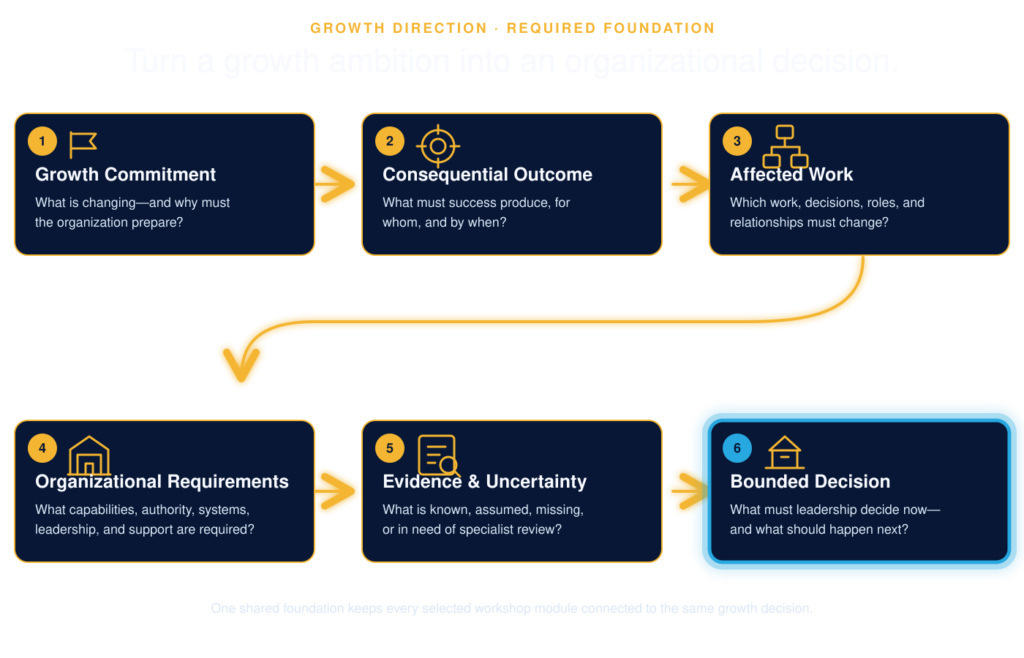
Connect the growth commitment
to the organization it requires.
Growth Commitment
- Revenue or customer growth
- New funding or investment
- New product or service
- New market or location
- Acquisition or integration
- Major contract or demand increase
Consequential Outcome
- What success must produce
- Who must experience the result
- When the result is required
- How success will be recognized
- What happens if the organization is unprepared
Affected Work
- Work that must expand
- Work that must change
- Work that must be created
- Work that may no longer be needed
- Critical workflows and dependencies
Organizational Requirements
- Capabilities
- Roles and responsibilities
- Leadership and authority
- Departments and interfaces
- Systems and information
- External partners and talent sources
Bounded Decision
- What must be decided
- Who owns the decision
- What evidence is available
- Which constraints apply
- What remains uncertain
- What should happen next
The growth plan becomes organizationally useful when leaders can trace a clear line from the commitment to the outcome, the affected work, the requirements of the organization, and the decision that must be made.
How growth loses organizational direction
STAGE 1
Leadership establishes a growth ambition
The organization commits to a new target, market, product, investment, acquisition, contract, or stage of development.
STAGE 2
Functions interpret the ambition independently
Each leader translates the commitment through the needs, constraints, and measures of their own department.
STAGE 3
Organizational changes accumulate
Hiring requests, new tools, expanded responsibilities, management layers, vendors, and process changes appear without a shared design.
STAGE 4
Growth creates friction instead of capacity
Dependencies, bottlenecks, duplicated effort, unclear accountability, and competing priorities make the organization harder to operate.
A growth target is not an organizational direction.
A target can describe the result the organization wants. It cannot, by itself, explain how the organization must change.
A useful organizational conversation must answer several additional questions.
Define the specific growth event or ambition. Is the organization entering a market, launching a product, integrating an acquisition, serving a new customer group, delivering a contract, or preparing for a new operating stage?
Clarify the consequential result—not merely the activity or target. Identify who depends on the outcome, when it is needed, and why it matters.
Determine which workflows, activities, decisions, relationships, and responsibilities must expand, change, begin, connect, or stop.
Identify the capabilities, leadership, authority, information, systems, processes, partnerships, and operating conditions required to support the work.
Distinguish known demand, current performance, demonstrated capability, and observed constraints from forecasts, assumptions, preferences, and untested beliefs.
Define a consequential but manageable decision that leadership can support with the available evidence. Separate that decision from questions that should be sequenced later or referred for specialist review.
What leaders need to agree on before redesigning the organization
The outcome
Define the result the organization must produce and the consequences of failing to prepare for it.
The boundary
Clarify which business line, market, location, function, workflow, team, customer group, or transition the current decision includes.
The evidence
Separate established facts and observed conditions from assumptions, estimates, preferences, and unresolved questions.
The decision
Name what leadership must decide, who owns that decision, what criteria matter, and what action it should enable.
The owner
Identify who has authority to make the decision and who must contribute evidence or operational context.
The sequence
Determine which questions must be resolved now and which changes should be designed after the direction is set.
The growth plan
A growth plan may establish:
- Revenue or margin targets
- Market and customer priorities
- Product or service expansion
- Capital and investment assumptions
- Acquisition objectives
- Sales and distribution goals
- Geographic expansion
- Strategic milestones
- Expected timing
- Financial measures
These choices explain where the organization intends to grow and why the opportunity matters.
The organizational direction
An organizational direction examines:
- The outcome the organization must produce
- The work that will change
- Capabilities that must be available
- Responsibilities requiring ownership
- Leadership and management implications
- Departmental and cross-functional interfaces
- Systems and information dependencies
- Internal and external sources of capacity
- Constraints and evidence gaps
- The decisions that must be sequenced
These choices explain what the organization must become to deliver the growth plan.
The Growth Direction determines which modules should follow.
The Organizational Growth & Expansion Workshop is configurable. Not every growth initiative requires every module.
Once the foundation is established, the workshop can focus on the organizational questions most relevant to the decision.
- Founder Dependency & Decision Bottlenecks
- New Department & Function Design
- New Market, Location & Business-Line Expansion
- Leadership Layer & Management Capacity
- Cross-Functional Operating Model
- Role Clarity & Accountability
- Capability Sourcing Strategy
Each selected module continues to support the same outcome and bounded organizational decision.
A useful foundation makes uncertainty visible.
Growth decisions rarely begin with complete information.
The organization may have:
- Forecasts that depend on assumptions
- Demand that has not yet materialized
- Capabilities that are difficult to measure
- Responsibilities performed informally
- Systems that cannot provide complete evidence
- Leaders with different interpretations of the problem
- Operating constraints that may change
- Questions requiring financial, legal, technical, regulatory, or other specialist review
The purpose is not to manufacture certainty. It is to establish what is known, what is assumed, what remains unresolved, and what leadership is prepared to decide despite uncertainty.
Set the direction before
you redesign the organization.
Connect the growth plan to the decisions its execution requires.
THE REQUIRED FOUNDATION
Module 1: Growth Direction
Every Organizational Growth & Expansion Workshop begins with Growth Direction.
This module establishes the growth commitment, consequential outcome, affected work, timeframe, evidence, constraints, stakeholders, and bounded organizational decision the workshop must support.
The foundation keeps later modules connected to the same organizational problem.
This module helps your team:
- Define the growth commitment
- Clarify the outcome that matters
- Establish the relevant timeframe
- Identify the work and stakeholders affected
- Surface assumptions, constraints, and dependencies
- Distinguish evidence from expectation
- Identify the organizational implications
- Define the decision the workshop must support
- Establish the boundary for additional modules
- Sequence questions that should be addressed later
What kind of organizational response does the growth commitment require?
A growth ambition may create several legitimate organizational questions. The first task is to determine which response requires attention now and which questions should follow.
Clarify
Define the commitment and outcome. The organization has expressed a broad ambition but lacks sufficient agreement about what is changing, why it matters, or what successful execution would produce.
Focus
Establish the organizational boundary. Leadership must identify the most consequential business line, workflow, location, function, or operating transition.
Connect
Translate growth into organizational requirements. The implications for work, capabilities, roles, authority, systems, leadership, or partnerships remain disconnected.
Sequence
Determine what must happen first. Several organizational changes may be necessary, but their dependencies, timing, and order are unclear.
Investigate
Resolve important uncertainty about demand, capability, cost, capacity, operating conditions, or consequences.
Commit
Authorize a bounded organizational decision supported by a clear outcome, evidence, constraints, boundary, and owner.
These categories do not prescribe a growth strategy. They help leadership determine what must be clarified, connected, investigated, sequenced, or decided before organizational change proceeds.
What should a growth direction review examine?
The commitment
What growth event, target, investment, market, product, acquisition, contract, or operating change is driving the conversation?
The outcome
What consequential result must be produced, for whom, by when, and how will the organization recognize meaningful progress?
The work
Which activities, workflows, decisions, relationships, responsibilities, and dependencies will be affected?
The organization
What capabilities, roles, leadership, authority, departments, systems, information, partners, and operating conditions may be required?
The evidence
What is known about demand, performance, capacity, capability, cost, timing, and current constraints? What remains assumed or uncertain?
The decision
What must leadership decide now, who owns the decision, and what should the decision enable the organization to do next?
From growth ambition to a bounded organizational decision
Growth Direction creates a disciplined path from a broad strategic commitment to a decision the organization can act on.
The process keeps strategy, work, organizational requirements, evidence, and ownership connected.
STEP 1
Define the commitment
State the growth event, ambition, timeframe, and reason the organization must prepare.
STEP 2
Clarify the outcome
Identify the consequential result, the stakeholders who depend on it, and how progress will be recognized.
STEP 3
Map the affected work
Determine which workflows, activities, decisions, relationships, and responsibilities will change.
STEP 4
Identify organizational requirements
Surface the capabilities, roles, authority, leadership, systems, information, and partnerships the work may require.
STEP 5
Test the evidence
Separate demonstrated facts and observed constraints from forecasts, assumptions, preferences, and unknowns.
STEP 6
Bound the decision
Name what leadership must decide now, who owns it, and which modules should support the next stage.
The result is not a predetermined organizational solution. It is a shared, evidence-backed foundation for the design decisions that follow.
- Keep the growth commitment visible
- Connect each requirement to affected work
- Record assumptions and evidence gaps
- Assign clear decision ownership
- Sequence the questions that follow
- Carry one foundation into every selected module
FROM DIRECTION TO CONFIGURATION
Configure the workshop around the growth decision that matters now.
The Organizational Growth & Expansion Workshop is designed to be configurable rather than forcing every organization through the same sequence.
Growth Direction reveals which organizational problems are consequential to the current growth commitment.
The foundation may lead into modules addressing:
- Founder dependency and decision bottlenecks
- New department and function design
- New market, location, or business-line expansion
- Leadership layers and management capacity
- Cross-functional operating models
- Role clarity and accountability
- Capability sourcing strategy
The goal is to select the smallest useful combination of modules capable of supporting the bounded decision.
DECISION AND PROFESSIONAL BOUNDARIES
Structured evidence supports leadership judgment. It does not replace it.
The workshop should not be presented as:
- Validating market demand or financial projections
- Guaranteeing successful growth
- Automatically determining an organizational structure
- Making employment or personnel decisions
- Replacing executive accountability
- Making legal, tax, regulatory, financial, or compliance determinations
- Providing the sole basis for a consequential organizational decision
The process helps leaders structure the decision, connect evidence, reveal assumptions, identify gaps, and determine what requires deeper review.
Financial, legal, tax, employment, regulatory, cybersecurity, organizational-development, and other questions may require qualified specialists.
What to bring into the conversation
You do not need a finished growth strategy, detailed operating model, or complete organizational dataset.
We begin with the commitments, plans, evidence, and observations the organization already has.
Useful inputs may include:
- Growth plans and strategic priorities
- Revenue, customer, product, or market targets
- Funding, investment, acquisition, or contract information
- Expansion timelines and major milestones
- Current organizational charts
- Departmental or functional plans
- Relevant workflows and process maps
- Current role descriptions and responsibility information
- Hiring plans and open requisitions
- Capacity, performance, quality, or service measures
- System and data information
- Known operational constraints
- Leadership concerns and employee observations
- Assumptions that materially affect the plan
- Questions already requiring specialist review
The purpose of pre-work is not to prove that the growth plan is correct. It is to give participants enough shared context to define the organizational decision responsibly.
What this module can help clarify
What the growth commitment means
Establish the event, target, timeframe, intended outcome, and organizational significance of the growth plan.
Which work will be affected
Identify the workflows, activities, responsibilities, relationships, and operating conditions most likely to change.
What the organization may require
Surface capabilities, roles, leadership, systems, authority, information, partnerships, and structural questions requiring examination.
What leadership must decide
Define a bounded organizational decision, its owner, the criteria that matter, and the action it should enable.
Growth Direction establishes the foundation for the engagement. Final outputs depend on the additional modules selected and the evidence available within the bounded decision.
Where might the work lead next?
Questions leaders ask before booking.
Organizational growth direction is a shared definition of the growth commitment, intended outcome, affected work, operating context, evidence, constraints, and organizational decision that must be supported. It connects a strategic growth plan to what the organization must be able to do and which choices require leadership attention.
A growth strategy explains where and why the organization intends to grow. Growth Direction examines what that strategy requires from the organization, including work, capabilities, responsibilities, leadership, departments, systems, information, talent sources, and decision ownership.
Without a shared foundation, participants may evaluate organizational issues against different outcomes, assumptions, timeframes, or boundaries. Growth Direction gives every selected module a common decision to support.
No. Growth Direction establishes the foundation and determines where deeper design work is needed. Additional modules can address departments, roles, leadership, operating models, capability sourcing, systems, expansion, or other requirements.
No. Bring the clearest information currently available, including commitments, forecasts, assumptions, evidence, constraints, and unresolved questions. The module can clarify what must be resolved before detailed organizational design proceeds.
It can make the disagreement visible and specific by distinguishing disagreements about the outcome, evidence, timeframe, affected work, organizational requirements, constraints, or decision criteria. Leadership remains responsible for the strategic decision.
Not every hiring action must stop. However, significant hiring decisions are stronger when the organization understands the work, outcome, capability, operating context, and responsibility the role must support.
Yes. It can establish the foundation for an acquisition, integration, new location, new market, or new business line. It does not replace legal, financial, tax, regulatory, or transaction-specific professional review.
The group may include executive and functional leaders, operators close to the affected work, finance, people or talent leaders, technology and data partners, product or service owners, and other relevant stakeholders.
Growth Direction is the required first module. It establishes the outcome, affected work, timeframe, evidence, constraints, stakeholders, and bounded organizational decision. The remaining modules are selected according to what that foundation reveals.
SET THE DIRECTION BEFORE YOU REDESIGN THE ORGANIZATION
Turn the growth plan into a clear organizational decision.
Connect the growth commitment to the outcome, affected work, capabilities, constraints, evidence, and organizational choices required for the next stage.
Growth Direction is the required foundation of Gobekli’s configurable Organizational Growth & Expansion Workshop.