
ORGANIZATIONAL GROWTH & EXPANSION WORKSHOP
Build the organization your next stage requires.
A new funding round, product, market, location, business line, or growth target creates more than a need for additional people.
It creates new work, decisions, capabilities, responsibilities, teams, systems, leadership demands, and dependencies.
This configurable workshop helps startups, founder-led companies, and growing SMBs translate a growth commitment into the organization required to deliver it.
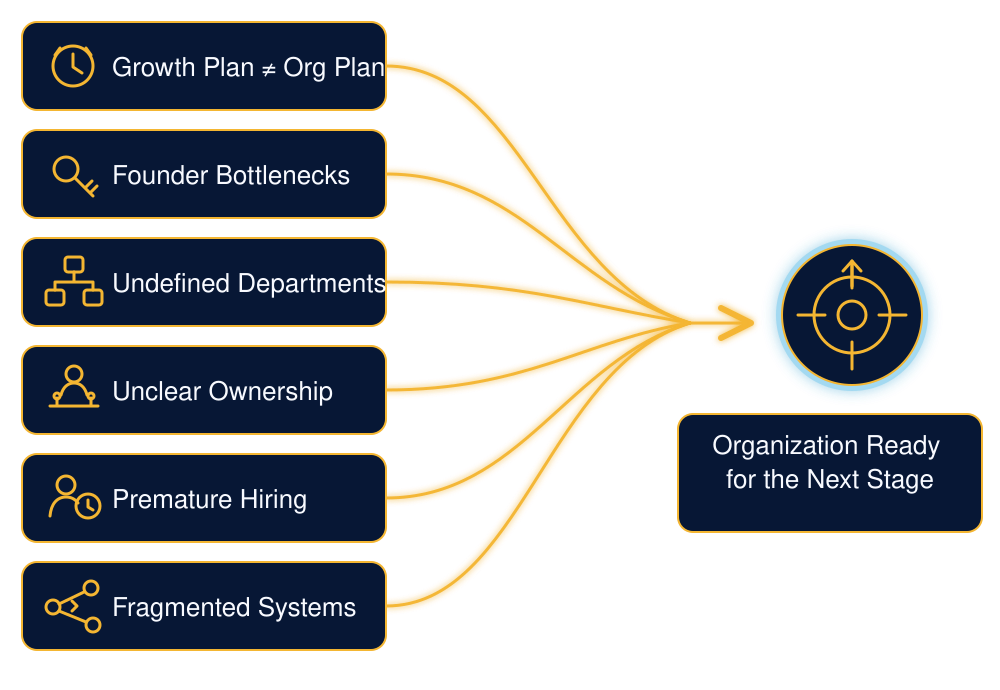
Growth plans often move faster than organizational design.
The growth plan does not explain what must be built
Leadership has defined the commercial objective but not the work, capabilities, teams, systems, and operating conditions required to deliver it.
Founders remain the hidden operating system
Important decisions, relationships, approvals, context, and exception handling continue to flow through a small number of people.
New departments begin with a job title
The organization decides to hire a department head before defining the outcomes, responsibilities, interfaces, and capabilities the function requires.
Teams multiply faster than responsibilities become clear
New roles and groups appear, but decision rights, ownership, handoffs, and cross-functional expectations remain ambiguous.
Hiring gets ahead of the operating design
People are recruited into roles whose priorities, authority, resources, systems, and relationships are still being determined.
The first management layer is unprepared
Strong individual contributors become managers without enough clarity, capacity, support, or shared expectations for the new responsibility.
Processes and systems reflect the smaller company
Informal tools, personal memory, manual coordination, and founder access cannot support the organization’s emerging scale or complexity.
Growth begins to fragment the organization
Departments, locations, markets, and leaders develop different practices, information, priorities, and interpretations of how the company should operate.
The challenge is translating growth into a coherent organization.
A business can know where it wants to go and still lack a clear view of what must exist to get there.
A forecast may describe expected revenue, customers, production, funding, or market expansion. An organizational chart may show positions leadership intends to add. Neither necessarily explains the new outcomes, work, capabilities, responsibilities, decisions, teams, systems, and operating connections required.
This workshop begins where growth strategy becomes organizational work.
Before choosing what to build, leaders need to understand:
- What growth commitment the organization must deliver
- What work must begin, expand, change, or stop
- Which capabilities and operating conditions the work requires
- Where responsibilities and decisions should live
- Which founder or executive dependencies must be distributed
- How new and existing functions must work together
- What management and infrastructure the next stage requires
- What should happen first
- What evidence should trigger the next investment
Organizational growth means being able to build and connect new capability as the business changes—without avoidable confusion, founder bottlenecks, premature hiring, fragmented teams, or operating systems that cannot support the next stage.
Start with the growth decision—not a predetermined organizational chart.
The Organizational Growth & Expansion Workshop is configured around a bounded growth commitment.
Every engagement begins with the required Growth Direction foundation. Your organization then selects the problem modules most relevant to what it must build next.
Required
1. Establish the Growth Direction
Define the growth commitment, intended outcome, affected work, timeframe, evidence, constraints, and organizational question the engagement must address.
Choose 2–3
2. Select the Problem Modules
Examine the founder dependency, department design, leadership, operating model, role, capability, hiring, infrastructure, culture, or launch problems most relevant to the decision.
Outcome
3. Build a 30–90 Day Organizational Growth Path
Leave with an evidence-backed organizational build portfolio, clear priorities, responsible owners, unresolved questions, and sequenced next steps.
A typical engagement combines the required foundation with two or three problem modules. Additional evidence review, stakeholder interviews, or specialist participation can be added when the decision requires it.
Organizational growth is the design of new capability—not simply the addition of headcount.
Explore the 12 Organizational Growth & Expansion Workshop Modules
The modules connect growth direction to organizational capability, structure, leadership, talent, infrastructure, and launch. Organizations do not need to complete all 12. The workshop is configured around the growth decision that matters now.
DEFINE WHAT THE ORGANIZATION MUST BUILD
Growth Direction
Define the growth commitment, intended outcome, affected work, timeframe, evidence, constraints, and bounded organizational decision. (Required foundation)
Founder Dependency & Decision Bottlenecks
Identify where work, relationships, context, authority, approvals, and exception handling remain concentrated in founders or a small leadership group.
New Department & Function Design
Translate a required function into outcomes, responsibilities, capabilities, roles, authority, systems, and cross-functional interfaces.
New Market, Location & Business-Line Expansion
Determine what existing organizational capability can be reused, what must be adapted, and what must be built for a new operating context.
DESIGN LEADERSHIP, ROLES & OPERATING CONNECTIONS
Leadership Layer & Management Capacity
Clarify where leadership and management are needed and whether managers have the capability, authority, time, information, and support to carry the responsibility.
Cross-Functional Operating Model
Define how teams coordinate work, exchange information, resolve conflicts, make decisions, and remain accountable across organizational boundaries.
Role Clarity & Accountability
Untangle responsibilities that accumulated informally and connect roles to outcomes, decisions, capabilities, evidence, and working relationships.
Capability Sourcing Strategy
Determine whether required capabilities should be developed, hired, contracted, acquired, automated, accessed through a partner, or combined.
BUILD, CONNECT & LAUNCH THE NEXT STAGE
Growth Hiring Sequence & Readiness
Determine which roles should be hired first, what must be defined before recruiting, and what evidence should trigger each addition.
Systems, Process & Operating Infrastructure
Identify where tools, information, workflows, governance, access, processes, and infrastructure must evolve to support the new organization.
Culture & Employee Experience Through Growth
Translate values and founder practices into observable conditions while examining how growth changes communication, trust, belonging, learning, and employee experience.
Organizational Launch, Integration & Mobilization
Prepare a new team, function, location, or business line to begin operating, connect with the existing organization, and learn from its first 30–90 days.
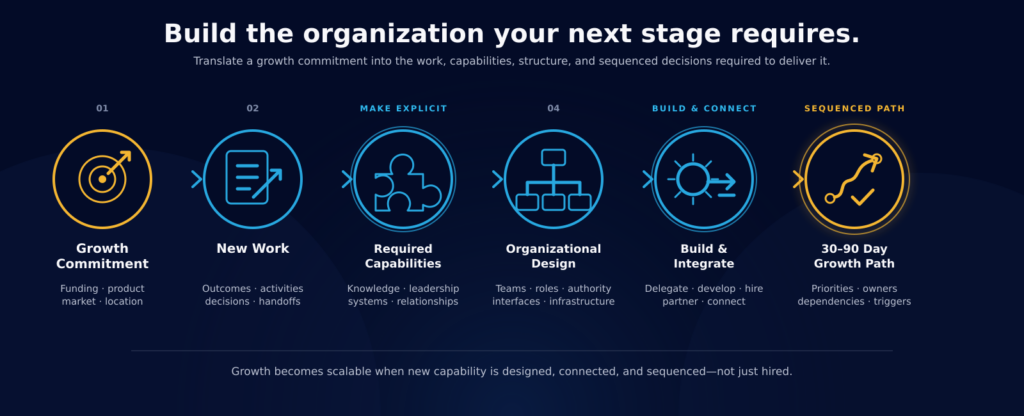
Growth requires more than hiring.
Clarify
Define the outcome, work, priorities, boundaries, decisions, and evidence required before adding structure.
Design
Create or redesign a function, department, team, role, workflow, decision process, or cross-functional interface.
Delegate
Move authority, ownership, relationships, and decisions away from unnecessary founder or executive concentration.
Develop
Build leadership, management, technical, operational, or collaborative capability inside the existing organization.
Hire
Bring in new capability, capacity, leadership, or experience through employment when the work and context are sufficiently defined.
Access Externally
Use contractors, fractional leaders, vendors, acquisitions, or partners to access capability without prematurely creating permanent structure.
Integrate
Connect new work, people, teams, systems, information, and decisions to the existing organization.
Sequence
Establish what must happen now, what depends on earlier work, and what evidence should trigger the next organizational investment.
These categories organize the available options and tradeoffs. They are not automatic recommendations and do not replace leadership judgment or qualified financial, legal, HR, labor, compliance, cybersecurity, tax, or other specialist review.
How Your Workshop Is Configured:
-
1
Free Discovery Call We explore the growth commitment, what the organization is preparing to build, the decision leadership needs to make, and the outcome it needs to deliver. -
2
Configure Your Workshop We establish the required Growth Direction foundation and recommend the two or three modules that belong together. -
3
Collaborative Workshop Founders, leaders, managers, specialists, and people close to the work connect their evidence, experience, assumptions, and constraints. -
4
Organizational Growth Path You leave with a bounded organizational build portfolio, clear owners, unanswered questions, and a 30–90 day path forward.

Leave with more than a conversation.
Growth Direction Brief
A shared definition of the growth commitment, intended outcome, organizational boundary, timeframe, evidence, constraints, and decision.
Future Work View
A grounded picture of the work that must begin, expand, change, connect, or stop as the organization grows.
Organizational Capability Map
A view of the capabilities, knowledge, leadership, systems, relationships, and operating conditions required for the next stage.
Responsibility & Decision Map
Clarity about where responsibilities, ownership, authority, approvals, and cross-functional decisions should live.
Selected Module Findings
Clear findings from the organizational growth modules included in the engagement.
Organizational Build Portfolio
An organized set of clarify, design, delegate, develop, hire, access externally, integrate, and sequence options.
30–90 Day Growth Path
A bounded implementation path with priorities, owners, dependencies, milestones, evidence needs, and specialist questions.
Final outputs depend on the selected modules, available evidence, participants, and the organizational decision established through the required Growth Direction foundation.

Build the next stage around real work—not an idealized organizational chart.
We help leaders understand the organization they have, define the organization they need, and build a credible path between them.
Work-connected
Begin with the outcomes and activities the next stage requires rather than starting with conventional positions or department names.
Human-centered
Examine how people actually contribute, coordinate, decide, learn, lead, and experience organizational growth.
Evidence-based
Separate known facts from assumptions and connect organizational investments to observable needs, dependencies, and outcomes.
System-aware & sequenced
Consider how roles, teams, leadership, processes, technology, relationships, and information operate together—and what must be built first.
When the workshop reveals something worth maintaining
Turn a one-time growth decision into ongoing organizational visibility.
Optional support for organizations that want to maintain the work, capabilities, responsibilities, relationships, and evidence revealed through the workshop.
Workshop Findings
Identify organizational capabilities, dependencies, responsibilities, decisions, or evidence that should remain visible after the engagement.
Gobekli Setup
Configure appropriate Gobekli tools around the work, people, capabilities, roles, teams, profiles, and organizational relationships leadership needs to understand.
Ongoing Visibility
Continue developing the organization’s Human Intelligence Layer as new people join, responsibilities shift, capabilities develop, and the next stage takes shape.
A Gobekli setup is an optional continuation—not a required workshop outcome. The appropriate configuration depends on the organizational decision, product availability, participants, and implementation scope.
Frequently asked questions
Questions leaders ask before booking.
An organizational growth workshop helps leaders translate a defined growth commitment into the work, capabilities, teams, roles, leadership, systems, relationships, and operating conditions required to deliver it. The purpose is not simply to produce an organizational chart or hiring plan. It is to understand what the organization must become, how the new pieces should fit together, and what should be built first.
No. Series A–C companies are a strong fit because new funding often creates an urgent need to build departments, leadership capacity, operating infrastructure, and coordination. The same challenges affect bootstrapped companies, family businesses, founder-led organizations, and established SMBs opening locations, adding services, entering markets, or moving into a more complex stage of operation.
The workshop may be useful when an organization is deploying new funding, launching a product or service, entering a market or geography, opening a location, building a department, moving beyond founder-led operations, adding management layers, preparing for significant hiring, or discovering that existing processes no longer support the business.
Every engagement begins with the required Growth Direction foundation. The organization then selects the two or three problem modules most relevant to the bounded growth decision, available evidence, affected work, and people who need to participate.
No. Completing every module would usually create unnecessary scope and dilute attention from the decision that matters now. A typical engagement combines the required foundation with two or three connected modules.
Yes. Growth problems are often connected. A new department may also require founder delegation, a leadership layer, role clarity, infrastructure, hiring readiness, and integration. The workshop configuration should include only the modules needed to support one coherent decision.
Organizational Growth & Expansion asks what the organization must build and how the new capability should fit together. Workforce Scalability asks how the organization can increase, reduce, redeploy, or reconfigure the workforce capacity and capability required as work changes. The two workshops can connect without being the same engagement.
AI Transformation focuses on how AI changes work, workflows, decisions, capabilities, adoption, value, governance, and risk. Organizational Growth & Expansion focuses on the organization required to deliver a broader growth commitment. An AI-enabled growth initiative may use connected modules from both workshops.
Yes. New Department & Function Design begins with the outcomes and work the function must support, then examines responsibilities, capabilities, roles, authority, systems, information, measures, and cross-functional relationships. The purpose is to design a functioning capability—not merely name a department head.
No. The workshop can clarify which work and capabilities may require new people, how roles should be sequenced, what prerequisites matter, and what must be established before recruiting. Recruiters and hiring leaders remain responsible for evaluating and selecting candidates.
No. Leadership should enter with a credible growth direction. The workshop translates that direction into organizational requirements. It does not provide investment advice, determine product-market fit, forecast returns, set valuation, or guarantee that a strategy will succeed.
Yes. The workshop can make concentrated decisions, relationships, knowledge, approvals, and exception handling visible and help leaders consider delegation, documentation, capability development, role design, systems, and operating changes. The goal is not to remove founders; it is to ensure growth does not require every important action to continue flowing through them.
Useful inputs may include the growth plan, funding or expansion commitments, forecasts, organizational charts, current roles, department plans, hiring priorities, process maps, system information, customer commitments, leadership observations, and known operating constraints. A perfect data set is not required.
No. The workshop is designed to produce a useful organizational growth path whether or not the organization continues into TalentSync or TalentPass. A Gobekli setup is an optional continuation when ongoing visibility would be valuable.
BUILD THE NEXT STAGE DELIBERATELY
Turn your growth plan into an organization that can deliver it.
Connect the growth commitment to the work, capabilities, roles, leadership, systems, and operating relationships it requires—then sequence what the organization should build next.
In a free exploratory conversation, we will help identify the organizational decision that needs to be made and determine whether this workshop is the right starting point.
