
A LEARNING VISIBILITY & CREDENTIALING WORKSHOP MODULE
Employer-Readable Learning Profiles: Help Employers See What Learners Can Do
Learners complete courses, projects, assessments, internships, credentials, and other meaningful experiences.
But employers often receive only a degree title, transcript, résumé, badge, or list of skills.
The learning may be credible. The record may be accurate. Yet the employer still cannot see what the learner did, how the capabilities were developed, what evidence was reviewed, or how the learning may relate to the work.
Workshop Module 10 — Employer-Readable Learning Profiles
Does this sound familiar?
Degree titles say too little
Employers can see what program a learner completed but not the activities, capabilities, projects, or evidence behind it.
Transcripts require institutional interpretation
Course codes, credit hours, grades, and academic terminology may be difficult for an employer to translate into work.
Skills appear without context
Learners list skills without showing where those capabilities came from or how they were demonstrated.
Important projects become résumé bullets
Research, capstones, internships, labs, and employer-connected experiences are compressed into a few lines.
Credentials accumulate without a coherent story
Degrees, badges, certificates, licenses, and other records remain scattered across platforms.
Employers fall back on familiar signals
Hiring teams rely on institution names, degree requirements, titles, keywords, experience, and personal networks.
What is an employer-readable learning profile?
An employer-readable learning profile is a purpose-built view of a learner’s education, experience, capabilities, credentials, projects, and supporting evidence designed to help an employer understand potential relevance to work.
A useful profile can connect education and program context, courses and learning experiences, projects and work-based learning, activities, responsibilities, technical and human capabilities, skills and their origins, credentials, assessments, accomplishments, and appropriate confirmation.
The profile is not simply a redesigned transcript or a longer résumé. It translates learning into a structured account while preserving enough institutional context for the evidence to remain credible.
The problem is not that employers reject learning. It is that they cannot always interpret what the records mean.
Institutions may organize learning around courses, credit hours, outcomes, assessments, programs, and credentials. Employers may organize work around responsibilities, activities, problems, tools, conditions, deliverables, capabilities, and outcomes.
- What the learner studied
- What the learner did
- What the learner produced
- What the learner demonstrated
- Which capabilities were involved
- Where those capabilities came from
- What evidence supports the account
- Who reviewed or confirmed the evidence
- Which claims remain self-reported
- What work the profile is intended to support
When these connections are missing, employers fall back on signals that are easier to read rather than evidence that may be more meaningful.
See the complete profile—not just the résumé or transcript.
Learning Context
- Institution and program
- Courses and pathways
- Learning outcomes
- Projects and experiences
- Conditions and expectations
Activities and Responsibilities
- Work performed
- Problems addressed
- Decisions made
- Tools and methods used
- Individual and team responsibilities
Capabilities
- Technical capabilities
- Human capabilities
- Applied knowledge
- Skills and their origins
- Emerging strengths
Evidence and Confirmation
- Assessments
- Projects and artifacts
- Demonstrations
- Instructor or supervisor review
- Credentials and verified records
Employer Purpose
- Opportunity requirements
- Relevant work activities
- Prerequisites
- Evidence questions
- Human review and follow-up
A learning profile becomes employer-readable when educational context, activities, capabilities, evidence, confirmation, and opportunity requirements can be understood together.
How meaningful learning becomes difficult for employers to read
STAGE 1
Learning occurs in institutional structures
Learners complete courses, programs, projects, assessments, credentials, placements, and other experiences designed around educational goals.
STAGE 2
The institution records completion
Grades, credits, degrees, badges, competencies, and transcript entries confirm important achievements.
STAGE 3
The learner enters an employment process
The learner must translate those records into a résumé, application, interview response, portfolio, or professional profile.
STAGE 4
Context and evidence disappear
Employers receive abbreviated claims while learners struggle to explain what they did, what they demonstrated, and how the learning relates to the opportunity.
A skill name is not enough to explain capability.
Skills can provide useful shared language. But a skill listed without context cannot explain where it came from, what the learner did, how it was applied, what evidence supports it, who reviewed it, or how current and relevant it may be.
A useful employer-readable profile should help answer:
Was it developed through a course, project, job, internship, laboratory, clinical experience, credential, or independent practice?
Which activities required the capability, and what level of responsibility did the learner hold?
Which tools, methods, collaborators, constraints, customers, or operating conditions shaped the work?
Was it demonstrated through an assessment, artifact, project, observation, credential, result, or reviewed experience?
Did an instructor, supervisor, assessor, client, credential issuer, or other qualified participant confirm part of the account?
Does the evidence connect to the opportunity, or is additional information or assessment needed?
What makes learning evidence readable to an employer?
Where did the skill come from?
Was it developed through a course, project, job, internship, laboratory, clinical experience, credential, or independent practice?
What did the learner do?
Which activities required the capability, and what level of responsibility did the learner hold?
How was the skill used?
Which tools, methods, collaborators, constraints, customers, or operating conditions shaped the work?
What evidence supports the claim?
Was the capability demonstrated through an assessment, artifact, project, observation, credential, result, or reviewed experience?
Who reviewed the evidence?
Did an instructor, supervisor, assessor, client, credential issuer, or other qualified participant confirm part of the account?
How current and relevant is it?
Does the evidence connect to the opportunity, or would the employer need additional information or assessment?
Institutional learning records
- Courses and credit hours
- Grades and completion
- Program requirements
- Learning outcomes
- Academic competencies
- Assessment criteria
- Degrees and certificates
- Faculty or institutional review
These records serve important institutional purposes, but employers may not know how to translate them into work.
Employer decision context
- Work activities
- Problems addressed
- Responsibilities held
- Tools and systems used
- Decisions or recommendations made
- Deliverables and outcomes
- Relevant capabilities
- Required credentials or prerequisites
These questions should inform profile design without erasing the educational meaning of the learning.
Learning and work describe the same person from different directions.
The goal is not to make education imitate a job description. It is to build a credible bridge between learning evidence and the work an employer needs to understand.
- Translate without stripping context
- Connect capabilities to their origins
- Preserve institutional authority
- Show the status of each claim
- Make employer questions explicit
- Keep human interpretation visible
An employer profile should be purpose-built—not a permanent public summary of the person.
A learner may need different views for an internship, licensed occupation, project-based role, first professional role, or later career move.
- Follow the learner’s purpose
- Select information relevant to the opportunity
- Preserve the evidence and its source
- Respect the learner’s sharing choices
- Keep institutional authority visible
- Exclude private or irrelevant information
Help employers see the learning
Connect courses, projects, activities, capabilities, credentials, and reviewed evidence so learners can carry the right profile into the right employment conversation.
THE MATCHING WORKSHOP MODULE
Module 10: Employer-Readable Learning Profiles
This module helps learning organizations translate education, experience, capabilities, credentials, projects, and evidence into profiles employers can understand.
Participants examine what institutional records currently communicate, what learners must reconstruct on their own, what employers need to interpret, and how a purpose-built profile could connect those perspectives.
The goal is not to promise employment or redesign education exclusively around hiring. It is to help learners carry a clearer, more credible account of what they have learned and demonstrated into employment conversations.
This module helps your team:
- Identify the employment purposes a learner profile should support
- Connect academic learning to activities and capabilities
- Preserve the context behind skills and competency claims
- Make projects and work-based experiences easier to interpret
- Connect credentials to their criteria and evidence
- Distinguish learner-provided, reviewed, and verified information
- Incorporate employer questions without reproducing a job description
- Clarify learner control and institutional authority
- Identify information that should remain private or excluded
- Develop a bounded employer-readable profile model
What should happen to each part of the learner profile?
A useful profile does not include every available record or claim. The organization should determine what each piece of information needs in order to become understandable, credible, relevant, and appropriate for an employment purpose.
Translate
Connect learning to work language without erasing its educational meaning.
Contextualize
Add the setting, purpose, conditions, responsibility, level, and constraints needed to understand the learning.
Evidence
Connect the claim to an appropriate assessment, artifact, demonstration, outcome, credential, or reviewed experience.
Confirm
Identify what an institution, instructor, supervisor, assessor, or credential issuer can responsibly confirm.
Tailor
Select relevant information for a defined employment, internship, apprenticeship, project, or career purpose.
Protect
Keep private, sensitive, developmental, irrelevant, unreviewed, or unauthorized information outside the profile.
These categories structure profile design and evidence decisions. They do not automatically determine employability, candidate quality, occupational readiness, culture fit, hiring priority, or employment success.
What should an employer-readable learning profile review examine?
The purpose
Which employment, internship, apprenticeship, project, placement, or career conversation should the profile support?
The learning
Which courses, programs, projects, assessments, credentials, or experiences are relevant to that purpose?
The activity
What did the learner actually do, and under what conditions, expectations, or level of responsibility?
The capability
Which technical, human, contextual, or professional capabilities may the activity or learning help demonstrate?
The evidence
What supports the account, who reviewed it, and what remains self-reported, inferred, incomplete, or unresolved?
The audience
What does the employer need to understand, what should remain outside the profile, and what judgment does the employer retain?
From learning record to employer profile
Long term, TalentSync EDU could help institutions structure relationships among courses, programs, outcomes, projects, work-based experiences, assessments, credentials, capabilities, and reviewed evidence.
With the learner’s participation, relevant information could connect to TalentPass and support an employer-readable profile.
STEP 1
Connect the learning record
Bring together relevant education, experiences, projects, credentials, activities, capabilities, and approved evidence.
STEP 2
Clarify the learner’s purpose
Identify the opportunity, audience, career direction, or employment conversation the profile should support.
STEP 3
Select relevant evidence
Choose the learning and experience information that helps explain potential relevance to that purpose.
STEP 4
Translate without stripping context
Connect academic outcomes and experiences to work activities and capabilities while preserving where the learning came from.
STEP 5
Distinguish the status of each claim
Show what is learner-provided, institutionally confirmed, credentialed, reviewed, inferred, or still missing.
STEP 6
Share a purpose-built profile
Allow the learner to review the profile and choose when it is shared with an employer or another authorized recipient.
The profile helps carry learning into an employment conversation. Employers remain responsible for evaluating the opportunity, asking appropriate questions, interpreting the evidence, and making the decision.
- Connect institutional learning records
- Clarify the learner’s purpose
- Select relevant evidence
- Translate without stripping context
- Distinguish the status of each claim
- Share a purpose-built profile
WHY TALENTPASS MATTERS
Let learners build on their evidence instead of rebuilding their story.
TalentPass is designed to give an individual a connected, reusable foundation that may include education, employment and other experience, activities, skills and their origins, projects, credentials, accomplishment stories, confirmed records, and evidence selected for a particular purpose.
The learner controls their TalentPass information and chooses when it is shared. An employer-readable profile can draw from that foundation without exposing the learner’s complete record or requiring the person to begin again for every opportunity.
PRODUCT AND DECISION BOUNDARIES
An employer-readable profile supports a better conversation. It does not make the hiring decision.
TalentSync EDU, TalentPass, and TalentSync Recruiter should not be presented as:
- Determining the “best” candidate
- Automatically matching a learner to an opportunity
- Predicting job performance or employment success
- Producing a definitive employability or culture-fit score
- Verifying every learner-provided statement
- Treating a skill label as complete proof of capability
- Converting an institutional record into an employment guarantee
- Allowing an employer unrestricted access to learner information
- Replacing interviews, assessments, references, or human review
- Replacing institutional systems of record
- Eliminating bias
- Providing the sole basis for a consequential decision
The product connections described here include capabilities TalentSync EDU is designed to grow into through Launch Partnerships and funded implementation work.
The workshop can still clarify profile purposes, evidence requirements, employer language, learner control, institutional responsibilities, and decision boundaries independently of future product adoption. TalentPass is not designed for use by minors.
What to bring into the conversation
You do not need a completed skills ontology, a new comprehensive learner record, or a fully integrated employer platform.
We begin with a bounded learner population, employment purpose, and set of existing learning records connected to Learning Visibility Direction.
Useful inputs may include:
- Current transcripts and learner records
- Degree, certificate, and program descriptions
- Course and program learning outcomes
- Competency or skills frameworks
- Project and portfolio requirements
- Work-based learning structures
- Internship, clinical, or placement records
- Assessment rubrics
- Digital badges and credentials
- Example learner résumés or profiles
- Career-services materials
- Employer job descriptions and opportunity requirements
- Employer and learner feedback
- Known skills-translation challenges
- Existing institutional and recruiting systems
- Consent, sharing, access, correction, and retention practices
Learning Visibility Direction establishes the learner population, audience, purpose, evidence boundary, and decision this module should support.
What this module can help clarify
What employers need to understand
Identify the activities, capabilities, contexts, evidence, and institutional signals required for a bounded employment purpose.
Which learning evidence should become visible
Determine which courses, projects, experiences, credentials, assessments, and outcomes belong in the profile.
How educational and employer language should connect
Translate learning into work-relevant terms without erasing its origin, context, or broader educational meaning.
How learners should control and use the profile
Clarify profile selection, review, sharing, access, correction, confirmation, and appropriate decision boundaries.
Final outputs depend on the modules selected and the learning-visibility decision established through the workshop’s required Learning Visibility Direction module.
Where might the work lead next?
Employer-readable learning profiles frequently reveal connected problems in evidence architecture, work-based learning, profile design, credentials, employer alignment, and governance.
Connected Learning Evidence & Context
Connect courses, experiences, activities, capabilities, credentials, and evidence without stripping away meaningful relationships.
Projects, Teams & Work-Based Learning
Make responsibilities, contributions, deliverables, feedback, capabilities, and outcomes visible within authentic experiences.
Purpose-Built Learner Profiles
Turn one connected body of evidence into distinct profiles for learning, projects, transfer, prior learning, and employment.
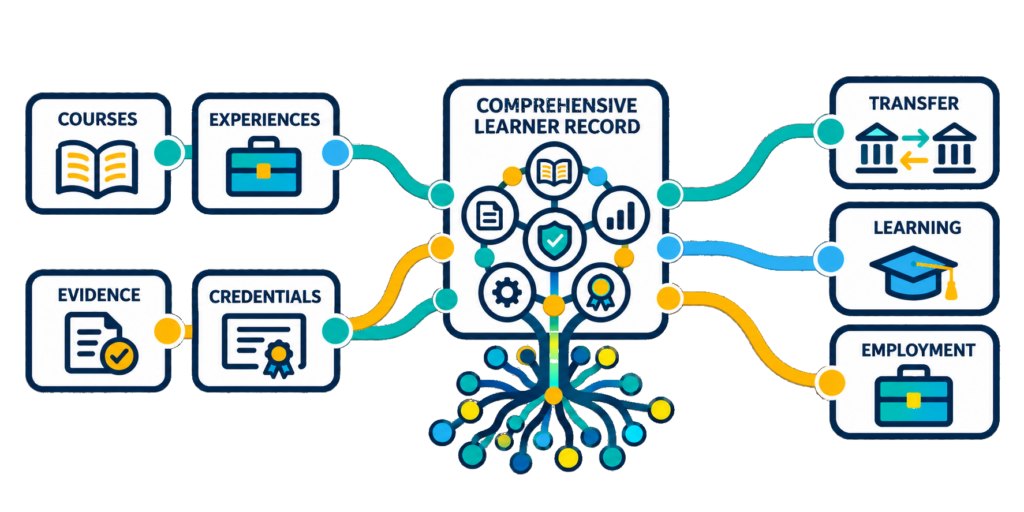
Credentials & Comprehensive Learner Records
Connect recognition to its learning, criteria, assessment, evidence, issuer, and intended use.
Frequently asked questions
Questions learning organizations ask about employer-readable learning profiles.
A purpose-built view of education, experience, capabilities, credentials, projects, and evidence designed to help an employer understand potential relevance to work.
A résumé is usually a brief self-authored summary. An employer-readable profile can provide structured connections among learning, activities, capabilities, credentials, projects, evidence, and confirmation.
A transcript is an authoritative institutional record. An employer-readable profile is a selected, purpose-built translation for an employment audience while preserving the transcript’s authority.
No. A comprehensive learner record may connect a broad range of achievements. An employer-readable profile is a purpose-built view for an employment-related audience or opportunity.
Not necessarily. A portfolio often emphasizes artifacts or projects. The profile may include portfolio evidence alongside education, activities, skills, credentials, assessments, and confirmation.
No. Different opportunities require different evidence. A learner should be able to share a purpose-built profile rather than disclose their complete record.
No. The profile should include learning relevant to its purpose and useful to the intended audience.
Skills should be connected to their origins and use whenever possible, including activities, conditions, evidence, and appropriate review.
An institution can confirm records, assessments, credentials, outcomes, or reviewed evidence within its authority. That does not automatically prove readiness for every work context.
They can provide more useful evidence than a degree requirement, title, keyword match, or self-reported skills list alone. Employers must still define and evaluate the work responsibly.
No. Employer language can improve translation, but it should not dictate curriculum or reduce education to immediate job tasks.
No single profile can prove readiness for every responsibility or environment. Employers remain responsible for interpreting the evidence for a specific opportunity.
No. Structured evidence may reduce reliance on some weak proxies, but profile design, requirements, interpretation, technology, and human decisions can each reproduce bias.
The learner should understand the profile, participate in its development, and choose when it is shared. Institutions remain authoritative for records they issue.
Not automatically. Access should be bounded by purpose, relevance, permission, institutional authority, and informed learner sharing choices.
Long term, TalentSync EDU could connect courses, programs, outcomes, projects, assessments, credentials, capabilities, and reviewed evidence to learner-controlled TalentPass profiles.
TalentSync Recruiter can structure an opportunity’s activities, capabilities, prerequisites, context, and evidence questions. A TalentPass profile can then organize relevant learner evidence for human review.
Every engagement begins with Learning Visibility Direction. This module may combine with Connected Learning Evidence, Work-Based Learning, Purpose-Built Profiles, Comprehensive Learner Records, Employer Demand, or Learning Evidence Governance.
HELP EMPLOYERS SEE THE LEARNING
Turn meaningful learning into evidence employers can understand.
Connect courses, projects, activities, capabilities, credentials, and reviewed evidence—then help learners carry the right profile into the right employment conversation.
This module is part of Gobekli’s configurable Learning Visibility & Credentialing Workshop.