
LEARNING VISIBILITY & CREDENTIALING WORKSHOP
Make Every Learner’s Knowledge, Skills, and Experience Visible.
Learning happens across courses, employment, military service, projects, internships, credentials, community activity, and life—but much of it remains disconnected, difficult to recognize, or impossible to use.
The Learning Visibility & Credentialing Workshop helps institutions connect prior, current, and completed learning to evidence, skills, credentials, learner-controlled Profiles, and the people who need to understand them.
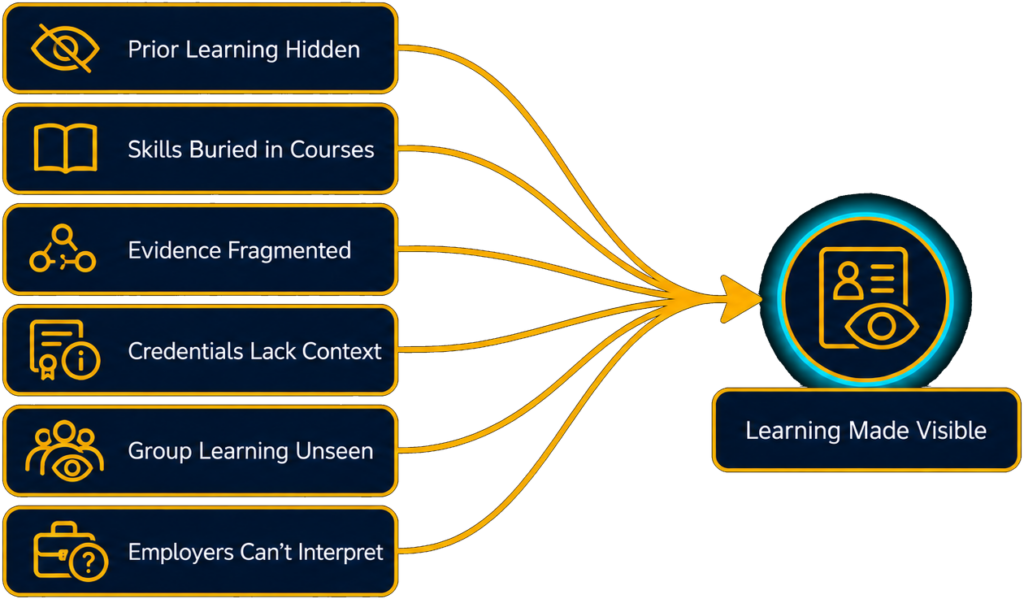
The learning is there. The complete picture usually is not.
Prior learning remains hidden
Students arrive with years of work, training, military service, credentials, projects, and lived experience that may never enter a formal recognition process.
Students cannot see what they are developing
Courses display content, grades, and credits without always helping learners understand the capabilities they are building or the evidence supporting them.
Learning is fragmented across systems
Transcripts, learning platforms, credential providers, portfolios, advising systems, and personal documents hold separate pieces of the learner’s story.
PLA is difficult to navigate
Learners may not know what qualifies, what evidence to provide, where to begin, or how their experience will be evaluated.
Credentials lack usable context
A badge, certificate, or degree may identify what was awarded without explaining what the learner did, demonstrated, or can show.
Employers struggle to interpret learning
Employers receive institution-specific course titles and credentials without a clear view of the activities, skills, evidence, or applied experience behind them.
Group learning remains invisible
Programs can report enrollment, completion, and grades but may struggle to see learning patterns across courses, projects, cohorts, and teams.
Learners repeatedly rebuild their story
The same person may reconstruct similar evidence for PLA, advising, transfer, scholarships, internships, graduate education, and employment.
The problem is not a shortage of learner data. It is the missing connection between learning, evidence, and purpose.
Most institutions already hold substantial information about their learners. The student information system may contain courses and grades. The learning management system may hold assignments and assessments. Portfolio and credential platforms may contain work products and badges. Advisors may document goals and barriers. Employers may observe applied performance. Learners may carry additional evidence in résumés, personal files, military records, licenses, and previous transcripts.
These records can all be accurate while still failing to create a useful picture of the learner.
To make learning visible, institutions need to connect:
- Learning experiences and activities performed
- Knowledge, technical skills, and human capabilities
- Responsibilities, work products, and accomplishments
- Assessments, criteria, credentials, and formal recognition
- Learner goals, program context, and external opportunities
- Verification, consent, and appropriate sharing
Learning visibility is the ability to connect a person’s learning, experiences, activities, capabilities, evidence, assessments, and credentials well enough for the right audience to understand and use them responsibly.
The goal is not to collapse every record into one institutional database. It is to make trusted pieces of learning connect well enough to support a particular learner, institutional, or employment decision.
Start with the learning decision—not a predetermined technology.
The Learning Visibility & Credentialing Workshop is configured around a bounded institutional problem. Every engagement begins with the required Learning Visibility Direction foundation. Your institution then selects the modules most relevant to the learners, evidence, Profiles, credentials, systems, audiences, or decisions being examined.
Required
1. Establish the Learning Visibility Direction
Define the learner population, learning experiences, institutional purpose, intended audiences, available evidence, systems, constraints, timeframe, and consequential decision.
Choose 2–3
2. Select the Problem Modules
Examine the prior-learning, learner-visibility, evidence, Profile, credential, employer-interpretation, portability, system, or governance problems surrounding the decision.
Outcome
3. Build a 30–90 Day Learning Visibility Path
Leave with a focused response, Profile and evidence priorities, responsible owners, unresolved questions, and sequenced next steps.
A typical engagement combines the required foundation with two or three problem modules. Additional learner conversations, faculty review, employer participation, system analysis, credential design, or specialist involvement can be added when the decision requires it.
Learning visibility should create value for everyone who depends on the learning.
Explore the 12 Learning Visibility & Credentialing Workshop Modules
The modules connect prior learning, current learning, evidence, Profiles, credentials, institutional systems, and external use. Institutions do not need to complete all 12. The workshop is configured around the learning-visibility decision that matters now.
ESTABLISH THE LEARNING PICTURE
Learning Visibility Direction
Define the learner population, visibility problem, institutional purpose, intended audiences, evidence, systems, constraints, and decision. (Required foundation)
Prior Learning Discovery
Identify learning gained through employment, previous education, military service, credentials, community participation, projects, and other experiences.
PLA Evidence & Recognition Readiness
Clarify how learners enter prior-learning processes, what evidence is needed, who evaluates it, and how decisions are communicated.
Student Learning Visibility
Help learners see the activities, knowledge, skills, evidence, credentials, and progress developing across their educational experience.
TURN LEARNING INTO USABLE PROFILES
Talent Tree & Connected Learning Evidence
Connect experiences to activities, capabilities, evidence, accomplishments, assessments, credentials, and verification without separating learning from its origins.
Purpose-Built Learner Profiles
Determine which Profiles learners need for PLA, advising, program progress, transfer, projects, career exploration, and employment.
Course, Cohort & Program Visibility
Use Teams-mode views to understand learning patterns across courses, cohorts, programs, pathways, and other institutional groupings.
Projects, Teams & Work-Based Learning
Make responsibilities, contributions, capabilities, and outcomes visible within projects, internships, labs, clinical experiences, and employer-connected learning.
CREDENTIAL, SHARE & SUSTAIN
Credentials & Comprehensive Learner Records
Connect degrees, certificates, badges, microcredentials, competencies, and learner records to the evidence and learning context behind them.
Employer-Readable Learning Profiles
Translate learning into appropriately shared Profiles that employers can understand without claiming to predict fit or future success.
Learner-Controlled Sharing & Portability
Define how learners access, assemble, correct, permission, share, and carry their evidence across institutions, platforms, and opportunities.
Systems, Standards & Visibility Governance
Connect institutional systems and establish responsibility for exchange, evidence quality, credential integrity, access, correction, and verification.
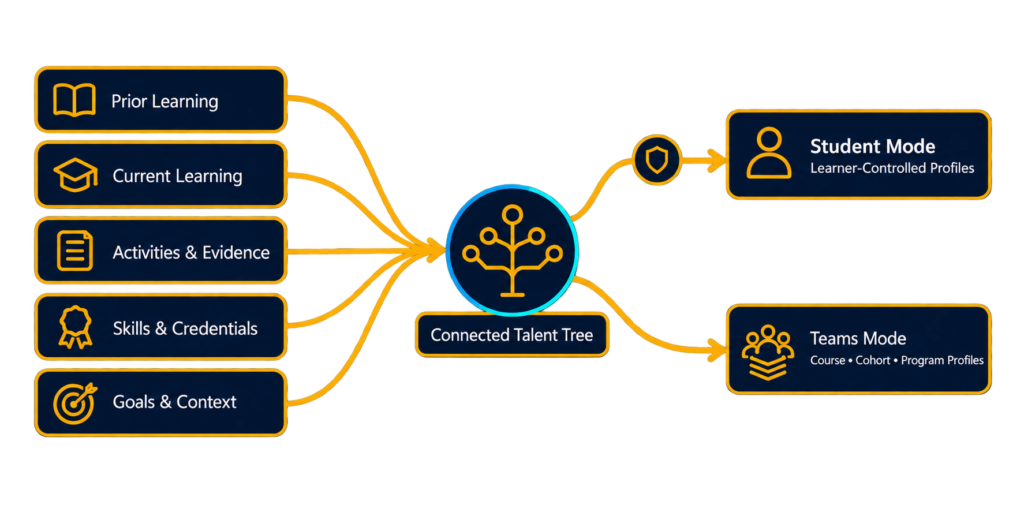
One connected body of learning can support many practical Profiles.
Prior Learning Profile
Organize previous education, work, service, credentials, projects, activities, and evidence for a PLA or recognition conversation.
Learning Progress Profile
Help the learner and advisor understand what is developing, what has been demonstrated, and what may need further attention.
Course or Experience Profile
Show what a learner did and developed through a course, internship, project, clinical placement, research experience, or co-curricular activity.
Transfer or Continuation Profile
Assemble relevant learning for transfer, advanced standing, program entry, graduate education, licensure, or continuing education.
Project and Team Profile
Connect shared work to each learner’s responsibilities, contributions, capabilities, work products, and accomplishments.
Employment Profile
Present learner-selected experiences, activities, capabilities, evidence, credentials, and accomplishments relevant to an opportunity.
Course or Cohort Profile
Allow authorized institutional users to examine learning patterns, evidence, strengths, and visibility gaps across a defined group.
Program Learning Profile
Connect program outcomes, courses, experiences, learner evidence, credentials, capability development, and remaining visibility gaps.
These Profiles do not replace the complete person or underlying record. They provide an appropriate window into connected evidence for a specific conversation or decision. The categories organize evidence and institutional judgment; they do not automatically award credit, establish competency, recommend employment, or authorize disclosure.
How Your Workshop Is Configured:
-
1
Free Discovery Call Identify the learner population, institutional problem, intended audience, and consequential decision requiring better visibility. -
2
Focused Intake & Direction Gather available evidence and establish the required Learning Visibility Direction, participants, boundaries, systems, and decision criteria. -
3
Collaborative Workshop Complete the selected modules with the learners, faculty, evaluators, advisors, registrars, technology teams, employers, and leaders who hold relevant knowledge. -
4
Learning Visibility Path Integrate findings into a 30–90 day response with Profile priorities, owners, evidence needs, dependencies, and questions requiring further review.

Leave with more than a conversation.
Learning Visibility Decision Foundation
A shared definition of the learner population, institutional need, audience, evidence boundary, systems, constraints, and decision.
Learning Evidence Map
A view of relevant experiences, activities, capabilities, assessments, credentials, work products, systems, and missing evidence.
Profile Use-Case Map
A definition of the Profiles needed for learners, faculty, advisors, evaluators, program leaders, transfer partners, and employers.
Prior Learning Path
A clearer route from discovering prior learning to gathering evidence and entering an appropriate institutional review process.
Student and Teams View
A distinction between what the learner needs to see and what authorized participants need to understand across courses, cohorts, projects, and programs.
Credential and Record Response
A recommendation for how credentials, badges, learner records, and Profiles should relate to evidence and learner use.
System and Standards Map
A practical view of systems, integrations, standards, identities, permissions, and exchanges relevant to the decision.
30–90 Day Action Plan
A sequenced plan with responsible owners, immediate actions, evidence needs, dependencies, decision points, and unresolved questions.
Final outputs depend on the selected modules, available evidence, participants, and decision established through the required Learning Visibility Direction foundation.
The workshop supports institutional and human judgment. It does not automatically award credit, verify every learner claim, determine competency, guarantee transfer, establish employability, replace faculty evaluation, or make legal, accreditation, privacy, accessibility, or compliance determinations.

Make learning visible to the individual—and across the learning community.
Student mode preserves the learner’s connected story. Teams mode helps authorized institutional users understand learning across shared experiences and bounded groups. Together, they can create a more complete Human Intelligence Layer for education.
Learner-centered
Help individuals discover prior learning, see current development, build useful Profiles, and choose what evidence to carry forward.
Evidence-connected
Keep skills and credentials connected to the experiences, activities, assessments, work products, and accomplishments behind them.
Profile-powered
Use the same connected Talent Tree to build different views for PLA, advising, progress, transfer, projects, programs, and employment.
Institutionally useful
Support course, cohort, project, program, employer-partner, and institutional views without reducing learners to a single score.
When the workshop reveals something worth maintaining
Turn a one-time learning review into ongoing visibility.
Optional Gobekli support can help institutions maintain the relationships among learners, experiences, capabilities, evidence, credentials, Profiles, teams, programs, partners, and opportunities revealed through the workshop.
Workshop Findings
Identify the learner evidence, Profile use cases, group views, system relationships, permissions, and decisions that should remain visible after the engagement.
Gobekli Configuration
Explore how TalentPass student mode, TalentSync EDU teams mode, Pythia, the Talent Tree, Profiles, Passport Pages, STAMP, and integrations could support the approved scope.
Ongoing Human Intelligence
Maintain learner-controlled Profiles and authorized course, cohort, project, or program views as learning and evidence continue to develop.
A Gobekli setup is an optional continuation—not a required workshop outcome. The appropriate configuration depends on the institutional decision, participating population, product availability, implementation scope, existing systems, privacy and consent requirements, accessibility needs, and appropriate specialist review.
TalentPass is not designed for use by minors.
Questions institutional leaders ask before booking.
It is a configurable facilitated process that helps an institution connect prior, current, and completed learning to activities, capabilities, evidence, assessments, credentials, Profiles, systems, and the people who need to understand them.
Every engagement begins with the required Learning Visibility Direction foundation. The institution then selects the problem modules most relevant to its decision.
The workshop is designed primarily for colleges, universities, community colleges, adult and continuing education providers, workforce education organizations, and other institutions responsible for postsecondary or workforce-connected learning.
Participants may include learners, academic leaders, faculty, PLA evaluators, registrars, advisors, career services, assessment, institutional research, technology teams, employers, and qualified specialists.
No. Every engagement begins with Learning Visibility Direction. Most institutions then select two or three additional modules connected to the decision established through that foundation.
The module structure focuses the conversation rather than turning every engagement into a complete institutional transformation.
Learning visibility is the ability to see and understand what a person has learned, where it occurred, what activities were performed, what evidence exists, how the learning was assessed or verified, and how it may be used.
Visibility does not mean every claim is automatically accepted or every audience receives access to the complete record.
Learning visibility asks whether prior, current, and completed learning can be seen, understood, recognized, carried, and used.
Learning alignment asks whether outcomes, curriculum, activities, assessments, credentials, pathways, and external requirements meaningfully correspond. A program can be aligned on paper while its resulting learning remains difficult to see.
The Program Relevance Workshop examines whether an educational offering remains connected to its purpose, learners, community, changing work, delivery conditions, and outcomes.
This workshop examines whether a learner’s prior, current, and completed learning can be discovered, connected to evidence, recognized, profiled, and understood.
Prior learning assessment is an institutional process for evaluating learning gained outside the conventional course or program in which credit may ordinarily be awarded.
The workshop can improve discovery, evidence preparation, communication, routing, and process design. Authorized institutional evaluators remain responsible for academic review and credit decisions.
No. Gobekli can potentially help learners discover and organize experiences, activities, capabilities, credentials, accomplishments, and evidence into a Prior Learning Profile.
That Profile can support institutional review, but it does not determine equivalency, establish competency, or award credit.
The Talent Tree is a connected view of the person that can relate experiences, activities, evidence, accomplishments, credentials, technical skills, human capabilities, motivations, interests, and other dimensions of talent.
Its practical value is preserving the context and origins behind an assertion so that the same connected evidence can support multiple Profiles.
A learner Profile is a purpose-specific view assembled from relevant parts of the learner’s connected evidence.
A Prior Learning Profile may support PLA. A Learning Progress Profile may support advising. A Project Profile may explain responsibilities and contributions. An Employment Profile may present learner-selected evidence relevant to an opportunity.
A résumé is generally a self-presented summary. A transcript is an official academic record. A badge or credential is an assertion issued according to defined criteria.
A Profile can bring relevant elements from these and other sources together around a particular purpose while preserving connections among experiences, activities, capabilities, evidence, accomplishments, assessments, and credentials.
Student mode helps an individual understand and use their own learning. Teams mode helps authorized institutional users examine learning across courses, projects, cohorts, programs, internships, and employer partnerships.
Collective views should preserve appropriate access boundaries and the distinction between group patterns and individual evidence.
Not by default. The learner should be able to choose what is appropriate to share, subject to product configuration, institutional agreements, and applicable requirements.
An employer-facing Profile should contain relevant evidence rather than exposing the person’s complete history or every dimension of their Talent Tree.
No. A Comprehensive Learner Record is a standards-based way to represent multiple learning achievements and credentials in a verifiable digital record.
A TalentPass Profile is a purpose-specific view that can potentially incorporate or reference credentials, learner records, experiences, activities, and evidence. Learner records can be important inputs to Profiles.
No. The workshop begins with the institution’s decision and existing environment. It identifies what information exists, where it resides, what is missing, and which connections may be necessary.
The response may involve process changes, clearer Profiles, evidence practices, integrations, standards adoption, or further investigation.
No. Digital credentials may be useful when the institution has a clear learning assertion, evidence standard, issuing authority, learner use case, and maintenance plan.
The more immediate need may instead be prior-learning discovery, better evidence, a learner Profile, stronger system connections, or clearer employer interpretation.
The workshop defines the learning evidence, Profiles, participants, systems, permissions, and decisions a future Gobekli configuration may support.
TalentPass can provide the learner-controlled layer. TalentSync EDU can provide authorized institutional and Teams views. The Talent Tree can preserve connected intelligence, while Profiles make selected evidence useful for particular decisions. Capabilities are at different stages of availability and any implementation would be scoped accordingly.
MAKE LEARNING VISIBLE
Turn disconnected learning into evidence people can understand and use.
Help learners show what they already know, see what they are developing, and carry meaningful evidence into what comes next.
Connect prior learning, capabilities, assessments, credentials, Talent Trees, Profiles, institutional systems, and employer interpretation—then build a practical path toward better recognition and use.
In a free exploratory conversation, we will help identify the learning-visibility decision your institution needs to make and determine whether this workshop is the right starting point.
