
LER & TRUSTED WORKFORCE INFRASTRUCTURE WORKSHOP MODULE
Workforce Infrastructure Direction
Define the exchange your organizations need to make useful—who needs what information, for which decision, and under which responsibilities—before choosing the infrastructure work that should follow.
Does this sound familiar?
The initiative starts with a platform
Partners discuss wallets, credentials, or integrations before agreeing on the exchange people and organizations need to complete.
Different partners expect different benefits
An agency wants less repeated documentation, a provider wants portable records, and an employer wants better evidence—but the initiative has not defined which use case comes first.
The receiving decision is missing
The group knows what information it could issue or share, but not who would use it, what they would need to understand, or what decision it should inform.
The scope keeps expanding
Additional records, systems, populations, and partners enter the discussion without a clear boundary around the first useful exchange.
The people making key decisions are absent
Participants can describe the ambition but cannot confirm source responsibilities, receiving requirements, sharing arrangements, or operating commitments.
Success means completing the demonstration
The plan measures issuance or technical connection without defining whether people can present the information and recipients can use it appropriately.
What is workforce infrastructure direction?
Workforce infrastructure direction establishes the purpose and boundaries of a selected learning and employment record exchange.
It identifies the people and organizations involved, the information they need to exchange, and the receiving decision that makes the exchange useful.
The receiving decision might concern understanding completed preparation, reviewing relevant experience, confirming a qualification, or considering information within another defined process.
Direction also identifies what is known, what remains assumed, who can make the relevant decisions, and which questions deserve deeper work.
This required foundation gives the workshop a shared reference point so subsequent modules address a coherent use case.
Infrastructure becomes easier to scope when the exchange has a purpose.
A record can be issued without anyone being prepared to receive it.
A system connection can function without resolving what the information means or how it should be used.
A person can receive a digital record while remaining unsure where to present it or how to obtain help.
The foundation begins with the intended benefit and the people who need to experience it.
It then connects that purpose to the receiving decision, participating organizations, available evidence, and practical boundaries.
That gives the group a clearer basis for selecting modules, involving the right partners, and deciding what a useful result would look like.
Where the direction needs to become clear
Purpose and benefit
The problem being addressed
Intended users
Expected practical benefit
Current difficulties
Criteria for useful exchange
The selected exchange
Information in scope
Source or issuer
Person or organization presenting it
Intended recipient
Receiving workflow
The decision
What the recipient needs to determine
Relevant claims and context
Available decision authority
Information that is unnecessary
Limits on interpretation
Participants and responsibilities
Sponsoring organization
Source-system owners
Individual representatives
Receiving organizations
Technical and operating partners
Boundaries and next steps
Initial population and setting
Systems within scope
Assumptions requiring validation
Decisions outside the workshop
Modules and follow-up work
The foundation defines one exchange or a tightly bounded group of related exchanges. A wider vision can remain visible without becoming the scope of the first workshop.
How this module helps
Establish a shared purpose
Identify the problem, intended benefit, and people or organizations the exchange should serve.
Define the receiving decision
Clarify who needs to use the information, what they need to understand, and how it fits their workflow.
Set responsibilities and boundaries
Identify relevant partners, decision authority, available evidence, and the limits of the selected engagement.
Select the work that follows
Choose problem modules and validation tasks around the questions that prevent the exchange from becoming workable.
A credential initiative needs a destination for its information.
A partnership may want to issue portable records of completed preparation.
That describes an output. It does not yet explain where people would present the records, who would review them, or what the records would help establish.
The foundation examines those questions before the group commits to a wider implementation plan.
Example: “We want a workforce wallet, but partners describe different reasons for using it.”
A workforce agency wants participants to avoid repeatedly supplying completion documents. A provider wants its records to travel beyond its own platform. Employers want information that helps them understand relevant preparation.
The workshop selects one initial exchange: a person presenting a record of completed preparation within a participating employer’s application process.
Partners identify the receiving question, the provider’s source responsibility, the person’s presentation choices, and the employer representative needed to validate the workflow.
The wider wallet ambition remains a future context. The selected exchange gives the workshop a concrete starting point for examining trust, acceptance, and operation.
Questions to review together
What difficulty should the exchange address, for whom, and what would become more workable if it succeeded?
What information is relevant, where does it originate, and who would issue, hold, present, receive, or rely on it?
What does the recipient need to determine, and how would the information enter that process?
What examples, records, workflows, or feedback support the proposed use case, and what still needs confirmation?
Who can make the relevant decisions, which organizations must be involved, and what remains outside the engagement?
What would demonstrate useful exchange, and which modules or validation tasks are needed to prepare the next decision?
What needs to connect?
Intended benefit
A concrete improvement that matters to the people or organizations involved.
Exchange use case
A defined situation in which relevant information moves between identified participants.
Receiving decision
The question or process that gives the exchanged information a practical purpose.
Evidence and context
The available records, examples, source information, and feedback needed to examine the use case.
Responsible participants
The organizations and people whose knowledge, authority, or operating role is necessary.
Scope and review criteria
The boundaries and conditions used to decide whether the selected arrangement is worth taking forward.
When the initiative begins with a technology ambition
Partners may move toward implementation while important questions remain unresolved.
- The platform is clearer than the intended benefit.
- Available data defines the exchange.
- Receiving organizations are assumed to be interested.
- Technical connection becomes the main success measure.
- New requirements expand the scope.
- Responsibilities remain attached to “the partnership.”
The group can invest effort without establishing who will use the result or how it will operate.
When the initiative begins with a defined exchange
Partners can assess the work against a shared purpose.
- The benefit is connected to a specific problem.
- Information follows the receiving question.
- Relevant participants are identified for validation.
- Success includes practical use and interpretation.
- Scope boundaries guide subsequent choices.
- Decisions and responsibilities have named owners.
The foundation makes it easier to choose appropriate infrastructure work and identify what should wait.
A practical example: defining the first useful completion-record exchange
A state-sponsored initiative wants to make learning records more portable across workforce and education services.
Several partners propose starting with a wallet and a broad collection of credentials.
The foundation asks which exchange would provide a useful first test.
The group selects a completed preparation program whose participants commonly apply to a small group of employers.
The provider can describe the program and its completion requirements. The employers need to confirm whether and how that information would help their review.
Partners identify the intended benefit: making the selected preparation easier for applicants to present and for reviewers to understand.
They define the initial population, participating organizations, relevant record, and receiving workflow.
They also identify open questions about source responsibility, record meaning, presentation choices, and employer acceptance.
The group selects the modules needed to examine those questions and assigns follow-up with people who are not yet represented.
The result is a scoped infrastructure direction brief. It does not assume that the selected employers will accept the record, that every credential belongs in the first exchange, or that a statewide rollout is ready.
The receiving decision helps define what information is necessary.
An organization may hold many records that could be shared.
The selected use case should explain which information a recipient needs and what it would help establish.
A completion claim may need program context. An account of experience may need activities and evidence. A current qualification may require attention to status.
These differences affect the infrastructure questions the workshop should examine.
The foundation identifies the information relevant to the decision and the limits of the conclusions it can support.
It also identifies information that does not belong in the initial exchange simply because it is available.
A sponsor can convene the work without controlling every decision.
An agency, technology office, or coalition may initiate the workshop.
Other organizations may still control the source records, receiving workflow, platform, or operating resources.
Individuals also need an appropriate voice in arrangements affecting how they receive and present information.
The foundation distinguishes the sponsor’s decisions from those requiring another participant’s involvement or authorization.
Absent partners become explicit dependencies or validation tasks.
That helps the workshop produce a practical plan without treating sponsorship as authority over the whole exchange.
WORKSHOP MODULE 1 — REQUIRED FOUNDATION
Give the infrastructure work a shared direction.
This required foundation is a focused minicourse and working session. Your team learns how to define a useful exchange, applies the method to one selected use case, and establishes the purpose, participants, evidence, and boundaries that guide the remaining workshop modules.
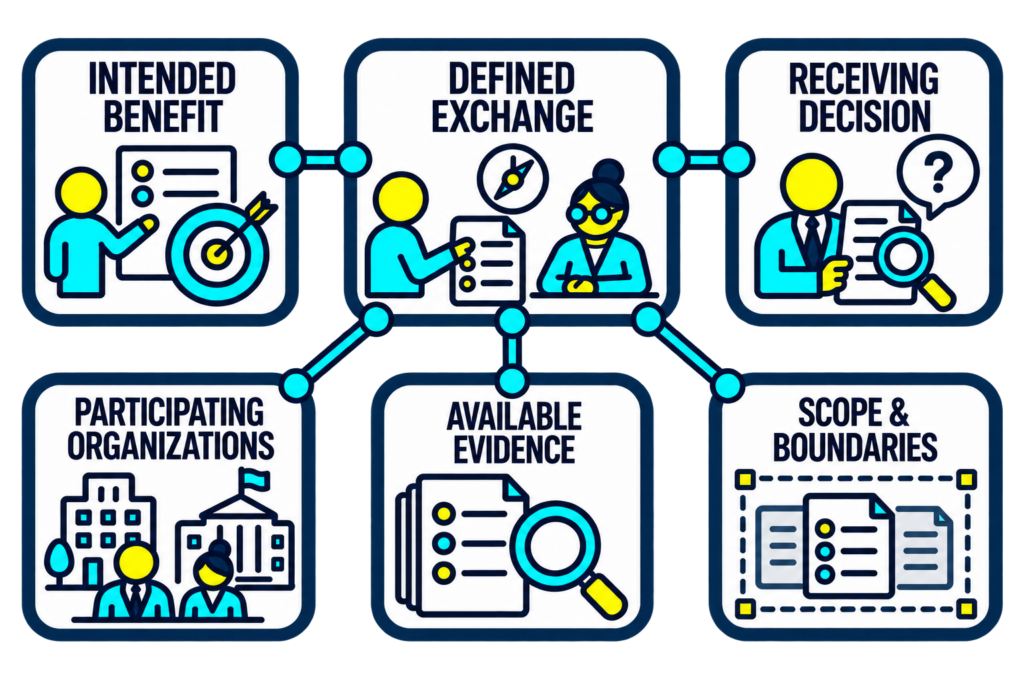
What can this module address?
The foundation establishes the scope of the workshop before deeper review begins.
- The problem the initiative should address
- Intended users and practical benefits
- The selected exchange use case
- Relevant information and source context
- Issuing, holding, presenting, and receiving roles
- The receiving decision and workflow
- Participating organizations and representatives
- Available examples, evidence, and feedback
- Decision authority and responsibilities
- Initial population, setting, and system boundaries
- Criteria for useful exchange
- Module selection and validation priorities
What kinds of responses might emerge?
The foundation may change the starting point of the initiative before partners examine detailed infrastructure questions.
Focus
Select one exchange, population, or receiving decision that provides a workable starting scope.
Clarify
Make the intended benefit, relevant information, participant roles, and use of the record explicit.
Involve
Identify missing source owners, recipients, individual perspectives, or operating partners.
Validate
Confirm whether the proposed exchange addresses a real need and fits the receiving workflow.
Bound
Separate the initial engagement from broader ambitions, unapproved commitments, and decisions requiring other authority.
Sequence
Select the modules and follow-up tasks needed to prepare the next consequential decision.
The foundation establishes a direction for investigation and action. It does not turn an untested use case into an approved implementation.
What will we review?
The initiative’s purpose
The problem, intended benefit, sponsor expectations, and reasons for beginning the work.
The proposed exchange
The relevant information, source, participants, destination, and circumstances of use.
The receiving workflow
The decision the record should inform and the people responsible for interpreting it.
Available evidence
Sample records, current processes, user feedback, partner statements, and known limitations.
Authority and participation
Who can confirm information, authorize changes, represent affected users, and undertake the work.
Scope and success criteria
The selected boundaries, practical review conditions, and questions guiding module selection.
The working exercise
Your team creates a shared direction brief around one proposed or existing workforce information exchange.
STEP 1
Name the problem and benefit
Identify what is difficult today and whose experience or decision the exchange should improve.
STEP 2
Describe the exchange
Specify the information, source, presenting party, recipient, and situation in which it would be used.
STEP 3
Clarify the receiving decision
Explain what the recipient needs to understand and which conclusions the information could support.
STEP 4
Identify evidence and participants
Review what is available, what remains assumed, and whose perspective or authority is missing.
STEP 5
Set boundaries and review criteria
Define the initial population, organizations, systems, exclusions, and conditions for a useful result.
STEP 6
Select the next work
Choose the problem modules, validation tasks, responsible owners, and decisions the workshop should prepare.
A draft Workforce Infrastructure Direction Brief connecting the selected exchange to its purpose, receiving decision, participants, evidence, boundaries, and next steps.
CONNECTING THE WORK TO A POSSIBLE GOBEKLI SETUP
Define what the configuration needs to accomplish.
The foundation can establish the purpose and starting requirements for a subsequent Gobekli configuration. It identifies the use case before determining which available capabilities, connections, or additional development might fit.
A proposed setup might need to connect:
- The selected exchange and intended benefit
- Participating organizations and relevant contacts
- Source systems and record responsibilities
- Information and claims within scope
- Individual receiving and presentation arrangements
- Recipient requirements and review questions
- Evidence sources and interpretation limits
- Authorized roles and operating responsibilities
- Acceptance criteria and validation tasks
- Decisions about scope, readiness, and continuation
TalentSync could support relevant organizational context, while TalentPass and Passport Pages could form part of an appropriately scoped individual record and presentation arrangement. Product fit, availability, permissions, and technical requirements would be confirmed separately.
The direction brief remains useful whether or not the partnership proceeds with Gobekli software.
KEEPING THE WORK FOCUSED
What this module does—and what needs separate work
This module establishes the direction and boundaries of the selected workshop engagement.
It identifies the exchange, receiving decision, participants, evidence, and questions that need deeper examination.
Detailed design, verification arrangements, permissions, technical integration, security review, procurement, and operating agreements are addressed through selected modules and the responsible organizations’ processes.
The module does not:
- Select a platform or architecture by default
- Establish that recipients will accept a record
- Validate every claim in the proposed information
- Authorize access to personal or organizational records
- Resolve identity or matching questions by itself
- Replace legal, security, or procurement review
- Commit absent partners to an arrangement
- Approve a pilot, deployment, or statewide rollout
The brief distinguishes confirmed information from assumptions and proposed arrangements.
Each organization retains responsibility for decisions within its authority.
What should you bring?
Bring one proposed or existing exchange and a clear account of why your organization wants to examine it.
Complete technical documentation is not required. Redacted or synthetic examples can often support the initial discussion.
Useful inputs may include:
- A short description of the initiative
- The problem or intended benefit
- The population or users in scope
- A sample record or information summary
- The current way information is exchanged
- Known issuing or source organizations
- Intended receiving organizations
- A description of the receiving workflow
- Relevant user or partner feedback
- Existing system or operating constraints
- Sponsor and decision-owner contacts
- Questions the workshop should help resolve
If the receiving decision or participant group is still unclear, bring the competing possibilities. The foundation can help select a bounded starting point.
What can you leave with?
Workforce Infrastructure Direction Brief
A shared definition of the problem, intended benefit, selected exchange, and receiving decision.
Participant & Responsibility Map
The relevant organizations, individual perspectives, decision owners, and participation gaps.
Evidence, Assumptions & Boundaries
Available examples, unconfirmed expectations, scope limits, and criteria for useful exchange.
Module & Validation Plan
Selected problem modules, confirmation tasks, responsible owners, and starting configuration questions.
This foundation guides the remaining engagement. Its direction may be revisited when later modules reveal a material change in the use case, evidence, or partner requirements.
Where might the work lead next?
Fragmented Systems & Source Responsibilities
Trace the records and systems involved when the selected exchange needs clearer source ownership, updates, or connections.
Employer & Institutional Acceptance
Validate what a receiving organization needs to request, interpret, and use the selected information.
Shared Governance, Funding & Operational Sustainability
Examine ownership, continuing resources, support, and partner responsibilities when the use case requires a shared operating arrangement.
The foundation can lead to any of the workshop’s problem modules. Selection follows the questions that matter most to the defined exchange.
Frequently asked questions
Questions organizations ask before beginning.
It establishes the purpose, receiving decision, scope, and responsibilities that make the other modules relevant. Without that foundation, partners can work on different assumptions about what the infrastructure should accomplish.
Include people who understand the problem, source information, intended users, receiving workflow, and relevant decisions. The foundation identifies where additional technical, operating, or partner participation is needed.
Yes. A sponsor can define its intended use case and identify the partners or decisions needed next. It cannot confirm another organization’s requirements or commitments without appropriate involvement.
A defined situation in which identified participants provide or present information to a recipient for a particular purpose. It should be specific enough to examine the record, workflow, and receiving decision.
No. Clarifying it is part of the foundation. If several decisions are proposed, the exercise helps select a useful starting scope.
Yes. The module can examine what the pilot is intended to enable, who would use its outputs, and which assumptions require validation before extending it.
Yes. An existing document-sharing process can provide a concrete example of the problem and intended benefit. Technology choices can follow a clearer understanding of the use case.
No. The foundation identifies requirements that can inform those decisions. It does not assume that a particular standard or platform is the correct starting point.
Use one exchange or a tightly bounded group with related purposes and participants. A selected record, program, population, or receiving workflow can provide a manageable starting point.
Make the goals explicit and identify where they overlap or require separate use cases. The foundation should not conceal conflicting expectations inside a broad shared statement.
Identify observable conditions relevant to the intended benefit, such as whether a person can present the record and a recipient can interpret it within the selected process. Technical delivery can be one condition without being the entire definition.
Record what needs that partner’s input or authorization and assign a validation route. The workshop can prepare questions without treating assumptions as confirmed requirements.
Usually not for the foundation. Redacted, synthetic, or summarized examples can often establish the relevant questions without exposing unnecessary personal information.
No. It identifies the proposed purpose, participants, and questions that need examination. Appropriate authority, individual choices, and recipient responsibilities require further review.
Choose the modules that address the most consequential unresolved questions in the direction brief. A typical engagement adds two or three problem modules to this foundation.
The brief can establish the exchange purpose, organizational context, individual presentation needs, and starting configuration questions. Product fit and implementation scope are confirmed separately.
The group proceeds into selected modules, validates missing requirements, and develops the action plan. The direction can be revised if new evidence changes the scope or intended benefit.
START WITH A USEFUL EXCHANGE
Give the infrastructure initiative a clear purpose.
Define who needs what information, which decision it should support, and what the participating organizations need to understand before moving forward.
Begin your LER & Trusted Workforce Infrastructure Workshop with Workforce Infrastructure Direction.