
WORKFORCE SCALABILITY PROBLEM
Employee Onboarding and Team Mobilization: Turn New People Into a Working Team
Organizations invest considerable effort in hiring employees, engaging contractors, moving internal talent, and assembling project teams.
But selecting the right people does not automatically make the work ready—or the team productive.
Effective onboarding and team mobilization connect people to the work, relationships, information, tools, decisions, and support they need to contribute.
Workshop Module 11 — Team Formation, Onboarding & Mobilization
Does this sound familiar?
Onboarding is mostly administrative
New contributors complete forms, policies, and orientation without gaining enough context about the work.
Access arrives after the person starts
Accounts, systems, data, equipment, permissions, and documents are unavailable when contribution should begin.
Responsibilities remain unclear
Job descriptions and project plans do not explain who owns decisions, activities, or handoffs.
Knowledge depends on whoever is available
New people learn through scattered conversations, outdated documents, and informal explanations.
Teams are assembled without being designed
Individuals are selected without examining whether their capabilities and responsibilities fit together.
Leaders confuse activity with readiness
Meetings and tasks begin, but no one can see whether the team is prepared to deliver.
What are employee onboarding and team mobilization?
Employee onboarding helps a new or transitioning employee understand the organization, role, work, relationships, systems, expectations, and support required to contribute.
Team mobilization extends beyond the individual. It establishes how employees, contractors, partners, managers, specialists, and other contributors will operate together around a shared outcome.
- A new employee joins
- An internal employee changes roles
- A contractor or consultant begins
- A new team or project forms
- A merger, reorganization, or technology change shifts responsibilities
The problem is not how quickly people start. It is how quickly coordinated contribution becomes possible.
Time to productivity is often treated as an individual measure, but contribution depends on the surrounding system.
- The outcome the team must support
- Work activities and responsibilities
- Available and missing capabilities
- Systems, tools, data, and permissions
- Knowledge and customer context
- Decisions, relationships, workflows, and handoffs
- Feedback, support, and evidence of readiness
Onboarding should be designed around contribution—not merely completion.
See the complete mobilization system
not just the onboarding checklist.
Shared Outcome
- Customer or stakeholder need
- Operational result
- Project commitment
- Quality expectations
- Timeframe and consequences
Work and Responsibilities
- Critical activities
- Individual ownership
- Shared responsibilities
- Decision rights
- Handoffs and dependencies
People and Capabilities
- Employees
- Internal movers
- Managers and specialists
- Contractors and partners
- Available and missing capabilities
Knowledge and Access
- Organizational context
- Process knowledge
- Customer information
- Systems and tools
- Data, permissions, and resources
Relationships and Readiness
- Working agreements
- Communication practices
- Escalation paths
- Feedback and support
- Readiness evidence
A team becomes ready when people can see what they are trying to accomplish, how the work fits together, what each contributor owns, what the team depends on, and where support or decisions are still required.
How onboarding becomes disconnected from the work
STAGE 1
A workforce decision is made
An employee is hired, an internal move is approved, a contractor is engaged, or a team is assembled.
STAGE 2
Administrative onboarding begins
Forms, policies, benefits, orientation, accounts, and required training become the primary focus.
STAGE 3
Operational context transfers informally
Managers and colleagues explain the real work through meetings, messages, documents, and observation.
STAGE 4
Readiness remains uncertain
The organization cannot tell whether responsibilities, access, knowledge, and coordination are ready.
An onboarding checklist can confirm completion. It cannot confirm readiness.
Administrative tasks are necessary, but completing them does not demonstrate that a person understands how to contribute.
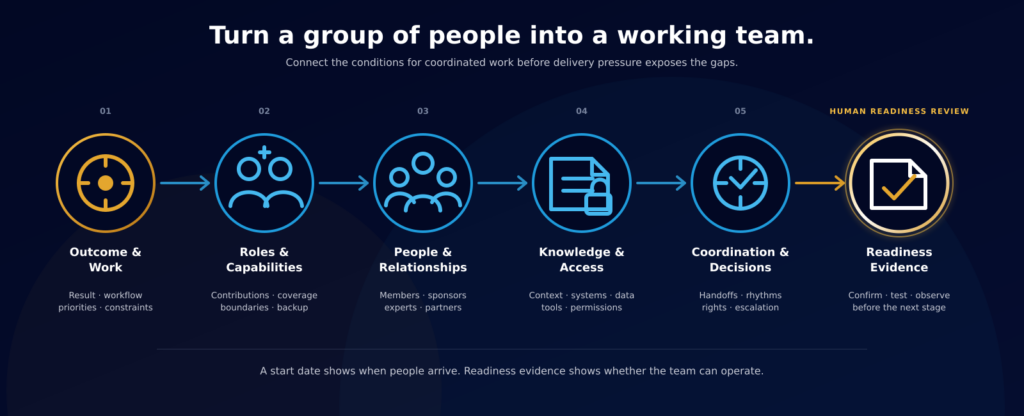
A useful mobilization process must answer:
Define the customer, stakeholder, operational, project, service, or organizational result.
Identify the activities, decisions, workflows, reviews, and handoffs required.
Clarify individual responsibilities, shared ownership, and unresolved accountability.
Identify organizational context, knowledge, systems, tools, data, access, relationships, and support.
Establish communication practices, decisions, escalation paths, response expectations, and feedback.
Define evidence that coordinated contribution can begin safely, responsibly, and effectively.
A collection of onboarded individuals is not necessarily a mobilized team.
Outcome gaps
Contributors understand assignments but not the larger result or organizational consequence.
Responsibility gaps
Multiple people assume someone else owns an activity, decision, review, relationship, or handoff.
Capability gaps
An important skill, experience, credential, perspective, or form of judgment remains unavailable.
Knowledge gaps
Critical context sits in someone’s memory, an outdated document, another department, or a partner.
Access gaps
People cannot reach required systems, information, equipment, locations, permissions, or decision-makers.
Relationship gaps
Communication, expectations, escalation paths, and working agreements remain implicit.
Individual onboarding
May emphasize documentation, orientation, policy, equipment, accounts, training, introductions, and individual tasks.
Team mobilization
Examines shared outcomes, connected work, responsibility, capability coverage, knowledge, access, decisions, and handoffs.
Different contributors need different onboarding
Employees, internal movers, contractors, partners, vendors, and specialists may require different access and conditions.
Connect the two
Individual onboarding should provide each person’s foundation while mobilization establishes the shared system of work.
Move from selected to ready.
Connect every contributor to the work, responsibilities, relationships, knowledge, systems, and support required for the team to perform.
THE MATCHING WORKSHOP MODULE
Team Formation, Onboarding & Mobilization
This module helps participants turn workforce decisions into coordinated operating capacity.
The workshop connects the required outcome to the team’s work, contributors, responsibilities, capabilities, knowledge, systems, relationships, and readiness conditions.
It can support a new employee, internal move, project team, contingent worker, client engagement, reorganization, or another bounded mobilization need.
This module helps your team:
- Define the outcome around which people must mobilize
- Map activities, responsibilities, decisions, and handoffs
- Clarify what each contributor owns
- Identify individual and team capability gaps
- Reveal knowledge and key-person dependencies
- Define required systems, information, equipment, and access
- Establish working agreements and escalation paths
- Distinguish completion from operational readiness
- Identify barriers requiring additional support
- Develop an evidence-backed mobilization plan
What does each part of the team need next?
Not every readiness gap should be addressed through more orientation or training. The appropriate response depends on what is preventing coordinated contribution.
Clarify
Make the outcome, responsibilities, priorities, quality requirements, decisions, and handoffs visible.
Connect
Establish required relationships with peers, managers, customers, partners, specialists, or decision-makers.
Equip
Provide necessary tools, systems, information, access, facilities, equipment, or resources.
Develop
Build capability through learning, practice, guidance, mentoring, feedback, or experience.
Redesign
Change responsibilities, workflows, meetings, handoffs, roles, systems, or team composition.
Investigate
Resolve uncertainty about readiness, ownership, access, capability, conditions, or specialist questions.
These categories structure planning and human decision-making. They do not automatically determine whether a person is qualified, productive, suitable, compliant, or ready for independent work.
What should a team-readiness review examine?
The outcome
What must the team accomplish, for whom, by when, and with what consequences?
The work
Which activities, workflows, decisions, reviews, and handoffs must operate together?
The contributors
Who participates, what relationship does each person have to the work, and what do they own?
The capabilities
What demonstrated skills, knowledge, experience, credentials, relationships, or judgment are available or missing?
The dependencies
What systems, data, tools, access, people, vendors, information, and conditions does the team require?
The readiness evidence
What demonstrates that responsibilities, access, capability, and coordination are ready?
Use TalentSync to connect each contributor to the team’s work.
TalentSync is designed to help organizations see how people, responsibilities, capabilities, and evidence connect around shared work.
The process begins with the outcome and team context—not an automated judgment about whether a person will succeed.
STEP 1
Define the team outcome
Clarify the customer, stakeholder, project, operational, or organizational result.
STEP 2
Map the work
Identify activities, workflows, responsibilities, decisions, reviews, and handoffs.
STEP 3
Connect contributors
Show which employees, managers, contractors, partners, specialists, or others connect to the work.
STEP 4
Examine capability coverage
Understand active, latent, emerging, and missing capabilities across the team.
STEP 5
Reveal readiness conditions
Identify knowledge, access, systems, tools, relationships, development needs, and barriers.
STEP 6
Support human coordination
Give authorized people a shared view for discussion, follow-up, support, and decisions.
TalentSync can help make the team’s operating context visible. Managers, employees, external contributors, HR, project leaders, and authorized participants remain responsible for interpretation, communication, support, and final decisions.
- See active capabilities demonstrated in current work
- Reveal latent capabilities from previous experience
- Recognize emerging capabilities being learned or practiced
- Connect talent gaps to a defined organizational need
- Identify missing or incomplete evidence
- Surface dependencies that may affect movement
TEAM PERFORMANCE PROFILES
Make team contribution visible without reducing people to a score.
A Team Performance Profile can organize a bounded team outcome, relevant work, contributor responsibilities, capability requirements, evidence, accomplishments, relationships, dependencies, gaps, and support needs.
The purpose is not to rank contributors or predict performance. A structured profile creates a shared foundation for understanding how the work fits together and what the team still needs.
PRODUCT AND DECISION BOUNDARIES
Talent intelligence supports team coordination. It does not replace management.
TalentSync, TalentPass, Pythia, Team Performance Profiles, and workshop outputs should not be presented as:
- Automatically assigning people to work
- Determining whether someone is fully productive
- Predicting individual or team success
- Producing a definitive personality or culture match
- Monitoring employees without appropriate transparency
- Making legal, employment, labor, accessibility, privacy, cybersecurity, or compliance determinations
- Replacing manager, employee, HR, project-leader, or specialist judgment
- Providing the sole basis for a consequential employment decision
The workflow helps clarify work, responsibilities, capabilities, evidence, relationships, dependencies, and support needs. Human participants remain responsible for interpretation, communication, decisions, and appropriate data use.
What to bring into the conversation
You do not need a perfect onboarding program, complete team architecture, or detailed capability inventory.
We begin with the workforce decision, team information, and operating artifacts the organization already has.
Useful inputs may include:
- The workforce outcome or project commitment
- Role descriptions and opportunity profiles
- Team charts or contributor lists
- Project plans and workflow documentation
- Responsibility or decision matrices
- Existing onboarding checklists
- Training and orientation materials
- Systems and access requirements
- Process and customer documentation
- Capability or skills information
- Available performance and readiness evidence
- Known handoff, communication, or knowledge-transfer problems
The Workforce Direction module establishes the consequential outcome and bounded mobilization decision this module should support.
What this module can help clarify
What the team must accomplish
Establish a shared view of the outcome, work, timeframe, stakeholders, and quality expectations.
How responsibilities connect
Reveal individual ownership, shared responsibilities, decisions, workflows, reviews, and handoffs.
What prevents contribution
Identify capability, knowledge, access, relationship, system, support, and operating-condition gaps.
What the team needs next
Organize practical responses to clarify, connect, equip, develop, redesign, or investigate.
Final outputs depend on the modules selected and the workforce decision established through the required Workforce Direction foundation.
Where might the work lead next?
Team mobilization frequently reveals connected problems in role design, capability visibility, knowledge transfer, workforce development, contingent work, and sustainable workload.
Skills-Based Role Design
Clarify outcomes, activities, responsibilities, capabilities, prerequisites, and operating context.
Workforce Capability Visibility
Understand which capabilities are active, latent, emerging, missing, concentrated, or difficult to access.
Critical Knowledge & Role Coverage
Reveal knowledge dependencies and prepare for loss, transfer, or concentration of critical work.
Workforce Growth & Reskilling
Develop capabilities the team needs but cannot immediately access with sufficient readiness.
Contingent Workforce Strategy
Connect external contributors while clarifying ownership, access, dependencies, and specialist questions.
Workload, Retention & Sustainable Scale
Determine whether the team can sustain the work without overload, hidden effort, or damaging dependency.
Frequently asked questions
Questions leaders ask before booking.
Employee onboarding helps a new or transitioning employee understand the organization, role, work, relationships, systems, expectations, and support required to contribute.
Team mobilization turns a selected group of contributors into coordinated operating capacity around a defined outcome.
Onboarding often focuses on an individual; mobilization examines how employees, managers, contractors, partners, and specialists operate together.
It describes how long contribution takes, but delays may come from unclear work, missing access, unavailable knowledge, weak management, or team dependencies.
Begin with the work and clarify outcomes, activities, responsibilities, decisions, relationships, systems, knowledge, access, feedback, and readiness evidence.
Use a consistent foundation for recurring requirements while adapting work-specific elements to the role, team, location, relationship, and context.
Provide enough context, access, relationships, and clarity for the agreed work while applying appropriate boundaries and specialist review.
Look for shared outcome understanding, clear responsibility, capability coverage, functioning access, available knowledge, established handoffs, and resolved barriers.
TalentSync can organize work and evidence but should not be presented as a definitive productivity measure or prediction of future performance.
No. It supports visibility and human review; it does not decide who belongs on a team or replace employee participation and judgment.
MOVE FROM SELECTED TO READY
Turn new people into coordinated, productive capacity.
Connect every contributor to the work, responsibilities, relationships, knowledge, systems, and support required for the team to perform.
This module is part of Gobekli’s configurable Workforce Scalability Workshop.