
WORKFORCE SCALABILITY WORKSHOP
Scale the work
not just the headcount.
A new contract, investment, acquisition, location, product, or surge in demand can create an urgent need for workforce capacity.
But hiring more people is not always the first—or only—answer.
This configurable workshop connects changing demand to the work, capabilities, roles, talent sources, and operating conditions your organization needs to scale successfully.
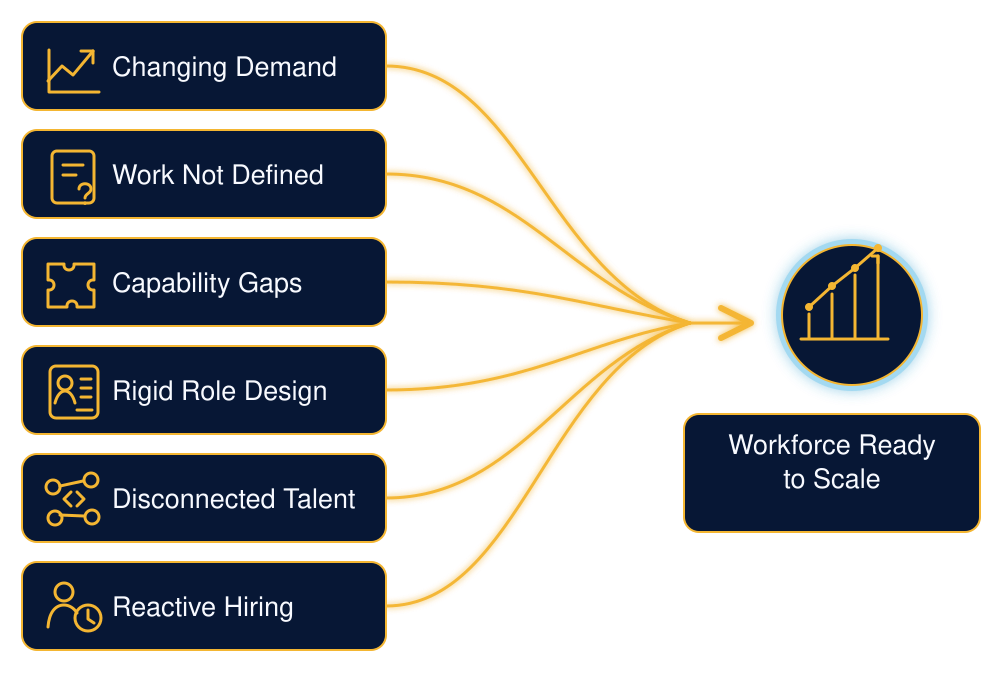
Workforce scaling problems
rarely begin with recruiting alone.
Demand grows before workforce requirements are clear
Existing capability is difficult to see
Internal talent cannot reach the work that needs it
Critical knowledge remains concentrated in a few people
Job descriptions no longer reflect the actual work
External talent pipelines begin too late
New hires increase headcount before they increase capacity
Growth overloads the managers and employees supporting it
The challenge is connecting changing demand to the right workforce response.
Organizations often begin with a visible symptom:
We need more people.
But that conclusion may conceal several different problems.
The organization may need more capacity, different capabilities, redesigned work, stronger role coverage, internal mobility, faster development, a new external talent source, contingent support, or better workforce mobilization.
Before choosing a response, leaders need to understand:
- What demand is changing
- What outcome the organization must deliver
- What work will increase, decrease, or change
- Which capabilities the work requires
- What relevant capability already exists
- Where knowledge or role coverage is fragile
- What can be developed internally
- What must be sourced externally
- What operating conditions are required for success
- What evidence should guide the decision
Workforce scalability means being able to increase, reduce, redeploy, or reconfigure workforce capacity and capability as work changes—without avoidable delays, capability gaps, burnout, excessive hiring, or operational fragility.
Start with the workforce decision—not a predetermined solution.
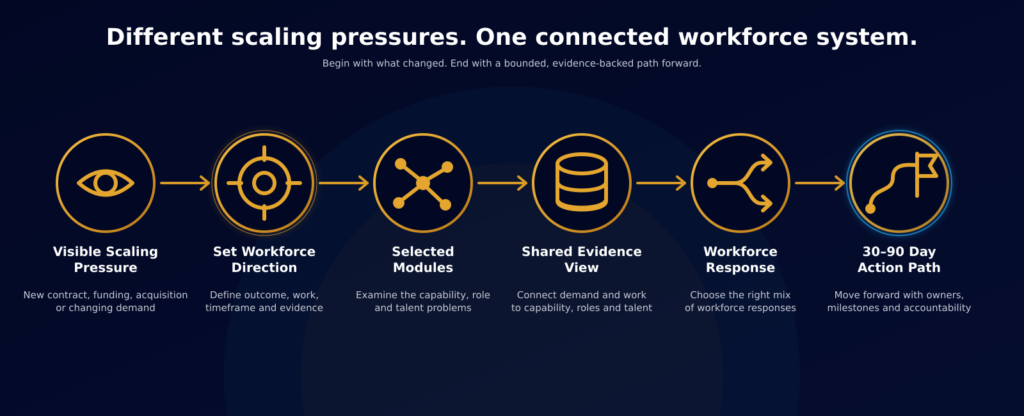
The Workforce Scalability Workshop is configured around a bounded organizational need. Every engagement begins with the required Workforce Direction foundation. Your organization then selects the problem modules that match the conditions surrounding that decision.
Required
1. Set the Workforce Direction
Establish the outcome, changing demand, affected work, timeframe, available evidence, and workforce question the engagement must address.
Choose 2-3
2. Select the Problem Modules
Examine the capability, role, talent supply, hiring, mobilization, or sustainability problems most relevant to the decision
Outcome
Build a 30–90 Day Workforce Action Path
Leave with an evidence-backed response portfolio, clear owners, unresolved questions, and bounded next steps.
A typical engagement combines the required foundation with two or three problem modules. Additional evidence review, stakeholder interviews, or specialist participation can be added when the decision requires it.
Workforce scalability is organizational design
not simply workforce growth.
Explore the 12 Workforce Scalability Workshop Modules
The modules connect demand, work, capability, talent supply, hiring, and sustainable execution. Organizations do not need to complete all 12. The workshop is configured around the workforce decision that matters now.
UNDERSTAND DEMAND, WORK & CAPABILITY
Set the Workforce Direction
Define the outcome, demand, work, timeframe, evidence, and bounded workforce question before choosing a response.
(Required foundation)
Workforce Demand & Capacity Planning
Determine how much capacity is needed, for what work, in which locations, and by when.
Workforce Capability Visibility
Reveal the active, latent, emerging, and missing capabilities relevant to the organization’s changing work.
Critical Knowledge & Role Coverage
Identify key-person dependencies, fragile role coverage, concentrated knowledge, and continuity risks that could limit scale.
DESIGN ROLES & BUILD TALENT SUPPLY
Work & Role Design
Translate changing work into clear outcomes, responsibilities, capabilities, evidence requirements, and operating conditions.
Internal Talent Sourcing & Mobility
Find relevant talent inside the organization and determine what would be required for people to move, contribute, or take on new work.
Workforce Growth & Reskilling
Identify which capabilities can be developed internally and connect learning to practice, evidence, and readiness.
External Talent Pipeline Development
Build sustainable sources of future talent through communities, schools, associations, apprenticeships, partners, and targeted outreach.
EXPAND, ACTIVATE & SUSTAIN CAPACITY
Hiring Readiness & Candidate Evidence
Clarify prerequisites, evidence criteria, application requirements, recruiter workflows, and the conditions needed to convert candidates into successful hires.
Flexible & Contingent Workforce Strategy
Determine when the work calls for employees, contractors, vendors, partners, temporary capacity, or another workforce relationship.
Team Formation, Onboarding & Mobilization
Turn individuals into a functioning workforce by aligning responsibilities, knowledge, relationships, onboarding, and team conditions.
Workload, Retention & Sustainable Scale
Evaluate whether expanded capacity can be maintained without creating burnout, manager overload, declining quality, or avoidable attrition.
Hiring is one workforce response
not the entire strategy.
Redeploy
Move existing capability toward new or higher-priority work.
Develop
Build missing capability through learning, practice, coaching, or expanded responsibility.
Hire
Clear takeaways from your Bring new capability or capacity into the organization through employment. modules
Contract
Add specialized, temporary, project-based, or variable capacity.
Partner
Access capability through schools, associations, workforce organizations, vendors, or strategic partners.
Redesign
Change responsibilities, roles, handoffs, teams, or workflows.
Automate
Use appropriate technology to change the amount or nature of human work required.
Investigate Further
Gather missing evidence or seek qualified specialist review before making a consequential workforce decision.
These categories organize the available options and tradeoffs. They are not automatic recommendations, and they do not replace the judgment of organizational leaders or qualified HR, legal, labor, compliance, or other specialists.
How Your Workshop Is Configured:
-
1
Free Discovery Call We explore what changed, the workforce pressure you are experiencing, the decision you need to make, and the outcome you need to protect. -
2
Configure Your Workshop We establish the required Workforce Direction foundation and recommend the two or three modules that belong together. -
3
Collaborative Workshop Leaders, managers, workforce specialists, and people close to the work connect their evidence, experience, assumptions, and constraints. -
4
Workforce Action Path You leave with a bounded portfolio of responses, clear owners, unanswered questions, and a 30–90 day path forward.

Leave with more than a conversation.
Workforce Direction Brief
A shared definition of the outcome, demand, work, evidence, constraints, and workforce decision.
Actual Work and Demand View
A grounded view of how work happens today and what is expected to change.
Evidence Register
Known facts, stakeholder observations, assumptions, contradictions, and missing evidence.
Selected Module Findings
Clear findings from the problem modules included in the engagement.
Capability and Dependency Map
A view of relevant capabilities, critical knowledge, role coverage, and workforce dependencies.
Workforce Response Portfolio
An organized set of redeploy, develop, hire, contract, partner, redesign, automate, or investigate options.
30–90 Day Workforce Action Path
A bounded implementation path with priorities, owners, milestones, and specialist questions.
Final outputs depend on the selected modules, available evidence, participants, and the decision established through the required Workforce Direction foundation.

Workforce scalability is human-centered organizational design.
We help leaders design transformations that respect how people work, build trust, and unlock the full potential of AI, together.
Human-Centered
Examine how people actually work, contribute, learn, coordinate, and experience workforce change.
Evidence-based
Separate known facts from assumptions and connect workforce responses to organizational outcomes.
Work-Connected
Begin with the work and capabilities the organization needs rather than relying only on positions or headcount.
Sustainable
Consider workload, management capacity, knowledge, quality, retention, and the organization’s ability to maintain performance.
When The workshop reveals something worth maintaining
Turn a one-time workforce decision into ongoing organizational visibility.
Optional path for organizations that want to maintain the profiles, evidence, relationships, and workforce signals revealed through the workshop.
Workshop Findings
Identify a workforce decision, capability, dependency, role, pipeline, or operating condition worth tracking over time.
Gobekli Setup
Configure relevant TalentSync profiles, Talent Trees, Opportunity Profiles, TalentPass connections, team views, or Passport Pages around the validated need.
Ongoing Visibility
Revisit capability, gaps, roles, workforce signals, and decisions as people, demand, and organizational conditions change.
Gobekli software is optional. The workshop is designed to produce a useful workforce action path whether or not the organization chooses to implement TalentSync or TalentPass.
Questions leaders ask before booking.
Workforce scalability is an organization’s ability to increase, reduce, redeploy, or reconfigure workforce capacity and capability as work changes.
It includes more than hiring. Depending on the need, an organization may redeploy existing talent, develop new capability, redesign roles, use contractors or partners, change workflows, automate appropriate work, or hire externally.
A workforce is scalable when the organization can make these changes without avoidable delays, critical capability gaps, unsustainable workloads, excessive hiring, or operational fragility.
The workshop is designed for organizations facing a consequential change in workforce demand.
That may include a company that has won a major contract, received new funding, completed an acquisition, launched a business line, opened a location, entered a new market, adopted new technology, experienced sustained growth, or encountered a structural talent shortage.
Participants may include executive leaders, functional leaders, operations, HR, talent acquisition, workforce development, finance, technology, program leaders, managers, and people close to the affected work.
No. The purpose of the workshop is to determine what workforce response the organization actually needs.
The appropriate response may involve internal mobility, development, role redesign, flexible capacity, partnerships, workflow changes, automation, hiring, or a combination of these actions.
You do not need to choose them alone.
During the initial consultation, we examine the triggering event, desired outcome, affected work, available evidence, and workforce decision. We then recommend the required foundation and the two or three modules that belong together.
No. Set the Workforce Direction is the required foundation. The remaining modules are selected according to the problems surrounding the decision.
A focused engagement will typically combine the foundation with two or three problem modules.
Yes. Workforce scalability problems are usually connected.
For example, a new contract may create simultaneous questions about capacity, critical role coverage, internal talent, role design, external pipelines, onboarding, and workload. The configuration process identifies which questions must be examined together and which can be addressed later.
Set the Workforce Direction is the required foundation for every engagement.
It establishes what has changed, the outcome the organization must deliver, the work affected, the timeframe, available evidence, relevant constraints, and the bounded workforce decision the workshop must support.
It prevents the engagement from beginning with an unsupported assumption that the organization simply needs to hire more people.
You do not need a perfect workforce plan or complete capability inventory.
Useful inputs may include:
- Growth plans, contracts, funding plans, acquisition priorities, or operating targets
- Organization charts and known role descriptions
- Workforce, hiring, workload, turnover, or capacity information
- Existing capability, skills, learning, or credential data
- Current job descriptions and recruiting materials
- Onboarding or mobilization plans
- Known critical-person dependencies
- Employee, manager, customer, or stakeholder observations
- Relevant operating, budget, timing, location, or compliance constraints
We use the evidence your organization already has and distinguish known facts from assumptions and missing information.
Yes. These are common workforce-scaling triggers.
The workshop does not assume that every trigger creates the same workforce need. It helps translate the specific commitment or growth event into work, capacity, capability, role, sourcing, and mobilization requirements.
A job description documents a position. Role design examines what the organization needs the work to accomplish and how that contribution should fit into the surrounding system.
The module considers outcomes, responsibilities, capabilities, decision rights, collaboration, knowledge, prerequisites, evidence, team conditions, and possible alternatives to creating a conventional role. Its findings may then be used to create a stronger job description or TalentSync Opportunity Profile.
The workshop can examine the organizational and team context surrounding successful contribution, including decision practices, communication, leadership conditions, values, stakeholder expectations, and ways of working.
It does not calculate a definitive cultural match or treat culture as a substitute for transparent job-related requirements and human judgment.
No. The workshop organizes organizational evidence, assumptions, dependencies, tradeoffs, and response options.
It does not determine worker classification, make legal employment decisions, conduct regulated psychological assessments, replace compensation analysis, decide whether someone should be hired or terminated, or determine labor, union, immigration, licensing, procurement, or regulatory compliance.
Issues requiring specialist judgment should be referred to qualified HR, legal, labor, compliance, compensation, procurement, occupational, or other appropriate professionals.
No. The workshop is designed to produce useful findings and a bounded workforce action path independently of any software purchase.
When an organization identifies profiles, capability views, recruiting workflows, team conditions, or workforce signals worth maintaining, Gobekli may be considered as an optional next step.
Your organization receives its agreed workshop outputs and 30–90 day action path.
You may implement the findings independently, engage relevant specialists, conduct additional investigation, return for another focused module, or explore a Gobekli setup when ongoing visibility and coordination would be useful.
Find the right starting point for scaling your workforce.
Tell us what changed—a new contract, funding round, acquisition, location, customer, product, technology, workforce shortage, or surge in demand.
In a free exploratory conversation, we will help identify the outcome that needs to be protected, the workforce decision that needs to be made, and the workshop modules that belong together.
No fixed package. No generic workforce assessment. No obligation to purchase Gobekli software.
