
WORKFORCE SCALABILITY PROBLEM
Workforce Capability Visibility: See the Talent Beyond Job Titles
Organizations often know who they employ, which roles people hold, and where they sit in the organizational chart.
They have much less visibility into what people can actually do, which capabilities are being used, what employees have developed elsewhere, what is beginning to emerge, and what the workforce may genuinely be missing.
Workforce capability visibility connects changing work to credible evidence about the people who may be able to perform it.
Workshop Module 3 — Workforce Capability Visibility
Does this sound familiar?
Job titles hide relevant capability
Employee records show assigned roles but not the full range of activities, experience, knowledge, relationships, and capabilities people possess.
Skills data is scattered across systems
Potential evidence sits across HR systems, learning platforms, project tools, résumés, credentials, performance records, and individual memory.
Leaders cannot see transferable talent
People may have capabilities developed in previous roles, projects, education, community work, military service, or independent activity.
Skills inventories become outdated
Static surveys and self-reported lists lose relevance as work, technology, teams, and individual experience change.
Capability gaps are assumed
The organization may begin hiring externally before determining whether the required capability already exists, could be developed, or can be redeployed.
Evidence and confidence are unclear
A capability may appear in a profile without showing where it came from, how recently it was used, or whether enough evidence supports a decision.
What is workforce capability visibility?
Workforce capability visibility is the organization’s ability to understand which capabilities are available, active, latent, emerging, missing, concentrated, or difficult to deploy in relation to the work it needs performed.
Capability can include technical and occupational skills; human capabilities; knowledge and expertise; credentials and licenses; activities performed; responsibilities carried; problems solved; organizational knowledge; leadership experience; interests; motivations; and practical conditions affecting deployment.
The purpose is not to reduce every person to a list of skills. It is to create a more complete and evidence-aware view of the workforce so people and organizations can make better decisions about work, development, mobility, hiring, succession, and change.
Visibility does not mean certainty. A responsible workforce view distinguishes confirmed information from self-reported evidence, organizational inference, outdated records, and areas that still need investigation.
The problem is not that the organization has no talent data. It is that the data does not form a usable picture.
Most organizations already possess fragments of workforce information. An HR system may contain job titles and employment history. A learning platform may record course completion. A project platform may show assignments. Managers may know who solved a difficult problem. Employees may carry relevant experience that has never entered an organizational system.
Each source reveals something. None necessarily shows the whole person or the complete workforce.
To create decision-useful visibility, organizations need to connect the work, activities, capability requirements, current contributors, prior experience, skills and credentials, organizational knowledge, interests, availability, evidence confidence, and anticipated demand.
Without those connections, leaders may mistake incomplete information for an actual capability shortage—or overlook concentrated expertise, hidden internal candidates, emerging talent, and critical work that depends on only one person.
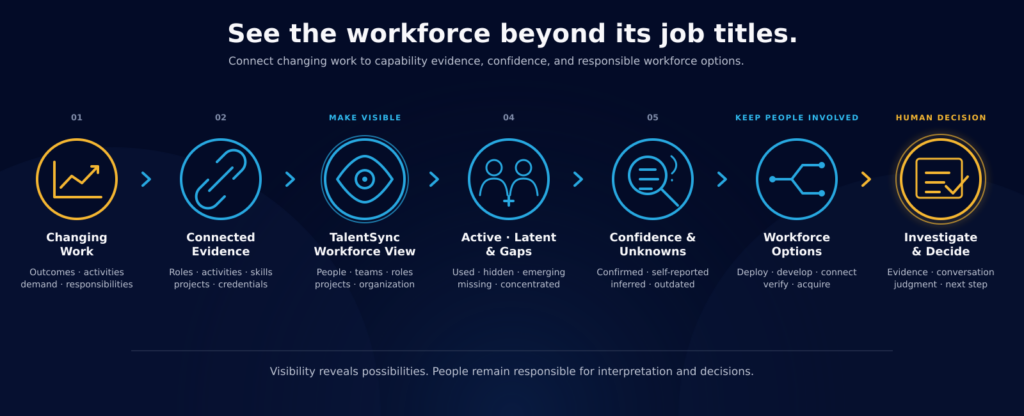
See the workforce beyond its job titles.
Changing Work
- Organizational commitments
- Critical workflows
- New technology
- Shifting responsibilities
- Future capability demand
Connected Evidence
- Roles and activities
- Projects and accomplishments
- Skills and their origins
- Credentials and licenses
- Learning and development
Capability View
- Active capability
- Latent capability
- Emerging capability
- Missing capability
- Uncertain capability
Confidence & Conditions
- Evidence strength
- Recency of use
- Availability
- Location and schedule
- Interest and permission
Workforce Decisions
- Deploy
- Develop
- Connect
- Verify
- Acquire
- Investigate
Capability becomes useful when it can be connected to real work, credible evidence, operating conditions, and a workforce decision—not merely attached to a person as an isolated keyword.
How workforce capability becomes invisible
STAGE 1
People are organized around roles
The organization records where people sit and what their positions are called, but not the full range of work they perform.
STAGE 2
Evidence fragments across systems
Projects, learning, credentials, accomplishments, relationships, and prior experience are captured in different places—or not captured at all.
STAGE 3
Work changes faster than records
Employees develop new capabilities, take on informal responsibilities, and adapt workflows without corresponding updates to formal workforce data.
STAGE 4
Assumptions become workforce decisions
Leaders hire, restructure, outsource, automate, or launch development programs without knowing which capabilities already exist or where evidence remains incomplete.
Why a traditional skills inventory is not enough
A skills inventory can provide a useful starting point. It may identify commonly reported skills and create a more structured workforce vocabulary.
But a list of skills cannot answer every question a workforce decision requires. A more useful capability review must connect each capability to its origin, use, evidence, recency, deployment conditions, and the work requiring it.
Without these relationships, a skills inventory may produce a large amount of information without improving the organization’s ability to act.
Not every capability occupies the same place in the workforce.
Active capability
Capabilities currently being used in visible work, assignments, responsibilities, projects, or workflows.
Latent capability
Relevant capabilities people possess but are not currently using—or that the organization cannot see through their assigned roles.
Emerging capability
Capabilities people are developing through new work, practice, education, mentorship, credentials, or experimentation.
Missing capability
Capabilities required by the work that are not available in sufficient strength, depth, location, timing, or quantity.
Concentrated capability
Important capability held by too few people, creating succession, continuity, workload, or dependency concerns.
Undocumented capability
Capability that may exist but lacks enough evidence, context, recency, or confirmation to support a responsible decision.
Visible talent
A visibility-centered view may identify skills in profiles, completed learning, credentials, previous roles, project participation, manager observations, employee-reported experience, and possible capability relationships.
Usable talent
A deployment-centered view also examines connection to the work, evidence, proficiency, recency, employee interest, time, workload, location, access, support, and the consequences of reassignment.
Knowing a capability exists does not mean it can be used.
Visibility reveals possibilities. It does not automatically establish readiness, availability, or the right workforce response.
Keep people in the decision
Capability visibility should expand the organization’s options without turning incomplete data into an automatic decision about a person.
Turn fragmented workforce data into a capability view you can use.
Connect changing work to active, latent, emerging, and missing capability—then decide what to deploy, develop, verify, acquire, or investigate.
THE MATCHING WORKSHOP MODULE
Module 3: Workforce Capability Visibility
This module helps participants reveal the active, latent, emerging, missing, concentrated, and insufficiently documented capabilities relevant to changing work.
The workshop connects workforce demand to the evidence the organization already has, identifies what remains hidden or uncertain, and clarifies where deeper employee, manager, technical, or specialist investigation is needed.
This module helps your team:
- Connect changing work to required capabilities
- Examine what current systems can and cannot reveal
- Identify active, latent, emerging, and missing capability
- Locate evidence across roles, projects, learning, and credentials
- Reveal capability concentrated in too few people
- Distinguish verified information from inference and unknowns
- Examine availability and deployment constraints
- Identify development and internal mobility opportunities
- Clarify where external talent may still be required
- Develop an evidence-backed capability response
What should happen next for each capability need?
The organization should consider the work, available evidence, current demand, employee circumstances, development requirements, and consequences of delay—not simply the presence or absence of a skill in a record.
Deploy
Connect available capability to the work
Develop
Strengthen capability internally
Connect
Reveal capability across boundaries
Verify
Strengthen the evidence
Acquire
Add capability externally
Investigate
Resolve uncertainty first
These categories organize evidence and workforce options. They do not automatically assign employees, determine readiness, select candidates, or replace human judgment.
What should a workforce capability review examine?
The work
What outcome, activity, workflow, responsibility, project, or decision makes the capability relevant?
The person’s experience
Where and how has the individual developed or used the capability?
The evidence
Is the information confirmed, demonstrated, credentialed, self-reported, inferred, outdated, or incomplete?
The conditions
Is the capability available in the required location, timeframe, workload, team, system, or operating environment?
The concentration
How many people hold the capability, where are they located, and what happens if one becomes unavailable?
The decision
Should the organization deploy, develop, connect, verify, acquire, or investigate?
Use TalentSync to connect capability evidence across the workforce.
TalentSync is designed to help organizations understand talent as more than a collection of job titles, résumés, and disconnected skills. The process begins with changing work and a bounded workforce question—not an automated judgment about a person.
STEP 1
Connect the changing work
Clarify the outcomes, activities, workflows, responsibilities, and capability demand the organization must support.
STEP 2
Bring evidence together
Connect roles, activities, projects, accomplishments, learning, skills, credentials, and relevant employee context.
STEP 3
Reveal active and latent talent
See capability currently used in work alongside relevant capability that roles and organizational systems may not show.
STEP 4
Identify talent gaps
Reveal capability that appears missing, insufficient, concentrated, unavailable, or unsupported by enough evidence.
STEP 5
Show confidence and unknowns
Distinguish confirmed information, self-reporting, inference, outdated evidence, and areas requiring further investigation.
STEP 6
Support a workforce response
Organize evidence to consider deployment, development, mobility, verification, external acquisition, or deeper review.
TalentSync helps organize workforce evidence and reveal relevant relationships. Leaders, managers, employees, and qualified specialists remain responsible for interpretation, conversation, verification, and workforce decisions.
- Changing work
- Roles and activities
- Projects and accomplishments
- Skills and their origins
- Credentials and learning
- Active and latent talent
- Confidence and unknowns
- Workforce response options
WHY TALENTPASS MATTERS
Let people contribute more than their current job title reveals.
TalentPass is designed to help an individual develop a reusable view of their own experience and talent evidence. With the individual’s participation, that profile may include employment and role history, activities, skills and their origins, credentials, accomplishment stories, interests, motivations, and evidence not held by the current employer.
The individual controls their TalentPass information and chooses when it is shared. When appropriate information is shared with TalentSync, the organization may gain a more complete view of capability while preserving the individual’s role in the exchange.
PRODUCT AND DECISION BOUNDARIES
Capability visibility supports workforce judgment. It does not replace it.
TalentSync and TalentPass should not be presented as definitively measuring everything a person can do, predicting performance or potential, automatically assigning people to work, determining employment actions, producing a definitive cultural match, eliminating bias, replacing employee or manager conversation, making legal determinations, or providing the sole basis for an employment decision.
The workflow helps people connect work, experience, evidence, skills, credentials, and organizational demand. Employment, privacy, accessibility, cybersecurity, labor, data governance, and other questions may require review by qualified specialists. TalentPass is not designed for use by minors.
What to bring into the conversation
You do not need a complete enterprise skills taxonomy or a perfect inventory of every employee capability.
We begin with the work, workforce information, and observations the organization already has.
Useful inputs may include:
- Workforce demand and capacity planning
- Important workflows and activities
- Current roles and job descriptions
- Organizational charts
- HRIS or employee profile information
- Skills inventories or taxonomies
- Learning and development records
- Credentials, licenses, and certifications
- Project and assignment information
- Performance and accomplishment evidence
- Succession or key-person concerns
- Internal mobility information
- Manager and employee observations
- Known capability gaps
- Roles that are consistently difficult to fill
- Data access, consent, and retention practices
Workforce Direction establishes the organizational outcome, affected work, available evidence, and bounded workforce decision this module should support.
What this module can help clarify
Which capabilities are visible
Identify capability demonstrated through work, activities, experience, learning, credentials, and organizational evidence.
What may be hidden or emerging
Reveal relevant experience, adjacent capability, development activity, and evidence that current roles or systems do not show.
Where gaps and dependencies exist
Identify capability that appears missing, insufficient, concentrated, unavailable, or difficult to deploy.
What the organization should do next
Organize evidence into options to deploy, develop, connect, verify, acquire, or investigate.
Final outputs depend on the modules selected and the workforce decision established through the required Workforce Direction foundation.
Where might the work lead next?
Workforce capability visibility frequently reveals connected problems in internal mobility, development, knowledge continuity, hiring, demand planning, and role design.
Internal Talent Sourcing & Mobility
Connect visible and latent internal capability to real opportunities, projects, roles, and development pathways.
Workforce Growth & Reskilling
Determine which capabilities can be developed internally and connect learning to changing work.
Critical Knowledge & Role Coverage
Reveal where critical work, relationships, and organizational knowledge depend on too few people.
Skills-Based Hiring & Candidate Evidence
Translate a confirmed external capability need into a structured opportunity and evidence-based hiring process.
Workforce Demand & Capacity Planning
Connect organizational demand to required work, capability, usable capacity, and timing.
Skills-Based Role Design
Define outcomes, activities, capabilities, responsibilities, and prerequisites around changing work.
Frequently asked questions
Questions leaders ask before booking.
SEE THE WORKFORCE MORE CLEARLY
Turn fragmented workforce data into a capability view you can use.
Connect changing work to active, latent, emerging, and missing capability—then decide what to deploy, develop, verify, acquire, or investigate.
This module is part of Gobekli’s configurable Workforce Scalability Workshop. Explore the complete 12-module structure and identify the right starting point for your organization.
