
MEMBERSHIP VALUE WORKSHOP MODULE
Collective Voice, Advocacy & Public Value
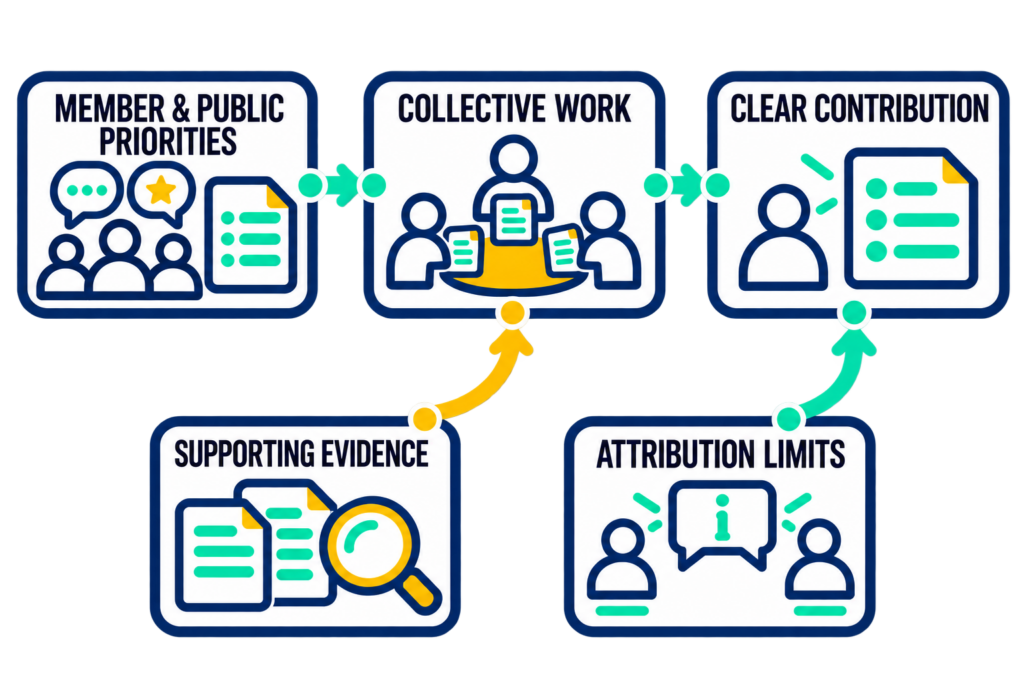
Collective work needs a clear account of whom it serves and what it contributes. Connect an initiative to member and public priorities, examine the evidence, and explain its value within appropriate limits.
Does this sound familiar?
Activity reports leave the benefit unclear
The organization lists meetings, submissions, campaigns, or partnerships without explaining what those activities were intended to improve.
A shared priority is assumed
An initiative is described as representing members without enough clarity about whose perspectives informed it or where views differ.
Member benefit and public benefit are blended together
The organization describes a collective initiative as serving everyone without examining who may benefit, face trade-offs, or experience a different result.
The organization’s contribution is difficult to distinguish
An initiative involves partners and outside decision-makers, but the available account does not explain the organization’s particular role.
Progress is recognized only at the final outcome
Useful research, coordination, access, or changes in understanding are overlooked while the organization waits for a broader result.
Success claims extend beyond the evidence
A policy change, public response, or sector development is attributed to the organization without enough information about other contributors and conditions.
What are collective voice, advocacy, and public value?
Collective voice concerns how an organization brings member perspectives and shared priorities into a wider conversation or coordinated effort.
Advocacy and collective initiatives may involve research, representation, public education, collaboration, or efforts to improve conditions affecting a profession, industry, or community.
Member value concerns how that work serves the people or organizations membership is intended to support.
Public value concerns the benefit an initiative is intended to provide beyond the membership itself, including the perspectives of people affected by the work.
This module examines one selected initiative and the relationship among its priorities, intended benefits, organizational contribution, available evidence, and limits on attribution.
A collective initiative needs an understandable reason for acting.
An association may describe advocacy as one of its most important membership benefits.
A member may still ask what the organization is working toward and why that priority matters.
Someone outside the membership may ask how the same initiative affects their community, work, or access to services.
The value account needs to address those questions with enough specificity to be useful.
Whose priority is being addressed? What change is intended? What part can the organization contribute? What evidence would help assess that contribution?
A useful review connects those relationships and makes differences, uncertainties, and trade-offs visible.
See the relationships behind collective value.
Priorities and Perspectives
Member concerns
Public or community needs
Sources of input
Differences in perspective
Questions requiring validation
Intended Benefits
Conditions to improve
People expected to benefit
Relevant time horizon
Possible trade-offs
Limits of the intended change
Organizational Contribution
Research or evidence
Representation and dialogue
Coordination and partnerships
Resources or practical support
Responsibilities within scope
Progress and Wider Change
Work completed
Information considered
Participation or coordination enabled
Decisions or practices changed
Longer-term results still uncertain
Evidence and Accountability
Source context
Feedback from affected groups
Partner contributions
External conditions
Ownership of review and explanation
A credible account connects the initiative to the priorities it serves and distinguishes the organization’s work from the wider change it hopes to support.
How collective value becomes difficult to explain
STAGE 1 — A broad priority becomes a commitment
The organization promises to strengthen a profession, influence an issue, or serve the public without making the intended benefit specific enough to review.
STAGE 2 — Activity becomes the main account
Meetings, publications, campaigns, and partnerships are reported more consistently than their connection to the priority.
STAGE 3 — A wider result becomes the success story
A decision or development is used to explain the initiative’s value without enough context about contributions and other influences.
STAGE 4 — The next investment is difficult to assess
The organization struggles to explain what it contributed, whose needs were served, and what should continue or change.
A completed activity is one part of the contribution account.
An initiative report can answer an important question:
What did the organization do?
A collective-value review also asks why that work mattered, how it related to the intended benefit, and what evidence is available about its contribution.
Questions that make the value clearer
Identify the member and public perspectives in scope, the sources informing the priority, and whose views remain uncertain or missing.
Describe the condition the initiative seeks to improve, for whom, and over what relevant period. Make potential differences in benefit visible.
Identify the research, representation, coordination, resources, or support it provides, alongside the roles of partners and outside decision-makers.
Distinguish completed work, information considered, coordination enabled, decisions made, and later results. Avoid treating each step as proof of the next.
Connect the account to sources, feedback, and relevant observations while considering other contributors and external conditions.
Identify a focused response, responsible owner, and proportionate way to review the initiative’s relevance or contribution.
A useful collective-value review needs six forms of clarity.
Priority
The initiative relates to an identifiable concern supported by appropriate input.
Benefit
The intended improvement and the people it is meant to serve are understandable.
Contribution
The organization can explain its role within the wider effort.
Evidence
The account is supported by sources appropriate to the question being asked.
Perspective
Differences, affected groups, and possible trade-offs remain visible.
Boundary
Claims distinguish organizational contribution from outcomes influenced by other parties and conditions.
Collective value people can understand
A useful account explains:
- Which priority the initiative addresses.
- Whose perspectives informed the work.
- What benefit is intended and for whom.
- What the organization contributes.
- What progress or results the evidence supports.
- What remains uncertain or outside its control.
Members and other audiences can understand why the work matters and what the organization is accountable for.
Collective value described through broad claims
The value becomes difficult to assess when it relies on:
- General promises to represent everyone.
- Activity totals without a connection to purpose.
- Public benefit assumed from member benefit.
- Partner work absorbed into one organization’s story.
- A wider change presented as a direct organizational result.
- Unresolved differences omitted from the explanation.
The review identifies which relationships need clarification and which claims need better support.
A shared initiative can make a useful contribution before a wider problem is resolved.
A professional association works with community partners to improve understanding of a service-access problem.
The organization wants to explain the value of the initiative to members and the public.
The team selects one part of the work for review: gathering practitioner experience and combining it with input from people seeking the service.
It identifies the priority behind the work, the perspectives represented, and groups whose experiences are still missing.
The association contributes a structured summary of practitioner concerns. Community partners contribute accounts of barriers people encounter.
Available records show that the combined material was discussed by a relevant decision-making group. Feedback indicates that it helped clarify questions requiring further investigation.
The broader access problem remains unresolved.
The review distinguishes the production of the material, its documented use, and any later change in services.
The team credits the partners’ contributions, narrows an earlier claim that the initiative had “improved access,” and assigns follow-up on the unresolved questions.
The resulting account explains a specific contribution while keeping the intended public benefit and the evidence still needed in view.
Member value and public value deserve distinct attention.
An initiative may serve both members and a wider community.
Those benefits may reinforce one another, but they should be examined rather than assumed.
Members may experience one set of effects while clients, service users, workers, or other groups experience another.
The review identifies the intended benefits and considers where priorities differ or trade-offs may arise.
It also asks whose perspective is needed to assess the public-value claim.
That distinction helps the organization explain the purpose of its work and identify questions that require broader input.
Contribution can be examined without claiming sole causation.
Collective outcomes often involve several organizations, outside decision-makers, and changing conditions.
The organization may provide evidence, convene participants, communicate a concern, or help coordinate practical work.
Those contributions can be described specifically.
The review examines whether relevant sources show how the contribution was received, used, or connected to subsequent steps.
It does not treat the timing of a later outcome as proof that the organization caused it.
Where the connection remains uncertain, the team records that uncertainty and identifies an appropriate next question.
THE MATCHING WORKSHOP MODULE
Module 8: Collective Voice, Advocacy & Public Value
This practical minicourse helps membership organizations relate collective initiatives to member and public priorities, examining the organization’s contribution, available evidence, and limits on attribution.
Participants learn a repeatable review method, apply it to one selected initiative, and identify whether the priority response concerns purpose, representation, intended benefit, contribution, or the evidence supporting the value account.
The exercise also defines the initiative records, priority relationships, stakeholder perspectives, contribution evidence, and review responsibilities that a subsequent Gobekli configuration would need to support.
This module helps your team:
- Define the collective-value question within scope.
- Identify the selected initiative and intended purpose.
- Clarify the member priorities informing the work.
- Identify relevant public or community perspectives.
- Distinguish intended member and public benefits.
- Examine differences and possible trade-offs.
- Describe the organization’s specific contribution.
- Clarify partner roles and external dependencies.
- Distinguish activities, progress, and wider outcomes.
- Review evidence and limits on attribution.
- Assign a focused improvement and validation plan.
- Outline a connected collective-value configuration.
What should happen to each part of the collective-value account?
The review leads to a deliberate response based on the priority, intended benefit, organizational role, affected perspectives, and available evidence.
Clarify
Make the initiative’s purpose, intended benefit, and scope more specific.
Include
Identify perspectives needed to understand the priority or assess the benefit.
Coordinate
Clarify responsibilities and contributions across the organization and its partners.
Substantiate
Connect the account to appropriate evidence of work, use, progress, or results.
Adapt
Revise the initiative or its explanation when priorities, conditions, or evidence change.
Reconsider
Review whether the work remains relevant and whether the proposed commitment is supported.
These responses inform the organization’s decisions. They do not establish consensus or determine the actions of outside parties.
The priority
What concern is being addressed, and what input supports its relevance?
The intended benefit
What should improve, for whom, and with what possible differences or trade-offs?
The contribution
What does the organization provide, and how does that relate to the wider effort?
The perspectives
Whose experience informs the account, and whose input is still needed?
The evidence
What supports the explanation of activity, progress, contribution, or outcome?
The improvement decision
What should continue or change, who can act, and what requires further review?
Trace one collective initiative from its priority to the contribution it can support.
Your team applies the method to the audience and value question established through Membership Value Direction.
STEP 1
Define the priority
Select one initiative and identify the concern, relevant perspectives, and decision within scope.
STEP 2
Describe the intended benefits
Clarify whom the work is intended to serve and where benefits or trade-offs may differ.
STEP 3
Map the contributions
Identify the organization’s work, partner roles, and decisions or conditions outside its control.
STEP 4
Examine the available evidence
Distinguish activities, documented use, observed progress, reported effects, and unresolved questions.
STEP 5
Assess the value account
Explain what the evidence supports about contribution and where the claim needs qualification or further input.
STEP 6
Assign and test the response
Choose an improvement, responsible owner, relevant feedback, and review point.
The result is a draft Collective Value & Contribution Map connecting priorities, intended benefits, organizational and partner roles, supporting evidence, attribution limits, and assigned improvements.
FUTURE PRODUCT CONNECTION
Keep collective work connected to priorities, contributions, and evidence.
A subsequent Gobekli configuration could help the organization maintain an understandable account of why an initiative exists, who contributes, and what is known about its value.
TalentSync could connect initiatives to priorities, responsible teams, partner roles, activities, source records, and review needs. TalentPass could help participating members organize relevant contributions and experiences they choose to retain or share.
Pythia could help teams clarify questions or assemble a source-grounded explanation from the information and permissions in scope. Passport Pages could support agreed source connections and sharing arrangements.
A connected collective-value review could potentially show:
- Which priority an initiative addresses.
- What input informed that priority.
- Which member and public benefits are intended.
- Whose perspectives are represented or still needed.
- What the organization contributes.
- What partners and other parties contribute.
- Which activities and subsequent steps are documented.
- What evidence supports the account of value.
- Which uncertainties or attribution limits remain.
- Who owns the next action or review.
The workshop produces a starting configuration brief: initiatives, priorities, stakeholder perspectives, intended benefits, contribution records, source context, partner relationships, and review responsibilities.
Specific feedback collection, partner collaboration, reporting, integrations, and product capabilities would be confirmed during solution planning.
PRODUCT AND DECISION BOUNDARIES
A collective voice needs a clear basis for what it represents.
The review helps the organization explain and assess its contribution to a selected initiative.
A later configuration should distinguish organizational positions, member input, public perspectives, activities, and claims about results.
The presence of information in a shared system does not establish consensus or resolve differences among the people affected.
The workshop and product connection do not establish:
- Agreement across all members.
- Representation of perspectives that were not sought.
- Public benefit based only on member benefit.
- A meeting or publication as proof of influence.
- A wider outcome caused solely by the organization.
- Partner contributions as the organization’s own work.
- The same effects for every affected group.
- Permission to disclose confidential input or partner information.
The organization remains responsible for its positions, representation commitments, and public value claims.
The collective-value brief remains useful independently of future product adoption.
What to bring into the conversation
You do not need a complete impact-evaluation system before beginning.
Start with one initiative connected to the question established through Membership Value Direction.
Useful inputs may include:
- The selected initiative and its purpose.
- The organizational decision within scope.
- Relevant member priorities or input.
- Available public or community perspectives.
- Descriptions of intended benefits.
- Known differences or trade-offs.
- Records of activities and contributions.
- Partner roles and responsibilities.
- Appropriate feedback or evidence of use.
- Current claims about progress or results.
- Source limitations and unresolved questions.
- Initiative owners and relevant perspectives.
The aim is to examine one initiative in sufficient detail to explain its contribution and identify a practical improvement or validation need.
What this module can help clarify
Why the initiative matters
Connect the work to a defined priority and the member or public benefits it is intended to support.
What the organization contributes
Describe its role alongside partners, outside decision-makers, and relevant conditions.
What the evidence supports
Distinguish activities, progress, contribution, wider outcomes, and unresolved questions.
What to improve or investigate next
Develop an assigned response, proportionate validation plan, and starting configuration brief.
These outputs begin with the example reviewed during the module. Final scope depends on the selected modules, available information, and question established through Membership Value Direction.
Where might the work lead next?
Member Segmentation & Representation Gaps
Examine whose perspectives are missing when the initiative’s account depends on understanding the breadth of member experience.
Member Listening & Feedback Intelligence
Connect input to defined questions, source context, interpretation, and follow-up when the priority or intended benefit needs further validation.
Member Value Evidence & Renewal Conversations
Relate the organization’s collective contribution to a broader membership-value account when the next question concerns renewal.
Your team can combine this module with other parts of the Membership Value Workshop according to the value question established through Membership Value Direction.
Frequently asked questions
Questions organizations ask before beginning.
Work through which an organization brings perspectives together, represents concerns, coordinates action, or contributes to an intended member or public benefit. The review examines one defined initiative and its contribution.
No. The selected initiative may involve public education, research, professional practice, community collaboration, or another collective effort.
Yes. Clarify the organization’s role, the contributions of partners, and which decisions or outcomes remain outside its control.
Identify who is expected to benefit and how. Then examine the relevant perspectives and evidence for each benefit rather than assuming they are identical.
Keep that difference visible. The review can clarify the input behind the initiative and the questions requiring further discussion without claiming unanimity.
That depends on the value claim and who is affected. A claim about public benefit may require perspectives that member input alone cannot provide.
They establish aspects of the work completed. Understanding their contribution also requires examining their relevance, use, or relationship to subsequent steps.
Yes, where the evidence supports it. For example, information may have been considered or coordination improved. Explain that progress at its actual scope.
Review the contribution, conditions, and unresolved questions. An unfinished outcome does not by itself explain whether the work was useful or should continue.
Examine the relationship using appropriate evidence and consider other contributors and conditions. Timing alone does not establish that the organization caused the change.
Describe them distinctly and use appropriate source information. A shared initiative’s value account should make each relevant role understandable.
Develop the account the available information supports, mark the gaps, and assign proportionate follow-up. Avoid filling uncertainty with stronger claims.
That Member Intelligence module examines how input is connected to questions and interpreted. This module examines how a collective initiative relates to priorities and what it contributes.
That Member Engagement module examines routes into contribution roles and the support participants need. This module examines the value of the collective initiative those roles may support.
That module brings relevant benefits into a broader value account for renewal. This module develops the specific account of a collective initiative’s purpose and contribution.
The outputs can inform a configuration connecting initiatives, priorities, contributions, perspectives, evidence, and review responsibilities. Specific capabilities and implementation requirements would be confirmed during scoping.
Your team will examine one initiative and develop a draft Collective Value & Contribution Map, an assigned improvement and validation plan, and starting configuration requirements. Wider evaluation and implementation continue afterward.
MAKE COLLECTIVE WORK’S CONTRIBUTION CLEAR
Explain the value of what your organization helps make possible.
Connect a shared initiative to the priorities it serves, the contribution your organization makes, and an account the evidence can support.
This module is part of Gobekli’s configurable Membership Value Workshop.