Your experience is spread across different places.
Assignments live in course folders. Work experience sits on your résumé. Club activities and volunteer contributions may never get written down. It’s hard to see how they fit together.
Your major doesn’t explain your individual strengths.
Two students can study the same subject and develop very different interests and abilities. The questions you explored, decisions you made, and work you contributed help tell your story.
Your next step may still be taking shape.
When someone asks what you want to do after college, you may not have a clear answer. Looking closely at your experiences can give you something concrete to build that conversation around.
Bring your college experience into focus.
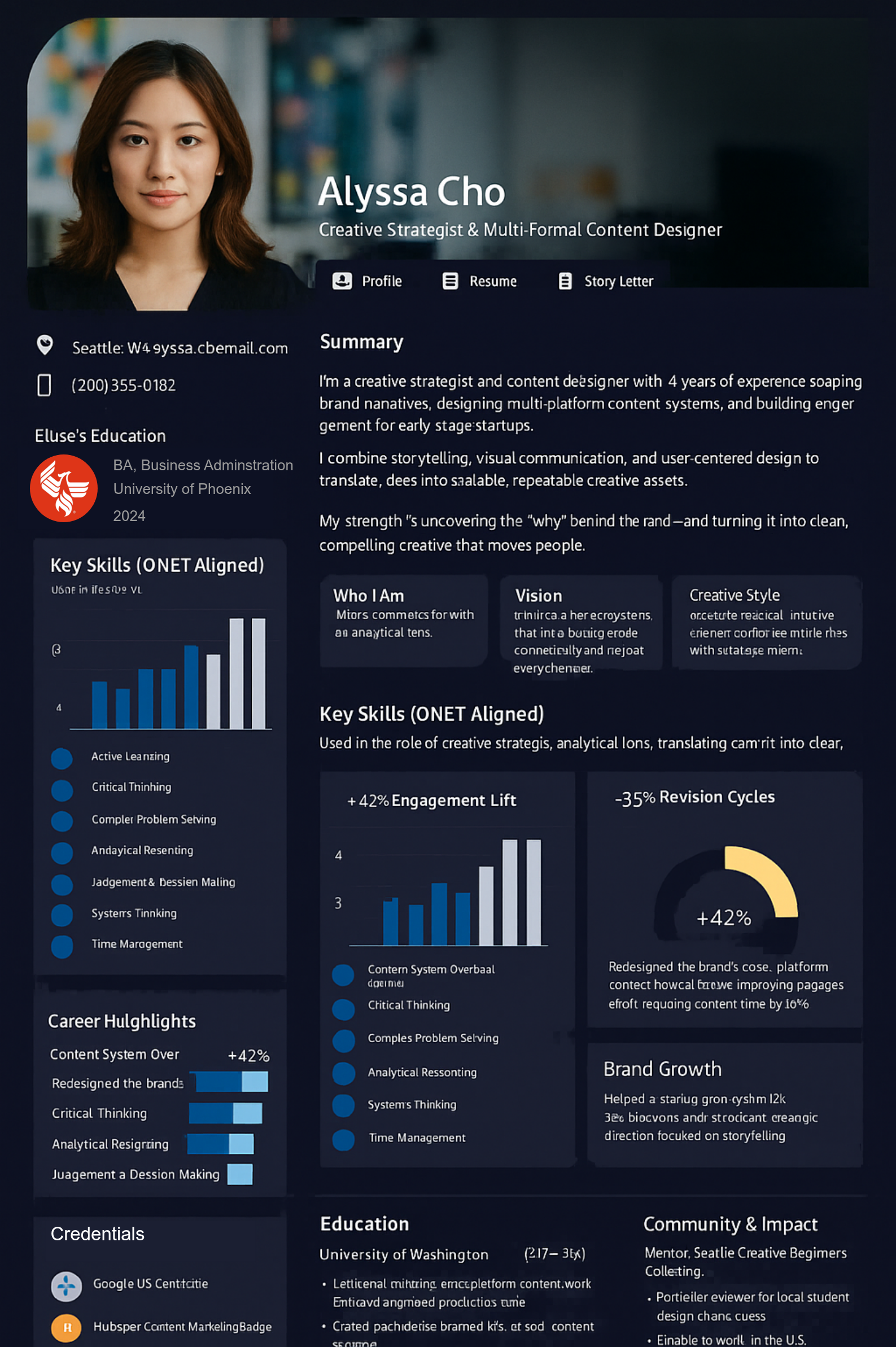
Create a professional profile that connects what you’ve studied with what you’ve done—and makes your contribution easier to understand.
Include relevant examples of:
Coursework, presentations, and group projects.
Research, writing, and creative work.
Internships, part-time jobs, and campus employment.
Student organizations, leadership, and community involvement.
Personal projects and experience gained before or outside college.
Recognize what you’re developing.
Look at specific experiences to identify the skills you’ve practiced, the responsibilities you’ve handled, and the work that holds your interest.
Explain your contribution with examples.
Show how you approached a question, supported a team, solved a problem, or carried a project forward.
Connect your experiences into a story you can use.
1. Start with what you’ve been doing.
Bring together your studies, jobs, activities, and projects. Start with a few experiences you remember well—you can build on them over time.
2. Talk through the details with Pythia.
Your AI guide helps you describe your role, the challenges you encountered, and the skills you used. Review its suggestions so they reflect your actual experience.
3. Give your contribution context.
Explain what you personally did and what came from it. Include relevant work samples or supporting material where available and appropriate to share.
4. Choose what matters for your next step.
Shape your profile around an internship, job, or professional introduction. Use the same reflection to prepare for conversations about further study or career direction.
Put your experience to work before and after graduation.
Applying for an internship or first role
Draw on coursework, employment, and activities to explain relevant experience—even when you haven’t held the job title before.
Exploring your direction
Look across projects and responsibilities for interests you want to pursue. Bring those examples to conversations with advisors, mentors, and people in different fields.
Preparing for further study
Connect your academic questions, writing, research, and other relevant experiences as you prepare the materials a program requests.
Making the most of work beyond the classroom
Recognize what you’ve learned through paid work, caregiving, volunteering, or community responsibilities alongside your studies.
Explore ways to show what college is helping you build.
Find examples of presenting group projects, explaining part-time work and volunteering, documenting creative work, and connecting undergraduate experiences with future opportunities.
A group presentation reveals more than the final slides. Preserving the research, decisions, collaboration, individual contributions, and audience response can ...
Your most valuable undergraduate experience may not come from a prestigious internship. Part-time work, volunteering, campus employment, and community involvement ...
Your strongest portfolio contains more than polished final pieces. Connecting research, drafts, feedback, revision, and reflection can show how your ...
Your education has produced more than a degree and a list of courses. A focused professional portfolio can connect your ...
Previous
Next
Questions college students may have
Do I need an internship before I can build a useful profile?
No. Coursework, paid work, student activities, personal projects, and community responsibilities can all provide useful examples. Describe what you did and why it matters for the opportunity.
What if my major doesn’t lead to one obvious career?
Start with the work itself: the questions you investigated, information you evaluated, things you created, and people you worked with. Those examples can help you explain your abilities across different settings.
How should I describe a group project?
Explain the shared goal, then identify your own responsibilities and contribution. Give teammates appropriate credit and choose material you’re permitted to share.
Can I include experience from before college?
Yes. Relevant earlier work and life experience can help explain what you bring, especially if you’re returning to education or combining study with an established career.
Can this help with graduate school applications?
Organizing your experiences can help you prepare examples for statements, interviews, and portfolios. Follow each program’s application requirements and use the formats it accepts.
What can I use today?
Start with the profile-building features currently available in TalentPass. Broader capabilities for learning portfolios, connected records, and ongoing guidance are developing in stages. See Product Availability for the current breakdown.
This website uses cookies. Essential cookies are required for the site to function properly. With your consent, we may also use functional, analytics and marketing cookies. Click "Settings" to choose categories, or "Accept All" to consent to all cookies. You can change your preferences at any time.
Cookie Settings
🔒 Necessary
These cookies are essential for the website to function properly. They include remembering your consent preferences. They cannot be disabled.
Always Active
⚙️ Functional
These cookies enable additional functionality such as live chat, embedded media, or personalized widgets. Without them, some features may not be available.
📊 Analytics
These cookies help us understand how visitors use our website by collecting anonymous statistics. This allows us to improve our content and services.
📢 Marketing
These cookies are used to display personalized ads and measure the effectiveness of advertising campaigns. They may be set by third-party advertising networks.
Necessary0
▶
No cookies detected in this category
Functional0
▶
No cookies detected in this category
Analytics0
▶
No cookies detected in this category
Marketing0
▶
No cookies detected in this category
Cookies are small text files stored on your device.
You can change your preferences at any time by clicking the cookies icon.