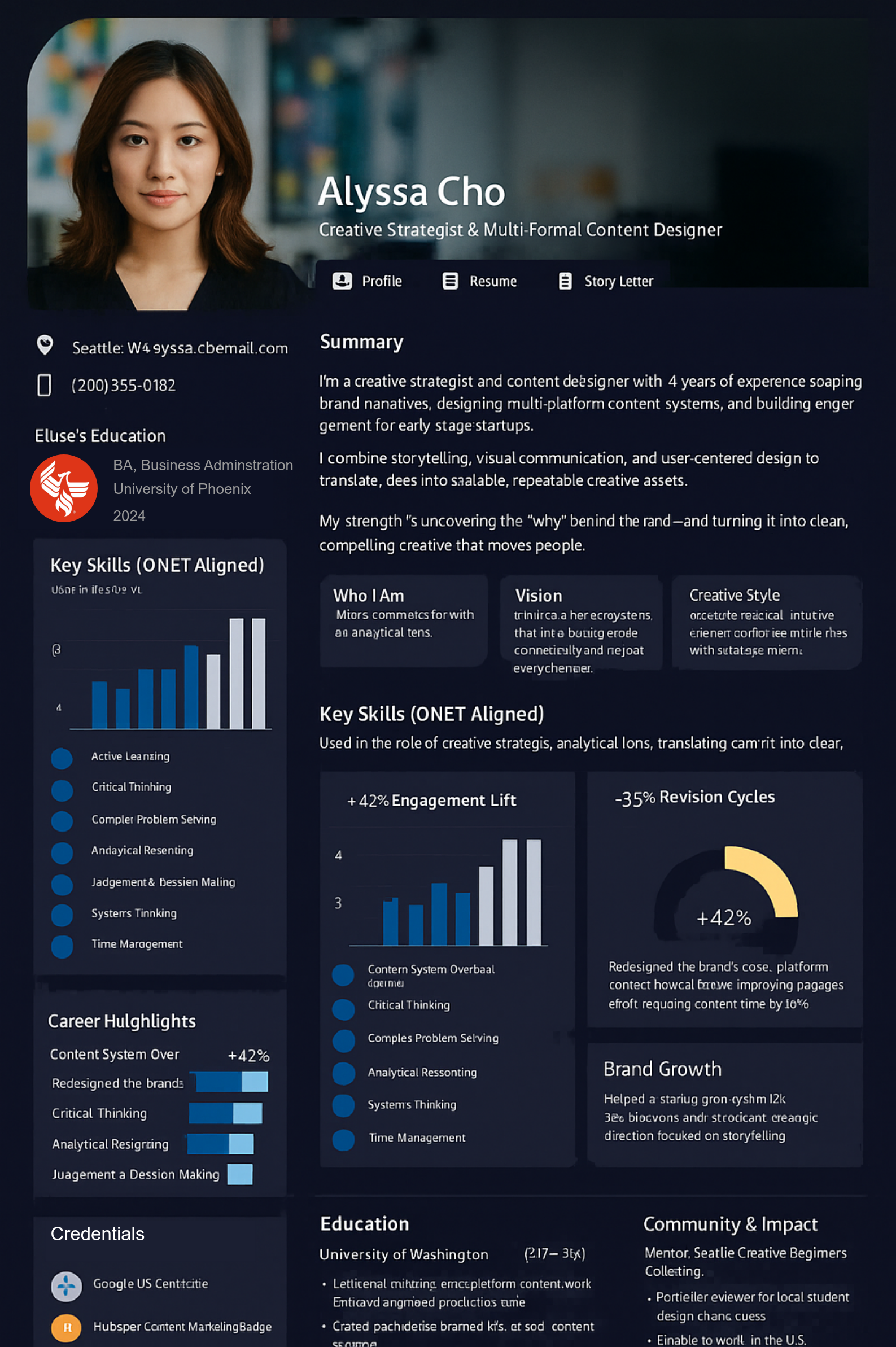
Building a business means solving problems your job title never mentions. TalentPass helps you bring that experience together, understand the strengths you’ve developed, and show others what you can contribute.
Create a professional profile grounded in what you’ve done, with Pythia, your AI guide.
You wear many hats. Your story should connect them.
Your title leaves too much out.
“Founder,” “owner,” or “director” can hide years of building systems, winning customers, developing people, and solving unfamiliar problems.
The business story overshadows your contribution.
Revenue and company milestones tell part of the story. They don’t explain the decisions you made, the work you led, or the capabilities you developed.
It’s hard to see what you should do next.
When you’re handling whatever the business needs, it can be difficult to recognize where you’re strongest, what you enjoy, and where you need support.
Build a professional profile around your contribution.
Bring relevant roles, projects, accomplishments, and supporting evidence into a profile that helps people understand how you work.
Explain what you built and why it mattered.
Describe your responsibilities and decisions.
Show skills through examples of using them.
Connect your contribution to results, giving the team its credit.
Include relevant experience from earlier ventures, employment, and learning.
Make introductions more meaningful.
Share your profile with a potential collaborator, adviser, or professional contact so they can explore the experience behind your introduction.
Carry your experience into your next chapter.
Use the work you’ve already done to explain what you could bring to another venture, leadership role, or opportunity.
Turn the work you remember into a story you can use.
1. Start with what you’ve built.
Bring your résumé or professional history, then identify the ventures, projects, and responsibilities that best represent your experience.
2. Talk through your contribution.
Pythia helps you describe the situation, what you did, and what you learned. Review its suggestions and make sure the story reflects your actual role.
3. Add examples that support it.
Include relevant accomplishments, credentials, and work examples you can share. Explain the context behind results and distinguish your contribution from the wider team’s work.
4. Create a profile and keep it current.
Choose what matters for your professional introduction or next opportunity. Update your experience as your responsibilities change and you take on new challenges.
Make your experience useful beyond the work in front of you.
Building your first business?
Draw on the experience that prepared you to start: previous roles, projects, customer knowledge, and problems you’ve already learned to solve.
Leading a growing small business?
Explain the range of work you handle across operations, customers, people, and delivery. Reflect on which responsibilities use your strengths and which call for additional support.
Working across several ventures?
Connect the experience across your businesses and projects. Help others understand the capabilities that carry from one setting to another.
Moving on from a venture?
Capture what you contributed and learned through growth, a sale, a closure, or a change of direction. Build a fuller account of your experience for whatever comes next.
Explore ways to show what you’ve built.
Read examples and practical guidance on documenting entrepreneurial experience, communicating your contribution, and making your professional story useful in new settings.
Follow a business owner documenting the decisions, tradeoffs, and collaboration behind a new-service initiative—while keeping confidential business plans private.
Your operational systems manage the work of the business. TalentPass can help you document the responsibilities, capabilities, outcomes, and learning ...
Explore how a small business could present its proposed team through clear responsibilities, relevant experience, and contributor-approved examples.
Previous
Next
A few things you might be wondering.
Is this for founders only?
No. It is also relevant to business owners, startup team members, and leaders whose work spans several responsibilities. You don’t need to have founded the business to explain what you helped build.
What if my business is early-stage or didn’t succeed?
Describe the work you actually did, the outcomes, and what you learned. Customer discovery, product development, operations, and team leadership can all provide relevant experience. Be clear about what was attempted and what was achieved.
How do I show my contribution without taking credit for the whole team?
Explain your responsibilities, decisions, and actions alongside the people you worked with. Use results as context and make clear which parts you directly contributed to.
Do I need to share confidential business information?
No. Choose examples you are able to share. You can describe your responsibilities and approach without including private customer details, internal documents, or sensitive figures.
Can I use TalentPass to manage my team?
TalentPass focuses on your individual experience and professional profile. For understanding your team’s capabilities, responsibilities, and needs together, explore TalentSync.
TalentPass currently supports professional networking and job application profiles. Broader capabilities for entrepreneurship, ongoing development, and organizational connections are at different stages of development.
This website uses cookies. Essential cookies are required for the site to function properly. With your consent, we may also use functional, analytics and marketing cookies. Click "Settings" to choose categories, or "Accept All" to consent to all cookies. You can change your preferences at any time.
Cookie Settings
🔒 Necessary
These cookies are essential for the website to function properly. They include remembering your consent preferences. They cannot be disabled.
Always Active
⚙️ Functional
These cookies enable additional functionality such as live chat, embedded media, or personalized widgets. Without them, some features may not be available.
📊 Analytics
These cookies help us understand how visitors use our website by collecting anonymous statistics. This allows us to improve our content and services.
📢 Marketing
These cookies are used to display personalized ads and measure the effectiveness of advertising campaigns. They may be set by third-party advertising networks.
Necessary0
▶
No cookies detected in this category
Functional0
▶
No cookies detected in this category
Analytics0
▶
No cookies detected in this category
Marketing0
▶
No cookies detected in this category
Cookies are small text files stored on your device.
You can change your preferences at any time by clicking the cookies icon.