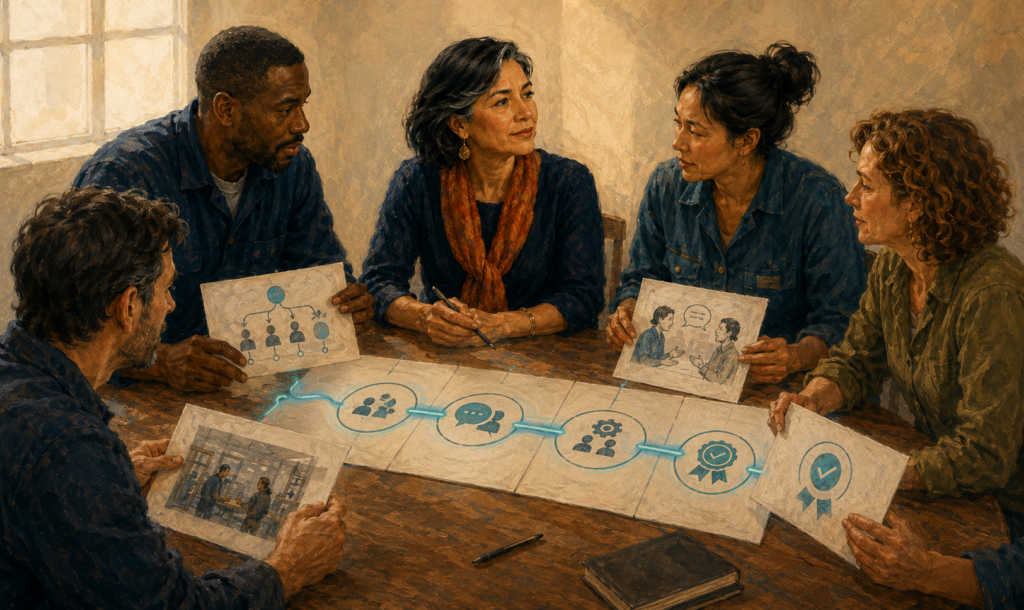
Elena leads professional development for a national membership organization with more than 20,000 members.
The organization offers credentials, continuing education, conferences, chapters, research, mentoring, volunteer opportunities, and an extensive collection of professional resources. Its team works hard to understand what members need and respond with useful programs.
It also has more data than ever.
Elena can see membership renewals, course registrations, credential completions, event attendance, email engagement, survey responses, and website activity. Yet when the leadership team begins planning for the next year, it still struggles to answer some of its most important questions:
What challenges are members encountering in their work?
Which capabilities are becoming more important?
Where are members trying to grow?
How are they applying what they learn?
Which programs are producing lasting value?
Which contributors and communities are being overlooked?
What should the organization build next?
The organization can see what members have clicked, attended, purchased, and completed. It cannot see clearly enough what they are becoming—or what their profession is becoming around them.
A membership database is not a map of the membership
Most membership systems are designed to manage transactions and participation. They provide essential operational information: who joined, who renewed, who registered, who completed a course, and who holds a credential.
But membership is more than a series of transactions.
Each person brings a changing combination of experiences, capabilities, motivations, interests, relationships, goals, and challenges. Members apply what they learn in different environments. They contribute to their profession through work that may never appear inside the association’s systems.
A membership database can tell Elena that 800 people completed a course. It cannot tell her:
Which ideas they later applied
What kinds of problems the learning helped them solve
Where they still needed support
Whether the learning contributed to advancement
What new capabilities their work now requires
How the course should change next year
Surveys help, but they provide intermittent snapshots. Questions have to be written before the organization knows what it may be missing, and members are asked to reconstruct experiences weeks or months after they occurred.
The organization is trying to understand a living community through systems designed primarily to record past activity.
Members need a reason to contribute better intelligence
It would be easy to describe this as a data-collection problem. But asking members for more information does not automatically produce better understanding.
Members already complete surveys, update directories, fill out event evaluations, and provide information to a growing number of platforms. They have little reason to continuously maintain another organizational profile—especially if the benefit flows mainly to the institution.
The exchange has to create value for the member first.
Through TalentPass, members build a private, portable source of truth about their own development. Pythia helps them connect learning, work, credentials, contributions, evidence, goals, and reflection so they can use that intelligence to:
Understand their strengths and direction
Prepare for opportunities
Apply trusted professional resources
Document growth and accomplishments
Find collaborators or mentors
Demonstrate what they can do
Carry their records between organizations
The information is not created simply because Elena’s organization wants better analytics. It is created because it helps each member know, grow, and show their own talent.
That changes the relationship.
Passport Pages create a consent-based exchange
Elena’s organization creates a Passport Page through which members can establish a trusted connection.
The organization can provide:
Verified membership and credentials
Professional standards
Learning resources
Research and industry intelligence
Career and leadership pathways
Event and chapter opportunities
Pythia conversations informed by its expertise
Members decide whether to connect and what they are willing to contribute in return. Depending on the purpose, that may include structured feedback, reflections on a learning experience, professional interests, career goals, or selected information about how a resource was applied.
The organization does not gain unrestricted access to each member’s TalentPass. A Passport Page is not a hidden window into someone’s private professional life.
It is a governed exchange.
The member understands what is being requested, why it is useful, and what value they receive. The organization receives only the information the member has chosen to provide for that relationship.
This makes the resulting intelligence both more useful and more trustworthy.
Elena sees an emerging need that attendance data missed
As Elena reviews aggregated, permission-based patterns across the membership, one trend stands out.
Members working across several industries are increasingly describing a similar challenge: they are being asked to redesign roles and workflows around AI, but lack a practical method for involving employees in the process.
The organization’s traditional data had shown growing interest in AI-related webinars. That insight was too broad to guide a meaningful response. It did not distinguish between members exploring new tools, writing policies, managing risk, redesigning work, or supporting employee adoption.
The richer member intelligence reveals something more specific:
The challenge is appearing across multiple sectors.
Mid-career managers are encountering it most often.
Members feel comfortable evaluating tools but less prepared to redesign roles.
Existing resources address technology and compliance more thoroughly than worker participation.
Members are asking for examples, facilitation methods, and peer support.
Several members already possess relevant experience that could help the rest of the community.
Elena: “We thought members needed another general AI course. What they actually need is help redesigning work with their people.”
This distinction changes what the organization decides to build.
The organization responds with its members, not merely for them
Instead of commissioning another broad webinar series, Elena identifies members who have chosen to share relevant experience and invites them to help shape a new program.
The organization assembles a working group that includes:
Members who have already led successful role-redesign efforts
Managers encountering the challenge for the first time
Learning and development practitioners
Employee representatives
Experts in responsible AI adoption
Chapter leaders who can test the approach in different environments
Together, they develop a practical pathway that combines professional standards, facilitated peer learning, workplace activities, and a credential connected to applied evidence.
Pythia helps participating members work through the pathway in the context of their own organizations. Instead of only consuming content, they document decisions, gather employee input, test new role designs, reflect on outcomes, and contribute what they learn.
The association’s knowledge informs member action. Member experience improves the association’s knowledge.
The feedback loop continues after the program launches
Elena’s team can track enrollment and completion, but it can also begin understanding whether the pathway helps members accomplish what it was designed to support.
With permission, participants can provide structured insight about:
Which parts of the framework they used
Where implementation became difficult
Which stakeholders needed more support
What changes they made to roles or workflows
How employees participated
What outcomes emerged
What additional capabilities members need
Pythia can prompt reflection while the experience is still fresh, rather than asking members to reconstruct everything in an annual survey.
The organization learns that members find the role-mapping framework valuable but struggle to facilitate conversations when employees fear displacement. It responds by adding a new conversation guide, examples from participating members, and training on psychologically safer engagement.
Members receive better support. The program becomes more effective. The organization gains stronger evidence of impact.
The feedback loop produces continuous improvement rather than a final report that sits on a shelf.
Hidden contributors become visible
The same intelligence also changes how Elena sees the membership itself.
The organization’s most visible members are often speakers, elected leaders, prolific authors, and people with the time and confidence to participate publicly. Their contributions matter, but they are not the only source of expertise in the community.
TalentPass allows members to document experience gained through work, service, mentoring, chapter participation, and applied projects. With their consent, selected contributions can become visible to the association.
Elena discovers members who have:
Solved difficult problems without presenting about them
Informally mentored peers for years
Applied association resources in innovative ways
Led valuable chapter projects
Developed experience in emerging areas
Connected people across otherwise separate parts of the community
These members can be invited into working groups, mentoring relationships, conference sessions, advisory roles, and recognition programs.
The organization becomes better at recognizing contribution rather than merely visibility.
A living map does not require organizational surveillance
A combined Talent Tree can help the association understand patterns across the membership: capabilities, interests, goals, learning, contributions, and emerging needs.
But such a map should not function as a centralized dossier on every person.
The individual Talent Tree belongs to the member. The organization sees only the information members intentionally contribute through a particular relationship. Sensitive or employer-specific information can remain private. Aggregated views can reveal patterns without exposing individual records.
This distinction is essential.
The goal is not to make every member transparent to the organization. It is to create enough trusted, reciprocal exchange for the community to better understand itself.
When people benefit from building and using their own intelligence, they have a reason to keep it current. When they trust the terms of exchange, they have a reason to contribute. When the organization returns useful resources, opportunities, recognition, and support, participation becomes mutually reinforcing.
Better intelligence emerges from agency and reciprocity—not extraction.
From measuring membership to understanding the community
At the next planning meeting, Elena’s leadership team still reviews membership totals, renewals, event attendance, and program revenue. Those measures remain important.
But they are no longer the only way the organization understands its success.
The team can also see:
What members are trying to accomplish
Which challenges are emerging across the profession
Where existing resources are helping
Where support remains incomplete
What capabilities are growing in importance
Which member experiences should inform new programs
How learning is being applied
Where the community is creating value for itself
This is the difference between maintaining a membership database and developing organizational self-awareness.
The organization is not simply collecting more data about its members. It is participating in a continuous exchange of intelligence with them.
Membership becomes a system of shared growth
Elena’s organization provides trusted knowledge, credentials, resources, relationships, and opportunities. Members apply those assets in the world, create new experience, and learn what the profession requires next.
Gobekli helps connect those two sides.
Members use TalentPass and Pythia to build intelligence that serves their own growth.
The organization provides trusted resources and recognition through Passport Pages.
Members choose what insight and feedback to contribute.
TalentSync helps the organization understand collective patterns.
Leaders respond with more relevant programs, pathways, opportunities, and support.
Members apply those resources and generate new intelligence.
The feedback loop continues to become more useful for everyone participating in it.
A membership list can tell Elena who belongs to the organization.
A living human intelligence layer can help the entire community understand where it is going next.
Priya leaves every conference with new ideas, contacts, and good intentions—but most of that value quickly fades. See how a membership organization can help conference learning and relationships continue long ...
Daniel’s association already has the trusted framework he needs. The challenge is finding and applying it while the work is happening. See how Passport Pages and Pythia turn a resource ...
Maya has the credential, experience, and evidence to lead—but her resume can only show fragments. See how TalentPass helps turn association membership and verified credentials into a trusted story of ...