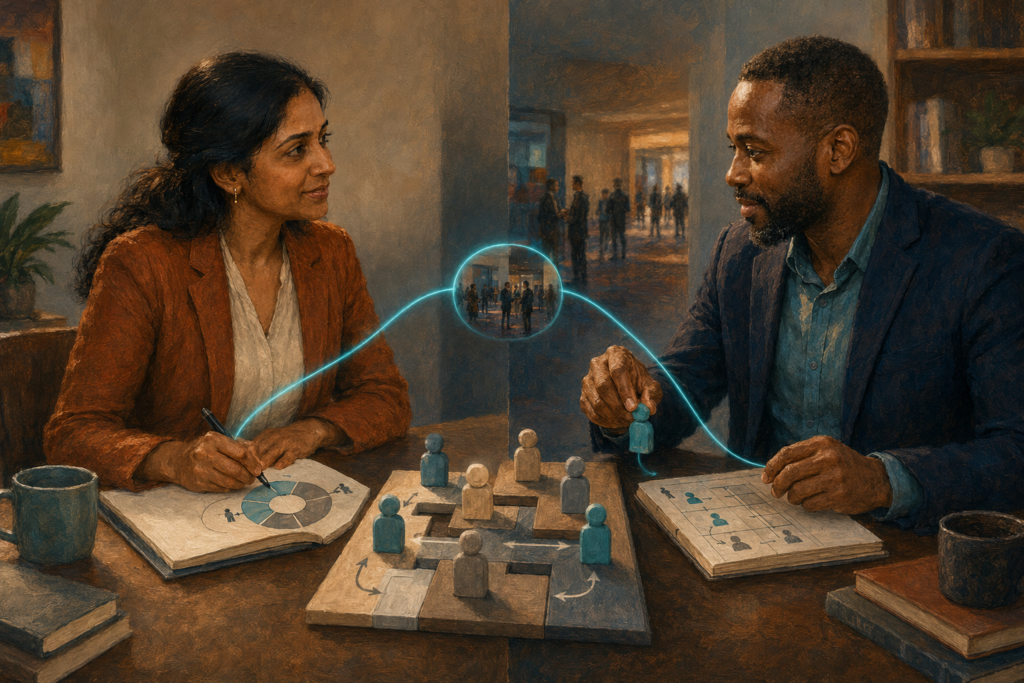
Priya looks forward to her professional association’s annual conference every year.
It is one of the few opportunities she has to step outside her daily responsibilities, learn from people across her field, and have the kinds of conversations that rarely happen inside her own organization.
For three days, she attends sessions, meets peers, exchanges contact information, and fills a notebook with ideas. She leaves energized and carrying a stack of business cards, QR codes, presentation links, and promises to follow up.
A month later, most of that value has faded.
Her notes are disconnected from her work. New contacts have become names in a phone or connections in a social feed. The people she met cannot easily remember what they discussed. The association knows which sessions Priya attended, but not what she learned, who she connected with, or what happened afterward.
The conference created real value. It simply had no reliable way to travel home with her.
Conferences create more value than attendance data can show
Membership conferences bring together many of the assets that make an association valuable:
Trusted expertise
Professional learning
Peer relationships
New ideas and practices
Volunteer leadership
Recognition and reputation
Access to potential collaborators, mentors, and employers
But the systems supporting most events are optimized for registration, scheduling, session access, and attendance. They can record that Priya entered a room or scanned into a workshop, but not what the experience meant to her.
Professional networking platforms do not solve the problem. They make it easy to add another connection, but usually strip away the context that made the connection valuable.
A month after the event, Priya may remember that she met someone named Marcus. Marcus may remember her face. Neither can easily recover the specific problem they discussed, the experience each person brought to it, or why they wanted to continue the conversation.
The conference creates an unusually rich concentration of human intelligence. Most of it disappears because attendees lack a useful way to capture, connect, and carry it forward.
Priya prepares to be understood, not merely introduced
Before this year’s conference, Priya’s association invites attendees to create an event profile in TalentPass.
Priya already has a broader private record of her experiences, skills, credentials, interests, and professional goals. She does not need to expose all of it to everyone at the conference.
Instead, Pythia helps her decide what she wants this audience to understand.
Pythia: “What would make this conference valuable for you?”
Priya: “I want to meet people working on workforce planning in rapidly changing industries. My organization is struggling to anticipate how AI will change several operational roles.”
Pythia helps Priya create a concise conference profile centered on that purpose. It includes:
A short introduction
The challenge she is exploring
Two relevant project stories
A credential connected to her work
Topics she wants to discuss
The kinds of people she hopes to meet
A simple QR code she can share
The profile is not a substitute for conversation. It gives the conversation somewhere more meaningful to begin.
One better introduction changes the event
After a session on workforce adaptability, Priya begins talking with Marcus, another association member working in a different industry.
In a typical conference exchange, they might share job titles and employers before moving on to the next session. Those details would tell them very little about why they should stay connected.
Instead, Priya shares her conference profile.
Marcus sees the operational workforce project she has been leading and recognizes that her organization is confronting a version of the same challenge his team addressed the previous year. Priya sees that Marcus has experience building a cross-functional response involving operations, learning, and frontline employees.
Marcus: “We approached this from different industries, but the underlying problem is almost identical.”
Priya: “I’ve been looking for someone who has already worked through the employee-engagement side of it.”
They add a short note to the connection so they will both remember why they met. Before leaving for their next sessions, they agree to compare their approaches after the conference.
Their connection now contains more than names and contact information. It has context, mutual relevance, and an intended next step.
Learning becomes connected to what Priya does next
Throughout the conference, Priya uses Pythia to capture brief reflections. She does not transcribe every session or attempt to preserve every slide.
Instead, Pythia helps her identify what matters.
After a workshop, it may ask:
Pythia: “What is one idea from this session that could change how you approach your workforce-planning project?”
Priya connects the idea to an existing project in her Talent Tree. She records a question she wants to bring back to her team and identifies a resource provided by the association that she wants to explore later.
At another session, she realizes that a framework being discussed relates to a capability gap she has observed inside her organization. Pythia helps her preserve that connection while it is fresh.
By the end of the conference, Priya has not simply collected information. She has connected selected learning to:
Her current work
Problems she is trying to solve
Capabilities she wants to develop
People who may be able to help
Resources she wants to revisit
Actions she intends to take
The conference becomes part of her ongoing professional development rather than an isolated event.
Contribution becomes part of the member’s professional story
Priya is not only an attendee. She also moderates a roundtable and helps a local chapter organize a networking session.
Those contributions are valuable to the association, but they can be difficult for Priya to explain outside the community. “Conference volunteer” does not communicate the planning, facilitation, relationship-building, or leadership involved.
Through the association’s Passport Page, Priya can document the role and connect it to the work she performed. The association can verify her participation, while Priya adds context about her responsibilities and what she learned.
The experience becomes portable evidence of contribution and leadership.
This also gives the association a better way to recognize the people who make its community work. Speakers, mentors, moderators, chapter leaders, reviewers, organizers, and volunteers can receive recognition connected to the actual value they created—not merely have their names appear on a program.
The conference continues after everyone leaves
Two weeks after the event, Pythia reminds Priya about the follow-up she and Marcus planned.
They meet virtually and compare their workforce-planning projects. Marcus shares lessons from his organization’s earlier effort. Priya contributes a framework introduced during the conference. Their discussion leads to a small peer group with three additional members who are confronting related challenges.
Several months later, Priya and Marcus submit a proposal to lead a session at the next annual conference. Instead of describing a general topic, they can show how a connection made through the association led to continuing collaboration and applied learning.
The conference has created a new cycle of member value:
Priya arrives with a clear purpose and a useful way to represent herself.
A better introduction leads to a higher-value connection.
Learning is connected to her work and development.
The relationship continues after the event.
The resulting collaboration contributes new knowledge to the community.
That knowledge returns to the association and its members.
The event no longer ends when the venue closes.
The association learns more than who attended
Event organizers normally rely on registrations, attendance, session ratings, surveys, and social engagement to understand success. These measures are useful, but they capture only a small portion of what a professional conference creates.
Through voluntary, permission-based Passport Page connections, the association can begin understanding broader patterns without claiming ownership over members’ personal records.
It may learn:
Which challenges members came to the conference hoping to solve
Which sessions led to meaningful reflection or follow-up
What topics members connected to their current work
Which resources attendees wanted to use afterward
Where new mentorship or collaboration relationships formed
Which capabilities appear to be growing in importance
How speakers and volunteers contributed to the community
Whether conference learning continued after the event
The association does not need access to Priya and Marcus’s private conversations or confidential workplace information. Members decide what they share. Aggregated signals can still help event leaders understand whether the conference produced meaningful learning, relationships, and action.
That intelligence can shape next year’s agenda, improve member support, identify emerging issues, and provide stronger evidence of value to sponsors and partners.
From a temporary event to living community infrastructure
A great conference creates moments people remember. But memory alone is not enough to sustain the relationships, learning, and professional growth generated there.
TalentPass gives each attendee a member-owned place to carry those experiences forward. Passport Pages create a trusted connection with the association. Pythia helps members prepare, reflect, follow up, and apply what they learn. TalentSync can help the organization understand broader patterns and continuously improve the experience.
Together, these capabilities turn the conference into more than a gathering.
It becomes an active part of a living professional community—one in which learning is applied, contribution is recognized, relationships retain their context, and each year builds upon the intelligence created the year before.
Priya does not leave with another collection of contacts and notes.
She leaves with new relationships, clearer direction, and a professional story that continues to grow.
Elena’s association can see who joined, attended, and completed a course—but not what members are becoming or what their profession will require next. A consent-based human intelligence layer changes what ...
Daniel’s association already has the trusted framework he needs. The challenge is finding and applying it while the work is happening. See how Passport Pages and Pythia turn a resource ...
Maya has the credential, experience, and evidence to lead—but her resume can only show fragments. See how TalentPass helps turn association membership and verified credentials into a trusted story of ...