
Recruiting guide
What does the evidence actually support?
Keep the source and limits of each claim visible during candidate review.
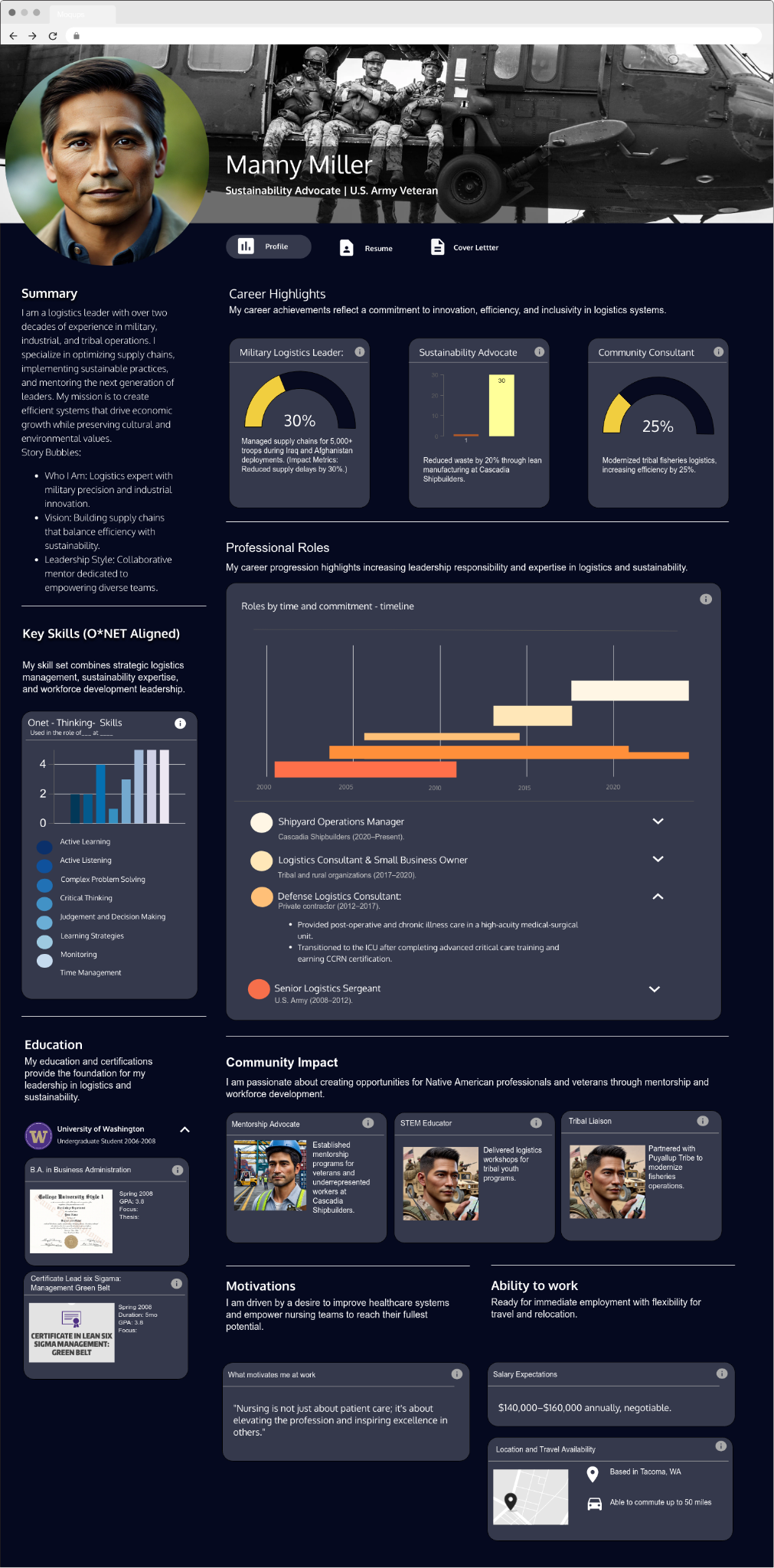
A polished profile can make experience easier to understand. It cannot, by itself, establish that every statement is verified. Useful review keeps the claim, source, context, and remaining questions connected.
Different sources answer different questions.
| Source | What it can contribute | What to examine |
|---|---|---|
| Candidate account | Purpose, decisions, responsibilities, and reflection | Specificity and the person’s own contribution |
| Work sample | An output or a demonstration of an activity | Authorship, conditions, and relevance to this role |
| Endorsement or reference | Another person’s account of the work | What they directly observed and when |
| Credential | A claim made by an identified issuer | Issuer, scope, status, and relevance |
A result needs its context.
If a candidate reports reducing a backlog, ask what the baseline was, what period the result covers, what else changed, and which actions they owned. A team achievement may provide strong evidence of collaboration while leaving individual technical depth unresolved.
Do not collapse “self-reported,” “supported by an example,” and “verified by an appropriate source” into one badge. The distinctions help a reviewer decide what to ask next.
Compare against the same work requirements.
Use the agreed role brief to organize review. For each important responsibility, record the relevant example, what it supports, and what still needs examination. Different candidates may offer different kinds of evidence for the same requirement.
A missing document does not automatically establish a missing capability. Ask whether another proportionate form of evidence could answer the question. Similarly, a well-formatted record should not displace scrutiny of the underlying work.
Turn uncertainty into an interview question.
Instead of writing “weak leadership,” record the narrower gap: “The example explains the team’s result but does not yet explain how the candidate handled disagreement.” That gives the interviewer something specific to explore and the candidate a fair chance to clarify.
Gobekli’s approach connects experience and supporting records with the purpose of the review. Pythia can help organize context within supported workflows; recruiters and hiring teams remain responsible for interpreting evidence and making decisions.
Bring one recruiting question.
Explore the recruiting workflow and discuss what a useful first engagement could include.
TalentPass is in public beta. TalentSync Recruiter is in development. Review current availability.