
LER & TRUSTED WORKFORCE INFRASTRUCTURE WORKSHOP MODULE
Identity, Account Access & Record Matching
Clarify whom a record describes, who can access the account, and how uncertainty gets resolved—so the selected exchange connects information to the appropriate person or organization.
Does this sound familiar?
One person appears under several records
Different programs, accounts, names, or contact details create separate entries without a clear process for determining whether they describe the same person.
A familiar detail becomes the matching rule
A name, email address, or other shared field is treated as sufficient without examining the uncertainty or consequences of an incorrect connection.
Access disappears when circumstances change
A participant loses access to an email address, phone, device, or former organization’s account and cannot find a workable recovery route.
An organizational account has unclear authority
A person can sign in on behalf of an organization, but partners cannot easily establish what that person is authorized to submit, change, or receive.
Uncertain matches become invisible decisions
A possible connection is accepted, rejected, or merged without a clear account of the evidence, responsible reviewer, or route to challenge it.
Support depends on whoever answers
Staff improvise when records conflict or accounts cannot be recovered, producing inconsistent outcomes and unclear responsibility.
What are identity, account access, and record matching?
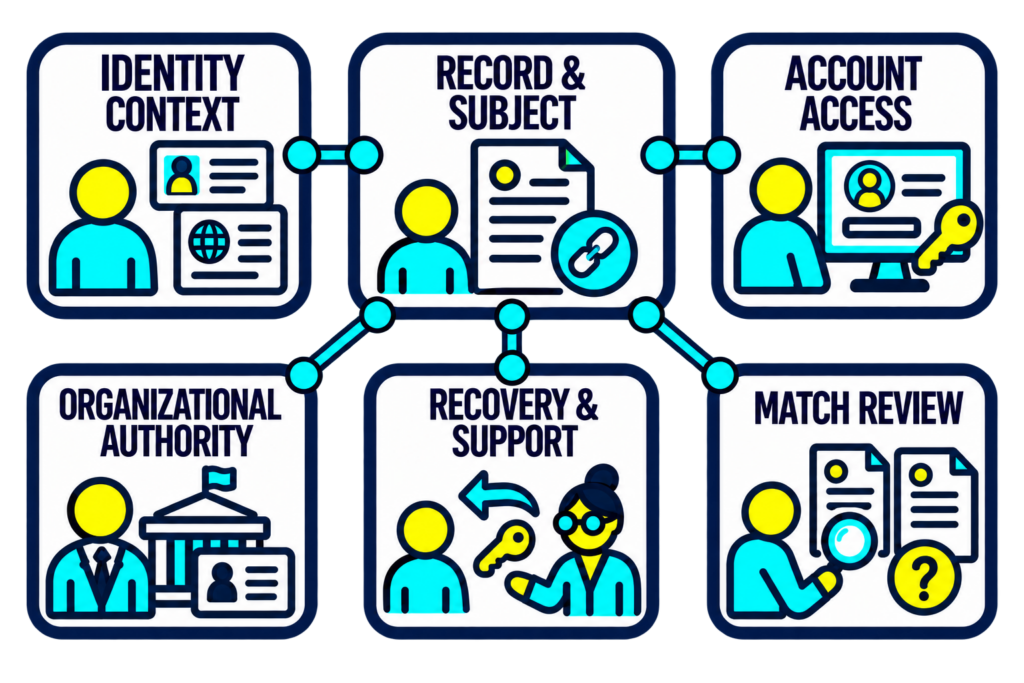
Identity work establishes which person or organization is involved in the selected exchange and what information supports that understanding.
Account access concerns how someone enters and uses a particular account, including the route available when their usual access method no longer works.
Record matching concerns whether separate records describe the same subject. A successful sign-in does not, by itself, settle whether every record associated with an account belongs there.
Organizational representation adds another question: what may a particular person do on behalf of the organization, and who can confirm that authority?
This module examines these relationships together while keeping their responsibilities distinct. The goal is a workable account of identification, access, matching, and resolution for the selected exchange.
A usable record needs a dependable connection to its subject.
Partners may have accurate information in their systems.
They may still be uncertain about which person it describes, which account should receive it, or who can act on an organization’s behalf.
Connecting the wrong record can expose information or influence a decision about someone it does not describe.
Failing to connect the right record can prevent a person from presenting relevant learning, experience, or recognition.
The workshop makes both kinds of error visible.
Partners can then define the evidence, review, recovery, and correction arrangements appropriate to their selected use case.
Where identity and access can become unclear
The subject
Person or organization described
Names and known variations
Source-specific identifiers
Relevant affiliations
Unresolved identity questions
Account access
Account creation
Sign-in arrangements
Contact or device changes
Assisted access
Recovery routes
Record matching
Candidate records
Available matching information
Conflicting details
Consequences of error
Review requirements
Organizational representation
Represented organization
Authorized representative
Permitted actions
Authority confirmation
Role changes and removal
Resolution and support
Issue reporting
Responsible reviewer
Supporting information
Correction or separation
Participant follow-up
The review focuses on the subjects, accounts, and records involved in the selected exchange. It does not require partners to resolve every identity question across their organizations.
How this module helps
Separate the questions
Distinguish the subject of a record, the person accessing an account, the proposed record connection, and any authority to represent an organization.
Examine matching uncertainty
Review the information supporting a possible connection, conflicting evidence, and what should happen when the relationship remains unresolved.
Make recovery workable
Trace how people regain appropriate access when contact details, devices, employment, or support needs change.
Assign resolution responsibilities
Identify who reviews uncertainty, corrects an association, supports the affected person, and confirms that the issue has been addressed.
The person who can sign in may still be missing the right records.
A participant may have an active account while earlier learning sits under a different name or identifier.
Another person may have similar identifying details, making a proposed connection uncertain.
The workshop examines how the exchange distinguishes access to an account from confidence in the records associated with it.
Example: “My training record is there, but I cannot connect it to my account.”
A participant completed training using an employer-provided email address.
They later leave that employer and create an account using a personal address.
The provider identifies a possible earlier record, but the available information does not yet establish that it belongs to the person making the request.
Partners examine the confirmation needed, who can review it, how the participant receives support, and what happens if the proposed connection cannot be established.
Questions to review together
Whom does the selected record describe, and what information establishes the person or organization involved?
How does the person access the relevant account, and which account actions require additional confirmation?
What supports connecting the records, what conflicts, and what remains unknown?
What happens when the usual email, phone, device, or organizational account is no longer available?
Who may act for an organization, for which purposes, and how is that authority confirmed or changed?
Who reviews uncertainty, corrects a mistaken connection, and follows through with the affected person or partner?
What needs to connect?
The record’s subject
The person or organization the information actually describes.
The account holder
The person using the account and the access arrangement supporting their actions.
The matching evidence
The information supporting or challenging a proposed connection between records.
The representative’s authority
The actions a person may take for an organization and who can confirm that responsibility.
Recovery and support
The route available when ordinary access or identification arrangements no longer work.
Review and correction
The responsible process for unresolved matches, mistaken associations, and subsequent changes.
When convenience becomes the matching rule
Partners may connect records without making the basis for that connection clear.
- A shared name is treated as sufficient.
- An email address is assumed to remain current.
- Signing in is treated as proof that every linked record belongs there.
- Organizational membership is confused with authority to act.
- Possible matches become permanent associations without review.
- Recovery depends on access to the very account someone has lost.
The exchange can become difficult to challenge when a connection is wrong or incomplete.
When identity and access responsibilities are explicit
Partners can understand and review the connection being made.
- The subject and account holder are distinguishable.
- Supporting and conflicting information remain visible.
- Uncertainty has a defined handling route.
- Organizational authority has an accountable source.
- Recovery considers changed circumstances.
- Incorrect associations can be investigated and corrected.
The resulting process gives participants and partners a clearer route through both ordinary use and exceptions.
A practical example
A regional partnership wants participants to present training records through a workforce portal.
One provider’s records use an internal learner identifier and an earlier surname.
The participant’s portal account uses a current surname and a personal email address.
A second provider holds another record with similar identifying information.
The workshop first distinguishes access to the portal from the decision to associate either provider record with that account.
Partners identify what each provider can confirm and which information is appropriate to request for the selected match.
They define who reviews a proposed connection when details conflict or remain incomplete.
They also examine how the participant can continue receiving assistance while the question is unresolved.
The resulting plan records the proposed relationship, supporting context, responsible reviewer, and route for correcting an incorrect association.
Implementation can then be scoped around that reviewed process, including the access and recovery arrangements needed to keep it usable.
A possible match is a question to resolve.
A matching process may identify records worth reviewing.
The strength of that suggestion depends on the information available and the conditions of the selected use case.
Missing information and conflicting information need different consideration.
Partners should also examine the consequences of connecting the wrong record and of failing to connect the right one.
The workshop helps establish what can proceed, what needs further confirmation, and who is responsible for the unresolved question.
It does not turn an incomplete match into a verified identity or a guarantee of accuracy.
Recovery belongs in the ordinary service experience.
People change names, jobs, contact details, devices, and circumstances.
An access arrangement that works at enrollment may become difficult to use later.
Recovery therefore needs a defined route, with understandable instructions and appropriate confirmation.
Assistance also needs boundaries: helping someone navigate the process does not automatically authorize a helper to access or act through their account.
The workshop examines the support available and who handles cases that cannot follow the usual route.
That makes continuity of access a practical design question from the beginning.
WORKSHOP MODULE 3
Identity, Account Access & Record Matching
This module is a focused minicourse and working session within the LER & Trusted Workforce Infrastructure Workshop.
Your team learns to distinguish identity, access, matching, and representation, then applies those distinctions to a selected record exchange.
The work produces a reviewed starting point for addressing uncertainty and defining the supporting product configuration.
What this module can address
The selected scope may include:
The workshop selects the questions that materially affect the defined exchange.
- People or organizations described by the relevant records.
- Names, identifiers, affiliations, and known variations.
- Account creation and initial access.
- Relationships between accounts and source records.
- Information supporting a proposed match.
- Conflicting, missing, or ambiguous identifying information.
- Duplicate records and mistaken associations.
- Recovery after contact, device, or employment changes.
- Organizational representatives and permitted actions.
- Assisted access and support responsibilities.
- Human review and escalation routes.
- Correction, separation, and follow-up after an error.
What kinds of responses might emerge?
The response depends on the problem uncovered in the selected example.
Clearer identity context
Define the information partners need to understand the person or organization described by a record.
A reviewed matching process
Specify how proposed connections are considered, when further confirmation is required, and who reviews uncertainty.
A workable recovery route
Clarify the steps and assistance available when someone cannot use their usual access method.
Explicit representation arrangements
Identify who confirms an organizational representative’s authority and how changes are communicated.
A correction and separation process
Establish how an incorrect association is investigated and how affected records or accounts are handled.
A focused configuration brief
Describe the account relationships, review states, support routes, and responsibilities a subsequent implementation would need.
Some responses may involve clearer instructions or responsibilities. Others may require technical changes, partner agreements, or additional specialist review.
What we review together
The selected exchange
The record, participating organizations, receiving use, and consequences of a mistaken association.
The identifying information
The relevant names, identifiers, source context, and limitations of the information available.
The account journey
Creation, access, changes, assistance, and recovery across the expected period of use.
The matching decision
Supporting evidence, conflicts, uncertainty, responsible reviewers, and appropriate next steps.
Organizational representation
Who may perform which actions and how that authority is established, maintained, or removed.
The resolution route
How issues are reported, investigated, corrected, and followed through with those affected.
The working exercise
Trace one record connection from request to resolution.
Choose a realistic example in which a record must be connected to a person, account, or authorized organizational representative.
STEP 1
Define the connection
State which record is being associated with which subject or account and why the exchange needs that relationship.
STEP 2
Separate the responsibilities
Identify the record’s subject, account holder, source organization, and any representative or helper involved.
STEP 3
Examine the available information
Record what supports the proposed connection, what conflicts, and what remains unknown.
STEP 4
Test an exception
Consider a changed name, unavailable email address, duplicate record, mistaken association, or departing organizational representative.
STEP 5
Assign review and recovery
Define who can investigate, what confirmation is needed, how assistance works, and what happens while the issue remains unresolved.
STEP 6
Record the response
Capture the proposed changes, owners, dependencies, and evidence needed to evaluate the revised process.
The exercise produces a reviewed identity, access, and matching map for the selected example.
CONNECTING THE WORKSHOP TO A POSSIBLE GOBEKLI SETUP
Turn the reviewed process into configuration requirements.
The workshop can help define how a subsequent Gobekli implementation would support the selected exchange across TalentPass, TalentSync, Passport Pages, and participating systems.
Depending on confirmed scope and product availability, the configuration brief may describe:
- The people and organizations involved.
- The accounts and source records that need to relate.
- Source identifiers and relevant identity context.
- Distinct roles for individuals and organizational representatives.
- Proposed associations that require review.
- Supporting information and unresolved questions.
- Account access and recovery dependencies.
- Assistance and escalation responsibilities.
- Correction and follow-up requirements.
- The information a receiving workflow needs about the association.
The workshop clarifies the behavior and responsibilities required before implementation is proposed.
Specific identity services, sign-in arrangements, matching capabilities, recovery functions, integrations, and controls must be confirmed separately against current product availability and participating organizations’ requirements.
SCOPE AND BOUNDARIES
A focused review of the selected identity and access problem.
The module begins with the exchange defined through Workforce Infrastructure Direction.
It examines the connection between selected subjects, accounts, and records, including the people responsible for resolving uncertainty.
It does not automatically establish or deliver:
- Verified identity for every participant.
- A universal identifier across all partners.
- Guaranteed matching accuracy.
- Automatic merging of duplicate records.
- A complete identity or access-management replacement.
- Authorization to represent an organization.
- A security assessment or compliance determination.
- Live account recovery or production integrations.
Identity and security specialists may need to review the resulting requirements before implementation.
Questions about record meaning, claim quality, permissions, and credential status connect to their respective modules when they affect the selected use case.
What should you bring?
A small set of representative examples is more useful than a complete database export.
Use fictionalized or appropriately redacted examples where practical.
Helpful starting materials
- A description of the selected exchange.
- Examples of the relevant record types.
- Existing account creation instructions.
- Current sign-in and recovery guidance.
- Examples of names or identifiers used across systems.
- Known duplicate or uncertain-match scenarios.
- Examples of mistaken or missing record associations.
- Organizational representative roles.
- Current support and escalation instructions.
- Source and partner responsibilities.
- Known access difficulties or participant feedback.
- Existing requirements relevant to the selected process.
Avoid bringing passwords, recovery secrets, or unnecessary identifying information into workshop materials.
What can you leave with?
An identity and account relationship map
A clear account of the selected subject, accounts, records, organizational representatives, and relevant relationships.
A matching and exception review
The supporting information, uncertainties, consequences, and review responsibilities for the selected connection.
A recovery and resolution outline
A practical route for access problems, mistaken associations, and follow-up, with responsible owners identified.
A configuration and validation brief
The relationships, review steps, dependencies, and test scenarios a subsequent implementation would need.
These outputs begin with the example reviewed during the module. Final scope depends on the modules selected, available inputs, and the exchange established through Workforce Infrastructure Direction.
Where might the work lead next?
Record Quality, Evidence & Provenance
Examine whether the information associated with the subject is complete, supported, and understandable, including its source history and correction routes.
Wallet Portability, Accessibility & Assisted Use
Examine how people receive, find, present, move, and recover their records across supported arrangements, including practical assistance.
Security, Procurement & Integration Readiness
Translate the selected identity, access, and matching requirements into the technical dependencies, specialist reviews, and implementation questions partners need to resolve.
These modules extend different parts of the work. Selection depends on the problem and decision established through Workforce Infrastructure Direction.
Frequently asked questions
Questions organizations ask before beginning.
It addresses uncertainty about whom a record describes, who can access the related account, and how partners establish or correct the connection. It also examines recovery and organizational representation where they affect the selected exchange.
The foundation defines the exchange, intended benefit, participating organizations, receiving decision, and boundaries. Those choices determine which identity and access questions this module needs to address.
No. The workshop clarifies the confirmation, responsibilities, and review arrangements the selected use case needs. Any identity-verification service or implementation requires separate scoping and review.
Account access concerns entering and using an account. Record matching concerns whether information from separate sources describes the same subject. Access to an account does not settle every proposed record association.
The module does not assume a shared identifier. It examines the identifiers already used, their scope, and the evidence needed to relate the selected records appropriately.
Those details may contribute to a review, but the workshop examines their limitations, possible conflicts, and the consequences of an incorrect connection. It does not prescribe a universal matching rule.
Partners define a route for further confirmation or accountable review. The work should make clear what remains unresolved, who is responsible, and which actions can proceed while the question is open.
It can examine a representative duplicate-record problem and define the response. Bulk cleanup, merging, or migration is separate implementation work and should not be assumed from the workshop.
These are useful cases to bring. The module examines how relevant history and source confirmation can support a connection without assuming that every difference indicates a different person.
The module traces the available recovery route and identifies gaps, responsible support, and confirmation requirements. It does not recover a live account during the session.
Yes, where relevant to the selected exchange. The review distinguishes access to an organizational account from authority to submit, change, or receive particular information on its behalf.
The workshop can examine assisted use and its boundaries. It clarifies what assistance is intended, what authority is needed, and which actions should remain with the individual or an appropriately authorized representative.
That module examines where information originates and who maintains it. This module examines the subject of the record, access to related accounts, and whether proposed associations are appropriate.
This module asks who is involved and how accounts and records relate. The permissions module examines what information may be presented or exchanged, for which purposes, and under which responsibilities.
It teaches a shared way to distinguish identity, access, matching, representation, and recovery. The exercise then applies those distinctions to a selected problem your partners can review together.
The outputs can inform requirements for account relationships, source context, review steps, and support arrangements in a subsequent Gobekli setup. Specific capabilities and integrations must be confirmed separately.
Partners can validate unresolved questions, assign process changes, seek necessary specialist review, and scope a focused implementation. The appropriate next step depends on the evidence and responsibilities identified during the workshop.
BUILD A MORE DEPENDABLE WORKFORCE EXCHANGE
Connect the right records to the right subject—with a clear route when something is uncertain.
Identity, Account Access & Record Matching helps your team examine the relationships, recovery arrangements, and review responsibilities that keep a selected exchange usable.
Begin with Workforce Infrastructure Direction, then combine the modules that address the questions your participating organizations need to resolve.