
LER & TRUSTED WORKFORCE INFRASTRUCTURE WORKSHOP MODULE
Wallet Portability, Accessibility & Assisted Use
Examine how people receive, find, present, move, and recover their records—so the exchange remains workable across supported tools, access needs, and assistance arrangements.
Does this sound familiar?
A record is delivered but never found again
People receive a message or credential, then cannot remember where it went, which account holds it, or how to retrieve it when needed.
The instructions assume a familiar device
The route depends on a particular phone, app, browser, or connection without making the requirements or available alternatives clear.
Moving a record changes what remains usable
An export produces a file, but partners have not checked whether another supported tool can interpret it or preserve the information needed for its intended use.
Presentation becomes the point of failure
A person can see their record but cannot complete the recipient’s requested steps or determine whether the presentation succeeded.
Help requires surrendering control
Staff or family members assist by taking over an account, choosing records, or acting without a clear explanation of their role and limits.
Lost access has no workable recovery route
A changed email address, lost device, forgotten account, or discontinued service leaves people unsure how to regain access or seek help.
What are wallet portability, accessibility, and assisted use?
Wallet portability concerns the supported ways a person can carry or move records between arrangements while preserving the properties needed for their intended use.
Accessibility concerns whether people can understand and complete the tasks involved, including with assistive technologies, different devices, and appropriate alternatives.
Assisted use concerns how another person helps someone carry out those tasks while preserving the individual’s appropriate role in choosing and presenting information.
Recovery concerns what happens when a person loses access to the account, device, service, or record they previously used.
This module examines those questions through one selected record journey so partners can define usable steps, supported limits, and accountable help.
The exchange needs to work from the holder’s side.
An organization may successfully issue a record and provide a delivery link.
The person receiving it still needs to understand what it is and where to keep it.
Later, they may need to find it on another device or present it through an unfamiliar process.
They may also need help without handing over every choice.
The workshop follows those tasks from the individual’s perspective.
That reveals the instructions, alternatives, support, and technical questions partners need to address before the exchange is ready for practical use.
Where the record journey can become difficult
Receiving and finding
Delivery instructions
Account or device requirements
Record identification
Finding records later
Confirmation of receipt
Understanding and presenting
Meaning of the record
Information requested
Recipient identification
Presentation steps
Confirmation and next steps
Moving between arrangements
Supported destinations
Export and import methods
Information preserved
Features that may not carry over
Instructions and limitations
Access and assistance
Assistive technology use
Language and comprehension
Device and connectivity constraints
Available help
The helper’s role
Recovery and continuity
Lost or changed devices
Changed contact details
Account recovery routes
Record retrieval or reissuance
Service changes and exit
The review focuses on the arrangements needed for the selected exchange. It does not assume that every wallet, file format, device, or receiving system is interchangeable.
How this module helps
Follow the complete holder journey
Examine how someone receives, finds, understands, and presents the selected record.
Define supported portability
Identify where records should be able to move and what must remain usable after the move.
Make assistance accountable
Clarify how help is provided, which choices remain with the individual, and when additional authority requires confirmation.
Plan for interrupted access
Identify recovery, alternative routes, and responsible support when the normal path cannot be completed.
Successful delivery is only the beginning.
A record may reach the intended person without becoming something they can reliably use.
The person may encounter difficulty only when they need to present it months later.
The workshop connects initial delivery to those later tasks and the support needed along the way.
Example: “I have the credential, but I can’t use it from this device.”
A participant receives a training record through a link and stores it in the supported arrangement.
Later, they try to present it from a different device during an application.
The instructions assume access to the original app, and the participant cannot tell whether an exported copy will meet the recipient’s needs.
Partners trace the supported options, identify what needs testing, and define a clear assistance route that preserves the participant’s choice about what to present.
Questions to review together
How does the person receive the record, recognize it, and locate it again?
Can the person understand the request, select the relevant information, and complete the supported presentation?
Which destinations and methods are in scope, and what must remain usable after the move?
Which access needs and practical constraints must the journey accommodate?
What may a helper explain or do, and which choices or actions require the individual or another confirmed authority?
What happens when access is lost or the original account, device, or service is no longer available?
What needs to connect?
The individual’s task
What the person is trying to accomplish with the selected record.
The supported arrangement
The wallet, account, device, presentation method, or alternative route involved.
The record’s usable properties
The content, context, and other properties that need to remain available for the intended use.
The access experience
The instructions, interactions, and accommodations needed to complete the task.
The assistance boundary
The helper’s role, the individual’s choices, and any authority requiring confirmation.
The recovery route
The responsible organization and practical steps for resolving lost access or unavailable records.
When the journey assumes everything works
Partners may design around a person using the expected device without assistance.
- Delivery is treated as the end of the process.
- Instructions assume familiarity with the tool.
- Export is treated as proof of portability.
- Accessibility questions appear late.
- Helpers act without clear boundaries.
- Recovery depends on informal troubleshooting.
People can hold useful records while still being unable to use them when needed.
When the journey includes real access conditions
Partners examine the tasks and circumstances the exchange needs to support.
- Receipt and later retrieval are considered together.
- Presentation instructions explain the required steps.
- Portability is tested between named arrangements.
- Accessibility and alternative routes inform the design.
- Assistance has understandable responsibilities.
- Recovery and service changes have accountable owners.
The resulting brief makes the supported journey and its limits clearer for individuals and participating organizations.
A practical example
A workforce program wants participants to retain completion records and present them to receiving organizations.
The workshop selects one record and follows its journey from delivery to later use.
Partners examine how the participant recognizes the delivery message and confirms that the record is available.
They then test the proposed instructions for finding and presenting it through the selected receiving route.
The group considers a participant using assistive technology and identifies interactions that need direct usability testing.
Next, partners examine whether the record can move to a named alternative arrangement while retaining the information needed by the recipient.
They distinguish a readable copy from the other properties the receiving workflow may require.
An assisted-use scenario clarifies how a staff member explains the steps while the participant makes the appropriate presentation choices.
A lost-device scenario identifies the account recovery and record retrieval responsibilities that must connect.
The resulting brief defines the supported journey, unresolved tests, assistance boundaries, and recovery routes without promising universal portability or uninterrupted access.
Portability needs a destination and a purpose.
A statement that a record can be exported leaves important questions unanswered.
Partners need to know where it is expected to go and how it will be used there.
They also need to identify which content and functional properties must remain available.
The workshop defines those expectations for named arrangements.
It identifies what has been demonstrated and what still requires testing.
That gives the initiative a more precise basis for describing supported portability.
Assistance should make the person’s choices easier to exercise.
Someone may need help understanding a request, navigating a screen, or locating a record.
The helper’s role should be clear to both the person and the organization providing support.
The workshop distinguishes explanation and navigation assistance from acting on someone’s behalf.
It identifies which actions the individual should perform and which authority questions need confirmation.
Partners also examine how help can be provided without unnecessary access to other information.
That makes assistance part of a usable exchange while keeping responsibilities visible.
WORKSHOP MODULE 8
Wallet Portability, Accessibility & Assisted Use
This module is a focused minicourse and working session within the LER & Trusted Workforce Infrastructure Workshop.
Your team learns to distinguish record receipt, presentation, portability, accessibility, assistance, and recovery, then applies those distinctions to a selected holder journey.
The work produces a reviewed starting point for usable steps, supported alternatives, assistance responsibilities, and a supporting product configuration.
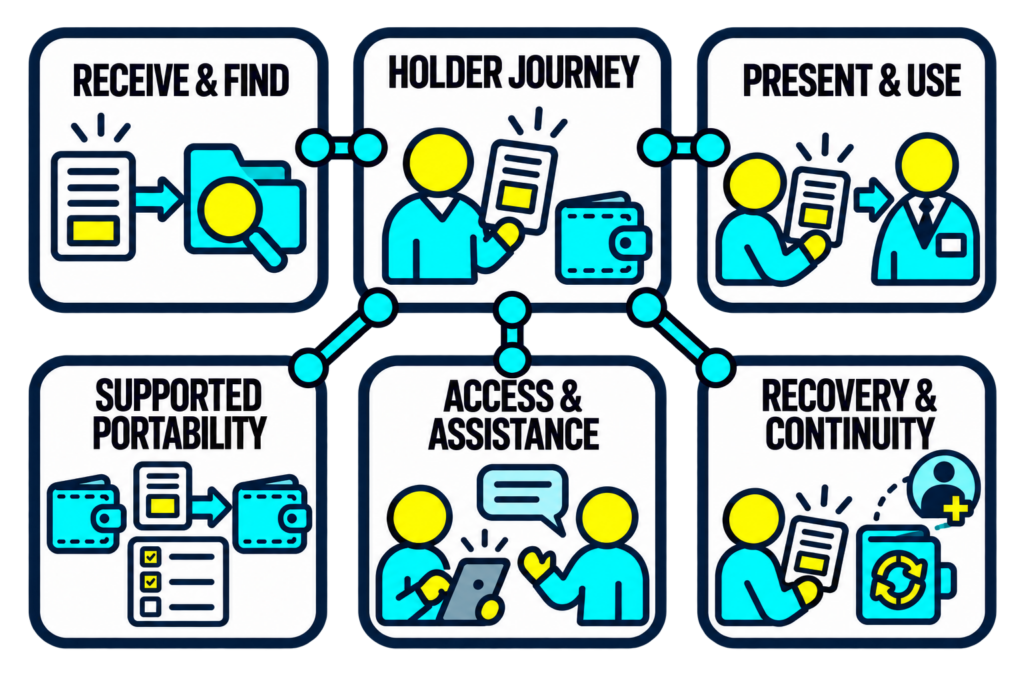
What this module can address
The selected scope may include:
The workshop selects the holder tasks and access conditions that materially affect the defined exchange.
- Record delivery and confirmation of receipt.
- Finding and recognizing records later.
- Understanding the selected record and request.
- Supported presentation steps.
- Device, browser, and connectivity assumptions.
- Named export and import arrangements.
- Information and properties preserved during movement.
- Accessibility and assistive technology questions.
- Language, comprehension, and alternative routes.
- Assistance roles and individual choices.
- Lost-access and record recovery scenarios.
- Service changes, continuity, and exit arrangements.
What kinds of responses might emerge?
The response depends on the gaps uncovered in the selected example.
Clearer receipt and retrieval instructions
Explain where the record arrives, how to recognize it, and how to find it again.
A workable presentation route
Define the supported steps, confirmation, and help available when someone presents the record.
A specific portability test
Identify the source, destination, method, and properties that must remain usable.
An accessibility and alternatives brief
Capture access needs, test questions, and alternative routes requiring confirmation.
An assistance and recovery arrangement
Assign support roles, individual choices, escalation, and responses to lost access.
A focused configuration brief
Specify the holder experience, supported tools, instructions, assistance boundaries, and dependencies a subsequent implementation would need.
Some responses may involve clearer instructions or better support. Others may require interface changes, additional testing, partner agreements, or technical work.
What we review together
The selected holder journey
What the person needs to receive, find, understand, and present.
The supported tools
The accounts, devices, wallets, browsers, and other arrangements involved.
Portability expectations
Named destinations, movement methods, preserved properties, and known limits.
Accessibility and practical conditions
Assistive technology, comprehension, language, connectivity, and device constraints.
Assistance responsibilities
Who helps, what they may do, and how the individual’s appropriate choices remain visible.
Recovery and continuity
Lost access, unavailable records, service changes, and accountable response routes.
The working exercise
Follow one record through ordinary use and an interrupted journey.
Choose a representative record and a supported route through which a person would receive and present it.
STEP 1
Describe the person’s task
Identify the record, intended recipient, purpose, and circumstances in which it will be used.
STEP 2
Walk through receipt and retrieval
Trace delivery, account requirements, recognition, and finding the record later.
STEP 3
Examine presentation
Review the request, information selection, receiving steps, and confirmation.
STEP 4
Test a move or alternative route
Name a destination or alternative method and identify what must remain usable.
STEP 5
Examine access and assistance
Consider an access need or practical constraint, then define help that preserves appropriate individual control.
STEP 6
Test interrupted access
Consider a lost device, changed contact detail, or unavailable service and assign recovery, support, and further validation.
The exercise produces a reviewed holder-journey, portability, and assistance brief for the selected example.
CONNECTING THE WORKSHOP TO A POSSIBLE GOBEKLI SETUP
Make the record journey usable for the person carrying it.
The workshop can help define how a subsequent Gobekli implementation would support the selected holder journey across TalentPass, TalentSync, Passport Pages, and participating systems.
Depending on confirmed scope and product availability, the configuration brief may describe:
- Record receipt and retrieval instructions.
- The supported holder account or wallet arrangement.
- Presentation requests and understandable choices.
- Named devices, browsers, or alternative routes.
- Export and import expectations.
- Information and properties that must be preserved.
- Accessibility and usability test scenarios.
- Assistance roles and individual-control boundaries.
- Recovery and support responsibilities.
- Service-transition instructions and dependencies.
The workshop clarifies the required experience before implementation is proposed.
Specific wallet functions, portability methods, accessibility support, recovery capabilities, delegated actions, and integrations must be confirmed separately against current product availability and partner requirements.
SCOPE AND BOUNDARIES
A focused review of the selected holder journey.
The module begins with the exchange defined through Workforce Infrastructure Direction.
It examines the tasks and supported arrangements through which people receive, find, present, move, and recover their records.
It does not automatically establish or deliver:
- Compatibility with every wallet or receiving system.
- Preservation of every feature through every export.
- An accessibility certification or complete accessibility audit.
- Guaranteed recovery in every circumstance.
- Authority for another person to act on someone’s behalf.
- Acceptance of a record by every recipient.
- Migration of all existing records or accounts.
- Production interfaces, recovery services, or integrations.
Appropriate accessibility, support, technical, and policy representatives may need to confirm the proposed arrangements.
Questions about identity, permissions, credential status, receiving acceptance, and operational sustainability connect to their respective modules when they affect the selected use case.
What should you bring?
One representative record and the current instructions for receiving or presenting it are enough to establish a practical starting point.
Include people who understand participant support and the tools involved. Use fictionalized or appropriately redacted examples where practical.
Helpful starting materials
- A description of the selected exchange.
- A representative record.
- Current delivery messages or instructions.
- Supported account and wallet arrangements.
- Presentation instructions from the recipient.
- Relevant device or browser requirements.
- Named portability destinations or methods.
- Known accessibility or usability concerns.
- Available language and assistance options.
- Current support roles and instructions.
- Recovery and record retrieval procedures.
- Known service-transition or exit requirements.
The workshop can identify unanswered questions without using live participant accounts, passwords, or recovery secrets.
What can you leave with?
A holder-journey map
The selected record’s receipt, retrieval, presentation, movement, and recovery steps.
A portability and access brief
Supported arrangements, properties to preserve, known constraints, and scenarios requiring testing.
An assistance and recovery outline
Helper responsibilities, individual choices, support routes, and responses to interrupted access.
A configuration and validation brief
Required experiences, responsible owners, technical dependencies, and representative tests for a subsequent implementation.
These outputs begin with the example reviewed during the module. Final scope depends on the modules selected, available inputs, and the exchange established through Workforce Infrastructure Direction.
Where might the work lead next?
Identity, Account Access & Record Matching
Clarify account access, recovery, and matching responsibilities that affect whether the appropriate person can retrieve and use their records.
Individual Control, Permissions & Data-Use Boundaries
Define presentation choices, assistance boundaries, recipient responsibilities, and what can be changed after information is shared.
Employer & Institutional Acceptance
Confirm how receiving organizations request, interpret, and use the records presented through the supported journey.
These modules extend different parts of the work. Selection depends on the problem and decision established through Workforce Infrastructure Direction.
Frequently asked questions
Questions organizations ask before beginning.
It addresses the practical difficulties people encounter when receiving, finding, presenting, moving, or recovering their records. It also examines accessibility and assistance within that journey.
The foundation establishes the selected exchange, intended benefit, participating organizations, and receiving use. Those choices determine which holder tasks and arrangements need review.
It refers to the selected arrangement through which a person holds or manages records for use. Partners identify the actual tools and supported functions instead of assuming every wallet works the same way.
No. The module defines named source and destination arrangements, the intended use, and the properties that need to remain available. Wider compatibility requires separate confirmation.
An export is one step. The workshop also asks whether the intended destination can use the result and whether the necessary information and properties have been preserved.
That depends on the selected arrangement. The workshop makes device assumptions explicit and examines which alternatives the participating organizations can support.
Those conditions can be included in the review. Partners identify workable steps, privacy considerations, and alternatives requiring confirmation rather than assuming the usual route is available.
It can identify tasks, user needs, and scenarios for testing and review available findings. A complete accessibility assessment or conformance determination is a separate scope.
Yes. The module can review whether instructions, record descriptions, and requests are understandable and identify where translation or other assistance is needed.
Yes, within a defined assistance arrangement. The workshop clarifies what staff explain or do, which choices remain with the individual, and which actions require additional authority.
No. Helping someone navigate or understand a task differs from performing an action under delegated or representative authority. The responsible organizations need to confirm any such authority.
The module traces the relevant recovery and support route. It identifies dependencies and unresolved cases without assuming every record or account can always be recovered.
That module examines identification, authentication, recovery authority, and matching uncertainty. This module follows the person’s usable journey and connects those mechanisms to instructions, assistance, and practical continuity.
The workshop can identify continuity and exit questions, including retrieval, supported movement, communications, and responsible owners. Specific arrangements require confirmation by the participating services.
Portability and acceptance address different questions. A person may successfully move or present a record while the recipient still needs to determine whether it meets the intended requirement.
The outputs can inform record delivery, retrieval, presentation, supported portability, assistance, and recovery requirements in a subsequent Gobekli configuration. Specific capabilities and integrations must be confirmed separately.
Partners can revise instructions, confirm support responsibilities, test representative journeys, and scope needed changes. Related modules can address identity, permissions, or receiving acceptance.
MAKE RECORDS WORKABLE FOR THE PEOPLE WHO CARRY THEM
Help people find, use, and carry their records forward.
Wallet Portability, Accessibility & Assisted Use helps your team connect the holder’s tasks to supported tools, understandable choices, appropriate assistance, and recovery routes.
Begin with Workforce Infrastructure Direction, then combine the modules that address the questions your participating organizations need to resolve.