
AN AI TRANSFORMATION WORKSHOP MODULE
The AI Handoff Problem:
Where Automation Creates Hidden Work
AI may complete a task faster while quietly shifting context-setting, checking, correction, coordination, approval, and exception handling back onto people.
If that work is not designed, supported, and measured, the promised productivity gain may not be real.
Does this sound familiar?
Employees spend time checking AI output
People must review AI-generated work before it can be trusted, shared, or used.
Errors return late in the workflow
Problems are discovered after the AI output has already moved into another task, system, or decision.
Exceptions overwhelm the team
AI handles routine cases quickly, but unusual or ambiguous cases accumulate around a smaller number of people.
Context disappears between tools
Employees repeatedly re-enter background information because the next tool or system does not receive what it needs.
Ownership becomes unclear
No one knows who is responsible for checking the output, resolving an exception, or approving the final result.
Productivity gains are hard to prove
The organization measures what AI produces but not the human effort required to make the output usable.
What is the AI handoff problem?
A human–AI handoff occurs whenever work, information, context, authority, or responsibility moves between a person and an AI system.
A person may give an AI assistant instructions and source material. The AI may generate an output that someone must review. A low-confidence result may be escalated to an employee. A worker may correct an error before passing the work into another system. A manager may approve the final decision.
These transfers are not inherently problematic. Many are necessary parts of responsible AI-enabled work.
The problem emerges when the handoff is incomplete, poorly designed, invisible, repeated, or unsupported. Important context may be lost. Responsibility may become unclear. Exceptions may be routed without the information needed to resolve them. Employees may absorb dozens of small tasks that were not included in the original automation plan.
The AI may appear to have completed its task while people quietly finish the job.
AI does not always remove work. It changes where the work goes.
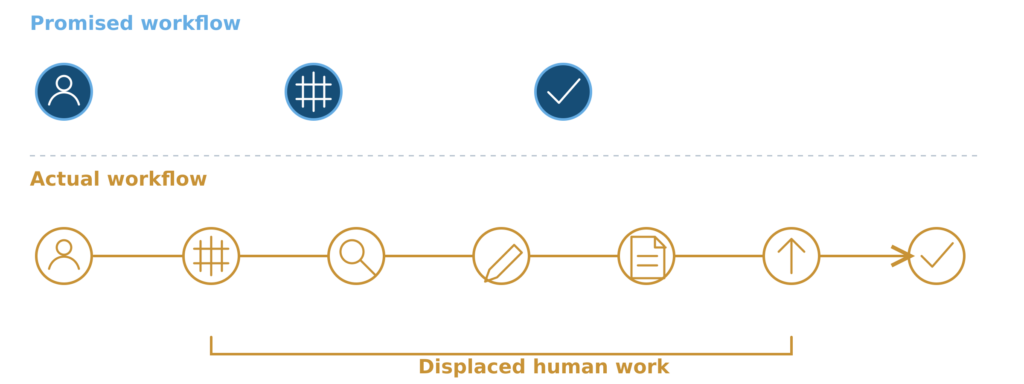
AI can accelerate drafting, classification, summarization, analysis, routing, and other individual activities. But faster task completion does not guarantee a faster or more reliable end-to-end workflow.
Some of this work represents necessary human judgment. Some results from disconnected systems, weak workflow design, unclear responsibilities, or an AI tool being applied to a task without considering everything around it.
When that work is hidden, the organization may count the time AI saved without subtracting the new human effort it created.
An AI-generated output may still require someone to:
- Supply missing organizational context
- Decide whether the result can be trusted
- Correct an error or misleading conclusion
- Reformat the output for another system
- Coordinate with the next person or team
- Resolve an unusual case
- Approve a consequential action
- Take responsibility for the outcome
How hidden handoff work appears
AI accelerates one task
The AI system completes a defined activity faster than the previous manual approach.
Context or exceptions remain
The output encounters ambiguity, missing information, unusual cases, quality concerns, or system boundaries.
People absorb the last mile
Employees check, correct, transfer, explain, coordinate, approve, and resolve what the AI could not complete.
Hidden work erodes the gain
The organization sees the faster AI task but not the human effort distributed across the rest of the workflow.
The human work AI productivity measures often miss
Most AI productivity measures concentrate on the task the technology performs: how quickly it produces an answer, how many items it processes, or how much direct manual effort appears to be removed.
Those measures can be useful, but they do not reveal the complete operating impact.
To understand whether AI is creating organizational value, leaders must examine the work required before, around, and after the AI-enabled task.
AI frequently needs information that is not available inside the tool. Employees may search for source material, reconstruct background, clean inputs, translate organizational knowledge into prompts, or explain the purpose of the task.
Someone must decide whether the result is accurate, appropriate, complete, and suitable for its intended use. Review becomes especially important when the output influences customers, employees, finances, safety, compliance, or other consequential decisions.
A fast first draft can still create work if employees must repair inaccurate statements, missing details, formatting problems, weak reasoning, or inappropriate recommendations.
AI-generated work may not arrive in the system where the next action occurs. Employees may copy, paste, reformat, tag, route, document, or explain the output before work can continue.
Routine cases may move faster while unusual cases become more concentrated. These exceptions often require more experience, judgment, context, and time than the cases AI completes successfully.
AI can contribute to an outcome, but it does not automatically establish who owns the decision. A person may still need to approve the action, explain the reasoning, answer questions, resolve harm, or accept accountability.
None of these activities should automatically be classified as waste. The question is whether they are necessary, properly assigned, adequately supported, and included in the organization’s understanding of AI value.
What leaders need to see clearly
Where work changes hands
Every transfer point is a potential source of context loss, delay, duplication, uncertainty, or necessary human judgment.
What travels with the handoff
The next contributor may need data, source material, assumptions, confidence, constraints, history, and a clear description of what happens next.
Which human work is necessary
Some decisions require judgment, empathy, accountability, professional expertise, or high-consequence review.
Where effort is accidental or duplicated
Employees may be repeating checks, recreating context, manually transferring information, or resolving exceptions that better design could prevent.
Not every human handoff is a failure.
The purpose of human–AI workflow design is not to remove people from every task. Human contribution can be the part of the process that makes an AI-enabled outcome trustworthy, responsible, and useful.
The organization must distinguish intentional human involvement from avoidable friction.
Necessary human contribution
Human involvement may be essential for:
- Judgment in ambiguous or high-risk situations
- Accountability for outcomes and commitments
- Empathy and relationship-sensitive decisions
- Interpretation of organizational or community context
- Professional judgment requiring qualified expertise
- High-consequence review and approval
- Resolution of genuinely novel exceptions
- Decisions involving values, priorities, or competing interests
This work should be visible, recognized, and supported. It should not be treated as an inconvenient remainder after automation.
Avoidable handoff friction
Human effort may be unnecessarily increased by:
- Context that should have transferred with the work
- Repeated correction of predictable mistakes
- Manual movement between disconnected tools
- Duplicate reviews with no clear purpose
- Poorly calibrated escalation rules
- Unclear ownership or approval responsibilities
- Exceptions routed without enough information
- AI outputs delivered in an unusable format
- Workflows designed around a demonstration rather than real operating conditions
This effort may not appear in a system report, but it still consumes time, attention, trust, and organizational capacity.
The goal is not to remove people from the workflow.
It is to make human contribution intentional, visible, and properly supported.
WORKSHOP MODULE DETAILS
How To Map Human-AI Handoffs & Hidden Work
This module traces where AI has moved or multiplied human checking, correction, coordination, approval, and exception handling.
Participants examine the complete workflow—not only the task performed by the AI—to understand how work moves between people, tools, systems, and decisions.
The module helps distinguish human contribution that should remain from avoidable friction that may need to be redesigned.
- Map every meaningful human–AI handoff
- Identify hidden review and assurance work
- Trace where context is retained, lost, or reconstructed
- Examine correction, coordination, and exception patterns
- Separate necessary human judgment from avoidable friction
- Clarify ownership, approval, and escalation responsibilities
- Identify what requires redesign, measurement, or further investigation
Where is the human effort accumulating?
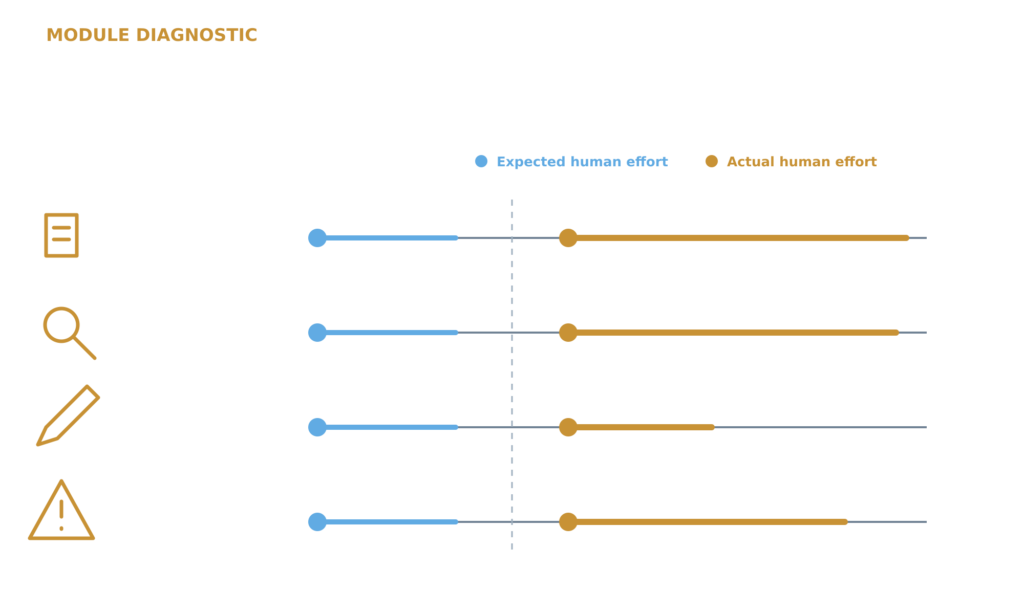
Expected human involvement and actual human effort are not always the same.
A Handoff Load Map helps the team examine where employees are absorbing more work than the workflow design anticipated.
Context
What information must people find, prepare, explain, or re-enter before the AI can perform effectively?
Verification
Which outputs must be checked, by whom, and according to what standard?
Correction
Where do employees repeatedly repair predictable errors, incomplete work, or unusable outputs?
Exceptions
Which cases leave the automated path, where do they go, and what does a person need to resolve them?
What should a human–AI handoff review examine?
Expected human involvement and actual human effort are not always the same.
A Handoff Load Map helps the team examine where employees are absorbing more work than the workflow design anticipated.
The transfer
What moves between the person and the AI system? Is the handoff clearly defined, or must the next contributor reconstruct the task?
The context
What information, history, assumptions, confidence, and constraints travel with the work? What is retained, lost, or recreated?
The authority
Who can make the decision, approve the result, change direction, or escalate the case? Is responsibility explicit?
The assurance work
What must a person check, correct, document, explain, repair, or own before the result becomes usable?
What to bring into the conversation
You do not need a perfect workflow map or a complete productivity study.
We begin with a bounded workflow, examples of what happens in practice, and the evidence your organization already has. The workshop helps separate documented facts from reported experiences, assumptions, and unanswered questions.
Useful inputs may include:
- Current workflow or process documentation
- Examples of AI-generated outputs
- Examples of corrections or follow-up work
- Known escalation or exception patterns
- Roles involved before and after the AI-enabled task
- Available measures of cycle time, throughput, quality, or rework
- Employee and manager observations
- Known points of delay, confusion, or repeated coordination
- Relevant policies, approval requirements, or quality standards
The goal is to understand the end-to-end work accurately enough to support a practical organizational decision.
What this module can help clarify
Where hidden work accumulates
Identify the tasks, handoffs, roles, and exceptions absorbing human effort beyond what the organization expected.
Which handoffs create friction
Distinguish transfers that support the work from those creating delay, duplication, context loss, or repeated correction.
What human contribution must remain
Clarify where judgment, accountability, empathy, expertise, and high-consequence review are essential.
How to redesign the workflow
Identify opportunities to improve context transfer, ownership, escalation, system integration, measurement, and employee support.
Final outputs depend on the modules selected and the decision established through the workshop’s required Decision Foundation.
Where might the work lead next?
Hidden human–AI work often connects to broader questions about value, failed automation, employee trust, and workflow design.
Proving AI Value & ROI
Measure AI value after human review, correction, coordination, quality, cost, and risk are included.
AI Boomerang Recovery
Repair automation or restructuring that removed work, knowledge, or accountability the organization still needs.
AI Adoption & Trust
Understand how workflow friction, unclear expectations, and weak support affect employee confidence and AI use.
Questions leaders ask before booking.
A human–AI handoff occurs whenever work, information, context, authority, or responsibility transfers between a person and an AI system.
Examples include an employee providing instructions to an AI assistant, a person reviewing an AI-generated output, an AI system escalating a low-confidence case, or a manager approving a recommendation before action is taken.
The handoff includes more than the output itself. A successful transfer may also require source material, assumptions, confidence, history, constraints, decision rights, and a clear next step.
AI can accelerate one activity while creating work elsewhere in the process.
Employees may need to prepare context, review outputs, repair errors, transfer information between systems, coordinate with other teams, handle exceptions, or assume responsibility for the result.
This does not necessarily mean the AI tool has failed. It may mean the workflow was designed around the AI task rather than the complete organizational outcome.
Not necessarily.
The appropriate level of human review depends on the purpose of the output, the consequences of error, the reliability of the system, the information involved, applicable requirements, and the organization’s tolerance for uncertainty.
Some outputs may require no individual review. Others may need sampling, threshold-based escalation, qualified professional judgment, or explicit approval before use.
This workshop can help structure the question, but it does not replace legal, cybersecurity, compliance, safety, or other specialist determinations.
Begin with the complete workflow rather than the AI task alone.
Examine the time and effort involved in preparing inputs, reviewing outputs, correcting errors, coordinating across tools, resolving exceptions, and approving results. Available measures might include cycle time, rework, exception volume, escalation frequency, quality problems, duplicate entry, delays, and employee observations.
Not every form of human effort must be converted into a single financial measure. The goal is to make the work visible enough to support an informed decision.
Improved AI performance may reduce some corrections, escalations, or exceptions. It will not automatically resolve missing context, disconnected systems, unclear ownership, weak decision rights, or poorly designed workflows.
The handoff problem is partly technical, but it is also organizational. It concerns how work, responsibility, information, and authority move across the complete process.
No. The module examines workflows, handoffs, operating conditions, evidence, and organizational dependencies—not individual employee performance.
Its purpose is to understand where human effort is required, why it exists, and whether the organization should support, redesign, measure, or investigate that work.
Every engagement begins with the required Decision Foundation, which establishes the consequential outcome, affected workflow, available evidence, and bounded decision the workshop must support.
Human–AI Handoffs & Hidden Work can then be selected when the organization needs to understand where AI has shifted, multiplied, or obscured human effort.
Depending on what the module reveals, it may be combined with modules addressing AI value, recovery, adoption, tool sprawl, talent coverage, or another connected problem.