
AN AI TRANSFORMATION WORKSHOP MODULE
AI Friction:
Find Out Why Employees Aren’t Adopting AI, and What to Fix First
AI tools, training, and pilots do not create adoption on their own. Employees make practical decisions about whether AI is useful, understandable, safe, supported, and compatible with the work they are expected to perform.
When leaders interpret every gap as resistance, they may miss the conditions that make adoption difficult, inconsistent, or unsafe.
Does this sound familiar?
Employees avoid approved AI tools
The organization provides an AI tool, but employees continue using familiar processes or find other ways to complete the work.
Usage spikes after launch, then fades
Initial interest produces activity, but regular use declines when employees encounter friction or cannot see sustained value.
Teams use AI inconsistently
Some employees integrate AI into everyday work while others use it occasionally, avoid it, or create their own approaches.
Training does not change the work
Employees complete courses and attend demonstrations, but the expected workflow or behavior never becomes normal practice.
Employees fear mistakes or consequences
People are unsure what is permitted, how their work will be judged, or what happens when AI produces an incorrect result.
Leaders call it resistance
I want to keep the same format as the others like AI Adoption Friction: Why employees
What is an AI adoption problem?
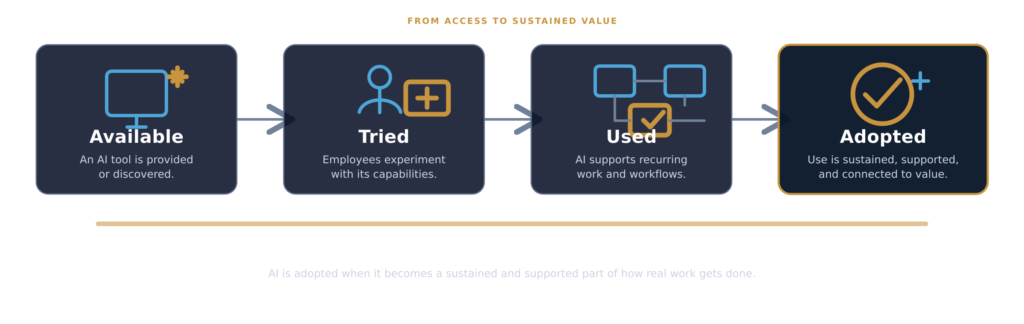
An AI adoption problem exists when employees do not use AI in the ways, situations, or workflows the organization expects—or when use remains inconsistent, superficial, fragile, or unofficial.
The visible symptom may be low usage. But the underlying problem can involve usefulness, trust, permission, capability, support, workflow fit, consequences, or several of these conditions at once.
Employees may avoid an approved tool because it adds steps, performs poorly, lacks necessary context, or does not fit the actual work. They may hesitate because policies are unclear or because they fear being blamed for an AI-generated mistake. Others may use unofficial tools because those options solve the work problem more effectively.
Adoption therefore does not mean maximizing usage. More activity is not automatically better. Responsible adoption occurs when people use an appropriate capability for appropriate work, with sufficient understanding, support, evidence, and accountability.
An adoption problem exists when the organization cannot explain why intended use is or is not occurring—or what must change to make useful, responsible practice possible.
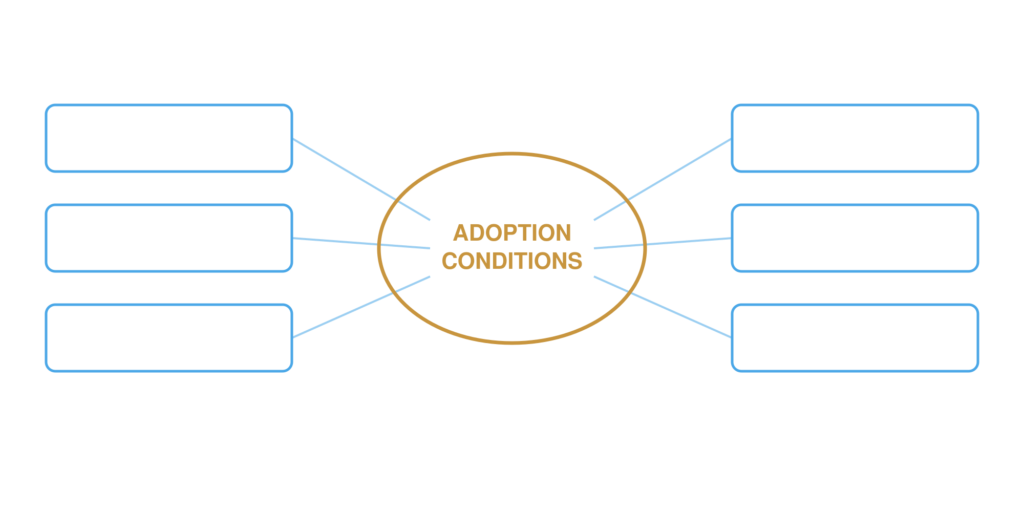
The problem is not simply resistance. It is the conditions surrounding adoption.
Employees do not adopt AI in isolation. They respond to the tool, the work, the expectations placed on them, the support available, and the consequences they believe may follow.
To understand the real barriers, leaders need to connect adoption to:
- The work employees are expected to perform
- The practical usefulness of the AI capability
- The quality and reliability employees experience
- The clarity of policies and permitted use
- The confidence employees have in reviewing outputs
- The training, time, and support available
- The compatibility of AI with the actual workflow
- The incentives and performance expectations surrounding use
- The consequences of mistakes, non-use, or disclosure
- The evidence connecting adoption to meaningful outcomes
Without these connections, low usage may look like unwillingness when the approved tool does not solve the work problem. High usage may look like success even when employees are creating hidden risk, duplicated work, or poor-quality outcomes.
A team may appear resistant because it has more complex exceptions than the pilot group. Employees may complete training but lack the time, data, permissions, or managerial support to apply it. A manager may encourage experimentation while employees remain uncertain about how mistakes will affect their performance.
Looking at the conditions surrounding adoption reveals where the organization can act.
How AI adoption breaks down
Technology is introduced
A tool, feature, pilot, or approved AI capability enters the organization with an intended use or expected benefit.
Expectations remain unclear
Employees receive broad encouragement or training without clear guidance about when, why, or how AI should be used in their work.
Friction and uncertainty accumulate
Employees encounter weak outputs, extra review, workflow disruption, policy questions, inadequate support, or unclear consequences.
People avoid, improvise, or disengage
Some employees return to familiar methods. Others use AI only superficially, create workarounds, or adopt unofficial tools that better meet the need.
Why an AI usage metric is not enough
Usage data can show whether an account was opened, a feature was activated, or an interaction occurred.
But usage answers only one question:
Was there activity?
A useful adoption review must answer several more.
Which employees, roles, teams, workflows, locations, or levels of responsibility show meaningful use, inconsistent use, or non-use?
Are employees applying AI to the intended workflow, experimenting with adjacent work, or using it for low-consequence tasks that do not affect outcomes?
Does use change depending on time pressure, customer sensitivity, data access, manager expectations, output quality, or the consequences of error?
Does the tool require extra preparation, context entry, verification, correction, system switching, approval, or documentation?
Are employees meeting an unmet work need, seeking better performance, avoiding slow processes, or responding to a lack of clarity and support?
Does appropriate use improve quality, speed, consistency, insight, customer experience, employee capacity, or another meaningful result?
Can another person or team continue the work, or would the organization lose capability, context, ownership, or decision quality?
Without this context, a usage metric can reward activity without showing whether adoption is useful, responsible, sustainable, or connected to the work that matters.
What leaders need to see clearly
Where adoption is enabled
Identify the teams, tasks, and conditions where AI is useful, understood, supported, trusted, and integrated into real work.
Where trust breaks down
Reveal where employees doubt the output, the policy, the purpose, the fairness of expectations, or the consequences of making a mistake.
Which conditions create friction
Understand the workflow, support, capability, permission, quality, and management conditions that make adoption difficult.
What should change first
Focus leadership attention on the few conditions most likely to improve useful and responsible adoption.
Low adoption is not the same as employee resistance.
Low usage may be visible, but behavior alone does not explain what employees are responding to.
Leaders should distinguish the behavior they observe from the organizational conditions producing it.
Visible behavior
Leaders may observe:
- Employees avoiding an approved tool
- Usage declining after an initial launch
- Usage declining after an initial launch
- Different practices across teams
- Employees returning to familiar processes
- Workarounds or unofficial tools emerging
- Training participation without changed behavior
- Managers struggling to enforce expectations
These behaviors are signals. They are not complete explanations.
Conditions underneath it
The behavior may reflect:
- A weak or poorly defined work need
- Limited usefulness or unreliable output
- Additional checking, correction, or coordination
- Unclear policies or inconsistent permission
- Insufficient capability, time, or support
- Poor integration with the actual workflow
- Fear of surveillance, displacement, or blame
- Incentives that reward other behavior
- Different operating conditions across teams
- Lack of evidence that the change improves outcomes
The appropriate response depends on which conditions are actually present.
The goal is not to force more AI activity. It is to create the conditions in which useful, appropriate, and supported adoption can occur.
Adoption grows when the work, expectations, support, and consequences make sense.
See the conditions. Fix what is blocking useful adoption. Enable what creates value.
WORKSHOP MODULE DETAILS
How to Diagnose AI Adoption & Trust
This module helps leaders understand why intended AI adoption is or is not occurring around a bounded workflow and organizational outcome.
Participants connect visible behavior to the usefulness, trust, permission, capability, support, workflow, and consequence conditions shaping employee decisions. The purpose is not to persuade employees to use AI regardless of the circumstances. It is to identify what should change to make appropriate adoption possible.
- Define what useful adoption should look like
- Connect intended AI use to real work and outcomes
- Examine usefulness, quality, and workflow fit
- Surface trust, permission, and consequence concerns
- Evaluate training, capability, time, and support
- Distinguish resistance from rational avoidance
- Identify unofficial use and workarounds
- Prioritize the conditions that should change first
- Develop an evidence-backed adoption response
What conditions are shaping adoption?
A tool can be available without being adoptable. The organization must understand whether employees experience the work need, usefulness, trust, permission, capability, support, and consequences required for sustained use.
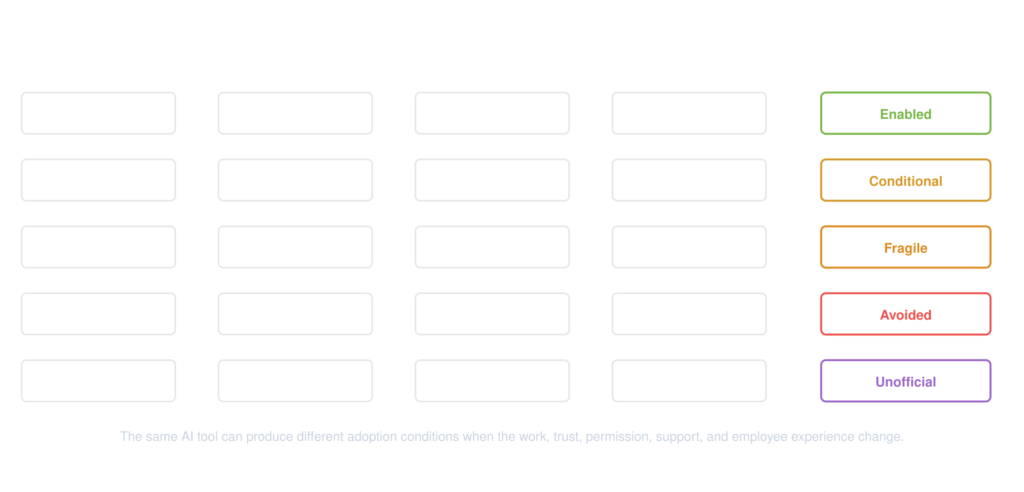
The Adoption Conditions Diagnostic organizes the available evidence into five practical conditions.
Enabled
Conditions support useful and responsible adoption The work need is clear, the capability creates value, expectations are understandable, employees have appropriate permission, and sufficient support is available.
Conditional
Adoption works only under certain circumstances The capability creates value for some tasks, teams, employees, or situations but does not yet support consistent use across the bounded workflow.
Fragile
Adoption exists but is difficult to sustain Employees are using AI, but use depends on extra effort, informal support, individual expertise, uncertain quality, or operating conditions that may not hold as adoption expands.
Avoided
Conditions discourage or prevent intended use Employees do not believe the capability is useful, reliable, permitted, safe, supported, or compatible with the work they must perform.
Unofficial
Adoption occurs outside approved visibility Employees use personal accounts, unapproved applications, undocumented prompts, or informal processes because those options meet a work need the official approach does not.
These categories describe organizational adoption conditions. They are not employee-performance ratings and should not be used to label individuals as resistant, compliant, or deficient.
What should an AI adoption review examine?
Expected human involvement and actual human effort are not always the same.
A Handoff Load Map helps the team examine where employees are absorbing more work than the workflow design anticipated.
The work
What should AI support, why does the work matter, and what outcome is the organization trying to improve?
The experience
How do employees encounter the tool, what must they do to use it, and what happens before and after the AI interaction?
The conditions
What usefulness, trust, permission, capability, support, workflow, management, and consequence conditions shape use?
The evidence
What usage patterns, observations, outcomes, quality measures, employee input, and workflow evidence explain what is happening?
What to bring into the conversation
You do not need perfect adoption analytics, a completed employee survey, or a comprehensive change-management assessment.
We begin with the evidence and observations your organization already has. The workshop then helps distinguish visible behavior from assumptions, missing information, and the conditions requiring closer examination.
Useful inputs may include:
- The AI tool, feature, pilot, or capability being considered
- The intended workflow or use case
- The outcome adoption is expected to improve
- Available usage and participation data
- Training materials and attendance records
- Policies, guidance, and permitted-use statements
- Communications used during launch or rollout
- Employee and manager observations
- Support requests and recurring questions
- Available quality, productivity, or outcome measures
- Known workarounds or unofficial tools
- Examples of successful use
- Examples of avoidance, abandonment, or misuse
- Known privacy, security, legal, or workforce concerns
- Differences across roles, teams, locations, or managers
The goal is not to judge the entire workforce in one session. The Decision Foundation establishes the outcome, workflow, population, and adoption decision the module should examine.
What this module can help clarify
Where adoption is working
Identify the tasks, teams, and conditions where AI is creating useful, supported, and repeatable practice.
Why people hesitate or bypass
Reveal the real usefulness, trust, permission, capability, workflow, and consequence conditions influencing behavior.
What support is missing
Surface gaps in training, guidance, management, time, documentation, integration, specialist support, or employee involvement.
What conditions to change
Prioritize practical changes that could improve appropriate adoption without forcing activity that does not serve the work.
Final outputs depend on the modules selected and the decision established through the workshop’s required Decision Foundation.
Where might the work lead next?
AI adoption problems frequently overlap with hidden work, capability gaps, and unclear governance. An adoption review may reveal that another transformation problem should be addressed alongside employee use.
Hidden Human–AI Handoffs
Reveal where AI introduces unexpected checking, correction, context preparation, coordination, or exception handling that discourages sustained use.
AI Talent & Knowledge Gaps
Identify whether employees have the capabilities, institutional knowledge, capacity, and support required to use AI effectively.
AI Governance & Accountability
Clarify policies, ownership, decision rights, controls, escalation paths, and boundaries requiring specialist review.
Questions leaders ask before booking.
Employees may avoid or inconsistently use AI for many reasons. The tool may not solve a meaningful work problem, may produce unreliable results, or may require more checking and correction than the existing process.
Employees may also lack clear permission, relevant training, managerial support, workflow integration, time to experiment, or confidence about what happens when AI makes a mistake.
Low adoption should therefore be treated as a signal requiring investigation—not automatic proof that employees are resistant to change.
Not necessarily.
Employees can resist a change, but what appears to be resistance may also be a rational response to poor usefulness, weak quality, unclear expectations, additional work, inconsistent management, or perceived risk.
Labeling employees as resistant too early can prevent leaders from seeing legitimate problems in the technology, workflow, implementation, or organizational environment.
The module examines both employee concerns and the conditions surrounding them.
Usage can be one useful measure, but it should be interpreted alongside the work performed and the outcomes the organization is trying to improve.
A meaningful adoption view may combine:
- Appropriate usage within the intended workflow
- Frequency and consistency of use
- Employee and manager observations
- Output quality and correction requirements
- Time, cost, or workflow effects
- Customer or operational outcomes
- Workarounds and unofficial use
- Support requests and abandonment patterns
- Confidence, permission, and trust indicators
The appropriate measures depend on the bounded use case and the consequences of the work.
No.
High usage can reflect useful adoption, but it can also include experimentation, superficial activity, duplicated effort, inappropriate use, or behavior driven by pressure rather than value.
The goal is not maximum activity. It is appropriate, supported use that improves a meaningful outcome without creating disproportionate hidden work, quality problems, or risk.
Training can help when employees lack relevant knowledge or confidence, but training cannot resolve every adoption condition.
A course will not fix a tool that does not meet the work need, unclear permission, poor integration, unreliable outputs, insufficient time, inconsistent management, or consequences that make experimentation feel unsafe.
Training should be connected to real work, appropriate support, opportunities to practice, and evidence that employees can apply what they learn.
Trust affects whether employees believe the capability, organization, and surrounding process are dependable enough to use.
Employees may ask whether outputs are accurate, whether they are permitted to use certain information, whether the system is fair, whether their work is being monitored, whether AI use could affect their role, and who is accountable when something goes wrong.
Trust does not require employees to believe AI is always correct. It requires clear expectations about where the system is useful, where human judgment remains necessary, and how uncertainty or mistakes should be handled.
Leaders should not assume all concerns are irrational or attempt to solve them only through reassurance.
Employees may have legitimate questions about job security, surveillance, workload, quality, fairness, customer impact, responsibility, or professional standards. Leaders should identify the specific concern, provide accurate information, clarify what is known and unknown, and involve appropriate HR, legal, privacy, security, labor, accessibility, or other specialists when required.
Trust grows through credible decisions and operating conditions—not messaging alone.
That depends on the role, workflow, capability, organizational policy, and applicable legal or professional requirements.
Before mandating use, leaders should determine whether the capability is appropriate for the work, sufficiently reliable, accessible, supported, permitted, and connected to a meaningful outcome.
Organizations should also clarify how performance will be evaluated, what human review remains necessary, and how employees can raise concerns or report problems.
The workshop does not make employment-policy or legal determinations.
No.
The module examines workflows, tools, expectations, support, evidence, and organizational conditions. It is not designed to monitor individual employees, rank personal performance, or identify people for disciplinary action.
Any employee-level information should be handled in accordance with organizational policy, applicable law, privacy requirements, labor obligations, and appropriate professional guidance.
Every engagement begins with the required Decision Foundation, which establishes the consequential outcome, affected workflow, available evidence, and bounded decision the workshop must support.
Adoption, Trust & Change Conditions can then be selected when the organization needs to understand why intended AI use is enabled, inconsistent, fragile, avoided, or unofficial.
Depending on what the module reveals, it may be combined with modules addressing hidden human–AI work, talent and knowledge coverage, governance, value and ROI, scale conditions, or another connected problem.
Create the conditions for AI to become useful, trusted work.
Connect employee behavior to the work, usefulness, trust, permission, capability, support, and consequences shaping adoption.
This module is part of Gobekli’s configurable AI Transformation Workshop. Explore the complete workshop, its 12-module structure, and how we identify the right starting point for your organization.
