
AN ORGANIZATIONAL GROWTH & EXPANSION WORKSHOP MODULE
New Department Design:
Build the Function Before You Fill the Org Chart
Growth often creates work that no existing team clearly owns. A new customer segment, product line, operational requirement, geographic expansion, or organizational capability may justify a dedicated function.
The common response is to name a department, hire a leader, and begin filling positions.
But an org-chart box is not yet an operating function.
A new department needs a clear purpose, defined work, appropriate authority, capable people, supporting systems, measurable outcomes, and working relationships with the rest of the organization.
Does this sound familiar?
The department begins with a job title
Leadership decides to hire a vice president, director, or department head before defining what the function must accomplish.
Responsibilities are borrowed from existing teams
Work is moved into the new department without determining which responsibilities belong together or what should remain elsewhere.
A leader inherits an undefined mandate
The new leader is expected to build the function while simultaneously discovering its purpose, boundaries, priorities, and authority.
Decision rights remain elsewhere
The department is held accountable for outcomes but lacks the authority to make decisions, access information, or control the resources involved.
Processes and systems arrive after hiring
People join before workflows, tools, data, measures, and cross-functional handoffs have been designed.
Conflict appears immediately
Existing teams and the new function disagree about ownership, priorities, approvals, customer relationships, resources, or who has the final say.
What is new department and function design?
New department and function design is the deliberate process of translating an organizational need into a workable operating structure.
It connects:
- The organizational outcome the function must support
- The customers, employees, partners, or stakeholders it serves
- The work and decisions required
- The responsibilities the function should own
- The responsibilities that should remain elsewhere
- The roles and capabilities needed
- The authority required to act
- The systems, information, and resources involved
- The interfaces with other parts of the organization
- The evidence that will demonstrate progress
- The conditions under which the function may need to change
A function and a department are related, but they are not identical.
A function is a coherent body of work or organizational capability. A department is one possible structural home for that work.
Some functions require a dedicated department. Others may be distributed across existing teams, provided through a shared service, organized as a center of excellence, supported by an external partner, or developed through a hybrid model.
The design process should determine the structure—not assume it in advance.
The problem is not where the box sits. It is whether the function can operate.
An org chart can show reporting relationships. It cannot explain how a department creates value, makes decisions, completes work, resolves conflict, or coordinates with the rest of the organization.
To design a functioning department, leaders need to connect:
- The growth outcome creating the need
- The customers or stakeholders affected
- The activities required to produce the outcome
- The responsibilities the function will own
- The authority required to carry those responsibilities
- The roles and capabilities needed
- The systems, information, and resources involved
- The work that will transfer from existing teams
- The dependencies and handoffs crossing functional boundaries
- The measures that will indicate whether the function is working
- The sequence through which the function should be established
Without these connections, a new department can become a collection point for unresolved work.
The organization has added structure without establishing an operating model.
See the complete function
not just the reporting structure.
Purpose and Outcomes
- Growth objective
- Customer or stakeholder need
- Organizational value
- Required service or capability
- Success conditions
Work and Responsibilities
- Core activities
- Recurring workflows
- Decisions and approvals
- Service responsibilities
- Work that remains elsewhere
Roles and Capabilities
- Leadership responsibilities
- Individual contributor roles
- Technical capabilities
- Human capabilities
- Capacity requirements
Authority and Interfaces
- Decision rights
- Escalation paths
- Cross-functional handoffs
- Shared responsibilities
- Internal and external partners
Systems and Evidence
- Technology and tools
- Data and information
- Policies and processes
- Resources and budget
- Measures and feedback
A new function becomes viable when its purpose, work, people, authority, interfaces, systems, and evidence are designed as one connected operating system.
How poorly designed departments take shape
STAGE 1
A legitimate organizational need appears
Growth creates new work, greater complexity, increasing risk, or a capability requirement that existing teams cannot absorb indefinitely.
STAGE 2
A department is announced
The organization chooses a name, reporting line, leader, or initial headcount before fully defining the work and operating requirements.
STAGE 3
People organize around ambiguity
New and existing employees negotiate responsibilities informally while processes, authority, systems, and success measures remain unclear.
STAGE 4
Duplication and conflict compound
Work falls between teams or is performed several times. Decisions escalate, costs rise, and the new function struggles to demonstrate its contribution.
An org chart cannot tell a department how to operate.
A reporting structure is an important design decision, but it answers only one question:
Who reports to whom?
A functioning department requires answers to several more.
A useful review must ask:
What organizational result, customer need, service commitment, operational capability, or risk condition justifies the function’s existence?
Which activities, workflows, decisions, services, and recurring responsibilities are required to produce that outcome?
Which responsibilities should remain with existing departments, leaders, shared services, external partners, or frontline teams?
Which decisions can the function make independently? Which require consultation, shared agreement, approval, or escalation?
What information, resources, approvals, services, customers, or deliverables must move between the new function and the rest of the organization?
What measures, observations, service levels, outcomes, feedback, or operating signals will demonstrate whether the function is creating value?
What leaders need to see before launching a new department
The purpose
Clarify the organizational need the function exists to address and the outcomes it should influence.
The boundaries
Define which work belongs inside the function, which remains elsewhere, and where shared responsibility is unavoidable.
The ownership
Identify who is accountable for activities, workflows, decisions, services, resources, and outcomes.
The authority
Determine whether the function has sufficient decision rights, access, budget, information, and leadership support.
The interfaces
Make dependencies, handoffs, approvals, service relationships, escalation paths, and cross-functional commitments visible.
The operating evidence
Establish how leadership will evaluate capacity, quality, service, cost, responsiveness, adoption, and contribution.
Org-chart-first department
An org-chart-first approach may emphasize:
- Department name
- Executive title
- Reporting line
- Initial headcount
- Budget ownership
- Position hierarchy
- Titles borrowed from other organizations
- Responsibilities collected from existing teams
- Immediate recruitment
- A fixed structure announced in advance
These decisions can create the appearance of progress while leaving the function itself undefined.
Function-first design
A function-first approach examines:
- The outcome creating the need
- The work required
- Customers and stakeholders served
- Responsibility boundaries
- Decision rights
- Roles and capabilities
- Cross-functional interfaces
- Systems and information
- Measures and feedback
- Launch sequence and transition conditions
The resulting structure is built around the work rather than assumed before the work is understood.
Should this become a department at all?
A new organizational need does not automatically require a permanent standalone department. Possible structures include:
- Dedicated department
- Expanded existing function
- Distributed responsibility
- Center of excellence
- Temporary or transitional team
- External partnership
- Hybrid model
The structure should follow the work.
The appropriate response depends on the work, capability, scale, frequency, strategic importance, coordination requirements, and evidence available.
The structural choice should remain open until leaders understand what the organization needs the function to accomplish.
Build the function before
you fill the org chart.
Connect purpose, work, authority, people, systems, and evidence.
WORKSHOP MODULE DETAILS
Module 3: New Department & Function Design
This module helps participants translate an organizational need into a coherent function, operating model, and implementation path.
The workshop examines the outcomes the function must support, the work it should own, the authority it requires, the capabilities involved, and the relationships it must establish across the organization.
The purpose is not simply to draw a department. It is to determine how the function can operate responsibly and contribute to the growth decision established through the workshop.
This module helps your team:
- Clarify why the function is needed
- Define the outcomes it should support
- Map the activities and workflows involved
- Establish responsibility boundaries
- Identify required decision rights
- Define leadership and contributor roles
- Determine capability and capacity requirements
- Design cross-functional interfaces
- Identify systems, information, and resource needs
- Compare structural options
- Develop a staged launch or transition path
- Establish evidence for reviewing the design
How should the organization establish the required function?
Not every capability gap requires the same organizational response. The structure should reflect the work, strategic importance, scale, available capability, and level of coordination required.
Create
Establish a dedicated department when the work is distinct, sustained, and consequential enough to require dedicated leadership, authority, resources, and accountability.
Formalize
Turn existing informal work into a defined function with clear responsibility, authority, processes, staffing, and measures.
Expand
Strengthen an established department with the additional capacity, expertise, systems, or authority required to own the work.
Distribute
Keep work across several functions while establishing explicit ownership, interfaces, decision rights, and coordination mechanisms.
Partner
Combine internal ownership with external expertise, shared services, contractors, technology, or another partner arrangement.
Investigate
Resolve uncertainty about the need, work, capability, demand, cost, risk, or operating relationships before fixing the structure.
These categories structure organizational design decisions. They are not automatic recommendations based on headcount, hierarchy, industry convention, or the preferences of a single leader.
What should a new department review examine?
The outcome
What organizational need justifies the function? Which customer, workforce, operating, growth, or risk outcome should it support?
The work
Which activities, workflows, decisions, services, and responsibilities must be performed consistently?
The capability
What knowledge, skills, relationships, experience, tools, and leadership capacity does the work require?
The authority
Which decisions, resources, information, approvals, and escalation mechanisms are necessary for the function to operate?
The interfaces
Where will the function depend on, provide service to, share responsibility with, or create consequences for other teams?
The evidence
What observations, workload signals, service gaps, delays, costs, risks, customer needs, or measures support the proposed design?
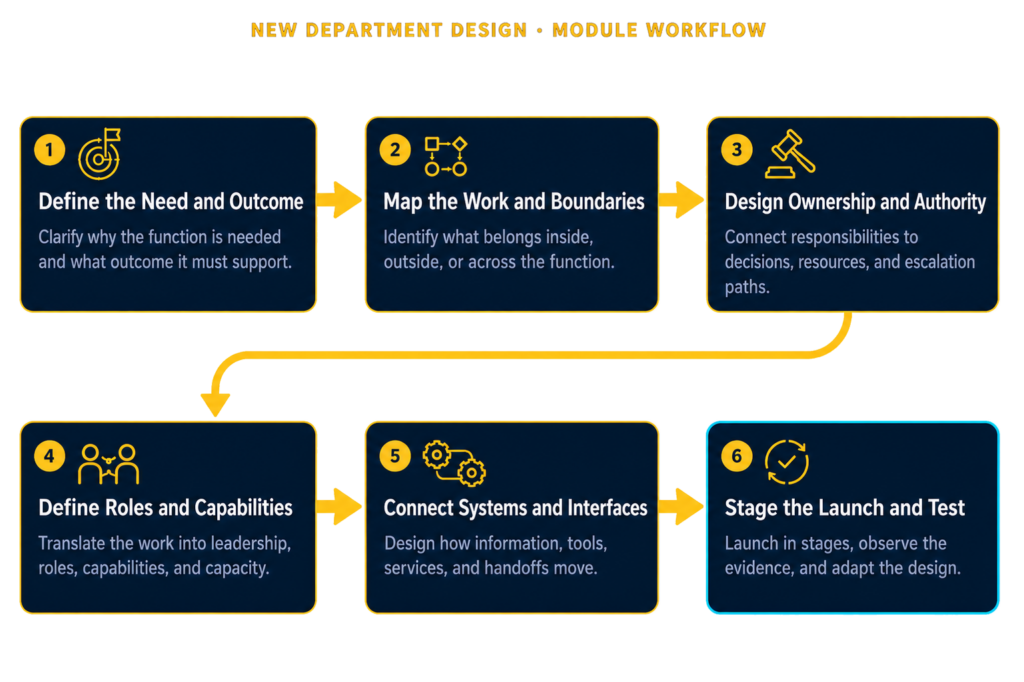
Build the operating function before finalizing the org chart.
The goal is to create enough operating clarity for the organization to launch deliberately, observe what happens, and adapt the structure with evidence.
STEP 1
Define the need and outcome
Clarify the growth condition creating the need, the people affected, and the organizational outcome the function must support.
STEP 2
Map the work and boundaries
Identify the activities, workflows, services, decisions, and responsibilities involved—then distinguish what belongs inside, outside, or across the function.
STEP 3
Design ownership and authority
Assign responsibility for the work and determine the decision rights, approvals, resources, access, and escalation paths required.
STEP 4
Define roles and capabilities
Translate the work into leadership responsibilities, contributor roles, capability requirements, capacity assumptions, and potential sourcing needs.
STEP 5
Connect systems and interfaces
Design how information, tools, resources, approvals, services, and deliverables will move between the function and the rest of the organization.
STEP 6
Stage the launch and test the design
Sequence the transition, identify early operating evidence, establish review points, and revise the model as the organization learns.
The goal is not to predict every future detail. It is to create enough operating clarity for the organization to launch the function deliberately, observe what happens, and adapt the structure with evidence.
- Connect responsibility to authority
- Design around the work ahead
- Make cross-functional interfaces explicit
- Sequence people, systems, and process changes
- Test assumptions with operating evidence
- Keep the structure adaptable
MAKE THE FUNCTION VISIBLE
Connect organizational design to the people and capabilities required.
TalentSync can help the organization maintain a structured view of the work, roles, activities, capabilities, relationships, and evidence connected to a new function.
This information can help leaders compare the proposed operating design with the capabilities currently available.
Depending on the available implementation and organizational context, that view may include:
- Organizational and function profiles
- Roles and reporting relationships
- Activities associated with each role
- Skills and their origins
- Credentials and experience
- Active capabilities
- Latent or underused capabilities
- Capability gaps
- Cross-functional relationships
- Leadership and contributor responsibilities
- Evidence requiring confirmation or development
- Potential internal and external talent sources
TalentSync may reveal that required capability already exists inside the organization, that important knowledge is concentrated in one person, or that a proposed role combines responsibilities that are unlikely to fit together effectively.
It does not independently determine the correct structure or assign people to roles.
PRODUCT AND DECISION BOUNDARIES
Organizational evidence supports design judgment. It does not make the decision.
TalentSync and the workshop should not be presented as:
- Automatically designing the department
- Determining the correct reporting structure
- Deciding who should lead the function
- Assigning people to roles without human judgment
- Predicting employee success
- Producing a definitive culture match
- Replacing leadership or employee consultation
- Making legal, tax, employment, or compliance determinations
- Guaranteeing that a proposed function will perform as expected
The process helps leaders structure the work, make relationships visible, identify evidence gaps, and compare organizational options.
Employment, labor, privacy, accessibility, cybersecurity, finance, tax, regulatory, and other questions may require review by qualified specialists.
What to bring into the conversation
You do not need a finished org chart, complete job descriptions, or a predetermined leadership structure.
We begin with the growth decision, operating evidence, and organizational observations already available.
Useful inputs may include:
- The growth objective creating the need
- Customer or stakeholder requirements
- Current and expected workload
- Work currently performed informally
- Existing department and role descriptions
- Organizational charts
- Process or workflow documentation
- Service-level expectations
- Known ownership and accountability gaps
- Decision and approval bottlenecks
- Cross-functional tensions
- Current systems and data sources
- Budget and resource assumptions
- Internal capability information
- Expected hiring or partnership needs
- Measures related to quality, cost, speed, risk, or customer experience
- Employee and manager observations
The required Growth Direction module establishes the outcome, boundary, constraints, evidence, and organizational decision this module should support.
What this module can help clarify
What the function should own
Define the outcome, work, services, decisions, and responsibilities that justify the function.
Where its boundaries should sit
Distinguish work that belongs inside the function from work that should remain elsewhere or be shared.
What structure and roles are required
Translate the work into leadership responsibilities, contributor roles, capability requirements, and capacity assumptions.
How it should connect to the organization
Clarify interfaces, handoffs, shared responsibilities, approvals, information flows, and escalation paths.
Final outputs depend on the modules selected and the organizational decision established through the workshop’s required Growth Direction module.
Where might the work lead next?
Questions leaders ask before booking.
New department design translates an organizational need into a functioning structure with a defined purpose, body of work, responsibility boundaries, decision rights, roles, capabilities, systems, measures, and cross-functional relationships.
A function is a coherent body of work or organizational capability. A department is one possible structural home for that work. A function may instead be distributed, shared, partnered, or organized through a hybrid model.
A new department may be appropriate when a consequential body of work is recurring, strategically important, difficult to coordinate through existing teams, and substantial enough to require dedicated ownership, authority, capability, and resources.
Specialist leadership may need to participate in the design, but hiring into a completely undefined mandate transfers unresolved organizational work to the new employee. Establish enough clarity for candidates to understand the opportunity while leaving room for the incoming leader to refine it.
Map current activities and decisions, identify what should transfer or remain, and define explicit interfaces and decision rights wherever responsibility is shared.
The reporting line should follow the outcomes, work, authority, dependencies, conflicts, and leadership support the function requires. There is no universal structure that works for every organization.
Establish enough clarity around purpose, priorities, boundaries, authority, roles, interfaces, resources, and measures for people to begin responsibly. Include assumptions and review points so the model can adapt.
That depends on the work. Centralization may support consistency and expertise; distributed ownership may keep decisions close to customers or operations. Many functions require a hybrid model.
A function cannot be accountable for an outcome if it lacks appropriate authority over the decisions, resources, information, or conditions involved. Clarify which decisions it owns, shares, influences, or escalates.
No. TalentSync can structure information about organizations, roles, activities, capabilities, relationships, and evidence. Leaders remain responsible for interpreting that evidence and making structural decisions.
Not necessarily. It may establish a new capability, formalize informal work, or reorganize existing responsibilities. Changes with employment, labor, legal, financial, or regulatory implications may require specialist review.
Every engagement begins with Growth Direction. New Department & Function Design is selected when the organization needs to establish, formalize, expand, distribute, or reconsider a capability required for growth.
DESIGN THE FUNCTION BEFORE YOU FILL THE BOXES
Build a department that can own outcomes—not just accumulate work.
Connect organizational needs to work, authority, roles, capabilities, systems, interfaces, and evidence—then establish the structure the function actually requires.
This module is part of Gobekli’s configurable Organizational Growth & Expansion Workshop.