
A LEARNING VISIBILITY & CREDENTIALING WORKSHOP MODULE
Student Learning Visibility:
See What Learners Know and Can Do
Institutions collect enormous amounts of information about students—but still struggle to see the complete learning taking shape across courses, projects, assessments, credentials, work, and other experiences.
Grades and transcripts document important achievements. They rarely explain the activities learners performed, the capabilities they developed, the evidence supporting those capabilities, or how learning connects across experiences.
Student Learning Visibility helps institutions make development easier for learners, educators, advisors, and authorized partners to understand.
Does this sound familiar?
Learning disappears inside courses
Assignments, projects, feedback, and demonstrated capabilities become difficult to find after a course ends.
Grades carry more meaning than they can explain
A grade summarizes performance within a course but does not show everything the learner practiced, produced, understood, or demonstrated.
Evidence is scattered across systems
Relevant information lives in the LMS, student information system, assessment platforms, e-portfolios, credential systems, advising tools, and personal files.
Co-curricular learning remains separate
Internships, research, student employment, clubs, competitions, service, and community participation may not appear alongside academic learning.
Students repeatedly reconstruct their progress
Learners rebuild résumés, applications, portfolios, and personal statements because their evidence does not remain connected across purposes.
Educators cannot see the complete learner
Faculty and advisors see the information available to their role or system, not necessarily the broader learning journey relevant to the decision.
What is student learning visibility?
Student learning visibility is the ability to understand how a learner’s activities, experiences, evidence, outcomes, capabilities, and credentials connect across their educational journey.
Learning may develop through courses, assignments, projects, research, laboratories, simulations, internships, student employment, service, organizations, competitions, independent learning, previous education, and professional development.
Visibility does not mean collecting every possible detail or making all information available to everyone. It means creating a purposeful, permission-aware view of the learning relevant to a defined learner goal or institutional decision.
The problem is not a lack of student data. It is a lack of connected learning context.
Institutions already hold extensive data about enrollment, attendance, grades, course completion, assessment, advising, credentials, and student activity. Those records answer important administrative questions but do not always explain how learning developed or what the learner can now do.
A useful view connects the learner’s goal, learning experience, activities, outcomes, evidence, feedback, capabilities, credentials, reflection, next opportunity, authorized users, and the support for any conclusion.
Without these relationships, institutions may have more student data than ever while learners remain difficult to understand.
See the complete learning journey—not just the academic record.
Learning Experiences
- Courses and programs
- Projects and research
- Work-based learning
- Co-curricular activities
- Prior and independent learning
Activities
- Problems addressed
- Work performed
- Decisions made
- Tools and methods used
- Contributions to teams
Learning Evidence
- Assignments and artifacts
- Assessments
- Demonstrations
- Feedback
- Verified records
Capabilities & Outcomes
- Knowledge
- Technical capabilities
- Human capabilities
- Program outcomes
- Emerging strengths
Purposeful Views
- Academic planning
- Learner reflection
- Advising
- Opportunity profiles
- Credential and career pathways
Learning becomes visible when experiences, activities, evidence, capabilities, outcomes, and purposeful next steps can be understood together.
How learning becomes fragmented
STAGE 1
Learning occurs across many settings
Students learn through courses, projects, employment, service, research, collaboration, practice, and experiences outside the institution.
STAGE 2
Each system captures a different fragment
The LMS stores assignments, the student information system stores grades, credential platforms store awards, and individuals retain evidence in personal accounts or files.
STAGE 3
Context is lost between systems
Activities, evidence, feedback, outcomes, and credentials are separated from the experiences that gave them meaning.
STAGE 4
Learners and institutions reconstruct the story
Students repeatedly explain what they learned while educators, advisors, and partners make decisions from incomplete or disconnected information.
A transcript is essential—but it was not designed to tell the whole learning story.
A transcript documents courses, grades, credits, terms, credentials, and academic standing. It provides an authoritative institutional record for important purposes.
Learning visibility complements the transcript by connecting it to richer evidence and context needed for a particular purpose.
A transcript may not show:
The same course title may contain different projects, activities, tools, experiences, and areas of emphasis.
A final grade does not provide direct access to the research, design, analysis, performance, presentation, or other work behind it.
Relevant learning may appear across several courses and experiences rather than within a single academic record.
Team projects, internships, laboratories, research, and community work require context about contribution and responsibility.
Employment, service, extracurricular activity, and independent projects may reinforce or extend formal study.
The record may not explain which evidence is relevant to a course, credential, transfer pathway, internship, job, or goal.
What can make student learning visible?
Assignments and work products
Research papers, designs, analyses, presentations, code, performances, plans, prototypes, and other products can show learning directly.
Assessments and demonstrations
Examinations, simulations, practical assessments, observed performances, and demonstrations can provide evidence against defined expectations.
Feedback and evaluation
Faculty comments, rubrics, supervisor observations, peer feedback, and structured reflection can help explain quality and development.
Experience records
Courses, internships, employment, research, service, leadership, and project roles establish where learning occurred.
Credentials and achievements
Degrees, certificates, badges, licenses, awards, and verified achievements can confirm recognized learning or participation.
Learner interpretation
Learners can explain what they did, what they learned, how evidence connects, and why the experience matters to their next goal.
Record collection
A collection-centered approach may emphasize:
- Number of data sources connected
- Volume of artifacts stored
- Courses and credits completed
- Assessment scores
- Badges and credentials earned
- Participation records
- Activity logs
- Data retained indefinitely
These records may be useful without explaining how the pieces relate or what decision they should support.
Learning visibility
A visibility-centered approach examines:
- The learner’s current purpose
- Relevant experiences
- Activities performed
- Evidence of learning
- Outcomes and capabilities
- Development across time
- Context and responsibility
- Learner participation and control
- An appropriate next step
The goal is to make the right learning understandable for the purpose in front of the learner.
The complete learner is not a single universal profile.
A student may need different views of the same underlying learning for different purposes.
Purpose-built visibility
- Academic planning: Completed learning, current development, prerequisites, and remaining requirements.
- Advising: Learning, interests, goals, barriers, opportunities, and unresolved questions.
- Transfer or recognition: Courses, outcomes, credentials, prior learning, and relevant evidence.
- Internship or employment: Selected activities, capabilities, projects, accomplishments, and evidence.
- Learner reflection: Development, connections, uncertainties, and future goals.
- Institutional improvement: Appropriately governed aggregate evidence about programs and support.
Purpose-built views reduce unnecessary disclosure while making relevant learning easier to interpret.
Making learning visible should not mean making the learner permanently observable.
Learner-centered visibility begins with a defined purpose, proportionate information, understandable sources, meaningful learner participation, review and correction, appropriate consent, purpose-specific Profiles, human interpretation, and clear limits.
Visibility becomes surveillance when it relies on continuous behavioral monitoring, hidden collection, unrelated information, indefinite retention, opaque inferences, universal scores, automated judgments, unclear access, or unexpected secondary uses.
The institution should make learning legible—not make the learner endlessly measurable.
Connect the learning already happening
across the student journey.
Make evidence useful without reducing the learner to a score.
THE MATCHING WORKSHOP MODULE
Module 4: Student Learning Visibility
This module helps institutions examine how learning is represented across courses, projects, assessments, credentials, work-based learning, co-curricular activity, and other experiences.
Participants identify where useful evidence is created, where context is lost, which systems and people hold relevant information, and what purposeful learner views are needed.
The objective is not to create a permanent universal profile or combine every student record. It is to make learning relevant to a defined learner goal or institutional decision more understandable.
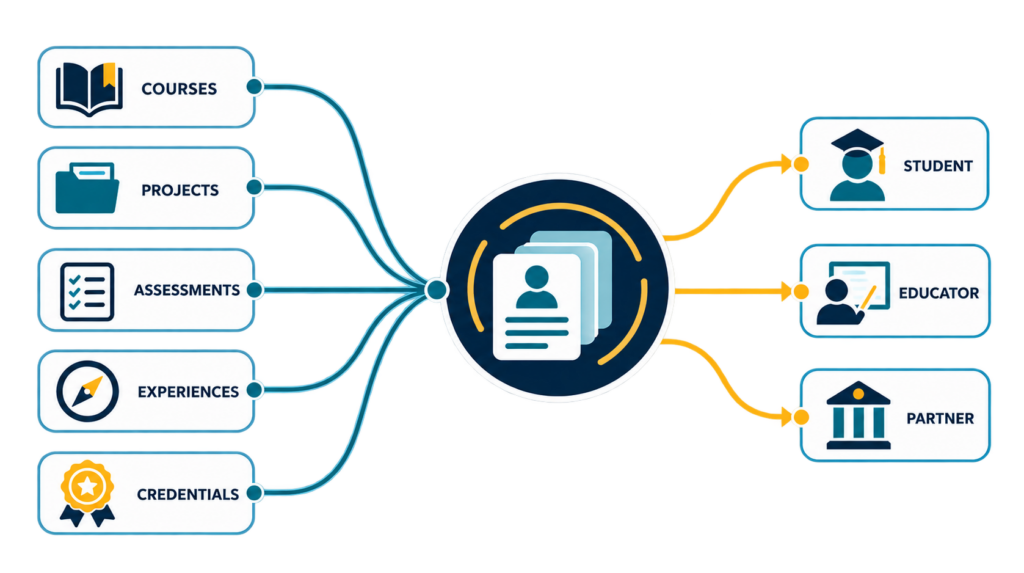
This module helps your team:
- Map where student learning occurs
- Identify the evidence created in each setting
- Connect activities to outcomes and capabilities
- Reveal where learning context is lost
- Examine how academic and experiential learning relate
- Clarify which records should remain authoritative
- Define purpose-built learner views
- Reduce repeated learner reconstruction
- Identify information-quality gaps
- Establish learner participation and control
- Clarify appropriate access and use
- Develop an evidence-backed visibility response
What should happen to each part of the learning record?
Not every record, artifact, activity, or inference should be combined into one system. The institution should determine what each element contributes to the learner’s goal and how it should be handled.
Connect
Link related experiences, activities, outcomes, capabilities, and artifacts so their relationships can be understood.
Contextualize
Explain the record’s source, purpose, standard, activity, learner contribution, and limitations.
Verify
Confirm the source or claim through issuer confirmation, institutional validation, learner review, or another appropriate step.
Profile
Include selected information in an academic, advising, transfer, employment, reflection, or other defined view.
Protect
Apply appropriate permissions, minimization, separation, retention limits, or exclusion from a particular decision.
Investigate
Resolve uncertainty about accuracy, relevance, ownership, authority, interoperability, accessibility, or use.
These categories organize information and workflow decisions. They do not determine learner ability, predict success, award credit, or replace authorized human judgment.
What should a student learning visibility review examine?
The purpose
What learner goal, institutional outcome, workflow, or decision should the information support?
The experience
Where did learning occur, and what activities, responsibilities, tools, people, and conditions shaped it?
The evidence
What artifacts, assessments, feedback, records, credentials, demonstrations, or explanations support the learning?
The interpretation
How are activities and evidence connected to outcomes or capabilities, and what remains uncertain?
The authority
Which records are authoritative, who may interpret them, and who is responsible for consequential decisions?
The learner’s role
Can the learner see, understand, correct, contextualize, control, and appropriately share the information?
Use one connected evidence base to create different views for different purposes.
A learner’s complete record may contain more information than any educator, advisor, evaluator, or employer needs. Purpose-built Profiles can organize selected evidence around a specific goal.
STEP 1
Establish the purpose
Define the learner goal, audience, decision, information boundary, and intended use.
STEP 2
Select relevant experiences
Identify the courses, projects, employment, credentials, service, or other experiences connected to that purpose.
STEP 3
Connect activities and evidence
Show what the learner did and which artifacts, assessments, credentials, or records support the account.
STEP 4
Interpret capabilities carefully
Connect evidence to possible knowledge, skills, outcomes, or capabilities while preserving source and uncertainty.
STEP 5
Invite learner review
Allow the learner to confirm, correct, contextualize, and decide whether the information is appropriate to share.
STEP 6
Support human use
Provide authorized participants with the context needed for their bounded decision.
A Profile organizes relevant evidence. It should not become a universal judgment about the learner or replace the authorized person responsible for the decision.
- Reuse one connected evidence base
- Select information for a defined purpose
- Preserve sources and context
- Give the learner review and control
- Limit unnecessary disclosure
- Support bounded human decisions
FROM FRAGMENTED LEARNING TO A CONNECTED STORY
Let learners build a reusable view of what they know and can do.
TalentPass is designed to help an individual connect education, employment, activities, skills, credentials, projects, work products, accomplishment stories, and evidence across experiences.
The underlying information can support different Profiles without asking the learner to reconstruct their story from the beginning each time. The individual controls their TalentPass information and chooses when it is shared.
TalentPass complements rather than replaces authoritative institutional records, learning systems, transcripts, assessments, or the people responsible for interpreting them.
PRODUCT AND DECISION BOUNDARIES
Learning evidence supports understanding. It does not define the learner.
TalentPass, TalentSync, Pythia, Profiles, or another technology should not be presented as creating a complete definition of a person, producing a universal learner score, predicting success, determining intelligence or potential, automatically awarding credit, replacing human judgment, treating activity as definitive evidence, requiring an entire record, eliminating bias, or making legal determinations.
Technology can organize evidence, preserve context, reveal relationships, identify missing information, and support better conversations. Academic policy, student records, privacy, accessibility, cybersecurity, intellectual property, accreditation, employment, and other questions may require qualified specialist review.
What to bring into the conversation
You do not need a complete learner-record architecture or perfect interoperability across every institutional system.
We begin with the learner journey, evidence, records, systems, and observations the institution already has.
Useful inputs may include:
- The Learning Visibility Decision Foundation
- Program and course learning outcomes
- Curriculum and course maps
- Assessment plans and rubrics
- Sample assignments and projects
- Credential and badge inventories
- Transcript and comprehensive-record examples
- E-portfolio practices
- Internship and work-based learning records
- Co-curricular and student-employment information
- Advising and career-services workflows
- Existing learner profiles or dashboards
- SIS and LMS maps
- Relevant data and interoperability standards
- Access, consent, correction, and retention practices
- Student, faculty, advisor, registrar, and employer observations
- Known gaps, duplication, or conflicting records
The Learning Visibility Direction module establishes the learner goal, affected journey, and information boundary this module should examine.
What this module can help clarify
Where learning becomes invisible
Identify where activities, evidence, outcomes, credentials, and context disappear across experiences, systems, and transitions.
What should be connected
Clarify relationships among experiences, activities, evidence, capabilities, outcomes, credentials, and learner goals.
Which views learners need
Define purpose-built academic, advising, recognition, transfer, reflection, employment, or other Profiles.
How visibility should be governed
Establish authority, learner participation, access, verification, protection, system ownership, and next steps.
Final outputs depend on the modules selected and the learner-centered decision established through the workshop’s required Learning Visibility Direction module.
Where might the work lead next?
Student learning visibility frequently reveals connected problems in prior-learning recognition, learner Profiles, credential portability, advising, and learning-record governance.
PLA Evidence & Recognition Readiness
Prepare experiential learning, evidence, institutional standards, and qualified reviewers for an appropriate recognition process.
Purpose-Built Learner Profiles
Create focused views of learning and evidence for academic planning, advising, recognition, transfer, employment, and other purposes.
Credential Transparency & Portability
Make credentials and recognized learning easier to understand, verify, exchange, and use.
Systems, Standards & Visibility Governance
Clarify how learning information moves across systems, standards, permissions, roles, and consequential decisions.
Questions institutions ask about student learning visibility.
It is the ability to understand how a learner’s experiences, activities, evidence, outcomes, capabilities, and credentials connect across their educational journey.
They provide authoritative academic records but do not always show activities, evidence, capabilities, individual contributions, or connections across learning settings. Visibility complements rather than replaces them.
That depends on the learner’s goal and institutional decision. Relevant learning may come from courses, projects, research, work, service, organizations, credentials, and other experiences.
No. Analytics often examines activity or performance data. Visibility focuses on making learning experiences, evidence, outcomes, capabilities, credentials, and their relationships understandable.
An e-portfolio can contribute selected artifacts and reflection. Visibility also considers connections to courses, outcomes, credentials, records, systems, permissions, and future purposes.
It is intended to represent learning and achievement beyond a conventional transcript. Its meaning still depends on evidence, context, standards, authority, access, and learner participation.
A connected evidence base can support learners, but no single presentation fits every purpose. Purpose-built Profiles can show what is relevant without exposing the entire record.
Identify meaningful learning settings and the evidence they create, then connect selected activities and records to relevant outcomes and learner goals without treating participation alone as capability.
Preserve the shared project context and the learner’s individual contribution, including activities, decisions, work products, collaboration, challenges, feedback, and outcomes.
Ownership and control depend on the record, source, policy, law, agreements, and systems. The workshop clarifies roles and appropriate use but does not make legal determinations.
Institutions should distinguish authoritative records from interpretations and inferences, then provide understandable correction, context, and dispute procedures.
AI may suggest possible relationships, but inferences should remain transparent, reviewable, correctable, and connected to sources. They are not verified mastery.
TalentPass can connect education, activities, evidence, skills, credentials, and accomplishments. Completeness depends on participation, records, integrations, verification, and purpose.
No. Those systems perform authoritative and operational functions. TalentPass can connect selected information into learner-controlled, purpose-built views.
That is the principle behind purpose-built Profiles: share information relevant to a goal or audience rather than every available record, subject to legitimate institutional requirements.
They can establish issuer, award, and validity and may improve interpretation. Verification alone does not explain how learning developed or whether it is relevant to a new decision.
Begin with a defined purpose, minimize information, explain sources and uses, provide learner participation and controls, and avoid continuous monitoring, hidden inferences, universal scores, and unrelated secondary uses.
Learning Visibility Direction establishes the decision foundation. This module examines learning across the ongoing academic, experiential, and co-curricular journey and can connect to Profiles, credentials, systems, or PLA work.
MAKE THE COMPLETE LEARNING JOURNEY VISIBLE
Turn fragmented student records into a connected learning story.
Connect courses, projects, assessments, experiences, credentials, capabilities, and evidence—then create purposeful views that help learners and authorized partners understand what the learning means.
This module is part of Gobekli’s configurable Learning Visibility & Credentialing Workshop.