
AN AI TRANSFORMATION WORKSHOP MODULE
AI Boomerang:
When AI Creates More Work
AI is introduced to reduce effort, accelerate decisions, and improve productivity. But the work does not always disappear.
It may return as review, correction, prompting, escalation, coordination, exception handling, customer recovery, or downstream cleanup.
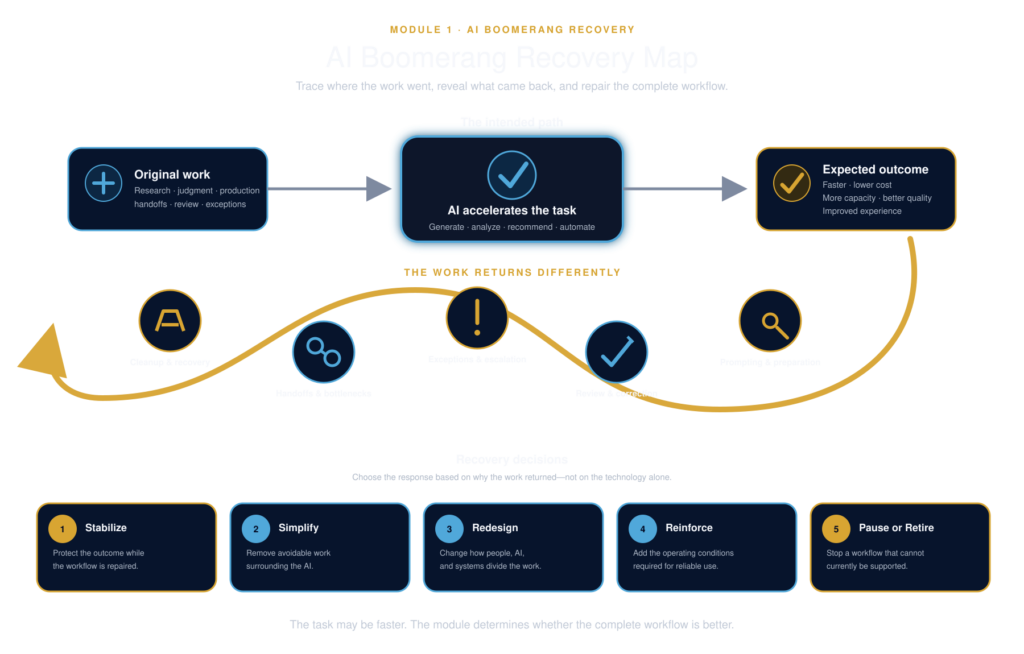
The task becomes faster. The complete workflow does not.
Does this sound familiar?
Employees spend more time reviewing AI output
Drafts and recommendations appear quickly, but employees must verify facts, correct errors, adjust context, and make the results usable.
Work moves instead of disappearing
AI reduces effort for one role while creating additional review, coordination, approval, or cleanup for someone else.
Exceptions overwhelm the new process
The automated path works for straightforward cases, but unusual situations require more intervention than the workflow anticipated.
Faster output creates downstream bottlenecks
AI increases the volume or speed of work entering a process without increasing the capacity of the people responsible for reviewing or completing it.
Employees create workarounds to keep things moving
Teams build unofficial prompts, spreadsheets, checks, templates, and manual steps to compensate for gaps in the AI-enabled workflow.
Productivity improves on paper but not in practice
A task-level measure shows time saved while total effort, rework, quality problems, and operating consequences remain unclear.
What is the AI Boomerang Effect?
The AI Boomerang Effect occurs when work that AI was expected to remove returns somewhere else in the organizational system.
The returning work may be visible. Employees may spend more time reviewing generated content, correcting errors, resolving exceptions, or answering questions created by automated output.
It may also be hidden. A manager may absorb additional approvals. A downstream team may receive more incomplete work. Employees may create unofficial checks and workarounds. Customers may encounter inconsistent results that require recovery.
The AI tool may still be functioning as designed. The local task may even become faster. The problem is that the complete workflow has redistributed effort, responsibility, and consequences in ways the implementation did not anticipate.
An AI boomerang is therefore not simply a technical failure. It is a mismatch between the AI capability, the workflow surrounding it, and the human system required to produce a reliable outcome.
The problem is not that AI failed.
It is that the work came back differently.
Organizations often evaluate AI at the point where the technology performs its most visible task.
They measure how quickly content is generated, cases are classified, information is retrieved, recommendations are produced, or actions are automated.
But the complete workflow includes what happens before and after that moment.
To understand whether work has truly been removed, leaders need to trace:
- The outcome the workflow is intended to produce
- The work performed before AI enters the process
- The specific contribution AI makes
- The review and judgment required after AI acts
- The exceptions the automated path cannot handle
- The handoffs between people, teams, and systems
- The correction, escalation, and recovery work created
- The data and organizational context the AI requires
- The people accountable for quality and consequences
- The total change in effort across the workflow
Without this view, an organization may celebrate time saved in one activity while other employees quietly absorb the displaced work.
The correct unit of analysis is not the AI task. It is the complete organizational outcome.
How the AI Boomerang Effect takes hold
AI accelerates a visible task
A team introduces AI to generate, analyze, retrieve, recommend, classify, or automate work more quickly.
The surrounding workflow remains unchanged
Roles, handoffs, approvals, data flows, review expectations, and exception paths continue operating as they did before AI was introduced.
Hidden work accumulates around the output
Employees add prompting, checking, correction, coordination, escalation, and unofficial workarounds to make the new process function.
The work returns downstream
Quality problems, bottlenecks, employee frustration, customer recovery, and total operating effort undermine the expected improvement.
Why task-level productivity measures are not enough
Time saved can provide useful evidence. It may show that AI performs a specific activity faster than the previous method.
But task-level speed answers only one question:
Did this activity become faster?
A workflow review must answer several more.
Was the work eliminated, transferred to another person, converted into review, or replaced by a different operating burden?
Did the AI-enabled process require prompting, preparation, monitoring, correction, documentation, or additional coordination?
Who handles situations that fall outside the expected path, and how much time and judgment do those cases require?
Did faster output increase the volume of work reaching reviewers, approvers, service teams, customers, or other systems?
Did the workflow produce more errors, inconsistency, rework, uncertainty, oversight, or exposure?
Does the workflow depend on hidden expertise, unofficial workarounds, unusually committed employees, or temporary support?
A task may become faster while the organization becomes less efficient.
What leaders need to see clearly
Where work has moved
Identify which people, teams, systems, customers, or downstream processes are absorbing effort AI was expected to remove.
Where human effort is hidden
Reveal prompting, preparation, review, correction, coordination, escalation, exception handling, and recovery work.
Which workflow conditions create the boomerang
Understand the data, handoffs, role design, review expectations, integration gaps, and operating assumptions causing work to return.
What would recover the intended value
Determine whether the workflow should be stabilized, simplified, redesigned, reinforced, paused, or retired.
Human involvement is not automatically a failure of automation.
Many AI-enabled workflows should include human judgment, review, accountability, and exception handling.
The goal is not to remove every person from the process. It is to ensure that human involvement is intentional, supported, visible, and appropriate to the consequence.
Designed human involvement
Human participation can provide:
- Context the AI cannot reliably interpret
- Judgment in consequential decisions
- Review proportional to quality and risk
- Accountability for organizational outcomes
- Resolution of meaningful exceptions
- Customer and employee understanding
- Continuous learning and improvement
- Escalation to qualified specialists
Local momentum can be lost when every initiative must wait for an abstract enterprise plan.
Hidden human labor
Poorly designed workflows can create:
- Repeated prompt construction
- Unplanned verification and correction
- Duplicate data entry
- Manual transfers between systems
- Excessive review of low-consequence output
- Unclear exception ownership
- Unofficial quality controls
- Downstream cleanup and customer recovery
- Workarounds required to keep the process functioning
This work is often absent from the original value case.
The goal is not human removal.
It is a deliberate division of work between people, AI, and systems that improves the complete outcome.
WORKSHOP MODULE DETAILS
How to Manage AI Boomerang Recovery
This module examines an AI-enabled workflow in which expected efficiency, capacity, quality, or value has not fully appeared—or where work has returned in another form.
Participants trace the intended outcome, original work, AI contribution, human involvement, handoffs, exceptions, downstream consequences, and total operating effort.
The purpose is not to blame employees, vendors, or the technology. It is to identify how the complete system is behaving and what would be required to recover the intended value.
- Define the outcome the AI-enabled workflow is intended to improve
- Map the workflow before and after AI was introduced
- Identify where work was removed, transferred, or transformed
- Reveal hidden review, correction, coordination, and exception handling
- Trace downstream effects and bottlenecks
- Clarify human and AI responsibilities
- Examine data, system, and integration conditions
- Develop an evidence-backed workflow recovery response
What should happen to the AI-enabled workflow next?
The organization should not assume that every boomerang requires more automation—or that the technology must automatically be removed.
The response depends on why the work returned, what outcome is affected, and which operating conditions can be changed.
Stabilize
Protect the outcome while the workflow is repaired Introduce immediate review, ownership, escalation, or operating support where the current process is producing unreliable or disruptive results.
Simplify
Remove avoidable work around the AI Eliminate redundant steps, duplicate entry, excessive approvals, unnecessary handoffs, and low-value review created by the implementation.
Redesign
Change how people, AI, and systems divide the work Reconfigure the workflow, responsibilities, decision points, handoffs, exception paths, and placement of the AI capability.
Shield Alt
Add the conditions required for reliable operation Improve data, integration, training, documentation, ownership, quality controls, monitoring, or specialist support.
Power Off
Stop a workflow that cannot currently be supported Pause the AI-enabled process when the organization lacks sufficient evidence, control, ownership, quality, or a credible path to improvement.
These categories do not determine whether an AI use is legally compliant, secure, private, ethical, or otherwise professionally acceptable. They organize workflow evidence and recovery options requiring decisions by the organization and, where appropriate, qualified specialists.
What should an AI Boomerang review examine?
The intended outcome
What improvement was the AI-enabled workflow expected to create, and how would the organization recognize it?
The changed work
What tasks, roles, handoffs, decisions, and exceptions changed after AI entered the workflow?
The returning effort
Where are employees, customers, managers, specialists, or downstream teams now absorbing review, correction, coordination, escalation, or recovery work?
The complete evidence
What demonstrates the workflow’s actual effect on time, cost, capacity, quality, experience, adoption, risk, and organizational outcomes?
What to bring into the conversation
You do not need a perfect process map or a complete measurement system.
We begin with the workflow information, employee observations, operating artifacts, and available evidence your organization already has. The workshop then distinguishes known facts from expectations, assumptions, missing evidence, and unresolved consequences.
Useful inputs may include:
- The AI-enabled workflow or use case being examined
- Original implementation goals or business case
- Workflow maps, procedures, or operating documentation
- Examples of AI inputs and outputs
- Prompts, templates, or employee-created aids
- Review, approval, and quality procedures
- Known errors, exceptions, and escalation records
- Employee and manager observations
- Customer or user feedback
- Usage, time, cost, quality, and outcome measures
- Integration and data-flow information
- Known workarounds or duplicate processes
- Roles and ownership information
- Relevant vendor or technical documentation
The goal is not to assess every AI-enabled workflow in the organization. The Decision Foundation establishes the outcome, workflow, and recovery decision the module should examine.
What this module can help clarify
Where the work returned
Identify the people, teams, systems, customers, and downstream processes absorbing unexpected effort.
Why the workflow is creating a boomerang
Reveal the role, data, integration, review, exception, handoff, and operating conditions producing hidden work.
What human involvement should remain
Distinguish necessary judgment and accountability from avoidable correction, coordination, and cleanup.
How to stabilize, simplify, redesign, reinforce, pause, or retire
Organize the available evidence into practical workflow recovery decisions.
Final outputs depend on the modules selected and the decision established through the workshop’s required Decision Foundation.
Where might the work lead next?
The AI Boomerang Effect frequently overlaps with unclear value, low adoption, weak governance, and tools or pilots that do not fit the operating workflow.
Proving AI Value & ROI
Determine whether the workflow creates defensible value after hidden labor, quality, dependencies, operating costs, and consequences are included.
AI Adoption & Workforce Readiness
Examine whether employees understand, trust, and have the capability and support required to use the AI-enabled workflow successfully.
AI Governance & Accountability
Clarify ownership, review requirements, operating boundaries, decision rights, and escalation paths surrounding the workflow.
Questions leaders ask before booking.
The AI Boomerang Effect occurs when work that AI was expected to remove returns somewhere else in the organizational system.
The work may return as prompting, preparation, verification, correction, review, coordination, escalation, exception handling, customer recovery, or downstream cleanup.
The AI may still perform its assigned task successfully. The boomerang occurs because the complete workflow has not produced the expected reduction in effort or improvement in outcomes.
AI can create more work when the surrounding workflow is not redesigned for the new capability.
Common causes include incomplete or inconsistent data, weak integrations, unclear ownership, excessive review, poor exception handling, increased output volume, incompatible processes, insufficient organizational context, and responsibilities that were never reassigned.
The technology changes one activity while the surrounding human and operating system remains largely unchanged.
No. Human review may be necessary and valuable, particularly when outputs influence consequential decisions, customers, employees, safety, quality, or organizational commitments.
The important questions are what must be reviewed, why review is required, who is qualified to perform it, how much effort it consumes, and whether that work was included in the operating model.
Designed human judgment is different from unplanned human cleanup.
Measure the complete workflow rather than only the activity performed by AI.
Include preparation, prompting, review, correction, handoffs, exceptions, escalation, rework, documentation, and downstream consequences. Examine whose time changed—not only the time of the original user.
Time saved in one task should not automatically be treated as organizational capacity or value.
Not necessarily.
The appropriate response may involve simplifying the workflow, improving data, integrating systems, changing responsibilities, reducing unnecessary review, strengthening training, clarifying exceptions, narrowing the AI use, or removing automation from a particular step.
More automation can create another boomerang if the underlying workflow problem remains unresolved.
Sometimes, but not automatically.
The AI capability may be valuable while the surrounding workflow is poorly designed or insufficiently supported. In other cases, the capability may create more burden than benefit or may not be suitable for the intended outcome.
The organization should examine the complete evidence before deciding whether to stabilize, simplify, redesign, reinforce, pause, or retire the workflow.
No. The module examines how work is structured around an AI capability.
Employees may be compensating for incomplete data, weak integrations, ambiguous responsibilities, unrealistic review expectations, poor workflow design, or other organizational conditions.
The workshop should not be used to attribute systemic workflow problems to individual employee performance.
No. The module examines organizational work, responsibilities, dependencies, evidence, and consequences.
It may identify issues requiring review by legal, cybersecurity, privacy, compliance, human resources, safety, procurement, or other qualified specialists. The workshop does not replace those functions or make their professional determinations.
Every engagement begins with the required Decision Foundation, which establishes the consequential outcome, affected workflow, available evidence, and bounded decision the workshop must support.
AI Boomerang Recovery can then be selected when an AI-enabled workflow is producing unexpected effort, friction, quality problems, downstream consequences, or unclear value.
Depending on what the module reveals, it may be combined with modules addressing value and ROI, adoption, governance, tool sprawl, pilot progression, workforce readiness, or another connected problem.
Stop measuring the task. Repair the complete AI-enabled workflow.
Trace where the work went, reveal what came back, and redesign the system around the outcome that matters.
This module is part of Gobekli’s configurable AI Transformation Workshop. Explore the complete workshop, its 12-module structure, and how we identify the right starting point for your organization.
