
LER & TRUSTED WORKFORCE INFRASTRUCTURE WORKSHOP MODULE
AI Context, Human Review & Decision Boundaries
Clarify how AI may assist with selected records, what evidence and uncertainty must remain visible, and who reviews interpretations, makes decisions, and handles corrections.
Does this sound familiar?
A summary becomes more authoritative than its source
Reviewers rely on an AI-generated account without seeing which records support it, what was omitted, or where interpretation has been added.
Missing information becomes a negative conclusion
An absence of documented experience is treated as evidence that a person lacks a capability, qualification, or relevant background.
The AI’s task keeps expanding
A tool introduced to organize information begins recommending suitability or influencing decisions without an explicit review of that change.
Human review exists only as a checkbox
A person approves an output without enough time, source access, guidance, or authority to examine and challenge it.
People cannot correct the interpretation
A person disputes a summary or inferred claim, but no one can explain whether the issue belongs with the source organization, the AI workflow, or the receiving reviewer.
Changes alter the meaning of the output
New instructions, reference material, or model behavior affect results, while reviewers continue treating the output as though nothing has changed.
What are AI context, human review, and decision boundaries?
AI context is the selected information, instructions, reference material, and purpose used to support an AI-assisted task.
Human review is the accountable examination of the resulting output, including its supporting evidence, interpretation, uncertainty, and suitability for the intended use.
Decision boundaries identify what AI may assist with, which conclusions it should not make, and which actions require an authorized person.
Correction routes connect questions about source information, generated interpretations, and receiving decisions to the people responsible for addressing each.
This module examines those responsibilities within a selected record exchange so partners can define useful assistance without obscuring how conclusions are reached.
Useful assistance keeps the basis for review visible.
AI may help organize records, summarize information, or identify questions for further review.
The resulting output still needs to show how it relates to the information provided.
A reviewer needs to distinguish a source statement from a generated interpretation.
They also need to recognize what the available records leave unresolved.
The workshop connects the proposed assistance to those review needs.
That gives partners a clearer basis for deciding where AI belongs in the workflow and what must happen before anyone acts on its output.
Where AI-assisted interpretation can become unclear
The assigned task
Intended assistance
Receiving purpose
Permitted outputs
Excluded judgments
Responsible owner
The available context
Selected source records
Relevant dates and conditions
Reference material
Information-use boundaries
Missing context
The generated output
Source-supported statements
Summaries and transformations
Inferences or suggestions
Uncertainty and limitations
Evidence references
Human review and action
Reviewer responsibilities
Access to underlying information
Review criteria
Escalation and override
Decision authority
Correction and change
Questions from the individual
Source correction routes
Interpretation corrections
Affected downstream uses
Review after system changes
The review focuses on one proposed AI-assisted task. It does not assume that the same context or review arrangement is appropriate for every use of workforce information.
How this module helps
Define a useful AI task
Identify the assistance needed and separate it from judgments or actions outside the selected scope.
Preserve evidence and uncertainty
Specify what reviewers need to see about sources, generated interpretation, and unresolved questions.
Make human review substantive
Clarify who reviews the output, what they examine, and how they can challenge, revise, or stop its use.
Assign correction and change routes
Distinguish source errors, interpretation problems, and decision concerns, then connect each to an accountable response.
A clear summary can still leave an important question unanswered.
An AI-generated account may make a collection of records easier to read.
That does not establish whether the records support every conclusion a recipient might draw.
The workshop examines what the output should say, what it should leave open, and what the reviewer needs to inspect.
Example: “The summary says there is no relevant experience. Was that actually established?”
A participant presents selected training and employment records.
An AI-assisted summary does not identify experience relevant to one requirement.
A reviewer reads that omission as a conclusion that the person lacks the experience.
Partners revise the proposed output and review process so missing documentation remains distinguishable from an assessed absence, with a clear route to request additional context.
Questions to review together
What should AI help someone do, and which judgments or actions are outside that task?
Which records, instructions, and references are appropriate for the purpose?
Can a reviewer distinguish source statements from generated summaries, inferences, and suggestions?
How should unresolved questions, conflicting sources, and insufficient context appear?
Who examines the output, what must they check, and who may authorize the next action?
How are concerns investigated, outputs corrected, and changes to the arrangement reviewed?
What needs to connect?
The assistance purpose
The specific task AI is intended to support within the selected exchange.
The source context
The records, conditions, dates, and references available for that task.
The generated interpretation
The summary, organization, suggestion, or inference produced from the context.
The visible limitations
The missing information, conflicts, assumptions, and uncertainty relevant to interpretation.
The accountable reviewer
The person with the information, guidance, capacity, and authority to examine the output.
The correction and decision route
The responsibilities for responding to concerns, changing an interpretation, and authorizing any resulting action.
When generated text becomes an unexplained conclusion
Partners may introduce AI assistance without defining how its output should be reviewed.
- Source statements and inferences are blended.
- Missing records become assumed deficiencies.
- Output labels imply more certainty than the evidence supports.
- Reviewers cannot inspect the underlying context.
- Approval happens without a meaningful challenge route.
- Corrections stop at one screen while earlier outputs remain in use.
The workflow can make information easier to consume while making its limitations harder to recognize.
When assistance supports accountable judgment
Partners can explain how the output relates to its sources and intended use.
- The AI task has an explicit scope.
- Source evidence remains available for review.
- Generated interpretations are distinguishable.
- Missing context and uncertainty are visible.
- Reviewers can question, revise, or stop the proposed use.
- Corrections have responsible owners and follow-through.
The arrangement gives people a clearer basis for using assistance while retaining responsibility for what happens next.
A practical example
A workforce partnership wants AI to summarize preparation records for an advisor reviewing a participant’s next step.
The workshop defines the task as organizing documented preparation and identifying questions for discussion.
Partners identify the selected records and reference requirements the summary may use.
They exclude a final determination of eligibility or suitability from the proposed task.
The group examines how the output distinguishes source statements, generated summaries, and unresolved comparisons.
A test example includes an older record and a more recent record that appear inconsistent.
Partners define how that conflict should remain visible and when the advisor should seek clarification.
They then consider a participant who says the summary misrepresents an activity described in the original record.
The correction route distinguishes revising the generated interpretation from asking the source organization to correct its record.
The resulting brief defines the AI task, review responsibilities, exception handling, and validation questions before the partnership considers implementation.
Human review needs the ability to change what happens.
Assigning a reviewer does not explain what that person is expected to examine.
They need access to the relevant evidence and enough context to understand the intended use.
They also need a practical way to question or revise the output.
The workshop identifies which checks belong with the reviewer and which concerns require escalation.
Partners clarify who may pause the workflow or authorize the next action.
That makes review an operational responsibility with a defined effect on the process.
Correcting a source and correcting an interpretation are different tasks.
A source record may contain an inaccurate date or description.
A generated summary may also misinterpret a source that is accurate.
The workshop separates those situations.
Partners identify who can correct the source and who is responsible for revising or withdrawing the generated output.
They also consider whether an earlier interpretation has already informed another action.
That connects the immediate correction to the receiving responsibilities and follow-through the selected workflow needs.
WORKSHOP MODULE 10
AI Context, Human Review & Decision Boundaries
This module is a focused minicourse and working session within the LER & Trusted Workforce Infrastructure Workshop.
Your team learns to distinguish source information, AI-generated interpretation, uncertainty, human review, and decision authority, then applies those distinctions to a selected task.
The work produces a reviewed starting point for useful AI assistance, visible evidence, correction responsibilities, and a supporting product configuration.
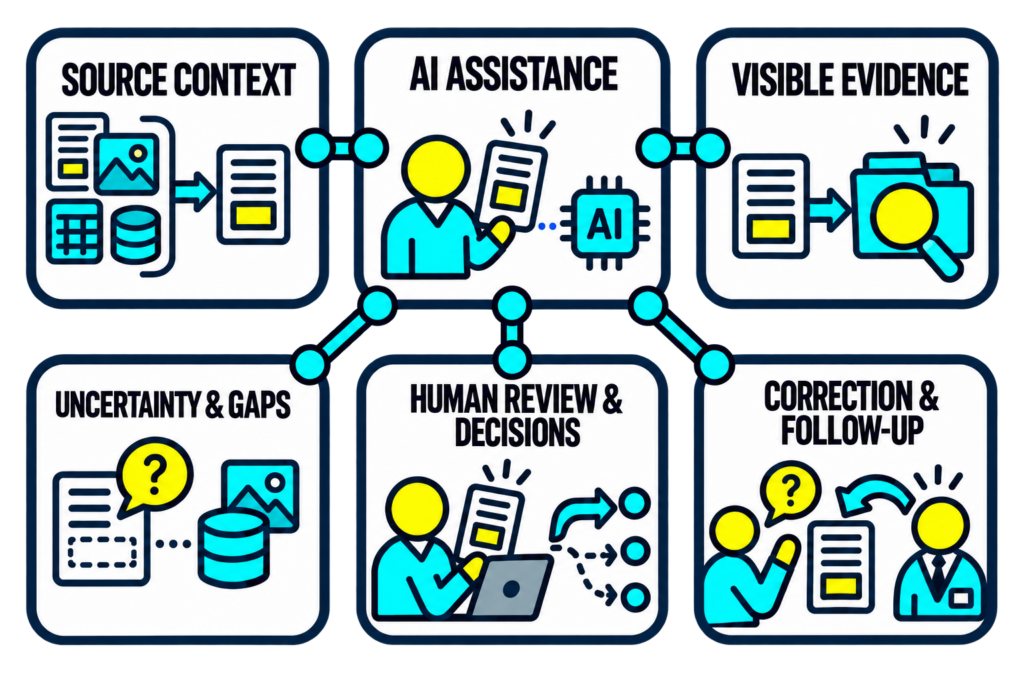
What this module can address
The selected scope may include:
The workshop selects the AI and review questions that materially affect the defined exchange.
- The purpose of a proposed AI-assisted task.
- Permitted outputs and excluded judgments.
- Selected records and reference context.
- Relevant dates, conditions, and source limitations.
- Distinctions between source statements and generated interpretation.
- Evidence references and reviewer access.
- Missing information and conflicting sources.
- Uncertainty and conditions for further review.
- Reviewer guidance, capacity, and authority.
- Escalation, override, and decision responsibilities.
- Source, interpretation, and decision correction routes.
- Validation scenarios and review after changes.
What kinds of responses might emerge?
The response depends on the gaps uncovered in the selected example.
A narrower AI task
Limit the proposed assistance to a useful activity with explicit outputs and boundaries.
Better context requirements
Identify the sources, reference material, dates, and conditions needed for the task.
A more reviewable output
Make evidence, generated interpretation, missing context, and uncertainty easier to distinguish.
An accountable review step
Assign the reviewer, required checks, challenge route, and authority over the next action.
A correction and escalation arrangement
Connect source errors, interpretation concerns, and decision questions to the appropriate owners.
A focused configuration brief
Specify context, output presentation, human checkpoints, correction routes, and validation requirements for a subsequent implementation.
Some responses may involve clearer instructions or output wording. Others may require workflow changes, additional testing, specialist review, or a decision to leave the task outside AI assistance.
What we review together
The proposed assistance
The intended task, benefit, permitted outputs, and excluded judgments.
The source context
The records and references available, their limitations, and the conditions governing their use.
The generated output
How statements, summaries, inferences, uncertainty, and evidence references are presented.
The human review
Who examines the output, what they check, and what authority they have.
Concerns and corrections
How people question an interpretation and how responsible organizations investigate and respond.
Validation and change
Representative examples, failure conditions, review criteria, and triggers for reassessment.
The working exercise
Follow one AI-assisted interpretation from source to action.
Choose a representative task in which AI would help someone organize or interpret selected workforce records.
STEP 1
Define the assistance
State the task, intended benefit, permitted output, and judgments outside the AI’s role.
STEP 2
Identify the context
Select the relevant records and references, including their dates, limitations, and use boundaries.
STEP 3
Examine a sample output
Separate source-supported statements from summaries, inferences, suggestions, and unresolved questions.
STEP 4
Test a difficult case
Introduce missing information, conflicting records, or an unsupported interpretation and define the expected response.
STEP 5
Assign review and decision rights
Identify what the reviewer checks, how they challenge the output, and who authorizes the next action.
STEP 6
Trace a correction
Consider a concern raised by the individual and assign investigation, revision, communication, and any downstream review.
The exercise produces a reviewed AI-assistance, human-review, and decision-boundary brief for the selected example.
CONNECTING THE WORKSHOP TO A POSSIBLE GOBEKLI SETUP
Keep AI assistance connected to evidence and accountable review.
The workshop can help define how a subsequent Gobekli implementation would support the selected task across TalentPass, TalentSync, Passport Pages, and participating systems.
Depending on confirmed scope and product availability, the configuration brief may describe:
- The permitted AI-assisted task.
- Selected source records and reference context.
- Instructions and excluded judgments.
- Distinctions between source content and generated interpretation.
- Evidence references and reviewer access.
- Missing-information and uncertainty presentation.
- Human review steps and responsible roles.
- Escalation, revision, and decision checkpoints.
- Correction requests and affected-output tracking.
- Validation examples and change-review triggers.
The workshop clarifies the intended behavior and responsibilities before implementation is proposed.
Specific AI functions, evidence-linking methods, review controls, activity records, correction mechanisms, and integrations must be confirmed separately against current product availability and partner requirements.
SCOPE AND BOUNDARIES
A focused review of one AI-assisted task.
The module begins with the exchange defined through Workforce Infrastructure Direction.
It examines how selected records may support AI assistance and what evidence, review, and decision responsibilities the proposed use requires.
It does not automatically establish or deliver:
- Accurate output in every case.
- Proof that all relevant information has been supplied.
- A finding that a system is free from bias.
- Authority to automate a receiving decision.
- A legal or compliance determination.
- A complete model evaluation or security assessment.
- Correction of every previously distributed output.
- Production AI workflows or integrations.
Appropriate operational, technical, policy, and subject-matter representatives may need to confirm the proposed arrangement.
Questions about record quality, information-use boundaries, receiving acceptance, and continuing governance connect to their respective modules when they affect the selected use case.
What should you bring?
One proposed AI-assisted task and a representative set of source records are enough to establish a practical starting point.
Use fictionalized or appropriately redacted examples. A sample output is helpful, but the workshop can begin with a description of the intended assistance.
Helpful starting materials
- A description of the selected exchange.
- The proposed AI task and intended benefit.
- Representative source records.
- Relevant reference requirements or guidance.
- Current instructions or prompt descriptions.
- Sample outputs, if available.
- Examples of missing or conflicting information.
- Reviewer roles and existing guidance.
- The receiving decision and responsible owner.
- Current escalation or challenge routes.
- Examples of interpretation concerns.
- Known validation or change-review practices.
The workshop does not require uploading live participant records to an AI service or granting access to production systems.
What can you leave with?
An AI-assistance scope
The selected task, intended benefit, permitted outputs, and excluded judgments.
An evidence and interpretation brief
Required context, source references, generated-content distinctions, and visible limitations.
A review and correction outline
Reviewer responsibilities, decision authority, escalation, and routes for addressing source or interpretation concerns.
A configuration and validation brief
Required behavior, responsible owners, representative test cases, and change-review questions for a subsequent implementation.
These outputs begin with the example reviewed during the module. Final scope depends on the modules selected, available inputs, and the exchange established through Workforce Infrastructure Direction.
Where might the work lead next?
Record Quality, Evidence & Provenance
Examine the completeness, accuracy, source history, and supporting evidence of the records used in the proposed AI task.
Individual Control, Permissions & Data-Use Boundaries
Clarify which information may be used for the selected purpose, recipient responsibilities, and the boundaries around additional uses.
Shared Governance, Funding & Operational Sustainability
Assign continuing ownership, review responsibilities, resources, and change processes for the AI-assisted arrangement.
These modules extend different parts of the work. Selection depends on the problem and decision established through Workforce Infrastructure Direction.
Frequently asked questions
Questions organizations ask before beginning.
It addresses unclear responsibilities when AI helps organize or interpret workforce records. The focus is what AI may do, what reviewers need to see, and who handles decisions and corrections.
The foundation establishes the exchange, intended benefit, participating organizations, and receiving decision. Those choices determine whether an AI-assisted task is useful and which boundaries matter.
No. The module can examine a proposed task before implementation. Existing outputs are helpful when available, but they are not required.
Examples include organizing selected records, drafting a summary, comparing documented information with a reference, or identifying questions for human review. Each proposed task needs its own scope and validation.
It begins by identifying the assistance needed and the decision authority involved. It does not assume that automating the receiving decision is appropriate or authorized.
A source statement reports information present in the selected record. An inference adds an interpretation or conclusion. The workshop examines how those differences remain visible to reviewers.
The output should make the relevant gap understandable without silently treating missing documentation as proof that a person lacks the experience or capability. Partners define the appropriate follow-up for the selected task.
The exercise can examine how a conflict is presented, which source context matters, and who investigates. It does not assume that AI should silently choose one account as correct.
A label alone does not explain what supports a statement or what remains unresolved. The workshop identifies the evidence, limitations, and review actions needed for the selected use.
The reviewer needs an explicit task, access to relevant evidence, appropriate guidance and capacity, and authority to challenge the output or affect the next action. The module makes those conditions concrete.
The appropriate reviewer depends on the task and receiving decision. Partners identify the subject knowledge, operational responsibility, and authority needed, including when specialist escalation is required.
The module can define an understandable route for raising concerns and supplying relevant context. It also identifies who investigates and how the person receives a response.
That is an interpretation problem requiring review of the generated output and its use. It should be distinguished from a request to change the underlying source record.
The workshop identifies how the concern reaches the responsible recipient and whether an affected action needs review. It does not assume that changing one output automatically corrects every downstream use.
No. It produces a concrete description of the proposed task, responsibilities, and test questions. Detailed evaluation and any required specialist review remain separate work.
The outputs can inform context selection, evidence presentation, AI-assistance boundaries, human review, and correction requirements in a subsequent Gobekli configuration. Specific capabilities and integrations must be confirmed separately.
Partners can confirm the task boundaries, refine reviewer guidance, test representative and difficult cases, and scope implementation. They can also decide that a proposed task needs more evidence or should remain outside AI assistance.
MAKE AI ASSISTANCE REVIEWABLE AND ACCOUNTABLE
Keep the evidence visible and the decision responsibility clear.
AI Context, Human Review & Decision Boundaries helps your team connect useful assistance to source context, explicit uncertainty, meaningful review, and correction routes.
Begin with Workforce Infrastructure Direction, then combine the modules that address the questions your participating organizations need to resolve.
