
AN AI TRANSFORMATION WORKSHOP MODULE
AI Initiative Overload:
How to Prioritize Competing AI Projects
AI initiatives are multiplying across organizations as departments, executives, vendors, and employees identify new opportunities to automate work, improve decisions, reduce costs, and create new capabilities.
Many of these ideas may be individually promising. The problem is that they frequently compete for the same people, data, systems, funding, leadership attention, and organizational capacity.
Without a shared way to compare and sequence them, everything becomes a priority—and little moves forward coherently.
Does this sound familiar?
Every team has an AI priority
Departments pursue separate initiatives without a shared view of which outcomes matter most or how the projects relate.
The same people support every initiative
A small group of technology, data, operational, legal, or subject-matter experts becomes a dependency for nearly every project.
Projects compete for the same data and systems
Several initiatives require access to the same information, integrations, platforms, infrastructure, or technical changes.
Leaders approve more than the organization can absorb
New initiatives are added without accounting for existing commitments, implementation effort, workflow disruption, or change capacity.
Urgency replaces prioritization
Projects advance because of executive sponsorship, vendor pressure, competitive anxiety, or visible enthusiasm rather than comparable evidence.
Nothing is clearly paused or stopped
Initiatives remain nominally active even when they lack ownership, evidence, resources, dependencies, or a credible path forward.
What is AI initiative overload?
AI initiative overload occurs when an organization has more active or proposed AI projects than it can coherently evaluate, support, sequence, integrate, and absorb.
The initiatives may include pilots, automation projects, embedded AI features, model development, agent deployments, data initiatives, workflow redesigns, vendor implementations, or broader transformation programs.
The problem is not necessarily that the organization has generated too many ideas. A healthy innovation environment should produce more possibilities than the organization ultimately pursues.
Overload begins when initiatives are allowed to make simultaneous and uncoordinated claims on the same organizational system.
Several projects may depend on the same data team. Multiple pilots may require changes to one workflow. Different executive sponsors may expect priority access to the same technical resources. Employees may be asked to adopt several overlapping changes at once.
In this condition, the organization cannot reliably determine what should advance now, what should be sequenced later, what should be combined, and what should stop.
The problem is not too many ideas.
It is too many simultaneous claims on the same system.
A list of AI projects can show leaders what teams want to pursue. It cannot show whether the organization can support all those initiatives at the same time.
A useful prioritization process must connect each initiative to:
- The organizational outcome it is intended to influence
- The work or workflow that must change
- The AI capability it is expected to provide
- The people and teams required to support it
- The data, systems, and integrations it depends on
- The operating and change capacity it will consume
- The evidence supporting its priority
- The consequences of delaying, combining, or stopping it
- The decision the organization must make next
Without these connections, initiatives may be ranked according to enthusiasm, estimated financial return, executive influence, or perceived urgency while important operational conditions remain hidden.
The most attractive initiative in isolation may not be the initiative the organization is ready to support next.
Prioritization is therefore not simply about selecting the best idea. It is about creating a credible sequence of organizational change.
How AI accountability becomes fragmented
Teams identify valuable opportunities
Leaders, departments, employees, and vendors recognize practical ways AI could improve work or create new capabilities.
Initiatives launch independently
Projects begin through different budgets, sponsors, departments, platforms, pilots, and transformation programs.
Dependencies and demands converge
Initiatives begin competing for the same people, data, systems, decisions, workflow access, and organizational attention.
Progress slows across the portfolio
Teams encounter bottlenecks, adoption fatigue, duplicated effort, delayed decisions, and projects that remain active without moving forward.
Why a ranked list of AI initiatives is not enough
A ranked list can help leaders express preference. It may identify which initiatives appear most valuable, urgent, affordable, or strategically aligned.
But a ranked list answers only one question:
Which initiatives appear most important?
A workable sequence must answer several more.
What consequential organizational result is expected to change, and how important is that outcome relative to other priorities?
Which workflow, activity, decision, role, handoff, or operating process must function differently for the initiative to create value?
Which data, systems, integrations, vendors, specialists, operational leaders, permissions, and supporting capabilities must be available?
How much implementation effort, leadership attention, employee time, training, review, support, and organizational change will it require?
Does another initiative provide a prerequisite, use the same capability, affect the same workflow, or create an opportunity to combine work?
What demonstrates urgency, feasibility, value, readiness, adoption potential, strategic importance, or the consequences of delay?
Without these relationships, the organization may create a numbered list that cannot be executed in the order presented.
What leaders need to see clearly
Where initiatives compete for capacity
Reveal which projects depend on the same teams, experts, leaders, funding, workflows, or organizational attention.
Which dependencies should come first
Identify foundational data, system, governance, workflow, or capability work that enables several initiatives.
Where change is concentrating
Understand which employees, customers, teams, processes, and operating areas are being asked to absorb multiple changes simultaneously.
Which sequence creates the strongest path forward
Determine what can advance now, what should follow, what can be combined, and what should be held or stopped.
Local urgency is not the same as organizational priority.
Teams closest to the work often understand needs and opportunities that are not visible from the center of the organization. Executive sponsors may also recognize strategic risks or possibilities that individual teams cannot see.
Both perspectives matter.
The problem begins when every local need or executive request becomes an immediate enterprise priority without being connected to shared dependencies and organizational capacity.
Valuable local momentum
Local initiative can support:
- Faster identification of practical opportunities
- Stronger engagement from affected teams
- Rapid experimentation and learning
- Direct evidence about workflow needs
- Early discovery of implementation barriers
- Broader participation in AI transformation
Local momentum can be lost when every initiative must wait for an abstract enterprise plan.
Portfolio overload
The same activity can create:
- Competing demands on shared teams
- Repeated data and integration work
- Conflicting workflow changes
- Uncoordinated vendor commitments
- Multiple initiatives targeting the same outcome
- Excessive adoption and training demands
- Leadership attention spread too thin
- Projects remaining active without progress
- Foundational work repeatedly deferred
These conditions make it difficult for individual initiatives to succeed—even when the underlying ideas are sound.
The goal is not to eliminate local initiative.
It is to connect local momentum to a sequence the complete organization can support.
WORKSHOP MODULE DETAILS
How to Manage AI Priorities & Sequencing
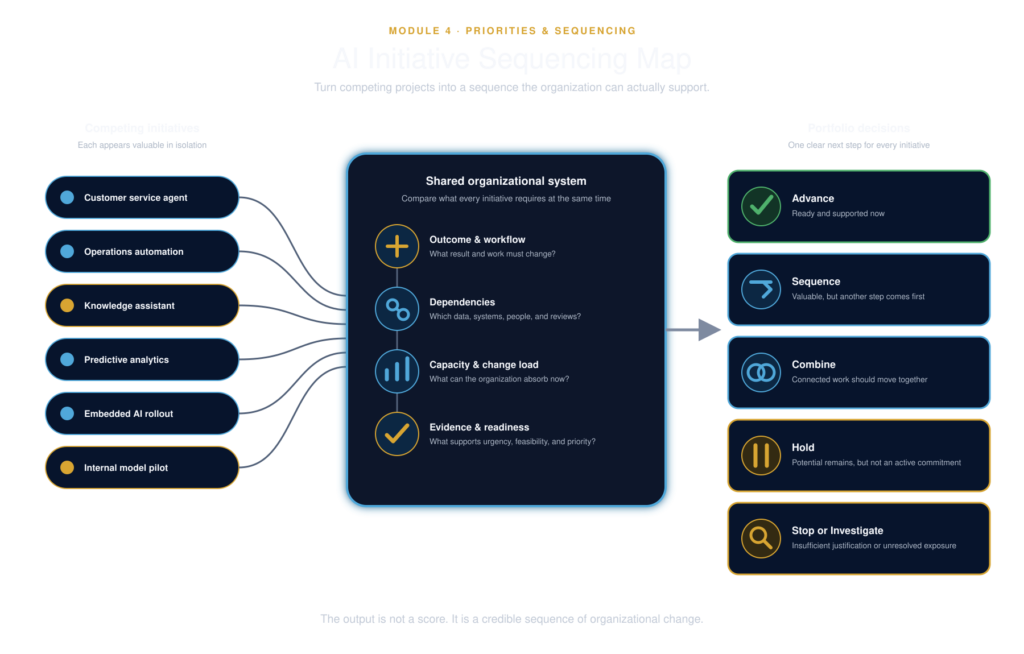
This module examines active and proposed AI initiatives as a connected portfolio of organizational change.
Participants connect each initiative to its intended outcome, affected workflow, dependencies, ownership, evidence, and capacity requirements. The purpose is not to produce an abstract ranking or score every idea.
It is to determine which initiatives the organization can responsibly advance, how the work should be sequenced, and where projects should be combined, held, stopped, or investigated further.
- Define the organizational outcomes initiatives are intended to influence
- Connect AI projects to the real workflows they must change
- Identify shared data, system, people, and specialist dependencies
- Reveal capacity constraints and concentrated change demands
- Distinguish foundational work from dependent initiatives
- Examine where initiatives overlap or should be combined
- Clarify what evidence supports urgency and readiness
- Develop an evidence-backed initiative sequence
What should happen to each AI initiative next?
An initiative should not advance simply because it appears valuable in isolation.
The organization must determine how the initiative fits with its outcomes, dependencies, available capacity, operating conditions, and other commitments.
Advance
Ready and supported now The initiative addresses an important outcome and has sufficient ownership, evidence, dependencies, capacity, and operating support to move forward.
Sequence
Valuable, but another step must come first The initiative may be worthwhile, but a prerequisite involving data, systems, governance, workflow design, capability, or organizational capacity must be addressed first.
Combine
Connected work should move together Two or more initiatives support the same outcome, affect the same workflow, require similar capabilities, or depend on the same foundational work.
Hold
Not ready for an active commitment The initiative may have potential, but the organization currently lacks sufficient capacity, evidence, ownership, readiness, or supporting conditions.
Stop or Investigate
Insufficient justification or unresolved exposure The initiative lacks a meaningful outcome, duplicates stronger work, cannot be supported, or requires additional evidence and qualified review before a responsible decision can be made.
These categories are not automatic recommendations generated by a score. They organize the evidence, dependencies, capacity constraints, and tradeoffs leadership must consider before committing the organization.
What should an AI initiative review examine?
The outcome
What consequential organizational result is the initiative intended to influence? How important is it relative to other priorities?
The readiness
Is the affected workflow, data, technology, ownership, governance, and operating environment ready to support the initiative?
The dependencies and capacity
What people, teams, systems, integrations, funding, leadership attention, and change capacity must be available?
The evidence
What demonstrates value, urgency, feasibility, adoption potential, organizational fit, or the consequences of delaying or stopping the initiative?
What to bring into the conversation
You do not need a perfect enterprise portfolio or a complete business case for every proposed AI project.
We begin with the initiatives, records, observations, and decisions your organization already has. The workshop then helps distinguish established facts from expectations, assumptions, missing evidence, and unresolved dependencies.
Useful inputs may include:
- Lists of active and proposed AI initiatives
- Current pilots, prototypes, models, or agents
- Initiative charters or business cases
- Strategic priorities and expected outcomes
- Relevant roadmaps and transformation programs
- Known workflow and operating impacts
- Data, technology, and integration requirements
- Available budget and staffing information
- Ownership and executive sponsorship
- Usage, value, quality, and outcome evidence
- Known capacity or adoption concerns
- Dependencies between initiatives
- Projects that have stalled, expanded, or remained unresolved
The goal is not to rank every AI idea across the enterprise in one session. The Decision Foundation establishes the outcome, workflow, and initiative boundary the module should examine.
What this module can help clarify
Which initiatives should move now
Identify projects with sufficient importance, readiness, evidence, ownership, and organizational support to advance.
What must happen first
Reveal the foundational data, technology, governance, workflow, capability, or capacity requirements other initiatives depend on.
Where initiatives should be combined or held
Surface connected projects that should move together and initiatives that should not consume active capacity yet.
What the organization should sequence, stop, or investigate
Organize the available evidence into a practical progression of portfolio decisions.
Final outputs depend on the modules selected and the decision established through the workshop’s required Decision Foundation.
Where might the work lead next?
AI initiative overload frequently overlaps with fragmented technology, pilots that cannot progress, unclear value, and weak organizational readiness. Prioritization may reveal that another problem must be addressed before the sequence can move forward.
AI Tool Sprawl
Map the tools, models, agents, data, integrations, ownership, and overlap underlying the initiative portfolio.
Escaping AI Pilot Purgatory
Determine what prevents a promising pilot from becoming a sustainable organizational capability.
Proving AI Value & ROI
Examine whether an initiative creates defensible value after its complete cost, effort, quality, dependencies, and consequences are considered.
Questions leaders ask before booking.
AI initiative overload occurs when an organization has more active or proposed AI projects than it can coherently evaluate, support, sequence, integrate, and absorb.
It often develops when departments, executives, employees, and vendors identify opportunities independently. Each initiative may appear reasonable on its own while collectively creating competing demands on the same people, data, systems, workflows, funding, and leadership attention.
The presence of many initiatives does not automatically mean an organization is overloaded. Overload exists when the portfolio makes more simultaneous demands than the organization can responsibly support.
AI tool sprawl concerns the growth of applications, models, agents, integrations, and embedded features without a shared view of how they relate.
AI initiative overload concerns the work the organization is attempting to undertake.
One initiative may involve several tools, and one tool may support several initiatives. An organization can have a relatively small technology portfolio while still attempting too many AI-enabled changes at once.
Tool Sprawl asks what capabilities and dependencies exist across the technology portfolio. Initiative Overload asks which organizational changes should advance and in what sequence.
Organizations should compare initiatives based on more than projected financial value or executive preference.
A useful review connects each initiative to its intended outcome, affected workflow, required AI capability, dependencies, ownership, evidence, readiness, capacity demands, and consequences of delay.
The goal is not simply to identify the initiative with the highest isolated score. It is to establish a sequence the organization can realistically execute and absorb.
No. A projected return does not establish that an initiative is ready to proceed.
A high-value initiative may depend on unavailable data, unresolved governance, overloaded technical teams, unprepared workflows, uncertain adoption, or foundational work that another initiative must complete first.
The strongest sequence may begin with enabling work that has a smaller direct return but makes several higher-value initiatives possible.
No. The organization should distinguish idea generation from active commitment.
Teams should be able to identify opportunities and propose experiments without every idea immediately becoming an approved implementation project.
A visible intake and sequencing process allows the organization to preserve useful ideas while limiting the number of initiatives making active demands on shared capacity.
A scoring model can help structure comparison, expose assumptions, and make criteria more consistent. It should not be treated as an automatic decision-maker.
Scores may conceal uncertainty, incomparable evidence, shared dependencies, concentrated change demands, political assumptions, or conditions that cannot be reduced responsibly to a single number.
The score is an input. Leadership must still evaluate the operating system around the initiative and the consequences of the sequence.
No. The module examines AI initiatives as organizational changes connected to outcomes, work, technology, data, people, evidence, dependencies, and capacity.
It may identify questions requiring further review by program management, enterprise architecture, finance, procurement, cybersecurity, privacy, legal, compliance, human resources, or other qualified specialists.
The workshop does not replace those functions or make their professional determinations.
Every engagement begins with the required Decision Foundation, which establishes the consequential outcome, affected workflow, available evidence, and bounded decision the workshop must support.
Priorities & Sequencing can then be selected when the organization needs to compare competing initiatives, expose shared dependencies, understand capacity constraints, and create a credible progression of work.
Depending on what the module reveals, it may be combined with modules addressing tool sprawl, pilot progression, value and ROI, governance, adoption, workforce readiness, or another connected problem.
Turn competing AI initiatives into a portfolio the organization can actually support.
Connect projects to outcomes, dependencies, capacity, ownership, and evidence—then decide what should advance now, what must come next, and what should wait.
This module is part of Gobekli’s configurable AI Transformation Workshop. Explore the complete workshop, its 12-module structure, and how we identify the right starting point for your organization.