
AN AI TRANSFORMATION WORKSHOP MODULE
AI Talent Gaps:
Build the Skills and Knowledge Coverage AI Requires
AI is changing what work requires faster than many organizations can see which capabilities they already have, which knowledge they depend on, and where critical coverage is missing.
The problem is not simply a shortage of AI skills. It is that leaders cannot see whether the right capabilities, people, knowledge, and evidence are available where the organization needs them.
Does this sound familiar?
Expertise is concentrated in a few people
Critical AI work depends on individual employees whose knowledge, judgment, or technical ability is difficult to replace.
Leaders cannot define the capabilities they need
The organization knows its work is changing but cannot translate that change into clear capability requirements.
Institutional knowledge is difficult to find
Important decisions, methods, exceptions, and lessons remain undocumented or scattered across teams and systems.
Training does not create dependable coverage
Employees complete courses, but leaders still cannot see who can apply the learning to real work or where support is needed.
Coverage varies across teams
One function can implement or govern AI effectively while another depends on informal help, workarounds, or a single expert.
Hiring becomes the default response
The organization begins recruiting before determining whether the real need is hiring, development, knowledge transfer, redesign, or clearer ownership.
What are AI talent and knowledge gaps?
AI talent and knowledge gaps exist when an organization lacks the capabilities, institutional knowledge, role coverage, or evidence required to perform changing work reliably.
Some gaps involve technical capabilities such as data engineering, model evaluation, integration, or AI security. Others involve operational judgment, customer knowledge, process expertise, change leadership, governance, or the ability to review and improve AI-supported work.
A gap may mean that a capability is completely absent. It may also mean that the capability exists but is concentrated in one person, available only in one team, unsupported by documented knowledge, or unverified through evidence of real application.
This is why an organization can employ talented people and still have fragile coverage. Individual capability does not automatically become organizational capacity.
The problem is therefore broader than identifying who has completed AI training or adding AI skills to job descriptions. Leaders need to understand what changing work requires, where the necessary capabilities and knowledge currently reside, and whether the organization can depend on them at the required level.
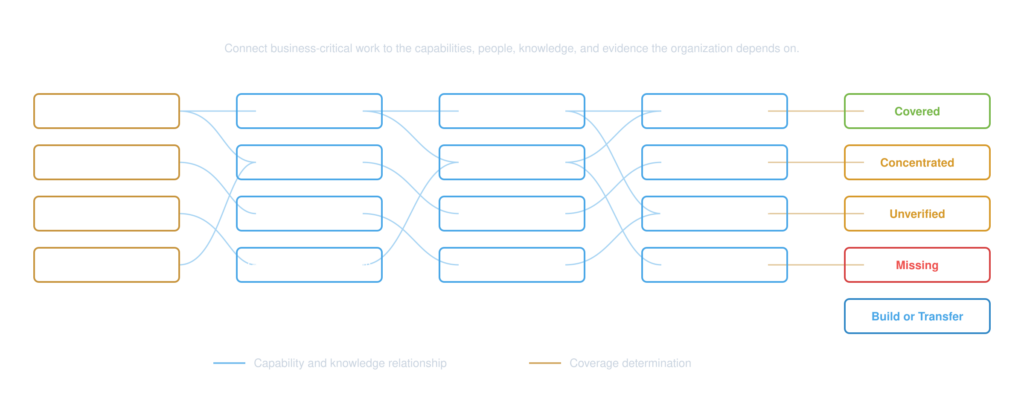
The problem is not simply a skills shortage. It is missing organizational coverage.
A skills list can describe what an individual knows or claims to know. It cannot show whether the organization has enough usable capability to support a consequential workflow or outcome.
To understand real coverage, leaders need to connect changing work to:
- The activities and decisions people must perform
- The technical and human capabilities the work requires
- The people and roles currently providing those capabilities
- The capacity available across teams and locations
- The institutional knowledge the work depends on
- The evidence showing that capabilities can be applied
- The systems, tools, and specialists supporting performance
- The consequences if a person, role, or knowledge source becomes unavailable
Without these connections, a capability may appear present because one employee possesses it, even though that person has no available capacity. A completed training program may suggest preparedness without showing whether employees can apply the learning. A new hire may add technical expertise but still lack the organizational knowledge required to improve the workflow.
A coverage view makes these conditions visible.
How AI talent and knowledge gaps take hold
Work changes faster than roles
AI alters activities, decisions, handoffs, and responsibilities before job descriptions or workforce plans catch up.
Capability needs remain unclear
Leaders discuss broad AI skills without defining what specific workflows, outcomes, and operating conditions require.
Knowledge remains concentrated
A small number of employees become the people everyone relies on to explain systems, correct outputs, resolve exceptions, or connect AI to the work.
Fragility grows as adoption expands
Pilots, workflows, and teams depend on capabilities and knowledge that are thinly distributed, difficult to verify, or unavailable at the required scale.
Why a simple AI tool inventory is not enough
Why a skills inventory is not enough
A skills inventory can help an organization understand what employees report, what managers observe, or what existing records associate with each person.
But a skills inventory answers only one question:
Which capabilities might exist?
A useful coverage review must answer several more.
Which activities, decisions, outcomes, exceptions, and responsibilities are changing because of AI?
What technical expertise, human judgment, operational knowledge, collaboration, leadership, or specialist support is necessary?
Which employees, teams, roles, partners, or specialists have evidence that they can perform the relevant work?
Is the capability available at the volume, location, level, and time the organization requires—or is it already overextended?
What process knowledge, customer context, decision criteria, work history, documentation, or institutional memory must remain accessible?
Is the capability supported by demonstrated work, outcomes, credentials, experience, manager observation, or only an unverified claim?
Can another person or team continue the work, or would the organization lose capability, context, ownership, or decision quality?
Without these relationships, a skills inventory may become another directory of terms rather than a foundation for workforce and operating decisions.
What leaders need to see clearly
Where coverage is strong or thin
Identify which critical capabilities and knowledge areas are sufficiently available—and which depend on limited capacity.
Where expertise is concentrated
Reveal workflows that rely on one employee, one team, one specialist, or one undocumented source of institutional knowledge.
What remains unverified or missing
Distinguish demonstrated capability from assumptions, self-reported skills, incomplete records, and requirements no one currently covers.
Where to invest or build next
Focus development, hiring, knowledge transfer, redesign, and specialist support on the gaps that matter most to priority outcomes.
Individual capability is not the same as organizational coverage.
A capable employee is valuable, but one person’s expertise does not necessarily give the organization dependable capacity.
True coverage exists when the right capabilities and knowledge are available, appropriately distributed, supported by evidence, connected to the work, and resilient enough to remain available as conditions change.
Individual capability
Individual capability may:
- Reside primarily in one person
- Be based on prior experience or training
- Be difficult for others to observe
- Have limited availability or capacity
- Depend on undocumented personal knowledge
- Be hard to transfer or replace
- Remain disconnected from priority work
- Disappear when the employee changes roles or leaves
A talented individual can perform important work while the organization around them remains vulnerable.
Organizational coverage
Organizational coverage requires:
- Clearly defined capability requirements
- Sufficient capacity across relevant roles
- Evidence connected to real work
- Shared and accessible knowledge
- Documented methods and decision criteria
- Deliberate backup and succession coverage
- Support from appropriate systems and specialists
- Continued review as work changes
Coverage turns individual talent and knowledge into a capability the organization can depend on.
The goal is not to reduce people to a list of skills. It is to understand how talent, knowledge, evidence, and capacity come together around the work that matters.
AI transformation depends on coverage—not just capability.
See where capability is strong, fragile, concentrated, or missing
—then decide what to build, transfer, redesign, or acquire.
WORKSHOP MODULE DETAILS
How To Map Talent, Knowledge & Coverage
This module identifies the capabilities, institutional knowledge, and role coverage required by changing AI-supported work.
Participants connect a bounded workflow and consequential outcome to the people, roles, expertise, knowledge, and evidence the organization currently relies on. The purpose is not to rate employees or produce a generic skills inventory. It is to understand where coverage is dependable, concentrated, unverified, or missing.
- Define the capabilities required by changing work
- Map capabilities to people, roles, and teams
- Identify concentrated expertise and single points of failure
- Surface institutional knowledge the workflow depends on
- Distinguish demonstrated capability from assumptions
- Examine available capacity and backup coverage
- Identify where knowledge must be documented or transferred
- Clarify whether gaps require development, redesign, hiring, redeployment, or specialist support
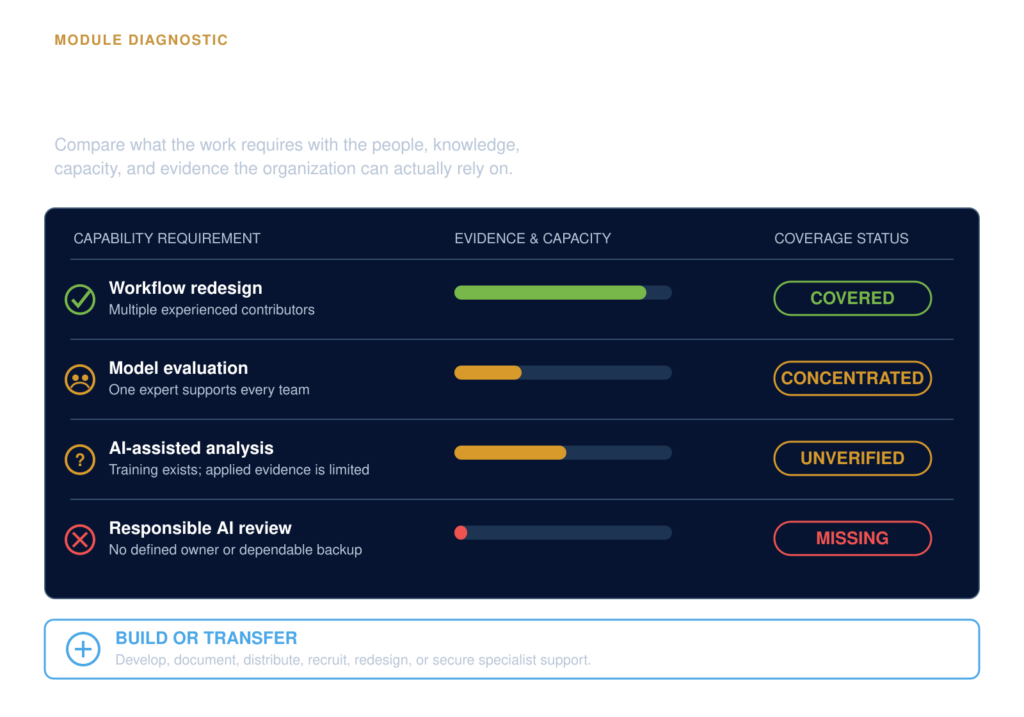
Where is the organization’s coverage fragile?
Knowing that a capability exists is only the first step. The organization must determine whether that capability and its supporting knowledge are available, dependable, sufficiently distributed, and connected to the work.
The Coverage Fragility Map organizes each requirement into a practical coverage condition.
Covered
Available, evidenced, and sufficiently supported The necessary capability, knowledge, capacity, and ownership are available where the work requires them. Evidence supports the organization’s confidence in the coverage.
Concentrated
Coverage depends on too few people The necessary capability or knowledge exists, but it is concentrated in one individual, role, team, location, vendor, or informal relationship
Unverified
Capability or knowledge may exist, but evidence is limited The organization believes the requirement is covered but lacks enough evidence to confirm the level, availability, relevance, or practical application of the capability.
Missing
No dependable coverage exists The organization cannot identify a person, role, team, knowledge source, or support structure capable of meeting the requirement.
Build or Transfer
Coverage requires deliberate development The organization understands what is needed and must now build, distribute, document, transfer, recruit, redesign, or obtain the necessary capability and knowledge.
These categories do not evaluate individual employee performance. They help leaders examine organizational conditions and determine what evidence or action is needed around a bounded workflow and decision.
What should a talent and knowledge coverage review examine?
Expected human involvement and actual human effort are not always the same.
A Handoff Load Map helps the team examine where employees are absorbing more work than the workflow design anticipated.
The work and outcomes
What must be accomplished, which activities and decisions matter, and what would happen if the requirement were not covered?
The capabilities and capacity
What technical expertise, human judgment, operational knowledge, collaboration, and available effort does the work require?
The people and roles
Who currently contributes, who owns the result, who provides backup, and where are responsibilities informal or unassigned?
The knowledge and evidence
What documentation, experience, work products, credentials, observations, outcomes, and institutional context support confidence in the coverage?
What to bring into the conversation
You do not need a complete skills taxonomy, a perfect workforce plan, or a validated profile for every employee.
We begin with the work, evidence, and observations your organization already has. The workshop then helps distinguish known capabilities from assumptions, concentrated knowledge, missing information, and genuine gaps.
Useful inputs may include:
- The priority workflow or AI-supported outcome
- Current roles and responsibilities
- Job descriptions or role profiles
- Existing skills and capability frameworks
- Team structures and organizational charts
- Training and credential records
- Project histories and work samples
- Performance or outcome evidence
- Process documentation and playbooks
- Knowledge repositories and system documentation
- Succession, workforce, or hiring plans
- Known experts and informal contributors
- Employee and manager observations
- Known bottlenecks, dependencies, or coverage concerns
The goal is not to assess the entire workforce in one session. The Decision Foundation establishes the outcome, workflow, and organizational boundary the module should examine.
What this module can help clarify
Where coverage is fragile
Identify critical work that depends on limited capability, capacity, knowledge, evidence, or backup.
Which knowledge must be protected or shared
Surface institutional knowledge, decision criteria, methods, relationships, and lessons that should be documented or transferred.
What is truly missing or merely unverified
Separate confirmed gaps from incomplete records, unclear requirements, unrecognized talent, and unsupported assumptions.
What to build, transfer, redesign, or acquire
Organize development, redeployment, knowledge transfer, workflow redesign, specialist support, and hiring into practical response options.
Final outputs depend on the modules selected and the decision established through the workshop’s required Decision Foundation.
Where might the work lead next?
Talent and knowledge gaps frequently overlap with hidden work, inconsistent adoption, and failed automation. A coverage review may reveal that another transformation problem needs to be addressed alongside workforce capacity.
Hidden Human–AI Handoffs
Reveal where employees are absorbing unexpected checking, correction, coordination, context preparation, and exception handling.
AI Adoption & Trust
Examine whether unclear expectations, weak support, workflow conditions, or employee concerns are preventing dependable use.
AI Boomerang Recovery
Restore lost work, knowledge, judgment, and accountability when automation or restructuring removes capabilities the organization still needs.
Questions leaders ask before booking.
An AI talent gap exists when an organization lacks the people, capabilities, capacity, knowledge, or evidence required to perform changing AI-supported work reliably.
The gap may involve technical expertise such as data engineering, integration, model evaluation, or AI security. It may also involve operational judgment, workflow knowledge, customer context, change leadership, governance, communication, or human oversight.
A talent gap does not always mean that the organization must hire someone new. The required capability may already exist but remain hidden, underused, concentrated, unsupported, or disconnected from the relevant work.
A skills gap generally describes a difference between the skills people currently possess and the skills a role or organization expects to need.
A coverage gap is broader. It asks whether the organization has sufficient capability, capacity, knowledge, evidence, ownership, and backup around a specific workflow or outcome.
A skill may exist in one person but still leave the organization with fragile coverage. Conversely, a team may cover a requirement effectively through complementary roles, systems, documentation, and specialist support even when no single person possesses every skill involved.
No. The module examines organizational coverage around a bounded workflow and decision. It does not score employees, rank individual performance, or make employment determinations.
Participants examine what the work requires, where relevant capability and knowledge currently exist, how dependable the evidence is, and where the organization may need stronger support.
Individual information should be handled consistently with applicable organizational policies, privacy requirements, employment practices, and specialist guidance.
No. Hiring is one possible response.
A gap may be addressed through employee development, redeployment, clearer role design, knowledge transfer, documentation, workflow redesign, better tools, external specialist support, stronger management practices, or a different division of work between people and AI.
The appropriate response depends on what the work requires, what capability already exists, how quickly coverage is needed, and whether the need is temporary, recurring, strategic, or highly specialized.
egin by defining the work and capability requirement clearly. Then examine evidence from relevant experience, projects, work samples, outcomes, credentials, manager observations, employee input, and adjacent responsibilities.
Employees may possess useful capabilities that do not appear in their current job title, HR record, or formal training history. At the same time, a broad self-reported skill should not automatically be treated as proof of readiness for a consequential task.
The module helps distinguish demonstrated capability, plausible adjacent capability, unverified claims, and genuine gaps.
AI-supported work depends on more than general technical ability. Employees often provide the context required to interpret information, recognize exceptions, apply judgment, maintain relationships, and understand why a process operates as it does.
If that knowledge is undocumented, inaccessible, or concentrated in a few people, the organization may struggle to train AI systems, evaluate outputs, redesign workflows, onboard new employees, or recover when someone leaves.
Institutional knowledge is therefore part of the organization’s practical coverage.
Training can be an important part of the response, but training alone does not guarantee coverage.
Employees need opportunities to apply learning to relevant work, access appropriate tools and support, receive feedback, and demonstrate capability under realistic conditions. The organization must also ensure that sufficient time, ownership, documentation, and capacity exist.
A training record shows participation. Coverage requires evidence that the organization can depend on the capability where it matters.
The most useful evidence depends on the capability and the work.
Possible evidence may include relevant experience, work products, project outcomes, observed performance, credentials, assessments, manager or peer observations, documented contributions, and the ability to handle realistic scenarios.
No single measure should automatically determine whether a person or team is ready. The strength of the evidence should be proportionate to the consequences of the work and interpreted in context.
The module examines the organizational conditions surrounding talent, knowledge, and coverage as part of a bounded AI transformation decision.
It may surface questions requiring further review by human resources, employment counsel, labor relations, workforce planning, learning and development, organizational design, accessibility, or other qualified specialists.
The workshop does not replace those functions or make professional employment, legal, or personnel determinations.
Every engagement begins with the required Decision Foundation, which establishes the consequential outcome, affected workflow, available evidence, and bounded decision the workshop must support.
Talent, Knowledge & Coverage can then be selected when the organization needs to understand which capabilities, people, roles, knowledge, and capacity the decision depends on.
Depending on what the module reveals, it may be combined with modules addressing hidden human–AI work, adoption and trust, value and ROI, scale conditions, recovery, or another connected problem.
Build the talent and knowledge coverage your AI transformation depends on.
Connect changing work to the capabilities, people, institutional knowledge, capacity, and evidence required to perform it reliably.
This module is part of Gobekli’s configurable AI Transformation Workshop. Explore the complete workshop, its 12-module structure, and how we identify the right starting point for your organization.
