
AN AI TRANSFORMATION WORKSHOP MODULE
AI Transformation Drift:
How to Keep Your AI Strategy Current
AI capabilities, organizational needs, operating conditions, evidence, and risks continue changing after an AI strategy or roadmap is approved.
The problem is not that the original strategy was necessarily wrong. It is that the conditions around it changed—and the organization did not update its decisions quickly enough.
Does this sound familiar?
The AI roadmap reflects last year’s assumptions
Priorities established months ago continue guiding investment even though capabilities, costs, risks, and organizational needs have changed.
New capabilities appear faster than plans can adapt
Models, agents, embedded features, and vendor offerings create options that did not exist when the transformation plan was developed.
Old pilots remain active without a new decision
Initiatives continue because no review point was established to confirm whether they should advance, change, pause, or end.
Lessons stay inside individual teams
Employees and project teams discover what works, but those lessons do not consistently inform broader strategy, governance, or investment.
Controls lag behind changing workflows
Policies and review practices remain fixed while AI systems gain access to new data, influence new decisions, or perform more consequential actions.
Leaders cannot tell what needs reconsideration
The organization receives updates about projects but lacks a shared process for determining which assumptions, priorities, and decisions are no longer current.
What is AI transformation drift?
AI transformation drift occurs when an organization’s AI strategy, priorities, controls, operating model, or investment decisions become increasingly disconnected from current conditions.
The original plan may have been reasonable when it was created. But AI capabilities change. Vendors introduce new features. Costs shift. Regulations and professional expectations develop. Employees redesign workflows. Evidence reveals unexpected value, limitations, dependencies, and consequences.
Organizational conditions also change. Leadership priorities move. Customer needs evolve. Budgets tighten or expand. Teams gain experience. Data becomes available—or proves less usable than expected.
Drift begins when these changes accumulate without triggering a corresponding review of the organization’s assumptions and decisions.
It is therefore not simply a planning problem. It is a gap between how quickly the environment changes and how effectively the organization learns, reassesses, and responds.
The problem is not that the strategy changed.
It is that the learning never reached the strategy.
AI transformation cannot be governed through a static plan alone. A roadmap establishes direction, but it cannot anticipate every capability, workflow change, operating dependency, or consequence that will emerge.
To keep transformation current, leaders need to connect:
- The outcomes the organization still intends to achieve
- The assumptions supporting current priorities
- The initiatives and workflows producing new evidence
- The AI capabilities now available
- The operating conditions required for responsible use
- The changes affecting people, data, systems, and governance
- The lessons emerging across teams
- The decisions that should be revisited
- The signals that should trigger the next review
Without those connections, learning remains local while strategy remains fixed.
A successful initiative may reveal an opportunity to expand. A disappointing pilot may expose a solvable workflow problem rather than a failed use case. A previously appropriate control may no longer match the system’s level of autonomy. A strategic priority may remain important even though the selected technology is no longer the best way to pursue it.
Keeping transformation current means revisiting decisions without repeatedly restarting the transformation.
How AI transformation drift takes hold
A strategy establishes direction
The organization defines priorities, approves initiatives, establishes controls, and begins changing work.
Reality produces new evidence
Teams discover unexpected value, limitations, dependencies, workarounds, risks, and operating requirements.
Conditions continue changing
New AI capabilities, vendor offerings, organizational needs, workforce expectations, and external requirements emerge.
Plans and reality separate
Initiatives, policies, investments, and assumptions continue without a structured decision about what should remain, change, expand, or end.
Why an annual AI strategy update is not enough
An annual review can provide an important leadership checkpoint. It creates an opportunity to reconsider priorities, investments, risks, and results.
But AI transformation does not change on an annual schedule.
A useful renewal process must answer several questions throughout the transformation.
Which organizational priorities, workflows, capabilities, systems, vendors, costs, risks, requirements, or operating conditions are different from when the decision was made?
What evidence has emerged about value, quality, adoption, human effort, customer experience, reliability, dependencies, and unintended consequences?
What did the organization originally believe about the problem, users, workflow, technology, data, capacity, cost, or expected outcome—and does the available evidence still support it?
Which initiatives, controls, workflows, investments, or strategic priorities can continue as planned, and which have changed enough to require leadership attention?
Which workflow owners, employees, technical teams, leaders, customers, governance partners, or qualified specialists have relevant evidence or decision authority?
What event, threshold, signal, or date should trigger the next reassessment?
Without these connections, strategy reviews may become broad conversations about trends rather than disciplined updates to consequential organizational decisions.
What leaders need to see clearly
Which assumptions have changed
Identify where current evidence no longer supports the beliefs behind an initiative, priority, control, or operating decision.
What the organization has learned
Bring together evidence from workflows, employees, customers, systems, pilots, and operational results.
Which decisions are becoming outdated
Reveal where changing capabilities or conditions have created a meaningful gap between the approved plan and present reality.
What requires action now
Distinguish changes that can be monitored from those requiring an updated decision, new evidence, specialist review, or immediate intervention.
Keeping AI transformation current does not mean chasing every new development.
AI markets move quickly. New tools, models, agents, features, claims, and risks appear continuously. Attempting to respond to every development can create instability, fatigue, fragmented investment, and repeated changes in direction.
The goal is not constant reinvention. It is disciplined adaptation.
Disciplined renewal
A deliberate renewal process can support:
- Decisions informed by current evidence
- Clear review points and decision triggers
- Organizational learning across initiatives
- Stable outcomes with adaptable methods
- Earlier recognition of changing risks
- Better use of emerging capabilities
- More defensible investment decisions
- Continuous improvement without constant disruption
The organization preserves strategic direction while updating the parts of the transformation that evidence shows should change.
Reactive transformation
Unstructured responses to change can create:
- Repeated shifts in priorities
- Technology chasing and vendor-driven decisions
- Abandoned work before evidence develops
- New pilots disconnected from strategy
- Frequent changes that exhaust employees
- Controls that alternate between excessive and insufficient
- Investment driven by urgency or novelty
- Difficulty learning from previous decisions
- A transformation that never becomes operational
Constant movement is not the same as remaining current.
The goal is to change when
the evidence warrants it
—and preserve continuity when it does not.
WORKSHOP MODULE DETAILS
How to Keep AI Transformation Current
This module helps organizations revisit consequential AI transformation decisions as evidence, capabilities, workflows, risks, and organizational conditions change.
Participants connect the transformation’s intended outcomes to what has happened since earlier decisions were made. They examine which assumptions still hold, what the organization has learned, and where current conditions require an updated response.
The purpose is not to replace the organization’s strategy or create another general AI roadmap. It is to keep a bounded transformation decision aligned with present reality.
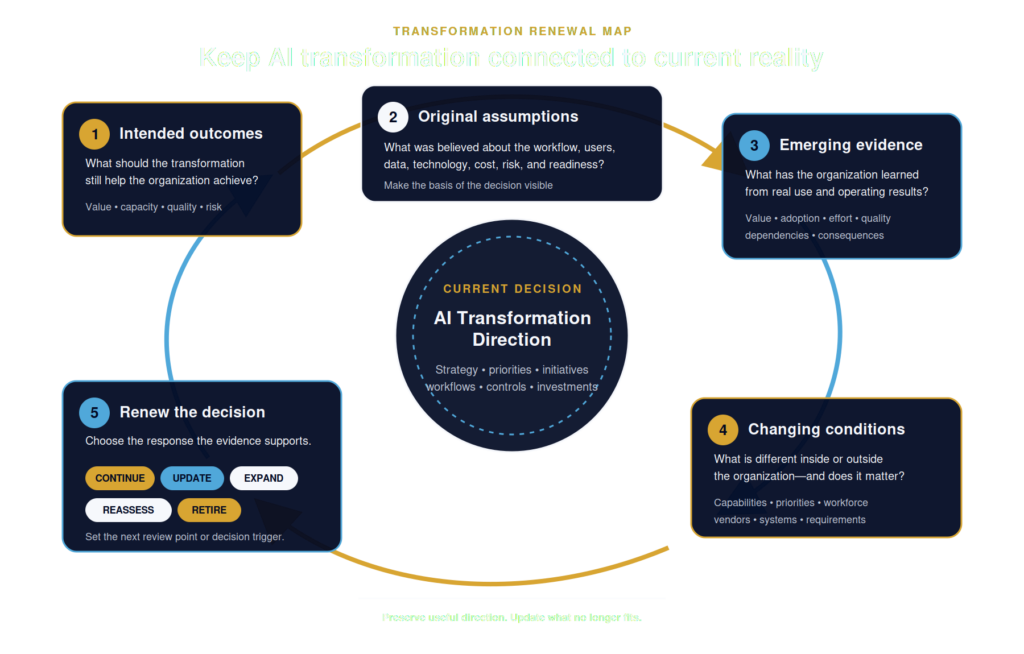
- Revisit the assumptions behind current AI decisions
- Connect operational learning to transformation strategy
- Identify changes in capabilities and operating conditions
- Examine whether outcomes and priorities remain current
- Distinguish meaningful signals from market noise
- Identify decisions requiring renewed leadership attention
- Establish practical review triggers and learning loops
- Develop an evidence-backed transformation response
What should happen to the transformation decision next?
The organization should not change direction merely because a new capability has appeared. It should also not preserve an outdated decision simply because time, money, or leadership credibility has already been invested.
The response depends on the intended outcome, current evidence, changed conditions, and consequences of acting—or failing to act.
Continue
The direction remains current The intended outcome remains important, available evidence supports the current approach, and no material change requires a different decision.
Update
The direction remains valid, but the approach should change The organization should adjust the workflow, technology, controls, ownership, measures, timing, or operating conditions while preserving the broader objective.
Expand
Evidence supports broader application The approach is producing meaningful results and may be ready to reach additional users, workflows, teams, capabilities, or operating environments.
Reassess
Material assumptions or conditions have changed The organization lacks enough current evidence—or the context has changed enough—that the existing decision can no longer be accepted without further review.
Retire
The decision no longer supports the organization’s needs The initiative, method, control, technology, or priority no longer produces sufficient value, addresses a meaningful outcome, or fits current operating conditions.
These categories are not automatic recommendations generated by a trend, score, or review date. They organize the evidence and tradeoffs leadership must consider before changing the transformation.
What should a transformation renewal review examine?
The intended outcome
What organizational result was the decision intended to influence? Does that outcome remain important, and is the current approach still connected to it?
The original assumptions
What did the organization believe about the workflow, users, data, technology, cost, risk, capacity, timing, and operating environment?
The emerging evidence
What has the organization learned about value, quality, adoption, effort, dependencies, experience, reliability, risk, and unintended consequences?
The changed conditions
What is different inside or outside the organization, and does that change materially affect the current decision?
What to bring into the conversation
You do not need a complete history of every AI decision or a continuously updated enterprise transformation model.
We begin with the strategy, evidence, and observations your organization already has. The workshop helps separate current facts from inherited assumptions, emerging signals, unanswered questions, and changes requiring specialist review.
Useful inputs may include:
- Current AI strategy, roadmap, or transformation priorities
- The original business case or decision record
- Active and recently completed AI initiatives
- Available outcome, usage, cost, quality, and adoption evidence
- Employee, manager, customer, or stakeholder observations
- Known workflow changes and workarounds
- Changes in AI capabilities, tools, models, or vendors
- Updated data and integration conditions
- Current governance policies and review records
- New organizational priorities or constraints
- Known legal, regulatory, contractual, or professional developments
- Decisions leadership suspects may no longer be current
The goal is not to update the complete enterprise strategy in one session. The Decision Foundation establishes the outcome, workflow, decision, and period the module should examine.
What this module can help clarify
Which assumptions still hold
Identify where current evidence continues to support the thinking behind the organization’s AI decisions.
What has materially changed
Reveal changes in outcomes, capabilities, workflows, evidence, risks, dependencies, or organizational conditions.
Which decisions require renewal
Distinguish decisions that remain current from those requiring an update, expansion, reassessment, or retirement.
How to keep future decisions current
Establish practical review points, decision triggers, evidence needs, ownership, and learning loops.
Final outputs depend on the modules selected and the decision established through the workshop’s required Decision Foundation.
Where might the work lead next?
Transformation drift frequently overlaps with initiative overload, outdated governance, weak evidence, and portfolio fragmentation. A renewal review may reveal that another problem must be addressed alongside the strategy itself.
AI Initiative Overload
Determine which competing AI projects should advance, sequence, combine, pause, stop, or receive further investigation.
Proving AI Value & ROI
Examine whether current investments still create defensible value after cost, quality, adoption, hidden work, dependencies, and risk are included.
AI Governance & Accountability
Update ownership, decision rights, boundaries, controls, documentation, and escalation paths as AI-enabled work changes.
Questions leaders ask before booking.
AI transformation drift occurs when an organization’s strategy, priorities, controls, investments, or operating decisions become disconnected from current evidence and conditions.
The original decisions may have been reasonable. Drift develops when capabilities, workflows, organizational needs, evidence, risks, or external requirements change without prompting a corresponding review.
There is no single review schedule appropriate for every organization or decision.
Organizations may use regular quarterly, semiannual, or annual reviews, but consequential decisions should also have event-based triggers. A review may be warranted when a workflow changes materially, new evidence emerges, an AI system gains greater autonomy, a vendor changes its service, an important dependency fails, or qualified specialists identify a new requirement.
The appropriate frequency depends on the pace of change and the consequences of the decision.
No. A current strategy is not one that changes constantly. It is one whose assumptions and decisions remain connected to available evidence.
A review may conclude that the existing direction should continue. Stability can be the correct response when outcomes remain important, evidence supports the approach, and no material change requires intervention.
Initiative prioritization determines how competing projects should fit into a workable organizational sequence.
Keeping AI Transformation Current revisits decisions after time, experience, and changing conditions have produced new information. It asks whether the assumptions and direction behind those decisions still hold.
The two modules may be used together when a strategy review changes the relative importance or readiness of active initiatives.
AI governance establishes ownership, decision rights, boundaries, controls, documentation, and escalation paths.
Keeping AI Transformation Current examines whether those arrangements—and the strategy surrounding them—remain appropriate as capabilities, workflows, evidence, and operating conditions change.
A renewal review may identify governance decisions that require specialist assessment or formal revision.
No. The appearance of a new capability does not demonstrate that the organization needs it.
Leaders should examine whether the capability addresses a meaningful outcome, fits the workflow, relies on appropriate data and systems, can be responsibly supported, and improves upon available alternatives.
The objective is not to keep every technology current. It is to keep organizational decisions current.
Technology can help collect portfolio information, monitor usage, track measures, document decisions, and identify changes or anomalies.
It cannot independently determine whether an organizational outcome remains important, whether evidence is sufficient, which tradeoffs are acceptable, or who should take responsibility for a consequential decision.
A meaningful renewal process combines appropriate technical evidence with organizational context, human judgment, and qualified specialist review where required.
No. The module helps participants identify changes, evidence, assumptions, and decisions that may require review.
It may surface questions for legal, compliance, cybersecurity, privacy, procurement, finance, labor, accessibility, or other qualified specialists. The workshop does not replace their professional determinations.
Every engagement begins with the required Decision Foundation, which establishes the consequential outcome, affected workflow, available evidence, and bounded decision the workshop must support.
AI Boomerang Recovery can then be selected when an AI-enabled workflow is producing unexpected effort, friction, quality problems, downstream consequences, or unclear value.
Depending on what the module reveals, it may be combined with modules addressing value and ROI, adoption, governance, tool sprawl, pilot progression, workforce readiness, or another connected problem.
Keep your AI strategy connected to what your organization is learning.
Revisit assumptions, examine changed conditions, and turn emerging evidence into current transformation decisions.
This module is part of Gobekli’s configurable AI Transformation Workshop. Explore the complete workshop, its 12-module structure, and how we identify the right starting point for your organization.