
REGIONAL WORKFORCE & INDUSTRY ALIGNMENT WORKSHOP MODULE
Apprenticeship & Work-Based Learning Capacity
Clarify the work, supervision, mentoring, and partner support needed for a useful placement—so apprenticeship and work-based learning plans reflect what employers and providers can realistically support.
Does this sound familiar?
Employer interest becomes a placement count.
Organizations express willingness to help, but the partnership has not confirmed the work, timing, supervision, or conditions behind each proposed opportunity.
There is work available, but the learning purpose is unclear.
Participants may be present in a workplace without a defined connection between their activities and the capabilities the pathway needs to develop.
Supervisors are expected to absorb the additional responsibility.
Experienced staff are named as supervisors or mentors without confirming their time, preparation, support, or competing duties.
Placement numbers hide differences in opportunity.
Sites offer different activities, equipment, schedules, and levels of responsibility, but the regional plan treats every place as equivalent.
Learning evidence depends on informal conversations.
Providers and employers have not agreed what should be observed, documented, reviewed, or communicated during the experience.
No one owns the response when a placement changes.
A supervisor leaves, the work changes, or a participant encounters difficulty, and the partners lack a clear route for support, adjustment, or reassignment.
What is apprenticeship and work-based learning capacity?
Work-based learning capacity is the ability to provide an authentic work experience that supports a defined learning purpose under workable conditions.
It includes the activities available, the people responsible for supervision and mentoring, the timing, and the support needed by participants and host organizations.
A placement is useful to a regional pathway when those conditions connect to the preparation the participant needs.
Different arrangements may include apprenticeships, internships, structured workplace learning, or other supervised experiences. Their requirements and operating arrangements should be identified for the selected model.
This module helps partners examine one proposed placement arrangement and determine what is confirmed, what remains conditional, and what must be addressed before it can support participants.
A willing host needs a workable learning arrangement.
An employer may support the initiative and want to offer opportunities.
Its ability to host participants depends on more than goodwill or available work.
The site needs suitable activities, appropriate supervision, time for guidance, and a clear relationship with the provider or coordinating partner.
Participants need to understand what they will do, how they will receive support, and how their progress will be reviewed.
The workshop examines these conditions together.
That gives the partnership a clearer basis for describing usable capacity and identifying the support required to develop additional opportunities.
What needs to connect?
Placement purpose
Selected pathway
Intended learning
Relevant role or activities
Participant starting expectations
Placement model
Work opportunity
Authentic activities
Equipment and environment
Exposure and practice
Sequence and duration
Limits of the site
Supervision and mentoring
Responsible supervisor
Mentor contribution
Available time
Preparation and support
Coverage arrangements
Evidence and coordination
Observation opportunities
Feedback
Progress records
Provider review
Partner communication
Participation and continuity
Entry arrangements
Workplace conditions
Participant support
Escalation routes
Changes and alternatives
Placement capacity should retain its site, activities, timing, supervision, and conditions. A total number of places can conceal important differences in what participants will experience.
How this module helps
1. Understand usable placement capacity
Learn why employer interest and available positions do not fully describe a supported learning opportunity.
2. Examine one hosting arrangement
Review the activities, supervision, mentoring, timing, and evidence relevant to the selected pathway.
3. Identify readiness gaps
Clarify which responsibilities and conditions must be confirmed before participants begin.
4. Prepare a practical response
Develop a placement-capacity brief that can inform partner commitments, host support, and a possible Gobekli configuration.
Begin with one proposed placement arrangement.
Choose an employer site or a tightly bounded group of opportunities that the initiative is considering.
For example, a manufacturing employer may offer to host participants from a maintenance preparation pathway.
The exercise examines which activities the site can support, who will supervise them, and how the experience will connect to the participant’s preparation.
Questions to review together
Identify the activities and capabilities the placement is intended to develop or help demonstrate. Clarify its relationship to other preparation.
Review the activities, equipment, conditions, and timing at the selected site. Identify where exposure is possible but hands-on practice may be limited.
Name the relevant roles and distinguish their responsibilities. Confirm available time, preparation needs, support, and coverage.
Clarify observation, feedback, evidence, and provider review. Identify who can make which judgments and what remains outside their role.
Review entry arrangements, schedules, location, equipment access, support needs, and the operating conditions participants need to understand.
Define contacts and responses for unavailable work, changed supervision, participant concerns, interrupted attendance, or a placement that cannot continue.
Six dimensions of usable placement capacity
Learning purpose
A defined contribution to the selected pathway and the capabilities participants need to develop.
Activity availability
Authentic work that offers appropriate exposure, practice, and progression within the placement period.
Supervision readiness
Named people with the availability, preparation, and support needed to oversee the work appropriately.
Mentoring and feedback
A workable arrangement for guidance, questions, reflection, and feedback during the experience.
Partner coordination
Clear responsibilities for evidence, communication, participant support, and review.
Continuity
A response when activities, staffing, or participant circumstances change.
When capacity is described only as placements
Partners may overlook:
- Differences in the activities available at each site.
- Limits on practice or equipment access.
- Supervisor time and competing responsibilities.
- Mentoring and feedback arrangements.
- Evidence and provider-review expectations.
- Support and contingency responsibilities.
The initiative may then count opportunities that are not yet ready to provide the intended learning experience.
When placement capacity becomes usable
Partners can establish:
- A defined learning purpose for each arrangement.
- Confirmed activities and operating conditions.
- Named supervision and mentoring roles.
- A practical feedback and evidence plan.
- Clear participant and host support routes.
- Review points and responses to change.
The resulting brief explains what a placement can support and what needs to happen before participants begin.
What this can look like in practice
A regional employer offers to host six participants from a maintenance preparation program.
The partnership initially records six available placements.
During the module, the employer and provider examine the activities participants need to practice and the work expected during the proposed period.
The site can offer relevant inspection and documentation activities, but access to some servicing tasks depends on the operating schedule.
The proposed supervisor already has substantial production responsibilities.
A second experienced employee is willing to mentor participants but has not been given time or guidance for that contribution.
The partners examine a smaller initial group, staged activity access, and a clearer division between supervision, mentoring, and provider review.
They agree to define the evidence participants will retain and the feedback the provider needs to understand progress.
They also identify a contact and response if the planned activities become unavailable.
The partnership leaves with a conditional placement plan and assigned readiness tasks before confirming the initial number of usable opportunities.
Supervision and mentoring need explicit responsibilities.
Supervision and mentoring may be provided by the same person, but they serve different purposes.
A supervisor may oversee assigned work, operating expectations, and the conditions under which activities take place.
A mentor may help participants ask questions, interpret experience, reflect on progress, and understand the workplace.
The arrangement should explain who provides each function and what support they receive.
It should also identify who covers an absence and who responds when a participant needs help beyond the host’s role.
Naming someone on a placement document does not establish that the responsibility is workable.
Being present does not establish the intended learning.
Attendance can confirm that someone spent time at a site.
It does not fully explain which activities they performed, the support involved, or what they demonstrated.
The workshop connects the learning purpose to opportunities for observation, feedback, and appropriate evidence.
It also distinguishes watching an activity, performing it with support, and performing it with greater independence.
Those differences help providers and employers interpret the experience without overstating readiness.
The brief identifies what can be reviewed within the placement and which conclusions require further evidence or assessment.
WORKSHOP MODULE 8
Turn potential placements into supported learning opportunities.
Apprenticeship & Work-Based Learning Capacity is a focused minicourse in examining the conditions behind a placement commitment. Participants review one selected hosting arrangement, identify its learning and support requirements, and define readiness responsibilities using the foundation established in Regional Workforce Direction.
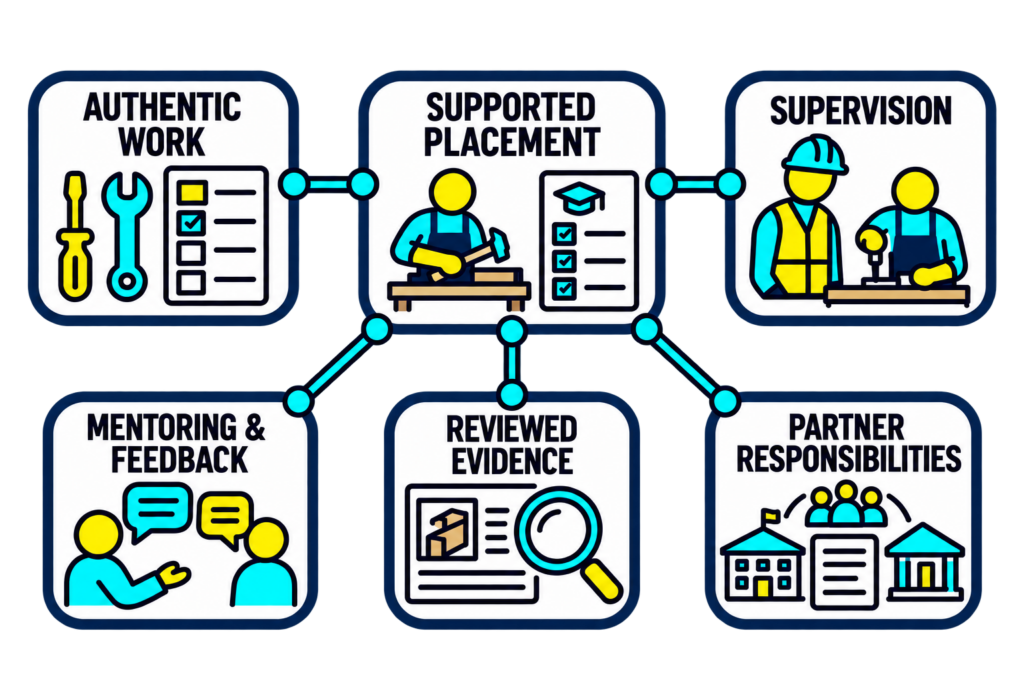
What can this module address?
The module examines one placement arrangement or a tightly bounded group of opportunities. Topics may include:
- The placement model and intended learning purpose.
- Its relationship to the regional preparation route.
- Authentic activities and opportunities for practice.
- Equipment, environment, and activity-access conditions.
- Timing, duration, and participant group size.
- Supervisor roles and confirmed availability.
- Mentoring, feedback, and host support.
- Evidence and provider-review expectations.
- Participant entry and support arrangements.
- Employer, provider, and coordinator responsibilities.
- Escalation, interruption, and alternative arrangements.
- Readiness confirmation and review triggers.
What responses might emerge?
The appropriate response depends on the gap between the proposed opportunity and the conditions needed to support it.
Clarify
Define what the placement is intended to provide and which activities it can realistically support.
Prepare
Identify the guidance, resources, or preparation needed by supervisors, mentors, hosts, and participants.
Allocate
Confirm time and responsibility for supervision, mentoring, feedback, and partner coordination.
Phase
Begin with a group size or activity sequence that fits confirmed host capacity.
Coordinate
Connect employer, provider, and participant responsibilities through clear communication and review arrangements.
Adapt
Revise activities, timing, support, or placement options when the original arrangement becomes unworkable.
The module may identify opportunities that can begin after specific readiness tasks, as well as opportunities that require further development before being counted as usable capacity.
What will we review?
The proposed placement commitment
The host, participant number, period, and experience currently being discussed.
The learning and work activities
What participants need to develop and which authentic activities the site can provide.
The supervision and mentoring arrangement
Who is responsible, what time is available, and what preparation or coverage is needed.
The evidence and feedback plan
How experience will be observed, discussed, documented, and reviewed.
The participation conditions
Entry arrangements, schedules, support, and information participants need before beginning.
The partner response arrangement
Contacts, escalation routes, review points, and alternatives when the placement changes.
A practical exercise: create a Work-Based Learning Capacity & Readiness Brief.
Participants examine one proposed hosting arrangement and identify what must be confirmed before it can support the intended experience.
STEP 1
Define the opportunity and purpose
Name the placement, host, participant group, and contribution to the selected pathway.
STEP 2
Map the available work
Identify activities, timing, equipment access, and limits affecting exposure or practice.
STEP 3
Confirm supervision and mentoring needs
Describe the roles, time, preparation, support, and coverage required.
STEP 4
Connect feedback and evidence
Identify what should be observed or retained, who reviews it, and what the evidence can support.
STEP 5
Define participant and partner support
Clarify entry information, contacts, communication, and responses to difficulties or interruptions.
STEP 6
Assign readiness and review decisions
Record unresolved conditions, responsible owners, confirmation dates, and the capacity that can be described once those conditions are met.
A draft Work-Based Learning Capacity & Readiness Brief connecting the proposed placement to its activities, supervision, mentoring, evidence, support, and confirmation responsibilities.
CONNECT THE WORKSHOP TO A PRACTICAL NEXT STEP
Define the context behind each usable placement.
A useful placement configuration should connect the opportunity with its learning purpose, work activities, and responsible people. This module identifies the relationships a subsequent Gobekli implementation would need to preserve.
- Host organizations and relevant work sites.
- Placement models and intended learning.
- Available activities and operating conditions.
- Participant starting expectations.
- Placement timing and confirmed capacity.
- Supervisor and mentor roles.
- Feedback, evidence, and review responsibilities.
- Provider and coordinator contacts.
- Support, escalation, and alternative arrangements.
- Readiness status, review dates, and changes affecting the placement.
Where appropriate, these requirements can inform a TalentSync configuration connecting host opportunities, work activities, supervision, and partner responsibilities. TalentPass and Passport Pages may support participants who choose to retain and share relevant accounts and evidence of their experience.
The workshop establishes starting requirements. Product functionality, record handling, integrations, access arrangements, and operating responsibilities are confirmed separately.
SCOPE AND BOUNDARIES
What this module does—and what requires further work
This module examines whether a proposed placement has the conditions needed to support its intended learning purpose.
It clarifies readiness questions and the responsibilities needed to resolve them.
It does not establish a registered apprenticeship, approve a placement’s compliance, authorize participants to perform particular work, or guarantee employment.
Further work may be needed to:
- Confirm the requirements of the selected placement model.
- Establish formal host and provider arrangements.
- Review workplace suitability and operating conditions.
- Prepare supervisors and mentors.
- Confirm participant entry and support arrangements.
- Develop detailed learning and assessment plans.
- Arrange alternatives or additional host capacity.
- Implement and maintain the supporting configuration.
Different placement models have different requirements. The responsible organizations should confirm the arrangements applicable to the selected experience through their established processes.
Hosts and providers retain responsibility for their authorized commitments, supervision, learning arrangements, and participant support.
What should participants bring?
Bring one proposed or existing placement arrangement and enough context to examine how it would operate.
A host’s expression of interest is a useful starting point when its unconfirmed conditions remain visible.
Useful inputs
- The Regional Workforce Direction Brief.
- Relevant role and preparation requirements.
- The proposed placement model and purpose.
- Host and site information.
- Available work-activity descriptions.
- Proposed timing and participant numbers.
- Supervisor and mentor role summaries.
- Existing host guidance or preparation materials.
- Feedback and evidence-review expectations.
- Participant information and support arrangements.
- Known constraints or previous placement difficulties.
- Employer, provider, and coordinator contacts.
Use authorized operational information and de-identified examples. The initial review can focus on the arrangement without requiring personal participant records.
What can you leave with?
Work-Based Learning Capacity Brief
A clear account of the proposed opportunity, its learning purpose, available activities, and conditions affecting usable capacity.
Supervision & Mentoring Plan
Defined roles, availability questions, preparation needs, support, and coverage responsibilities.
Evidence & Partner Support Plan
Feedback, review, communication, participant-support, and escalation arrangements requiring confirmation.
Readiness & Configuration Priorities
Assigned readiness tasks, review points, and starting requirements for a possible Gobekli configuration.
These outputs begin with the hosting arrangement examined during the module. Formal program development, detailed placement approval, and wider host coverage require additional work.
Where might the work lead next?
Employer Participation & Small-Business Access
Examine how hosting demands and shared support arrangements affect whether employers can participate.
Regional Access & Workforce Participation Constraints
Review the conditions that may affect whether interested people can enter and continue the selected work-based learning route.
Investment, Partner Commitments & Mobilization
Connect proposed placement capacity to the resources, decisions, and partner contributions needed to make it usable.
Regional Workforce Direction provides the required foundation. Training Capacity & Delivery Bottlenecks and Cross-Provider Pathway & Credential Alignment can help clarify how the placement fits the wider preparation route.
Frequently asked questions
Questions regional partners ask before beginning.
An opportunity with the activities, supervision, mentoring, timing, and partner support needed to provide its intended learning experience. A host’s interest alone does not establish that capacity.
Yes. The exercise can examine a selected apprenticeship or another work-based learning arrangement. Its specific requirements and responsibilities need to be identified for that model.
No. It can clarify capacity and readiness questions that inform further development. Registration and formal program arrangements require separate work through the appropriate processes.
The exercise focuses on one hosting arrangement or a tightly bounded group with comparable conditions. Wider employer coverage requires additional scope.
Include people who understand the work, supervision, learning requirements, and coordination responsibilities. This may involve host supervisors, employer representatives, providers, mentors, and intermediaries.
Yes. The module helps identify what needs to be confirmed before that interest becomes a usable opportunity.
The same person may fulfill both roles, but the responsibilities should be explicit. Oversight of work and developmental guidance may require different time, preparation, and support.
Review the activities, timing, equipment access, supervision, mentoring, and other conditions together. The responsible host and partners should confirm the resulting capacity.
Identify the gap and examine whether another part of the pathway can address it through an agreed arrangement. The placement’s description should accurately reflect what it provides.
Attendance provides limited information about participation. Activities performed, conditions, feedback, and appropriate evidence are needed to understand what someone practiced or demonstrated.
That depends on the learning purpose and authorized arrangements. The module identifies relevant activity descriptions, feedback, work examples, or other evidence and clarifies their interpretation limits.
Define who will review the effect on learning and decide whether activities, timing, support, or the placement itself need adjustment.
Potentially. Their capacity may depend on manageable responsibilities and shared support. Employer Participation & Small-Business Access can examine those arrangements in more detail.
That module examines overall preparation delivery. This module focuses on the authentic work, host supervision, mentoring, and partner arrangements needed for usable placements.
No. It identifies relevant readiness questions and responsible owners. Required reviews and approvals remain with the appropriate organizations and specialists.
It can identify starting configuration requirements. Product fit, integrations, evidence handling, permissions, and operating responsibilities are agreed separately.
Confirm the priority host conditions, assign supervision and mentoring responsibilities, establish support and review arrangements, and update the placement commitment before participants begin.
BUILD THE CONDITIONS BEHIND THE PLACEMENT
Create work-based learning opportunities your partners can support.
Connect authentic activities to prepared supervisors, useful mentoring, reviewed evidence, and accountable partner support.
Use that clearer picture to decide which opportunities are ready, what needs development, and how the experience will be maintained.