
REGIONAL WORKFORCE & INDUSTRY ALIGNMENT WORKSHOP
Bring Economic Plans, Employers, Training, and Talent Into Alignment.
Your region is working toward new investment, stronger industries, and better opportunities. Progress becomes difficult when employer demand, training capacity, available talent, and partner commitments do not connect.
Build a practical plan around a selected industry, occupation, or regional initiative. Clarify what is needed, what is available, what remains uncertain, and who can act.
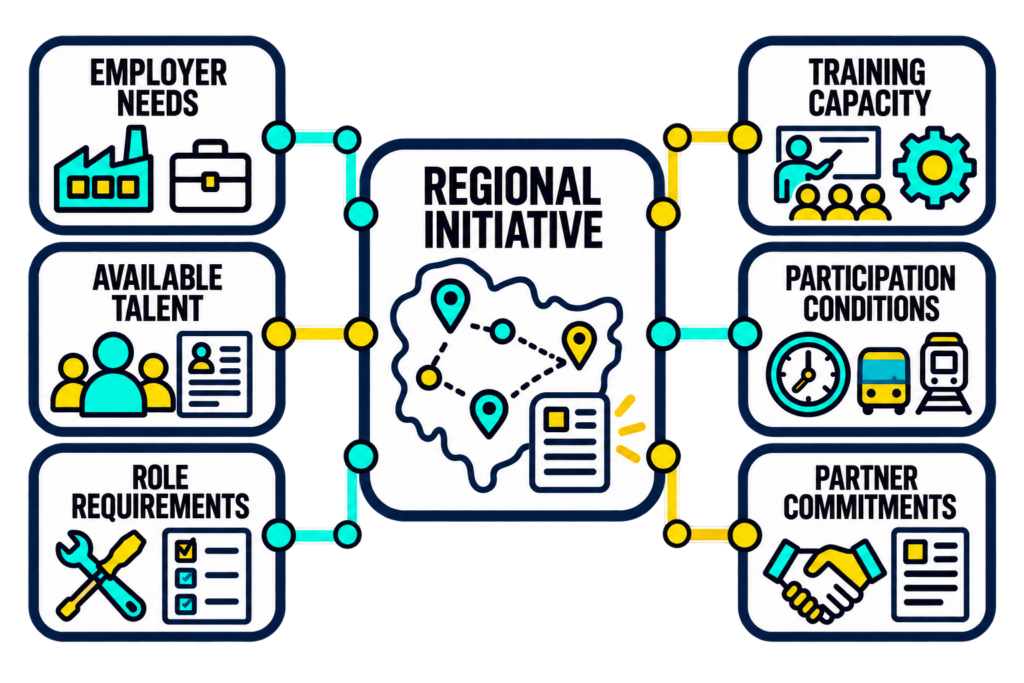
Shared ambitions. Disconnected plans.
Economic plans lack a clear workforce route
An expansion, investment, or sector strategy describes the intended opportunity without establishing how the relevant people, preparation, and hiring decisions will connect.
Employer demand remains too broad
Partners hear that employers need talent, but the roles, tasks, timing, conditions, and actual hiring commitments remain unclear.
Available talent is difficult to understand
Regional statistics and résumés reveal only part of the experience, capability, interests, and availability that could inform a workforce response.
Training capacity is assumed
A program exists, but its instructor availability, facilities, equipment, schedules, placements, or completion timing may not match the initiative’s needs.
Providers prepare people along disconnected routes
Programs and credentials describe related preparation differently, making it difficult to understand progression, gaps, or how their contributions fit together.
Participation depends on unresolved conditions
Travel, schedules, accessibility, digital access, and other practical conditions affect whether people can use the proposed opportunities.
Partnerships lack confirmed commitments
Organizations support the ambition but have not agreed on who will provide capacity, make decisions, contribute resources, or resolve dependencies.
The picture changes after the plan is written
Hiring schedules, project timing, training availability, and participant circumstances shift without a shared process for updating the response.
A regional opportunity needs an operating plan.
An economic-development initiative may depend on employers, education providers, workforce organizations, public agencies, and community partners contributing at different points.
An employer may clarify the work and hiring conditions. A provider may develop relevant preparation. A workforce organization may help identify interested people. A community partner may help make participation practical.
Those contributions need to connect within a realistic sequence.
Regional workforce alignment means making the demand, available capability, preparation requirements, capacity, and responsibilities understandable enough to support a decision and coordinated action.
To understand that alignment, your partnership may need to examine:
- Which industry, geography, occupation, or initiative is in scope.
- What economic or workforce decision needs to be made.
- Which employer needs are confirmed and which remain projections.
- What people would actually need to do in the selected roles.
- What relevant experience and capability may already be available.
- Which occupational transitions deserve closer examination.
- What training capacity exists and what constrains it.
- How providers, programs, and credentials connect.
- Where work-based learning requires additional commitments.
- Whether employers of different sizes can participate.
- Which regional conditions affect access to the pathway.
- Who will act, what they can commit, and how the plan stays current.
Regional workforce and industry alignment connects an economic ambition to a practical account of demand, people, preparation, and partner action.
Start with the initiative your region needs to make workable.
The Regional Workforce & Industry Alignment Workshop is configured around a defined initiative and a decision the participating organizations need to make.
Every engagement begins with the required Regional Workforce Direction foundation. The group then selects the modules that address its most important questions about demand, available talent, preparation, delivery capacity, access, or commitments.
Each selected module combines a short practical lesson with an applied exercise using a bounded example. Participants examine the evidence, distinguish assumptions from confirmed arrangements, and identify actions they can carry forward.
Required
1. Establish the Regional Workforce Direction
Define the geography, industry or initiative, intended opportunity, organizational decision, available evidence, responsible partners, and boundaries of the engagement.
Choose 2–3
2. Select the Problem Modules
Examine the employer demand, role requirements, talent supply, transitions, training capacity, provider alignment, work-based learning, participation, or coordination questions that matter most.
Outcome
3. Build a 30–90 Day Regional Workforce Action Plan
Leave with priorities, responsible owners, partner dependencies, practical changes, validation needs, review points, and a starting configuration brief.
A typical engagement combines the required foundation with two or three problem modules. Your organization does not need to complete all 12.
An economic-development organization, workforce leader, intermediary, or industry partnership can convene the work. Preparation establishes which organizations need to participate and which decisions remain outside the authority of those attending.
The consultation establishes the appropriate format, preparation, participants, and fee.
Make the initiative more actionable for everyone involved.
For economic-development organizations
Connect an investment or industry ambition to the workforce assumptions, preparation capacity, and partner decisions it depends on.
For workforce leaders and public agencies
Identify where existing programs and resources can contribute, where evidence is missing, and which decisions need coordination.
For employers and industry partnerships
Clarify role needs, hiring conditions, participation requirements, and commitments that providers and intermediaries can use.
For educators, training providers, and regional intermediaries
Understand how preparation, delivery capacity, progression, and employer expectations connect within the selected initiative.
Explore the 12 Regional Workforce & Industry Alignment Workshop Modules
The modules examine how employer needs, regional talent, preparation capacity, and partner responsibilities connect around a selected initiative.
Choose the modules that help answer your particular question. Each produces a practical working brief and identifies the records, relationships, commitments, and review arrangements a future Gobekli configuration would need.
ESTABLISH DIRECTION, DEMAND, AND AVAILABLE TALENT
Regional Workforce Direction
Define the geography, industry or initiative, intended opportunity, decision, available evidence, partner responsibilities, and boundaries the workshop should address. (Required foundation)
Employer Demand & Hiring Commitment
Distinguish projected demand, expressed interest, active requirements, and confirmed hiring commitments so workforce responses reflect the strength and timing of the evidence.
Critical Roles & Capability Requirements
Clarify the work, activities, capabilities, entry expectations, and evidence relevant to priority roles so partners can prepare for specific needs.
Regional Talent Supply & Hidden Capability
Examine available information about people’s experience, capabilities, interests, and availability to identify potential talent sources and gaps requiring validation.
CONNECT TRANSITIONS, PREPARATION, AND DELIVERY CAPACITY
Career Transitions & Transferable Experience
Compare selected source and destination occupations to identify relevant transferable experience, additional preparation, and assumptions that need review with workers and employers.
Training Capacity & Delivery Bottlenecks
Examine instructors, facilities, equipment, schedules, cohort capacity, and other constraints to determine what preparation can realistically be delivered and when.
Cross-Provider Pathway & Credential Alignment
Clarify how programs, learning requirements, evidence, and credentials connect across providers so a regional preparation route has understandable progression and handoffs.
Apprenticeship & Work-Based Learning Capacity
Examine placement opportunities, supervision, mentoring, work activities, and partner responsibilities to identify what is needed for usable work-based learning capacity.
ENABLE PARTICIPATION, CONFIRM COMMITMENTS, AND ADAPT
Employer Participation & Small-Business Access
Clarify how employers enter and contribute to the initiative, including participation demands and shared arrangements that make involvement workable for smaller organizations.
Regional Access & Workforce Participation Constraints
Examine geographic, scheduling, accessibility, transportation, care, and other participation conditions across the selected region to identify constraints requiring a coordinated response.
Investment, Partner Commitments & Mobilization
Connect proposed investments, contributions, decisions, dependencies, and owners into a practical sequence for launching or expanding the selected initiative.
Regional Workforce Results & Demand Change
Review demand signals, delivery, participation, and supported results to identify what has changed, which assumptions need updating, and what the partnership should adjust.

The right response depends on what is out of alignment.
Clarify
Make the initiative, role need, requirement, or participation expectation specific enough to examine.
Validate
Check demand signals, capability assumptions, availability, and proposed commitments with the appropriate sources.
Recognize
Identify relevant experience and the evidence needed to understand how it may contribute to a workforce response.
Connect
Relate roles, preparation, providers, credentials, and opportunities within a coherent regional route.
Expand
Identify which delivery constraint limits usable capacity and what would be required to address it.
Enable
Make participation more workable for employers, providers, and people affected by the initiative.
Commit
Assign responsibilities and distinguish confirmed contributions from proposals requiring authorization.
Adapt
Review changes in demand, delivery, participation, and results so the plan can be adjusted.
An announced investment, projected vacancy, employer expression of interest, training place, and confirmed hire describe different events. Their meaning depends on source context, timing, conditions, and what has actually been established.
How the workshop comes together
-
1
Free Discovery Call Identify the regional or industry challenge, the proposed initiative, and the decision your organization or partnership needs to make. -
2
Focused Intake & Direction Agree on the selected example, relevant partners, available materials, decision authority, dependencies, and modules needed to examine it. -
3
Collaborative Workshop Learn the review method, apply it to the selected initiative, and develop practical responses with clear responsibilities. -
4
Regional Workforce Action Plan Bring the findings into an assigned 30–90 day plan with validation needs, partner decisions, review points, and a starting configuration brief.
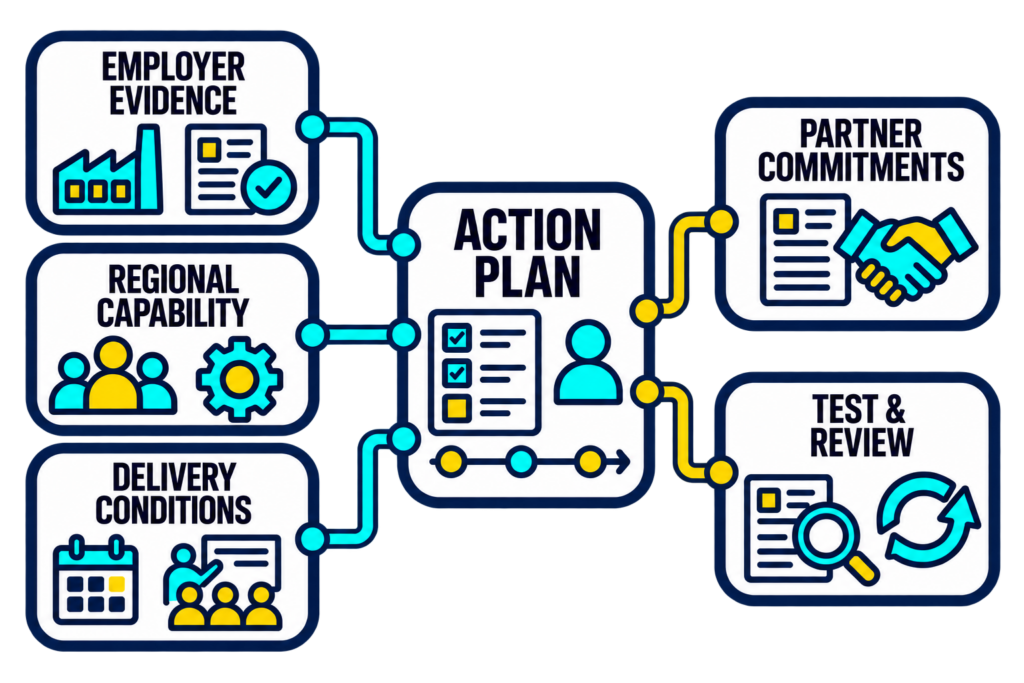
What you can leave with
Regional Workforce Decision Foundation
A shared definition of the initiative, geography, intended opportunity, decision, participating organizations, boundaries, and criteria for a useful result.
Demand & Capability Alignment Map
An account connecting priority roles and employer needs to relevant available experience, preparation requirements, and questions requiring validation.
Preparation & Capacity Brief
A view of the providers, programs, facilities, instructors, work-based learning arrangements, and other conditions affecting delivery.
Evidence & Assumption Register
A distinction among projections, employer statements, source records, reviewed evidence, confirmed commitments, and unresolved questions.
Participation & Access Response Plan
Practical changes addressing the conditions that make involvement difficult for people, employers, or delivery partners.
Ownership & Partner Commitment Plan
Assigned responsibilities distinguishing confirmed contributions from proposals that require authorization, resources, or further agreement.
Starting Gobekli Configuration Brief
An outline of the role, activity, capability, preparation, opportunity, capacity, source, and responsibility relationships worth maintaining.
30–90 Day Regional Workforce Action Plan
Sequenced actions, responsible owners, dependencies, validation needs, decision points, and review conditions.
Final outputs depend on the selected modules, available information, participants, and question established through Regional Workforce Direction.
The workshop creates a practical starting point within that scope. Investment decisions, program changes, hiring, implementation, and review of longer-term results continue afterward.
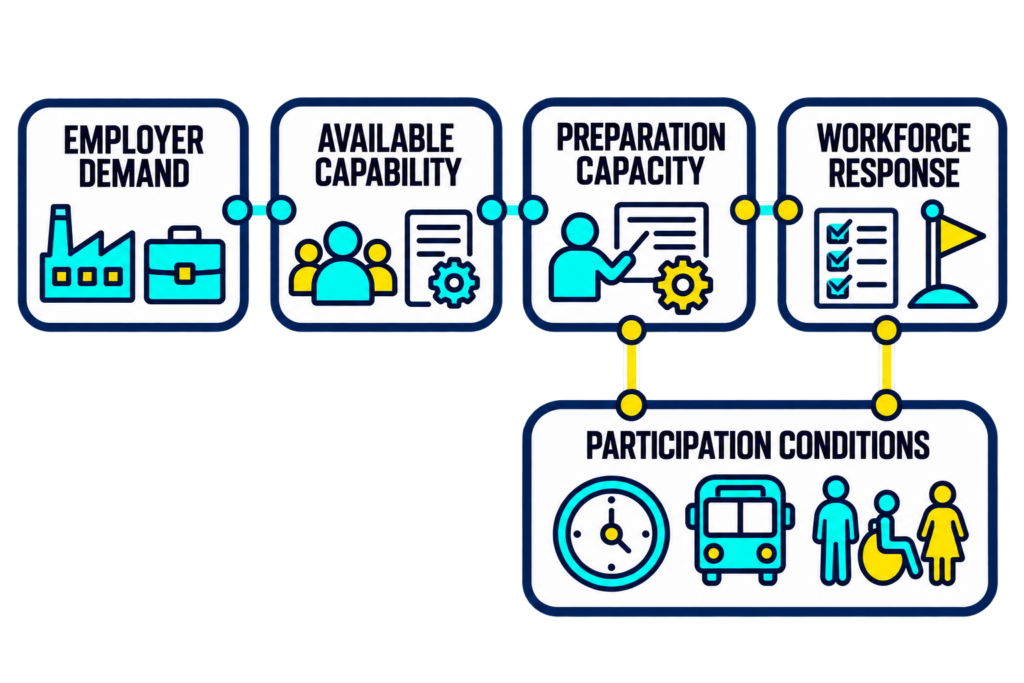
Build the response around evidence and accountable participation.
We help economic-development, workforce, industry, and education partners examine how their contributions connect to a selected regional opportunity.
The work should make the next decision clearer and identify what each organization can realistically do, confirm, or take forward.
Decision-focused
Begin with a consequential choice and a bounded initiative. Identify who can make the decision and what they need to understand.
Grounded in work and people
Connect role requirements to actual activities and relevant experience. Include a practical way to test assumptions with employers and people affected by the proposed route.
Evidence-aware
Distinguish projections, expressed needs, reviewed information, and confirmed commitments. Keep missing information and uncertainty visible.
Practical & accountable
Choose actions partners can operate. Name who acts, who decides, what depends on another organization, and when the arrangement should be reviewed.
When the workshop reveals something worth maintaining
Keep the regional picture connected as conditions change.
A workshop may reveal that alignment depends on information and relationships that are difficult to maintain across employer conversations, economic plans, program catalogs, capacity spreadsheets, and partnership meetings.
A potential Gobekli configuration could connect relevant organizational context through TalentSync with participant-controlled experience, interests, and evidence through TalentPass, where people choose to participate.
The starting point is the initiative examined during the workshop: which roles matter, what preparation is needed, what capacity exists, which opportunities are confirmed, and who is responsible for keeping that context current.
Workshop Findings
Identify the selected initiative, demand assumptions, relevant capabilities, preparation needs, delivery constraints, and commitments that should remain understandable.
Gobekli Setup
Scope relevant role and opportunity descriptions, experience and evidence relationships, provider information, capacity records, source connections, sharing choices, and authorized views.
Ongoing Review
Maintain the context needed to respond when hiring schedules shift, providers change capacity, participation constraints emerge, or new evidence requires a different decision.
Worked example: preparing for a manufacturing expansion
An economic-development organization is supporting a proposed manufacturing expansion.
Employers describe several priority roles, but their hiring schedules and entry expectations are not yet equally clear.
A community college offers relevant preparation. A workforce partner identifies people with potentially transferable experience. Smaller employers are interested in participating but have limited time to supervise placements.
The workshop could examine the role requirements, strength of the demand evidence, delivery constraints, and decisions needed before launching a coordinated response.
The resulting configuration brief could define role and activity descriptions, relevant preparation, evidence sources, provider capacity, employer participation arrangements, and responsible contacts.
TalentSync could help participating organizations maintain appropriate context about the roles, programs, opportunities, and commitments within scope.
TalentPass could help interested individuals organize relevant experience and evidence they choose to share. An expression of interest would remain distinguishable from confirmed availability or readiness for a particular role.
Passport Pages could support appropriate presentation and source connections. Pythia could help people explain their experience or help authorized teams prepare questions using the information within scope.
The regional view would not require unrestricted access to personal records. Aggregate planning information and individual sharing choices would need distinct purposes and boundaries.
The partnership would test whether the revised arrangement improves the selected decision and coordination process. It would not assume that the configuration guarantees hiring, investment, or economic growth.
A Gobekli setup is an optional continuation. The workshop outputs remain useful independently of product adoption.
The configuration described here includes potential capabilities. Current availability, integration needs, configuration work, and required development would be confirmed during scoping. Existing employer, education, workforce, and public systems can retain their responsibilities.
Frequently asked questions
Questions organizations ask before beginning.
It is a configurable, facilitated workshop that helps organizations connect employer needs, available talent, preparation capacity, and partner action around a selected regional or industry initiative.
Every engagement begins with Regional Workforce Direction and then applies selected problem modules to a bounded example. The result is a practical action plan grounded in available evidence and accountable next steps.
It is designed for economic-development organizations, state and regional workforce leaders, industry partnerships, workforce boards, and regional intermediaries.
Educators, training providers, employers, public agencies, and community partners can participate where their information or decisions are relevant to the selected initiative.
Yes. A convening organization can begin by clarifying the initiative, evidence gaps, relevant partners, and decisions it needs to prepare.
The workshop distinguishes work it can do directly from arrangements requiring other organizations to participate or agree.
Yes. A selected expansion, industry initiative, or group of priority occupations can provide a useful scope.
The workshop examines the workforce conditions and partner decisions involved. It does not assume that a broad industrial ambition already represents confirmed hiring demand.
No. Every engagement begins with the required Regional Workforce Direction foundation.
A typical workshop then includes two or three modules selected around the initiative and decision the group wants to address.
Yes. A defined scope makes it easier to examine role requirements, available evidence, capacity, and responsibilities.
The workshop does not need to address an entire state economy or every occupation in a sector.
Begin with one initiative and the decision it needs to support.
Useful materials may include economic plans, employer conversations, role descriptions, demand estimates, program information, capacity constraints, partner proposals, participation evidence, and existing measures. Complete information is not required to begin.
Employer participation is valuable when the selected question concerns requirements, hiring conditions, placements, or commitments.
The group can begin with available evidence, but employer-dependent assumptions and decisions remain identified for confirmation. Attending intermediaries cannot make commitments on an employer’s behalf.
The review identifies the source, timing, conditions, and status of each demand statement.
A forecast, expression of interest, active requirement, and confirmed commitment are represented according to what they establish. The workshop does not treat them as equivalent.
Yes. A selected module examines the expectations, time requirements, entry routes, and potential shared arrangements affecting employer participation.
Any arrangement involving supervision, hiring, resources, or other commitments must be confirmed by the responsible organizations.
It can identify preparation gaps, provider connections, delivery constraints, and changes worth examining.
It does not create instructors, facilities, placements, or funding by itself. Curriculum changes and capacity investments remain with the organizations authorized to make them.
Not necessarily. Planning can often begin with aggregate information, role examples, provider materials, and de-identified evidence.
Where individual participation becomes relevant, the purpose, appropriate information, permissions, and sharing boundaries need to be established. Regional planning does not imply universal access to personal records.
That workshop examines how people move through a selected service journey, including navigation, intake, referrals, support, and transitions.
Regional Workforce & Industry Alignment examines the demand, preparation capacity, available talent, and partner commitments needed around an industry or regional initiative. Its access review concerns regional conditions; individual assistance arrangements belong in the pathway workshop.
This workshop defines the workforce initiative, evidence needs, and operating relationships that need to connect.
LER & Trusted Workforce Infrastructure examines the records, identity, systems, permissions, and governance arrangements needed for trusted exchange. A regional alignment project can provide a concrete use case for that infrastructure work.
Your group leaves with a scoped response and a 30–90 day action plan. Next steps may include validating employer requirements, confirming provider capacity, reviewing a transition route, testing an employer participation arrangement, or securing a partner decision.
Gobekli software is optional. Where the findings identify information and relationships worth maintaining, the configuration brief becomes the starting point for a separate implementation conversation.
TURN A REGIONAL AMBITION INTO SHARED ACTION
Give partners a clearer basis for moving together.
Connect employer needs, available talent, preparation capacity, and responsibilities around the initiative your region wants to advance.
Begin with Regional Workforce Direction, then select the modules that address the decisions and dependencies that matter most.
Let’s Start with the Initiative You Want to Advance.
Tell us which regional or industry challenge you are addressing, who is involved, and what needs to become clearer before the work can move forward.
During a free discovery call, we will clarify the decision, identify relevant participants and partners, and discuss the workshop scope that fits.