
ORGANIZATIONAL GROWTH & EXPANSION PROBLEM
Capability Sourcing Strategy:
Stop Treating Every Gap as a Hiring Problem
When growth creates new work, leaders often move directly from “we need this capability” to “we need to hire someone.”
But the organization may already have relevant talent. The capability may be developed, contracted, accessed through a partner, acquired, supported with technology, or reduced through work redesign.
Capability sourcing strategy helps leaders choose the right combination based on the work, urgency, duration, evidence, dependencies, cost, and consequences of getting the decision wrong.
Does this sound familiar?
Every capability gap becomes a job opening
Leaders assume new work requires permanent headcount before evaluating other ways to access or develop the capability.
Internal capability remains invisible
Employees with relevant experience, interests, relationships, or transferable skills are overlooked because their current titles do not match the need.
Contractors become permanent workarounds
External support introduced for speed continues indefinitely without a clear decision about ownership, transfer, integration, or exit.
Training is selected before the gap is defined
The organization purchases courses or programs without knowing whether the real gap involves knowledge, practice, capacity, authority, systems, or role design.
Technology is expected to replace unclear work
Automation or AI is introduced before the activities, exceptions, decisions, information, and human responsibilities are understood.
Leaders cannot compare sourcing options
Hiring, development, contracting, partnership, acquisition, and redesign are evaluated through separate processes with different assumptions and incomplete evidence.
What is capability sourcing strategy?
Capability sourcing strategy is the process of determining how an organization should obtain, develop, access, combine, or reduce the capabilities required to perform consequential work.
Possible responses may include mobilizing existing employees, redeploying internal talent, developing people, hiring employees, engaging contractors or consultants, building vendor relationships, forming partnerships, acquiring a team or company, using automation or AI, redesigning the work, or combining several approaches.
The decision begins with the work and capability required—not with a predetermined source.
A useful strategy considers urgency, duration, organizational importance, available evidence, dependencies, and what the organization should continue to own.
The problem is not simply finding talent. It is choosing how the organization should access capability.
A job title can bundle many activities, capabilities, responsibilities, relationships, and operating conditions into one familiar label. That can make hiring appear to be the only available response.
Leaders need to connect the need to the outcome, activities, required capability and capacity, urgency, duration, existing internal capability, employee interest, development time, ownership, information and system access, knowledge transfer, cost, reversibility, dependencies, and evidence.
The organization may discover that it needs a person, partner, tool, temporary bridge, redesigned workflow, or carefully sequenced combination.
See the complete capability decision
not just the open position.
Work and Outcomes
- Growth commitments
- Customer needs
- Required activities
- Decisions and responsibilities
- Definition of completion
Capability and Capacity
- Technical capability
- Human capability
- Domain knowledge
- Relationships and access
- Volume and availability
Current Organizational Position
- Active capability
- Latent and transferable capability
- Development potential
- Existing vendors and partners
- Known capability gaps
Sourcing Options
- Internal mobilization
- Development
- Hiring
- Contracting
- Partnership or acquisition
- Automation or redesign
Evidence and Tradeoffs
- Time to capability
- Quality and reliability
- Cost and reversibility
- Dependencies and exposure
- Ownership and long-term value
A sourcing decision becomes useful when leaders can compare the work, required capability, current organizational position, available options, and consequences in one view.
How organizations default to hiring
STAGE 1
Growth creates a new demand
A customer commitment, market opportunity, expansion, product, regulation, system, or operating challenge creates additional work.
STAGE 2
The need becomes a familiar role
Leaders use an existing job title or previous position description to represent the capability they believe is missing.
STAGE 3
One sourcing channel takes over
The need enters recruiting, procurement, learning, technology, or partnership processes before alternatives are compared.
STAGE 4
The response creates new dependencies
The organization adds headcount, vendors, tools, or programs without resolving ownership, integration, transfer, duration, or long-term implications.
A sourcing slogan is not a capability strategy.
“Build, buy, or borrow” can be a useful starting point, but each option contains several different decisions.
A responsible sourcing strategy compares the complete operating consequences—not simply the initial price or speed.
Some capabilities are central to differentiation, customer trust, institutional knowledge, control, resilience, or long-term value. Others may be accessed effectively through an external source.
Internal development may create durable value but take longer. Hiring may also require substantial time. A contractor or partner may provide a temporary bridge.
A permanent role may not fit temporary, uncertain, seasonal, transitional, or project-based demand. A short-term source may not fit a capability the organization must retain.
Employees may have demonstrated, latent, adjacent, or transferable capability that is not visible in their formal positions.
External experts may complete the work without leaving the organization able to maintain, repeat, govern, or improve it.
A source may introduce vendor concentration, licensing, integration, data access, availability, intellectual-property, security, or key-person dependencies.
The gap may be reduced by simplifying activities, changing handoffs, redistributing decisions, improving information, standardizing work, or removing unnecessary demand.
Capability and capacity are different problems
Capability gap
The organization lacks required knowledge, skills, experience, judgment, credentials, relationships, or operating ability.
Capacity gap
The capability exists but is not available in sufficient volume, time, location, scheduling, coverage, or management attention.
Immediate access
A short-term response may prioritize speed, specialized expertise, flexible capacity, temporary coverage, experimentation, and reversibility.
Durable capability
A long-term response may prioritize ownership, institutional knowledge, repeatability, internal careers, improvement, integration, and differentiation.
Temporary bridge
Contractors, partners, or technology may support urgent delivery while a longer-term capability is built or transferred.
Sequenced strategy
The organization may need several responses operating together at different stages of the capability lifecycle.
A capability problem
Asks whether the organization can perform the work appropriately. Development, hiring, partnership, acquisition, or specialized external support may be relevant.
A capacity problem
Asks whether enough capability is available when and where the work requires it. Workload, scheduling, temporary support, systems, or process design may be relevant.
The fastest source is not always sustainable
Immediate access can protect delivery, but the organization must decide what knowledge, ownership, and capability should remain after the bridge ends.
The durable source is not always fast enough
The right strategy may use immediate access while durable capability is developed, hired, transferred, acquired, or designed into the organization.
Source the capability
not just the position.
Choose the response that fits the work, timing, and ownership required.
WORKSHOP MODULE DETAILS
Module 8: Capability Sourcing Strategy
This module helps participants determine how the organization should obtain, develop, access, combine, or reduce the capabilities required for growth.
Participants examine a defined capability need and compare internal mobilization, development, hiring, contracting, partnership, acquisition, automation, and work redesign.
The purpose is not to select a vendor, conduct executive search, prescribe training, or make an employment decision. It is to develop an evidence-backed capability response that fits the organization’s work, timing, ownership needs, and operating conditions.
This module helps your team:
- Connect capability needs to defined work and outcomes
- Distinguish capability gaps from capacity constraints
- Identify existing internal and transferable capability
- Evaluate realistic development pathways
- Clarify what the organization should own
- Compare permanent, temporary, and transitional sources
- Examine technology and work-redesign options
- Identify knowledge-transfer requirements
- Reveal sourcing dependencies and exposure
- Compare time, cost, flexibility, and durability
- Identify questions requiring specialist review
- Develop an evidence-backed sourcing strategy
How should the organization address each capability need?
No single sourcing option is universally best. The response should follow the work, existing organizational capability, urgency, duration, evidence, ownership requirements, dependencies, and consequences of being unprepared.
Mobilize
Use capability already available internally but disconnected by role boundaries, workload, location, access, or visibility.
Develop
Build capability where employees have relevant foundations and the gap can realistically be closed in time.
Hire
Add durable employee capability when continuing demand and organizational ownership justify a permanent role.
Contract
Access specialized, temporary, variable, transitional, or project-based capability.
Partner or Acquire
Access capability, infrastructure, knowledge, intellectual property, relationships, or an established team.
Automate
Use technology to support or perform defined work with clear information, exceptions, and human responsibility.
Redesign
Reduce or alter the need by changing activities, decisions, handoffs, processes, service expectations, or low-value work.
Investigate
Resolve uncertainty about the work, capability, duration, sources, costs, dependencies, or consequences.
A capability need may require several responses used together or in sequence. These categories structure organizational planning and human judgment; they do not automatically determine employment, procurement, technology, partnership, or acquisition decisions.
What should a capability-sourcing review examine?
The need
What outcome and work require the capability? When is it needed, for how long, and what happens if it remains unavailable?
The capability
What knowledge, skills, experience, judgment, credentials, relationships, capacity, or operating conditions are required?
The internal position
What active, latent, transferable, emerging, or developable capability already exists?
The sourcing options
Which internal, hiring, development, contracting, partnership, acquisition, technology, or redesign responses are available?
The dependencies and tradeoffs
What does each option require, and what costs, delays, risks, constraints, dependencies, or commitments might it create?
The evidence and decision
What supports the response, what remains uncertain, who owns the decision, and when should it be revisited?
Use TalentSync to connect capability decisions with organizational evidence.
TalentSync can help organizations connect required work to roles, activities, capabilities, people, teams, evidence, and gaps.
The process begins with an organizational need—not an automated recommendation to hire, develop, contract, or automate.
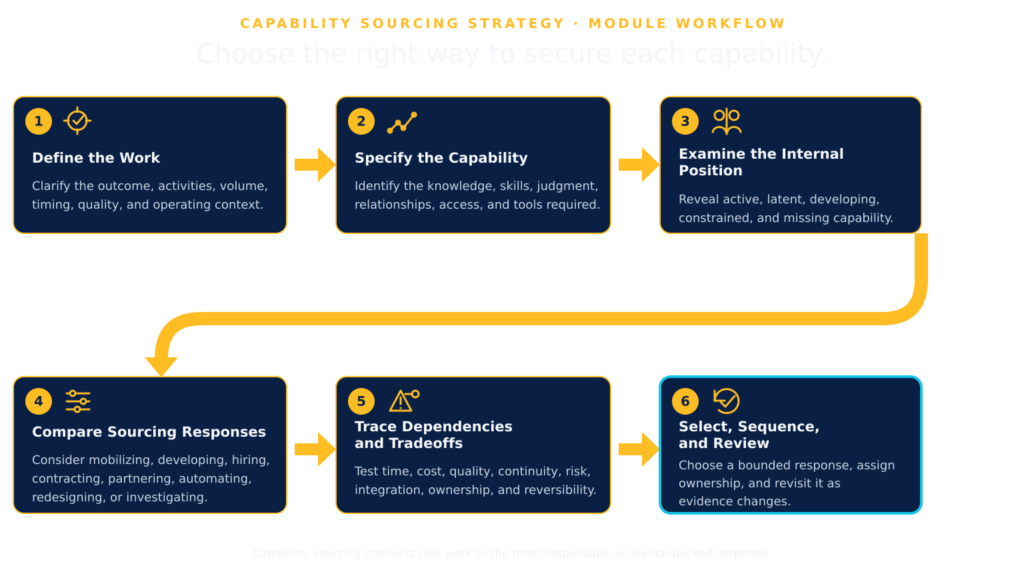
STEP 1
Define the work
Clarify the outcome, activities, responsibilities, decisions, systems, conditions, and timeframe creating the need.
STEP 2
Specify the capability
Identify the knowledge, skills, experience, judgment, credentials, relationships, capacity, and evidence required.
STEP 3
Examine the internal position
Review active, latent, transferable, emerging, and developable capability with appropriate participation.
STEP 4
Compare sourcing responses
Evaluate mobilization, development, hiring, contracting, partnership, acquisition, automation, and redesign.
STEP 5
Trace dependencies and tradeoffs
Examine time, cost, ownership, transfer, integration, reversibility, risk, support, and consequences.
STEP 6
Select, sequence, and review
Develop a human-led response, assign ownership, define review conditions, and adapt as demand changes.
TalentSync can make the relationship between organizational work, available talent, capability gaps, and sourcing decisions more visible. Employees, managers, HR, procurement, technology leaders, executives, partners, and appropriate specialists remain responsible for participation, interpretation, due diligence, and decisions.
- Connect needs to defined work
- See internal capability and gaps
- Compare sourcing responses
- Trace dependencies and tradeoffs
- Sequence immediate and durable actions
- Review decisions as conditions change
BUILD A CONNECTED CAPABILITY PORTFOLIO
Let capability decisions build on one another.
Organizations often evaluate each hiring request, contract, learning program, partnership, or technology investment independently.
This makes it difficult to see whether several decisions are addressing the same underlying capability—or creating overlapping dependencies.
A structured capability portfolio can connect work, internal talent, development, external sources, technology, knowledge transfer, dependencies, commitments, evidence, and review conditions.
The goal is not to centralize every decision. It is to make connected capability decisions visible enough to coordinate.
PRODUCT AND DECISION BOUNDARIES
Structured evidence supports sourcing judgment. It does not make the decision.
TalentSync, TalentPass, Pythia, and workshop outputs should not be presented as:
- Automatically choosing a sourcing option
- Determining whether an employee should be redeployed
- Determining who is capable of development
- Selecting the “best” candidate, contractor, vendor, or partner
- Predicting individual or organizational performance
- Making employment or worker-classification decisions
- Prescribing a learning program
- Conducting vendor, cybersecurity, legal, or acquisition due diligence
- Determining whether work should be automated
- Replacing procurement, HR, finance, technology, or executive judgment
- Guaranteeing that a sourcing strategy will meet future demand
The workflow clarifies requirements, organizes evidence, compares options, identifies dependencies, and supports transparent human review.
Employment, labor, compensation, worker classification, procurement, privacy, accessibility, cybersecurity, intellectual property, tax, insurance, acquisition, competition, regulatory, and other questions may require qualified specialist review.
What to bring into the conversation
You do not need a complete skills inventory, finalized hiring plan, or fully mapped vendor portfolio.
We begin with one consequential capability need and the evidence already available.
Useful inputs may include:
- Growth and operating priorities
- Customer, contract, or market commitments
- Defined outcomes and workflows
- Role and team profiles
- Organizational charts
- Capability or skills frameworks
- Known capability and capacity gaps
- Employee experience and interest information
- Internal mobility or succession information
- Learning and development programs
- Current job openings and hiring plans
- Contractor and consultant relationships
- Staffing and managed-service agreements
- Vendor and partner information
- Technology and automation plans
- Acquisition or integration considerations
- Workload and capacity information
- Cost and budget information
- Time-to-hire or productivity evidence
- Knowledge-transfer requirements
- Key-person and vendor dependencies
- Previous sourcing decisions
- Employee and manager observations
- Known legal, security, procurement, or operating constraints
The Growth Direction foundation establishes the consequential outcome and capability boundary this module should examine.
What this module can help clarify
What capability the organization actually needs
Translate growth demand into defined work, capability, capacity, conditions, and evidence.
What is already available internally
Identify active, latent, transferable, emerging, and realistically developable capability.
Which sourcing responses fit the need
Compare mobilization, development, hiring, contracting, partnership, acquisition, automation, and redesign.
How the response should be sequenced
Determine immediate and durable actions, dependencies, ownership, and review conditions.
Final outputs depend on the modules selected and the organizational decision established through the workshop’s required Growth Direction foundation.
Where might the work lead next?
Questions leaders ask before booking.
Capability sourcing determines how an organization should obtain, develop, access, combine, or reduce the capabilities required for important work.
Recruiting finds and evaluates people for employment. Capability sourcing begins earlier by determining whether hiring is appropriate or whether capability should be mobilized, developed, contracted, partnered, acquired, automated, or redesigned.
A capability gap concerns knowledge, skill, experience, judgment, credentials, relationships, or operating ability. A capacity gap means capability exists but is not available in sufficient volume, time, location, or coverage.
The organization should examine internal capability, but employee interest, workload, development time, role consequences, support, availability, and urgency must also be considered.
Internal development may fit when relevant foundations exist, people are interested, practice and support are available, and readiness can be achieved in time.
Contracting may fit specialized, temporary, uncertain, variable, transitional, or project-based work. Worker-classification and employment questions require specialist review.
A partner may provide capability, infrastructure, knowledge, relationships, distribution, credentials, capacity, or access that would be difficult to build independently.
An acquisition may provide a team, intellectual property, relationships, technology, infrastructure, or operating capability, while introducing major financial, legal, cultural, technical, and integration considerations.
Technology may perform or augment defined activities, but leaders must understand the work, information, decisions, exceptions, quality, risks, and continuing human responsibilities.
Sometimes demand can be reduced by simplifying activities, removing low-value work, improving information, changing handoffs, redistributing decisions, standardizing processes, or using technology appropriately.
Consider sourcing time, onboarding, management, benefits, infrastructure, integration, learning, knowledge transfer, coordination, quality, risk, dependency, reversibility, and delay—not only the initial price.
Not necessarily. Immediate coverage, durable ownership, specialist support, internal development, technology, and redesign may be combined and sequenced.
TalentSync can organize work requirements, internal capability, evidence, gaps, relationships, and sourcing considerations. People remain responsible for the decision.
No. The module compares capability responses and may identify questions requiring deeper specialist review.
Every engagement begins with Growth Direction. Capability Sourcing Strategy is selected when growth creates a capability or capacity need and leaders must determine how it should be addressed.
SOURCE THE CAPABILITY—NOT JUST THE POSITION
Choose how your organization should build, access, or redesign the capability growth requires.
Connect the work to internal talent, development, hiring, contractors, partners, acquisition, technology, and operating redesign—then build a sourcing strategy supported by evidence.
This module is part of Gobekli’s configurable Organizational Growth & Expansion Workshop. Explore the complete 12-module structure and identify the right starting point for your organization.
