
A LEARNING VISIBILITY & CREDENTIALING WORKSHOP MODULE
Course, Cohort & Program Visibility: See What Learners Are Actually Developing
Educational institutions collect enrollment, completion, grade, assessment, and credential data across courses and programs.
Yet leaders, educators, and support teams may still struggle to see which capabilities learners are developing, where meaningful evidence is emerging, how experiences connect across the curriculum, or where groups may need additional support.
Course, cohort, and program visibility connects intended learning with activities, evidence, and appropriately bounded patterns—without collapsing individual learners into a score or treating group data as a verdict.
Workshop Module 7 — Course, Cohort & Program Visibility
Does this sound familiar?
Course data remains disconnected
Learning activities, assessments, projects, feedback, and student evidence live across systems that do not provide a coherent view.
Grades substitute for learning visibility
Leaders can see marks and completion status but cannot easily understand the capabilities or evidence behind them.
Cohort patterns appear too late
Differences in participation, evidence development, or learner support may become visible only after completion or attrition.
Program outcomes remain abstract
Published outcomes describe what a program intends to develop, but institutions struggle to connect them to actual learner activity and evidence.
Program reviews require reconstruction
Faculty and administrators spend substantial time gathering information from courses, spreadsheets, surveys, and disconnected reports.
Aggregate data hides individual variation
Averages may make a cohort appear successful while concealing differences in opportunity, participation, evidence, and support.
What is course, cohort, and program visibility?
Course, cohort, and program visibility is the ability to examine how intended learning, educational experiences, learner activity, and available evidence connect across defined academic or training contexts.
Course visibility examines what learners are asked to do, what capabilities those activities may develop, what evidence is produced, and where gaps may be emerging.
Cohort visibility examines patterns across an appropriately defined group while preserving the distinction between collective observations and individual learner evidence.
Program visibility connects outcomes, courses, projects, assessments, credentials, and learner evidence across a broader educational pathway.
The goal is not constant surveillance or a definitive measurement of learning. It is to give authorized people enough connected evidence to ask better questions, improve learning experiences, allocate support, and make informed program decisions.
The problem is not a lack of educational data. It is a lack of connected learning context.
Most institutions already know who enrolled, which courses learners completed, what grades they received, and whether they earned a credential. Those records matter, but they do not automatically reveal what learners practiced, demonstrated, or connected across experiences.
- What learners were expected to develop
- Which activities created opportunities to practice
- What evidence learners produced
- Which capabilities that evidence may demonstrate
- How learning accumulated across courses
- Where evidence is strong, limited, or missing
- How experiences differ across learner groups
- Which patterns require investigation
- Who is authorized to see and interpret the information
Visibility begins when the institution can connect intent, experience, evidence, and decision context.
See the learning system—not just the reporting hierarchy.
Intended Learning
- Course outcomes
- Program outcomes
- Competencies
- Skills and knowledge
- Credential expectations
Learning Experiences
- Courses and modules
- Projects and assignments
- Work-based learning
- Research and practice
- Co-curricular experiences
Learner Evidence
- Demonstrated activities
- Work products
- Assessments
- Reflections and feedback
- Verified accomplishments
Collective Patterns
- Evidence distribution
- Participation differences
- Recurring strengths
- Development gaps
- Pathway variation
Decisions and Support
- Course improvement
- Learner support
- Curriculum alignment
- Resource allocation
- Program review
Collective visibility becomes useful when intended outcomes, learning experiences, learner evidence, and appropriately bounded patterns can be considered together.
How collective learning becomes difficult to see
STAGE 1
Learning is organized into separate containers
Courses, platforms, departments, experiential learning, and support services maintain different records and definitions.
STAGE 2
Reporting centers on administrative events
Enrollment, grades, completion, credits, and credential attainment become the most consistently visible measures.
STAGE 3
Learning evidence remains local
Projects, feedback, activities, and capability evidence stay inside individual courses, systems, or personal files.
STAGE 4
Institutions reconstruct the picture manually
Faculty and leaders rely on spreadsheets, surveys, samples, and retrospective interpretation to understand what may be happening across a cohort or program.
Course, cohort, and program views answer different questions.
Collective learning visibility is not a single dashboard. Each level serves a different educational purpose and must retain the evidence, context, and boundaries needed for responsible interpretation.
A useful collective view can help the institution ask:
Connect intended outcomes with activities, assessments, projects, learner evidence, and available support.
Examine variation in activity, evidence development, participation, progression, and support across an appropriately defined group.
Connect outcomes, courses, projects, experiences, credentials, and evidence across a longer pathway.
Reveal important capabilities that are isolated, duplicated, optional, inaccessible, or dependent on one course.
Preserve distinctions among grades, artifacts, assessments, reflections, verified experiences, and self-reports.
Shape the view around course improvement, learner support, program review, curriculum alignment, or another bounded decision.
What makes collective learning visibility responsible and useful?
Purpose-bound
The view is designed around a legitimate educational question or decision rather than unrestricted data collection.
Contextual
Information is interpreted in relation to the course, activity, outcome, learner population, and conditions in which it was produced.
Evidence-aware
The view distinguishes verified evidence, self-reported information, participation data, assessment results, and inferred relationships.
Privacy-conscious
Access, aggregation, suppression, consent, sharing, retention, and appropriate use are addressed before sensitive patterns are exposed.
Human-interpreted
Educators, learners, and authorized leaders remain responsible for examining evidence, considering context, and deciding what action is appropriate.
Actionable
The view supports a defined next step such as investigation, course improvement, learner support, curriculum review, or evidence development.
Conventional reporting
- Enrollment and attendance
- Assignment completion
- Grades and credits
- Retention and graduation
- Credential attainment
- Aggregate averages
These measures can describe progress through an educational structure without fully explaining what learners practiced, demonstrated, connected, or retained.
Connected learning visibility
- Intended learning outcomes
- Activities learners actually performed
- Opportunities to practice
- Evidence learners produced
- Capabilities connected to evidence
- Variation within a cohort
- Missing or weak evidence
The goal is to place conventional measures inside a richer view of the learning experience.
A cohort pattern is a signal for inquiry—not a judgment about a person.
A visible difference may show that something deserves attention. It does not automatically explain why the difference exists or apply to every learner within a group.
- Distinguish pattern from cause
- Keep group observations separate from individual evidence
- Do not equate participation with capability
- Do not equate missing evidence with missing ability
- Support learning without normalizing surveillance
- Keep visibility separate from automatic evaluation
Collective visibility should not erase learner control.
A learner’s Talent Tree can connect experiences, activities, capabilities, and evidence across contexts. Purpose-built profiles can present selected information for a particular audience. Course, cohort, and program visibility serves a different purpose: helping authorized institutional users examine bounded collective patterns.
- A learner’s broader record is not automatically an institutional reporting dataset
- Information shared for one purpose should not silently become available for every purpose
- Aggregate patterns should not unnecessarily expose identifiable learner information
- Institutional records and learner-controlled evidence may have different permissions
- Access should follow role, purpose, and authorization
- Group information should not become the sole basis for a consequential individual decision
See learning across the system
Connect intended outcomes, experiences, evidence, and collective patterns without reducing learners to averages.
THE MATCHING WORKSHOP MODULE
Module 7: Course, Cohort & Program Visibility
This module helps institutions determine what authorized people need to see across courses, cohorts, and programs—and how available learning evidence could support those views responsibly.
Participants connect a bounded educational decision to intended outcomes, learning experiences, evidence sources, learner groups, privacy conditions, and appropriate action. The objective is not a universal dashboard. It is to define the visibility required to improve a course, understand a cohort, evaluate a program question, or support another consequential learning decision.
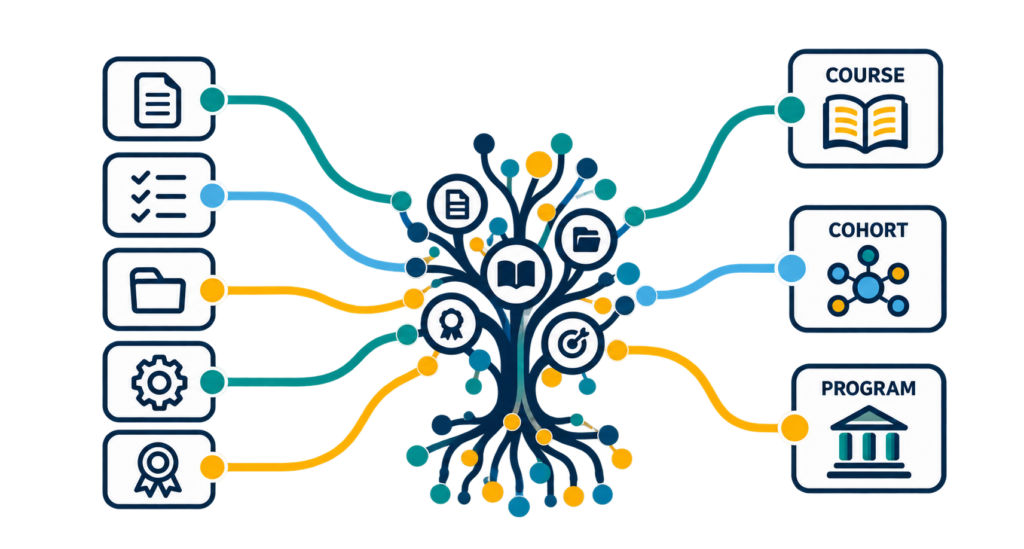
This module helps your team:
- Define the decision the collective view must support
- Distinguish course, cohort, and program visibility needs
- Connect intended outcomes to learning activities and evidence
- Identify meaningful patterns and evidence gaps
- Examine variation without reducing learners to averages
- Clarify aggregation, access, privacy, and sharing boundaries
- Determine which information requires learner participation
- Establish responsible interpretation practices
- Develop an evidence-backed visibility response
What should happen next for each visibility need?
Not every educational question requires a new dashboard, additional data, or a program-wide view. The response should follow the decision, available evidence, affected learners, and consequences of interpretation.
Reveal
Make an important pattern visible using available evidence.
Connect
Link fragmented outcomes, activities, assessments, experiences, and evidence.
Strengthen
Improve evidence that is too narrow, inconsistent, indirect, or incomplete.
Act
Use sufficient evidence for a bounded response such as support or course improvement.
Protect
Restrict or redesign a view that creates privacy, identification, access, or misuse concerns.
Investigate
Resolve uncertainty before explaining a pattern or selecting a response.
These categories organize institutional inquiry and human decision-making. They do not automatically evaluate learners, educators, courses, or programs.
What should a course, cohort, or program review examine?
The decision
What question must the institution answer, who will act, and what could change because of the view?
The scope
Which course, cohort, program, pathway, period, location, or learner population is relevant?
The intended learning
Which outcomes, activities, capabilities, credentials, or expectations define the educational intent?
The available evidence
What information exists, where did it come from, what does it demonstrate, and what are its limitations?
The variation
Which patterns, differences, gaps, or concentrations appear—and which interpretations remain unsupported?
The boundaries
Who may access the view, what detail is appropriate, and what privacy, consent, governance, or specialist review is required?
From learner evidence to collective insight
TalentSync EDU is intended to help institutions connect learning outcomes, experiences, capabilities, and evidence across authorized educational views. Specific workflows and available features depend on implementation stage, institutional configuration, evidence sources, permissions, and the selected use case.
STEP 1
Clarify the educational question
Identify the course, cohort, or program decision the institution needs to support.
STEP 2
Establish the authorized scope
Clarify which learners, experiences, evidence sources, periods, outcomes, and users belong within the view.
STEP 3
Connect relevant learning evidence
Bring together appropriate institutional records and learner-participated evidence.
STEP 4
Distinguish evidence types
Preserve differences among participation, completion, assessment, verified evidence, reflection, and inference.
STEP 5
Examine collective patterns
Investigate distributions, concentrations, differences, and missing evidence within the defined context.
STEP 6
Support human interpretation
Use the view to ask better questions, involve appropriate stakeholders, and determine whether improvement, support, or further investigation is warranted.
TalentSync EDU should support transparent inquiry into learning. It should not be positioned as an automated evaluator of learners, instructors, courses, or programs.
- Reconsider whether course activities align with stated outcomes
- Identify capabilities receiving limited practice
- Coordinate learning across multiple courses
- Recognize cohort-level differences requiring investigation
- Improve the timing or design of learner support
- Strengthen work-based learning connections
FROM VISIBILITY TO IMPROVEMENT
A collective view creates value only when it supports responsible action.
Visibility can help an institution improve course design, coordinate curriculum, direct learner support, strengthen experiential learning, prepare program-review evidence, and identify questions requiring deeper investigation.
Action should remain proportional to the quality of the evidence and the consequences of getting the interpretation wrong.
PRODUCT AND DECISION BOUNDARIES
Collective visibility supports educational judgment. It does not replace it.
TalentSync EDU and related collective views should not be presented as:
- Producing a complete or objective measure of learning
- Determining which learners will succeed
- Assigning definitive capability or readiness scores
- Automatically ranking learners, instructors, courses, or programs
- Diagnosing the cause of a visible pattern
- Treating correlation as causation
- Eliminating bias from educational decisions
- Replacing faculty, learner, advisor, or institutional judgment
- Making accreditation, legal, privacy, or compliance determinations
- Providing the sole basis for a consequential individual decision
- Making every element of a learner’s TalentPass available to the institution
The workflow can help authorized people organize relevant information, identify evidence gaps, and support more transparent inquiry. Privacy, accessibility, research ethics, student records, cybersecurity, accreditation, labor, and other questions may require qualified specialist review.
TalentPass is not designed for use by minors.
What to bring into the conversation
You do not need a complete institutional data model or a finished learning analytics strategy. We begin with the educational question, evidence, reporting practices, and concerns your institution already has.
Useful inputs may include:
- Course and program learning outcomes
- Curriculum and pathway maps
- Course descriptions and syllabi
- Learning activities and assessment designs
- Rubrics and competency frameworks
- Learning-management-system reports
- Student information system records
- Program review and accreditation materials
- Work-based and experiential learning records
- Existing dashboards and reports
- Learner feedback and survey findings
- Advising and support observations
- Samples of learner work or evidence
- Definitions of cohorts and comparison groups
- Access, privacy, consent, and retention practices
- Known evidence, interoperability, or reporting gaps
The Learning Visibility Direction module establishes the outcome, educational context, evidence boundary, and decision this module should support.
What this module can help clarify
Which collective view is needed
Determine whether the decision requires a course, cohort, program, pathway, or another bounded perspective.
What evidence should be connected
Identify the outcomes, activities, assessments, experiences, records, and learner evidence relevant to the question.
Which patterns require attention
Reveal concentrations, gaps, differences, and missing context that justify support, improvement, or investigation.
How the view should be governed
Clarify access, aggregation, interpretation, privacy, learner participation, ownership, and appropriate use.
Final outputs depend on the modules selected and the learning decision established through the workshop’s required Learning Visibility Direction module.
Where might the work lead next?
Collective learning visibility frequently reveals connected problems in individual evidence, learner-controlled profiles, curriculum alignment, and data interoperability.
Student Learning Visibility
Help individual learners see, understand, and communicate the capabilities and evidence they are developing.
Talent Tree & Connected Learning Evidence
Connect activities, experiences, capabilities, credentials, and evidence across fragmented learning contexts.
Purpose-Built Learner Profiles
Create bounded, audience-specific views of learner evidence without exposing a person’s complete record.
Learning & Credential Data Interoperability
Examine how records, evidence, credentials, definitions, permissions, and systems need to connect.
Frequently asked questions
Questions institutions ask about collective learning visibility.
Course visibility connects what a course intends learners to develop with the activities, assessments, experiences, and available evidence produced within it. It is not the same as monitoring every learner action.
Cohort visibility examines appropriately bounded patterns across a defined group. A cohort view should not imply that every person shares the same experience or characteristics.
Program visibility connects outcomes, courses, experiences, assessments, credentials, and learner evidence across an educational pathway.
Learning analytics may contribute data and analysis. Learning visibility also examines intent, evidence type, educational context, learner control, access, interpretation, and the decision being supported.
Grades summarize performance within a particular context but may not reveal activities performed, capabilities demonstrated, supporting evidence, or connections across experiences.
They may reveal patterns that justify closer attention, but group signals should not automatically determine an individual intervention or explain why a learner is experiencing difficulty.
Sometimes, but comparisons must account for differences in composition, opportunity, delivery, timing, curriculum, support, assessment, and external conditions.
Safeguards may include minimum group sizes, suppression, aggregation, access restrictions, de-identification, purpose-based permissions, and qualified privacy review.
No. Institutional views should follow authorized purpose, relevant evidence sources, learner choices, applicable policies, and agreed sharing conditions.
It should not be positioned as an automated ranking system. It can help authorized people examine connected evidence relevant to a bounded question.
No. Demonstrating causation generally requires an appropriate research design, reliable data, and qualified analysis beyond a visibility workshop.
No. Missing evidence may reflect activity design, system limitations, sharing choices, or an incomplete record.
No. It can organize relevant intent, experiences, evidence, patterns, gaps, and questions, but it does not replace formal review or accreditor judgment.
Learners can explain context, identify missing experiences, test whether interpretations are reasonable, and help distinguish the designed experience from what actually occurred.
Every engagement begins with Learning Visibility Direction. This module may then be combined with Student Learning Visibility, Talent Tree & Connected Learning Evidence, Purpose-Built Learner Profiles, or Learning & Credential Data Interoperability.
SEE LEARNING ACROSS THE SYSTEM
Turn disconnected course and program data into responsible learning visibility.
Connect intended outcomes, learning experiences, evidence, and collective patterns—then give educators and institutional leaders a clearer foundation for inquiry and improvement.
This module is part of Gobekli’s configurable Learning Visibility & Credentialing Workshop.
