
ORGANIZATIONAL GROWTH PROBLEM
Cross-Functional Collaboration:
Fix the Gaps Between Teams
As organizations grow, more important outcomes depend on several departments working together.
Each team may perform its own responsibilities well while customers, decisions, information, and unfinished work become trapped between them.
The problem is not simply poor communication. The organization has not designed how work should move across its internal boundaries.
Does this sound familiar?
Handoffs repeatedly break down
Work arrives late, incomplete, incorrectly formatted, or without the context the next team needs.
Every team has different priorities
Departments optimize their own goals while the shared customer or organizational outcome suffers.
Decisions stall between leaders
Several functions influence the decision, but no one knows who can make it or how disagreement should be resolved.
Meetings substitute for operating design
Teams add recurring meetings, status updates, and coordination calls because the underlying workflow remains unclear.
Information lives inside departmental systems
Employees rebuild context through messages, spreadsheets, duplicate entry, and manual follow-up.
Accountability disappears at the boundary
Each team can explain what it completed, but no one owns whether the end-to-end outcome was achieved.
What is a cross-functional operating model?
A cross-functional operating model defines how people, teams, departments, leaders, systems, and partners work together to produce outcomes that no single function controls alone.
It clarifies:
- The shared outcome
- The work that crosses boundaries
- The responsibilities of each participant
- The conditions that trigger a handoff
- The information that must travel with the work
- The systems and records involved
- The decisions required
- The authority to make those decisions
- The standards and service expectations between teams
- The way exceptions and conflicts are resolved
- The evidence used to evaluate the whole workflow
- The person or group responsible for improving it
A useful operating model does not eliminate functional specialization. It connects specialized teams so their separate contributions create a coherent result.
The problem is not that teams need to communicate more. They need a shared design for the work between them.
“Improve communication” may lead to more meetings, channels, reports, dashboards, or project managers. These can help, but they do not resolve an operating model that leaves the work ambiguous.
Leaders need to connect:
- The end-to-end outcome
- The customer or stakeholder experience
- Activities performed by each team
- Inputs and outputs at every handoff
- Information and evidence requirements
- Systems and sources of truth
- Decision rights
- Dependencies and timing
- Exceptions and escalation paths
- Capacity constraints
- Shared and functional measures
- Ownership of the complete result
The goal is not more coordination activity. It is less preventable coordination work.
See the complete workflow
not just the departments involved.
Shared Outcome
- Customer result
- Organizational priority
- Required quality
- Timing commitment
- Definition of completion
Teams and Work
- Functional responsibilities
- Cross-functional activities
- Contributors and specialists
- Managers and decision-makers
- External partners
Handoffs and Dependencies
- Required inputs
- Completion conditions
- Sequence and timing
- Capacity dependencies
- Exceptions and rework
Information and Systems
- Source records
- Required context
- System access
- Data ownership
- Shared visibility
Decisions and Evidence
- Decision rights
- Escalation paths
- Shared measures
- Review points
- Improvement ownership
A cross-functional workflow becomes manageable when the shared outcome, participating teams, handoffs, information, decisions, dependencies, and evidence can be viewed together.
How cross-functional breakdowns take hold
STAGE 1
Teams build around specialized responsibilities
Each function develops its own expertise, processes, systems, priorities, terminology, and measures.
STAGE 2
Growth creates more interdependence
More customers, products, locations, employees, projects, and requirements cause work to cross boundaries more frequently.
STAGE 3
Employees bridge the gaps manually
People rely on meetings, messages, spreadsheets, duplicate entry, personal relationships, and informal escalation.
STAGE 4
Coordination cost and failure compound
Delays, rework, conflict, inconsistent service, duplicated effort, lost information, and unclear accountability affect the complete outcome.
A sequence of boxes does not explain how teams should work together.
A process map may show that work moves between departments. It may not explain handoff conditions, required information, decision rights, or what happens when the expected process fails.
A useful cross-functional review must ask:
Define the customer, operational, workforce, financial, regulatory, or organizational result the workflow must collectively produce.
Identify where responsibility, information, approval, customer contact, evidence, or unfinished work moves between participants.
Clarify the information, documents, evidence, decisions, permissions, quality conditions, and context the receiver requires.
Establish decision authority, consultation requirements, time limits, and escalation paths for conflicts and exceptions.
Reveal where timing, capacity, system access, expertise, or quality determines what another team can accomplish.
Determine where information originates, which system is authoritative, who maintains it, and who can access it.
Connect functional measures to shared evidence of quality, timing, experience, cost, risk, and completion.
Assign responsibility for problems that exist between functions rather than inside one team.
What leaders need to see clearly
Where handoffs repeatedly fail
Identify transitions where work arrives incomplete, late, unclear, inaccessible, or below the required standard.
Where priorities compete
Reveal conflicting goals, incentives, deadlines, customer commitments, or definitions of success.
Where decision authority is missing
Surface choices requiring several functions but lacking a clear decision-maker or escalation path.
Where information loses context
Trace where employees must search, recreate, translate, re-enter, or personally explain information.
Where coordination consumes capacity
Distinguish essential collaboration from effort created by structural ambiguity.
Where shared outcomes lack ownership
Reveal workflows where every department owns one portion but no one owns the complete result.
Functional optimization
A department-centered model may emphasize local output, productivity, deadlines, service levels, budget adherence, utilization, volume, and procedure.
These measures may not reveal what happens to the complete workflow.
Shared-outcome performance
A cross-functional view examines end-to-end completion, customer experience, quality, total cycle time, waiting, rework, information continuity, exceptions, decision speed, coordination effort, and whether the outcome was achieved.
Formal work
The official process records assigned activities, required approvals, systems, and reporting relationships.
It rarely shows all the bridging work required to make the process function.
Invisible coordination
Employees search for information, translate terminology, reformat documents, chase approvals, repair handoffs, negotiate priorities, and protect customers from internal confusion.
The goal is to preserve valuable collaboration while eliminating preventable coordination work.
Fix the work between the teams
not just communication around it.
Connect specialized functions around the complete outcome.
WORKSHOP MODULE DETAILS
Module 6: Cross-Functional Operating Model
This module helps participants define how teams coordinate work, exchange information, resolve conflicts, make decisions, and remain accountable across organizational boundaries.
Participants examine a bounded workflow or outcome requiring several functions to contribute.
The purpose is not to redesign every department. It is to make critical handoffs, dependencies, decision rights, information flows, and shared responsibilities visible enough to improve a consequential outcome.
This module helps your team:
- Define the shared cross-functional outcome
- Map work across departments and roles
- Identify critical handoffs and dependencies
- Clarify inputs, outputs, and completion conditions
- Trace information and system requirements
- Reveal invisible coordination work
- Identify competing priorities and measures
- Clarify decision rights and consultation requirements
- Establish exception and escalation paths
- Align functional accountability with shared outcomes
- Identify questions requiring specialist review
- Develop an evidence-backed cross-functional response
What should happen next at each organizational boundary?
Not every cross-functional problem requires a major reorganization or new technology. The response should reflect the outcome, source of friction, consequences of failure, available evidence, and operating conditions.
Clarify
Define the responsibilities, inputs, outputs, timing, quality conditions, decisions, and escalation paths expected between teams.
Standardize
Create consistent requirements, records, terminology, templates, completion conditions, or service expectations.
Connect
Improve access, integration, shared records, context, and visibility so work moves without reconstruction.
Redistribute
Move work or authority closer to the people with the context, capability, capacity, or accountability required.
Redesign
Change the sequence, roles, interfaces, measures, meetings, systems, or boundaries when the model cannot perform.
Investigate
Gather evidence when the source of delay, rework, conflict, information loss, or poor performance is unclear.
These categories structure operating-model analysis and human decision-making. They do not automatically determine employment, technology, compliance, or restructuring decisions.
What should a cross-functional operating review examine?
The shared outcome
What complete result must the participating teams produce?
The work
Which activities happen inside each function, and which require participation across boundaries?
The handoffs
What inputs, outputs, evidence, timing, quality conditions, and context must move?
The decisions
Which choices are required, who has authority, who must be consulted, and how is disagreement resolved?
The information and systems
Where does necessary information originate, how is it maintained, and who can access and interpret it?
The organizational evidence
What do delays, queues, rework, complaints, exceptions, meetings, duplication, employee effort, and outcomes reveal?
Design the connections that turn separate teams into an operating system.
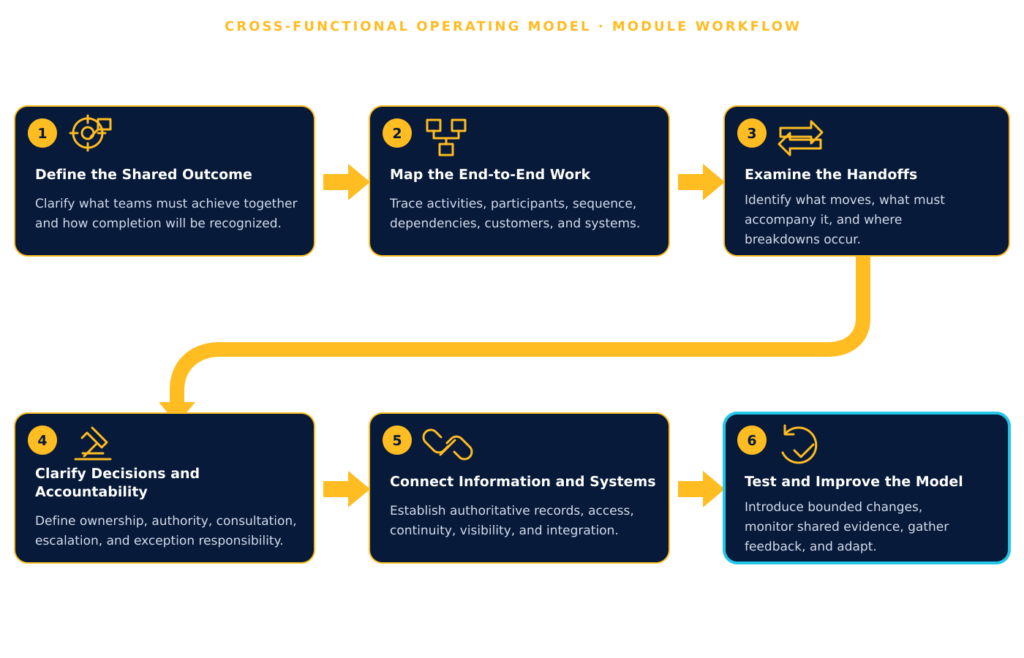
The review follows one consequential outcome across the functions, roles, systems, and decisions required to produce it.
STEP 1
Define the shared outcome
Clarify what teams must collectively achieve, for whom, under which conditions, and how completion is recognized.
STEP 2
Map the end-to-end work
Trace activities, participants, sequence, dependencies, customer interactions, and systems across the workflow.
STEP 3
Examine the handoffs
Identify what moves between teams, what must accompany it, what the receiver needs, and where breakdowns occur.
STEP 4
Clarify decisions and accountability
Define activity and outcome ownership, decision rights, consultation, escalation, and exception responsibility.
STEP 5
Connect information and systems
Establish authoritative records, access, information continuity, shared visibility, and necessary integration.
STEP 6
Test and improve the model
Introduce bounded changes, monitor shared evidence, gather feedback, and adapt as the organization learns.
The objective is not to remove every boundary. It is to ensure boundaries support specialization without interrupting the outcome.
- Follow the complete outcome
- Make handoff conditions explicit
- Connect functional and shared measures
- Clarify decisions and exceptions
- Preserve information context
- Improve the model through evidence
SEE THE PEOPLE AND WORK BETWEEN THE DEPARTMENTS
Make cross-functional contributions visible—not just formal reporting relationships.
Important work often crosses organizational structures without appearing clearly in job descriptions, department profiles, project records, or performance systems.
TalentSync can help organizations develop a more structured view of the work and evidence involved.
Depending on implementation and context, that view may include:
- Departments and organizational units
- Cross-functional workflows
- Roles participating in the work
- Activities performed across boundaries
- Formal and informal contributors
- Active and latent capabilities
- Leadership and coordination responsibilities
- Critical handoffs and dependencies
- Capability or capacity gaps
- Key-person dependencies
- Accomplishment, Responsibility, and Challenge evidence
- Systems and organizational relationships
This visibility can reveal who makes the workflow function and where invisible coordination needs stronger support.
PRODUCT AND DECISION BOUNDARIES
Organizational visibility supports operating decisions. It does not make them.
TalentSync and the workshop should not be presented as:
- Automatically determining responsibility for a failure
- Assigning blame to a department or employee
- Producing a definitive collaboration score
- Predicting individual or team performance
- Making employment decisions
- Replacing performance management
- Selecting software automatically
- Making legal, compliance, cybersecurity, or privacy determinations
- Guaranteeing improved collaboration
- Eliminating organizational conflict
- Replacing executive, operational, HR, or specialist judgment
The workflow structures responsibilities, activities, relationships, evidence, and operating tradeoffs so people can make better-informed decisions.
Employment, labor, privacy, cybersecurity, accessibility, records management, procurement, regulatory, and other questions may require qualified specialists.
What to bring into the conversation
You do not need a perfect enterprise process map or complete documentation from every department.
We begin with one consequential outcome or workflow and the information already available.
Useful inputs may include:
- Strategic and operating priorities
- Customer or stakeholder journey information
- Workflow or process maps
- Department and team profiles
- Organizational charts
- Role descriptions
- Project plans
- Responsibility matrices
- Standard operating procedures
- Handoff requirements
- Service-level expectations
- Decision and approval processes
- Escalation procedures
- Meeting structures
- System and integration diagrams
- Data ownership information
- Forms, templates, and shared records
- Performance measures
- Customer complaints or feedback
- Delay, queue, or cycle-time information
- Rework and quality evidence
- Employee and manager observations
- Known workarounds or unofficial tools
- Recurring cross-functional conflict
The Growth Direction foundation establishes the organizational outcome and cross-functional boundary the module should examine.
What this module can help clarify
How work crosses organizational boundaries
Connect the end-to-end outcome to teams, activities, dependencies, systems, and decisions.
Where cross-functional friction originates
Identify broken handoffs, missing context, competing priorities, authority gaps, invisible work, and avoidable coordination.
What each interface requires
Clarify inputs, outputs, timing, quality conditions, information, decision rights, and escalation paths.
How the operating model should respond
Determine where to clarify, standardize, connect, redistribute, redesign, or investigate the workflow.
Final outputs depend on the modules selected and the organizational decision established through the workshop’s required Growth Direction foundation.
Where might the work lead next?
Questions leaders ask before booking.
Cross-functional collaboration occurs when people from different departments, disciplines, roles, or units work together to produce a shared outcome.
It defines how work, information, responsibility, authority, and accountability move across organizational boundaries.
The shared outcome may be unclear, priorities may conflict, authority may be missing, responsibilities may overlap, handoffs may be incomplete, or participants may lack capacity.
Identify why extra communication is required. Communication should support the workflow rather than compensate for preventable structural ambiguity.
One person or group may own the end-to-end result while different teams own activities, decisions, information, systems, or exceptions.
A handoff occurs whenever work, responsibility, information, customer contact, evidence, or decision authority moves between participants.
Connect the priorities to the shared outcome, then clarify who has authority to make the tradeoff and how it will be communicated.
A RACI can clarify responsibility, accountability, consultation, and information, but it does not capture the complete operating model.
Technology can improve access and integration but cannot independently resolve conflicting priorities, unclear authority, poorly designed work, or missing accountability.
Combine functional measures with end-to-end evidence such as cycle time, waiting, rework, quality, experience, exceptions, information continuity, and outcomes.
TalentSync can organize departments, roles, activities, capabilities, relationships, and evidence. It should not automatically determine performance, responsibility, or staffing decisions.
The module examines cross-functional work as an organizational system and may identify questions requiring specialist review.
Every engagement begins with Growth Direction. This module is selected when an outcome depends on several teams whose handoffs, decisions, information, or accountability are unclear.
FIX THE WORK BETWEEN THE TEAMS
Turn departmental activity into a cross-functional system that produces the complete outcome.
Connect teams through clear work, handoffs, information, decisions, accountability, and evidence—then remove the friction growth has exposed between them.
This module is part of Gobekli’s configurable Organizational Growth Workshop.
