
ORGANIZATIONAL GROWTH & EXPANSION PROBLEM
Culture & Employee Experience Through Growth:
Scale Without Losing What Makes the Organization Work
Growth changes more than headcount. It changes how people communicate, make decisions, build relationships, understand expectations, access leaders, and experience the organization around them.
Practices that once happened naturally can become inconsistent or disappear. New employees may encounter a different organization from the one leaders believe they are building.
Culture and employee experience through growth helps leaders identify which behaviors, relationships, and operating conditions should be preserved—and what must evolve as the organization becomes larger and more complex.
Does this sound familiar?
The employee experience varies by team
People encounter different expectations, communication practices, development opportunities, and support depending on their manager or department.
Values are visible but difficult to observe
The organization can name its values, but employees cannot consistently see how they influence decisions, priorities, recognition, or behavior.
New employees experience a different company
Early employees remember a highly connected organization, while recent hires encounter more layers, less context, and fewer informal relationships.
Leadership feels increasingly distant
As the organization grows, employees have less access to decision-makers and less understanding of why important changes are happening.
High performance depends on hidden labor
Trusted employees quietly maintain relationships, translate decisions, resolve conflict, answer questions, and preserve institutional memory.
Culture concerns appear after damage is visible
Leaders notice declining engagement, unwanted turnover, conflict, burnout, or loss of trust only after underlying conditions have spread.
What does it mean to scale culture and employee experience?
Scaling culture and employee experience means preserving and strengthening the conditions that help people understand the organization, contribute effectively, build trust, and experience meaningful membership as growth changes how work is organized.
Culture is expressed through repeated patterns: how decisions are made and explained, authority is exercised, disagreement is handled, work is recognized, employees learn, and leaders respond when values conflict with pressure.
Employee experience is how those patterns are encountered across recruiting, onboarding, daily work, collaboration, management, development, mobility, recognition, change, and departure.
The goal is not to preserve every early-stage practice. It is to understand which cultural strengths remain important, where the experience is fragmenting, and what the next version of the organization requires.
The problem is not that the old culture disappeared. It is that the organization changed faster than its shared practices.
Smaller organizations often rely on proximity, shared history, direct access, and informal relationships. As new teams, managers, locations, systems, policies, and leadership layers appear, employees increasingly depend on deliberate practices instead of shared proximity.
A culture statement describes an intention. The employee experience reveals what the organization repeatedly makes possible.
See culture as an operating system
not a collection of slogans.
Organizational Direction
- Purpose and priorities
- Growth commitments
- Values in practice
- Leadership decisions
- Expectations during change
Work and Decisions
- Role clarity
- Decision authority
- Workload and pace
- Collaboration practices
- Escalation and support
Relationships and Leadership
- Manager practices
- Team connection
- Cross-functional trust
- Access to leadership
- Informal knowledge networks
Employee Journey
- Recruiting and expectations
- Onboarding and integration
- Development and mobility
- Recognition and feedback
- Transitions and departure
Systems and Evidence
- Policies and processes
- Communication channels
- Employee listening
- Experience differences
- Outcomes and warning signals
Culture becomes visible when organizational direction, everyday work, relationships, employee journeys, systems, and evidence can be examined together.
How culture fragments during growth
STAGE 1
Shared context lives in relationships
A relatively small group understands how decisions are made, what the organization values, and how work moves forward.
STAGE 2
Growth adds distance and variation
New employees, managers, locations, functions, systems, and layers create more ways to experience the organization.
STAGE 3
Local practices become inconsistent
Teams develop separate norms for communication, feedback, workload, development, recognition, and decision-making.
STAGE 4
The experience separates from the intended culture
Employees respond to the conditions they encounter, while leaders continue describing the culture they remember or hope to create.
Values matter when employees can see what they change.
Values provide useful language for organizational identity and decision-making. But a value becomes credible only when it affects what people actually do.
A culture review should connect values to real work, reinforced behavior, organizational systems, experience differences, demonstrated evidence, and the choices leaders make when values conflict.
Identify the activities, decisions, interactions, and tradeoffs through which employees would experience the value.
Examine what leaders reward, recognize, promote, tolerate, question, or correct—especially under pressure.
Determine whether goals, incentives, policies, tools, approvals, resources, and management practices make the desired behavior possible.
Identify differences across teams, locations, working arrangements, levels, employment types, or employee groups.
Use employee observations, workflow evidence, organizational stories, decisions, outcomes, and available measures.
Clarify how leaders navigate tensions such as speed versus quality, autonomy versus consistency, or performance versus sustainability.
A scalable culture does not require every team to work the same way
Purpose-ready
Employees understand the organization’s direction, current priorities, and how their work contributes.
Values-ready
Shared commitments are expressed through observable behavior, decisions, recognition, and accountability.
Management-ready
Managers have the context, capacity, support, and expectations needed to guide people consistently.
Relationship-ready
Employees can build the trust, access, and cross-functional connections required to contribute.
Voice-ready
Employees have credible channels for questions, concerns, ideas, and feedback—and understand what happens next.
Learning-ready
The organization can learn from experience differences and revisit its practices as growth changes the work.
Useful consistency
Shared expectations support fairness, safety, respect, information access, management responsibility, employee voice, opportunity, and accountability.
Necessary local variation
Teams retain flexibility in workflows, schedules, customer interaction, technical methods, communication rhythms, and specialized operating conditions.
Hidden culture-carrying work
Employees orient colleagues, preserve knowledge, connect teams, translate decisions, resolve conflict, and maintain trust without formal recognition.
Visible experience ownership
Leaders clarify who owns listening, management support, communication, employee transitions, response, and continued improvement.
Build an employee experience
that can carry the culture forward.
Connect values, work, relationships, systems, and evidence.
WORKSHOP MODULE DETAILS
Module 11: Culture & Employee Experience Through Growth
This module helps participants examine how growth is changing the organization employees experience—not only the culture leaders intend.
The workshop connects values, behaviors, employee journeys, management practices, relationships, systems, and operating conditions to the consequential work the organization is trying to scale.
Participants identify which cultural strengths should be preserved, where the employee experience is fragmenting, what hidden contributions support the organization, and which conditions require a deliberate response.
This module helps your team:
- Translate stated values into observable practices
- Map important moments across the employee experience
- Identify where experience varies across teams or groups
- Examine changes in communication, trust, belonging, and access
- Reveal hidden culture-carrying work
- Clarify the role managers play in employee experience
- Connect employee feedback to operating conditions
- Distinguish useful consistency from local variation
- Identify systems or incentives that contradict intentions
- Understand employee transitions through growth
- Identify questions requiring specialist review
- Develop an evidence-backed culture response
What should happen next as the organization grows?
Not every cultural practice should be preserved exactly as it exists today. Some represent enduring strengths. Others depend on smaller scale, shared history, or informal access that can no longer support the organization. The response should follow the evidence.
Preserve
Protect a behavior, relationship, or practice that continues to create meaningful value.
Clarify
Make values, expectations, decisions, responsibilities, opportunities, or employee commitments visible.
Strengthen
Improve a useful practice that varies significantly across teams, managers, locations, or employee groups.
Redesign
Adapt a practice that worked at a smaller scale but cannot reliably support the organization’s next stage.
Connect
Repair a relationship, context, access, communication, or information gap affecting trust and contribution.
Investigate
Resolve uncertainty before changing the employee experience or drawing conclusions.
Listen
Create credible channels for employee questions, observations, concerns, and ideas—and connect listening to response.
Revisit
Review cultural practices and experience evidence again as growth changes the organization.
These categories structure organizational learning and human decision-making. They do not automatically evaluate individual employees, predict behavior, determine cultural compatibility, or replace appropriate professional judgment.
What should a culture and employee experience review examine?
The work
What are employees trying to accomplish, and which cultural or operating conditions help or obstruct that work?
The experience
What do employees encounter across recruiting, onboarding, management, collaboration, development, change, and departure?
The behavior
How are values expressed through recurring decisions, interactions, tradeoffs, recognition, and accountability?
The relationships
Which managers, colleagues, leaders, customers, partners, and informal networks shape how employees navigate the organization?
The systems
Which policies, processes, technologies, incentives, information sources, and structures reinforce or contradict the intended experience?
The evidence
What do observations, stories, outcomes, workflow patterns, retention signals, and available measures demonstrate—and what remains uncertain?
Use TalentSync to understand the organization employees experience.
TalentSync can help connect employee experience to the activities, relationships, capabilities, stories, and operating conditions through which culture is created.
The process begins with consequential work and human experience—not with a culture score, personality label, or automated prediction.
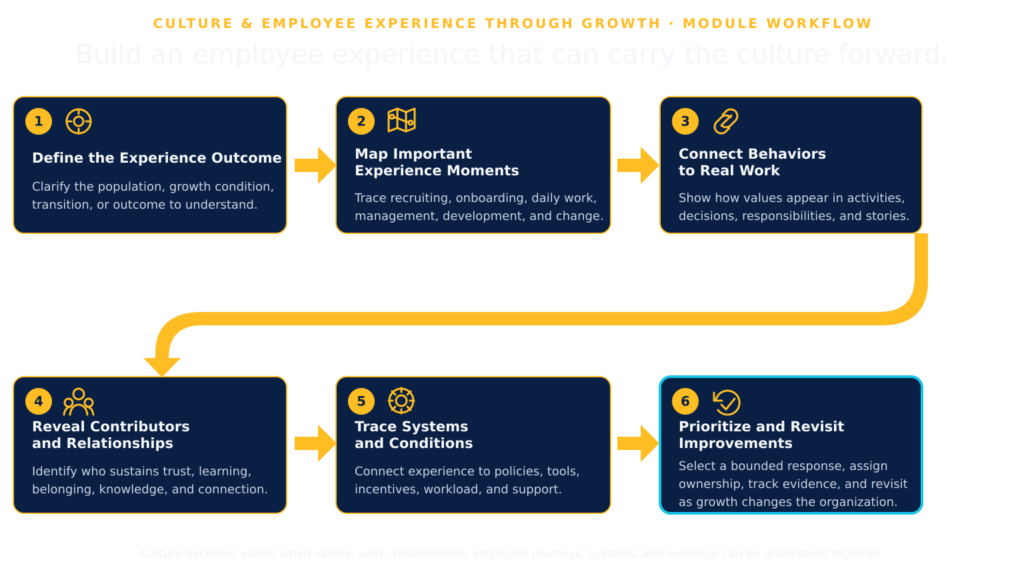
STEP 1
Define the experience outcome
Clarify which employee population, growth condition, workflow, transition, or organizational outcome the review needs to understand.
STEP 2
Map important experience moments
Identify where employees encounter the organization through recruiting, onboarding, work, management, development, change, and departure.
STEP 3
Connect behaviors to real work
Show how values and expectations appear through activities, decisions, responsibilities, relationships, and organizational stories.
STEP 4
Reveal contributors and relationships
Identify people and teams supporting trust, learning, communication, belonging, knowledge transfer, and connection.
STEP 5
Trace systems and conditions
Connect experience to policies, processes, tools, information, incentives, workload, design, and management support.
STEP 6
Prioritize and revisit improvements
Select a bounded response, assign ownership, identify evidence of progress, and review again as the organization grows.
TalentSync can help make organizational relationships, contributions, experience evidence, and capability more visible. Leaders, managers, employees, and qualified specialists remain responsible for interpretation, dialogue, action, and decisions.
- Connect values to observable work
- Reveal contributors and relationships
- Trace employee experience moments
- Connect systems and conditions
- Prioritize bounded improvements
- Revisit evidence as growth continues
TALENTPASS AND EMPLOYEE EXPERIENCE
Give employees a clearer view of what they have contributed and how they can grow.
Employee experience is shaped partly by whether people feel that the organization understands their work, capabilities, aspirations, and contributions.
Traditional employee systems often reduce people to a job title, manager, department, performance rating, or list of self-reported skills.
TalentPass is designed to help an individual develop a reusable, person-controlled view of their experience and talent evidence, including confirmed work history, activities, skills, credentials, accomplishment stories, learning, motivations, interests, and contributions beyond the formal job description.
The individual controls their TalentPass information and chooses when it is shared.
PRODUCT AND DECISION BOUNDARIES
Organizational evidence supports better culture decisions. It does not define people.
TalentSync, TalentPass, Pythia, and workshop outputs should not be presented as:
- Producing a definitive culture score
- Determining whether someone is a culture fit
- Predicting employee behavior or success
- Diagnosing an individual or organization
- Measuring belonging through a single number
- Eliminating bias
- Replacing employee dialogue
- Replacing leadership or manager judgment
- Making legal, labor, accessibility, or compliance determinations
- Providing the sole basis for an employment decision
- Guaranteeing engagement, retention, or cultural consistency
The workflow helps people structure observations, connect experience to operating conditions, recognize evidence gaps, and support more transparent human decisions.
Employment, privacy, accessibility, labor, organizational psychology, workplace safety, cybersecurity, and other questions may require qualified specialist review. TalentPass is not designed for use by minors.
What to bring into the conversation
You do not need a perfect culture assessment, complete employee journey map, or new engagement survey.
We begin with the values, workforce signals, employee observations, operating information, and experience evidence the organization already has.
Useful inputs may include:
- Organizational mission, purpose, and values
- Growth strategy and workforce plans
- Employee experience or engagement data
- Pulse surveys and open-text feedback
- Listening-session observations
- Recruiting and candidate feedback
- Onboarding materials and new-hire feedback
- Manager expectations and development resources
- Performance and recognition practices
- Learning, development, and mobility information
- Retention, turnover, and exit observations
- Internal communication examples
- Organizational policies and employee resources
- Role and decision-right documentation
- Team rituals and working agreements
- Employee community observations
- Examples of decisions affecting trust
- Stories demonstrating values in practice
- Known differences across teams or locations
- Evidence of hidden coordination or culture-carrying work
The Growth Direction module establishes the consequential outcome, affected work, growth conditions, available evidence, and bounded decision this module should support.
What this module can help clarify
Which cultural strengths should be preserved
Identify the behaviors, relationships, stories, and practices that continue to support meaningful work and organizational trust.
Where the employee experience is fragmenting
Reveal important differences across teams, managers, locations, transitions, working arrangements, or employee groups.
What operating conditions shape the experience
Connect culture concerns to workload, systems, policies, incentives, information, management support, and organizational design.
How the organization should respond
Organize evidence into options to preserve, clarify, strengthen, redesign, connect, listen, investigate, or revisit.
Final outputs depend on the modules selected and the growth decision established through the workshop’s required Growth Direction module.
Where might the work lead next?
Questions leaders ask before booking.
Growth changes access, information flow, management, relationships, and the ways employees experience organizational expectations. Problems arise when informal mechanisms can no longer reach everyone consistently.
Culture cannot be copied like a policy, but it can be supported through clearer expectations, leadership behavior, management practices, stories, systems, incentives, and employee participation.
Employee experience describes what people encounter across their relationship with the organization. Engagement describes aspects of connection, motivation, or involvement at a particular time.
No. The workshop can begin with existing feedback, manager input, onboarding and exit observations, workflow evidence, stories, policies, and known friction.
Define the strengths in observable terms, then preserve those strengths without protecting unsustainable informality, unclear boundaries, or hidden labor.
No. Teams may need different workflows and practices, while maintaining reasonable consistency around fairness, safety, respect, information, voice, opportunity, and accountability.
Use caution. Describe the actual work environment and behavioral expectations rather than relying on opaque judgments based on familiarity, personality, or background.
Look for activities that orient colleagues, connect teams, preserve knowledge, translate decisions, resolve conflict, mentor others, and maintain trust.
TalentSync can structure relevant work, relationship, contribution, story, and operating evidence. It should not be presented as producing a definitive culture or belonging score.
TalentPass helps individuals develop a person-controlled view of experience, activities, skills, credentials, accomplishments, motivations, and other talent evidence.
No. The module may reveal experience differences requiring deeper review, but it does not replace qualified human resources, legal, accessibility, labor, or other specialists.
Every engagement begins with Growth Direction. This module is selected when growth is changing trust, communication, belonging, management, employee journeys, or everyday working conditions.
GROW WITHOUT LOSING THE HUMAN CONNECTION
Build an employee experience that can carry the culture forward.
Connect values to real work, relationships, management practices, systems, employee journeys, and evidence—then strengthen the conditions people need to contribute as the organization grows.
This module is part of Gobekli’s configurable Organizational Growth & Expansion Workshop. Explore the complete 12-module structure and identify the right starting point for your organization.
