
LEARNING ALIGNMENT PROBLEM
Curriculum Coverage & Progression: Show How Learning Builds Across the Program
A curriculum can include every required course and still leave important outcomes weakly developed, unnecessarily repeated, introduced too late, or disconnected from meaningful evidence.
Faculty may know what happens inside their own courses while no one can see clearly how the complete learner experience builds capability over time.
Curriculum Coverage & Progression connects outcomes, capabilities, courses, activities, experiences, and evidence—so the institution can see where learning begins, how it develops, and where learners are expected to integrate and demonstrate it.
Workshop Module 3 — Curriculum Coverage & Progression
Does this sound familiar?
Important outcomes appear everywhere and nowhere
An outcome is listed across many courses, but responsibility for developing it deeply remains unclear.
Courses unintentionally repeat the same learning
Learners encounter similar introductory content several times without advancing to greater complexity, independence, or application.
Curriculum gaps remain hidden
A program outcome appears in the official map even though learners receive limited opportunity to practice or demonstrate it.
Course sequence does not reflect learning sequence
Prerequisites and program plans determine when courses occur, but not necessarily how capabilities should develop.
Experiential learning sits outside the curriculum map
Projects, internships, clinical experiences, labs, research, and co-curricular learning are treated as additions rather than part of the learning pathway.
Coverage is mistaken for progression
The institution can show where an outcome is mentioned but not how learner expectations change across the program.
What are curriculum coverage and progression?
Curriculum coverage describes where an outcome, capability, topic, requirement, or learning priority appears across a program.
Progression describes how the learner’s expected knowledge, performance, judgment, independence, responsibility, integration, or ability to transfer learning changes over time.
Coverage may occur through courses and course sequences, assignments, projects, capstones, laboratories, studios, clinical and field experiences, internships, research, simulations, co-curricular activities, learner support, work-based learning, and prior learning.
Coverage and progression are related, but they are not the same. An outcome may appear in several courses without becoming more demanding. A capability may be introduced once and then assumed without reinforcement. A capstone may assess an expectation that earlier courses did not give learners sufficient opportunity to develop.
A useful curriculum map therefore shows more than where learning is mentioned. It helps participants understand what learners encounter, practice, integrate, and demonstrate—and what evidence supports that interpretation.
The problem is not a missing curriculum map. It is a missing developmental pathway.
Many institutions already maintain curriculum maps. Courses appear on one axis, outcomes on the other, and each intersection contains a marker such as introduced, reinforced, or mastered.
That map can provide a useful starting point. It may not explain what actually happens at each intersection.
To understand whether the curriculum supports meaningful progression, the organization may need to connect:
- The outcome or capability being developed
- The meaning and expected level of that capability
- The courses and experiences responsible for it
- The learning activities learners actually perform
- The context in which the capability is applied
- The amount and type of practice available
- The feedback and support learners receive
- The evidence learners produce
- The people responsible for reviewing that evidence
- The prerequisites or dependencies involved
- The transitions between learning experiences
- The learners who can and cannot access the pathway
- The claim or decision the complete sequence must support
Without these connections, a curriculum map can show apparent coverage while hiding weak progression, shallow practice, inaccessible experiences, duplicated effort, and unsupported claims.
See the complete learning pathway—not just the course list.
Outcomes and Capabilities
Program outcomes
Course outcomes
Knowledge and skills
Judgment and dispositions
Institutional priorities
Learning Experiences
Courses and assignments
Projects and capstones
Labs and studios
Clinical and field learning
Work-based experiences
Development and Progression
Introduction
Guided practice
Increasing complexity
Integration and transfer
Independent application
Evidence and Feedback
Learner work
Demonstrations
Assessment results
Instructor feedback
Supervisor observations
Ownership and Decisions
Faculty responsibility
Program coordination
Curriculum governance
Learner support
Improvement decisions
A curriculum becomes decision-useful when intended outcomes, actual learning experiences, developmental expectations, evidence, and responsibility can be viewed together.
How curriculum fragmentation takes hold
STAGE 1 — Courses are designed locally
Faculty and departments create valuable learning experiences around disciplinary needs, course goals, expertise, requirements, and available resources.
STAGE 2 — Connections are documented broadly
The program associates courses with outcomes, often using general coverage markers or inherited curriculum categories.
STAGE 3 — Learning changes without the map changing
Assignments, technologies, delivery modes, staffing, learner needs, professional expectations, and experiential opportunities evolve.
STAGE 4 — The pathway becomes difficult to see
The institution can identify courses and stated outcomes but cannot explain where capabilities are deeply developed, how expectations progress, or where gaps and duplication affect learners.
A mark in a curriculum map does not prove that learning occurs.
A conventional curriculum matrix can answer an important question:
Where does the program say this outcome is addressed?
A meaningful progression review must answer several more.
The review should clarify:
Seeing an outcome more often does not necessarily mean learning it more deeply.
Complexity
Learners address less structured questions, more variables, competing evidence, or more difficult disciplinary and practical problems.
Independence
Learners move from following a model or receiving close guidance toward selecting methods and directing their own work.
Integration
Learners combine knowledge, capabilities, perspectives, tools, and evidence that were previously developed separately.
Responsibility
Learners become accountable for decisions, collaborators, stakeholders, quality, ethical implications, or real-world consequences.
Transfer
Learners apply a capability in unfamiliar settings, across disciplines, or beyond the environment in which it was initially learned.
Quality
Expectations become more demanding in precision, depth, effectiveness, originality, reliability, or professional standard.
Productive reinforcement
Revisiting learning can be valuable when it provides:
- Practice in a new context
- Greater complexity or uncertainty
- More independent performance
- Integration with additional capabilities
- Feedback from a different perspective
- Application to an authentic problem
- Greater responsibility for the result
- Preparation for a consequential demonstration
Purposeful reinforcement helps learners strengthen, adapt, and transfer what they know.
Accidental duplication
Repetition becomes a problem when learners encounter:
- The same introductory material multiple times
- Similar assignments with unchanged expectations
- Repeated prerequisites that do not reflect actual need
- Multiple courses claiming responsibility for the same content
- Redundant assessments collecting equivalent evidence
- Competing definitions of the same outcome
- Repeated coverage that displaces missing capabilities
- Learning experiences that do not build upon one another
The goal is not to eliminate repetition. It is to make every repeated encounter contribute intentionally to progression.
Some of the most important learning may not appear in the official map.
Curriculum maps often focus on formally approved courses and stated outcomes. Learners may develop consequential capabilities through internships, clinical and field experiences, research, capstones, student employment, leadership, service, competitions, community-engaged learning, mentoring, professional associations, military or public service, and prior work or life experience.
These experiences should not automatically be treated as equivalent to formal curriculum. They should be considered when they materially contribute to the outcome, capability, evidence, or learner pathway under review.
Excluding them can make the program appear to have a gap that learners actually address elsewhere. Including them without examining access, consistency, review, or evidence can make the curriculum appear stronger than it is.
One published curriculum does not always produce one learner experience.
Variation may result from transfer credit, prior learning, part-time enrollment, accelerated pathways, stop-out and re-entry, delivery format, campus location, electives, concentrations, scheduling, course availability, prerequisites, work, caregiving, accessibility needs, and placements with different conditions.
A progression claim should account for the pathways learners actually experience.
If a critical capability depends on one elective, one instructor, one placement, or one course offered infrequently, the official map may overstate the consistency of the program.
The objective is not to make every learner journey identical. It is to ensure that each recognized pathway provides a credible opportunity to develop and demonstrate the outcomes the program claims.
An opportunity in the curriculum is not meaningful if learners cannot reliably reach it.
Coverage and progression may be affected by scheduling, prerequisites, cost, transportation, technology, placement availability, faculty capacity, accessibility, work, caregiving, advising, and selective access to high-value experiences.
The institution should distinguish curriculum availability from learner access. A pathway is only as strong as the real opportunities learners have to move through it.
THE MATCHING WORKSHOP MODULE
Module 3: Curriculum Coverage & Progression
This module helps learning organizations see where important outcomes and capabilities are introduced, practiced, reinforced, integrated, demonstrated, and carried forward across the learner journey.
Participants connect the official curriculum to the activities, experiences, evidence, transitions, and operating conditions that shape what learners actually encounter.
The purpose is not merely to produce a more detailed curriculum map. It is to identify whether the complete pathway gives learners a credible opportunity to develop the outcomes established through Learning Alignment Direction and Outcome & Capability Clarity.
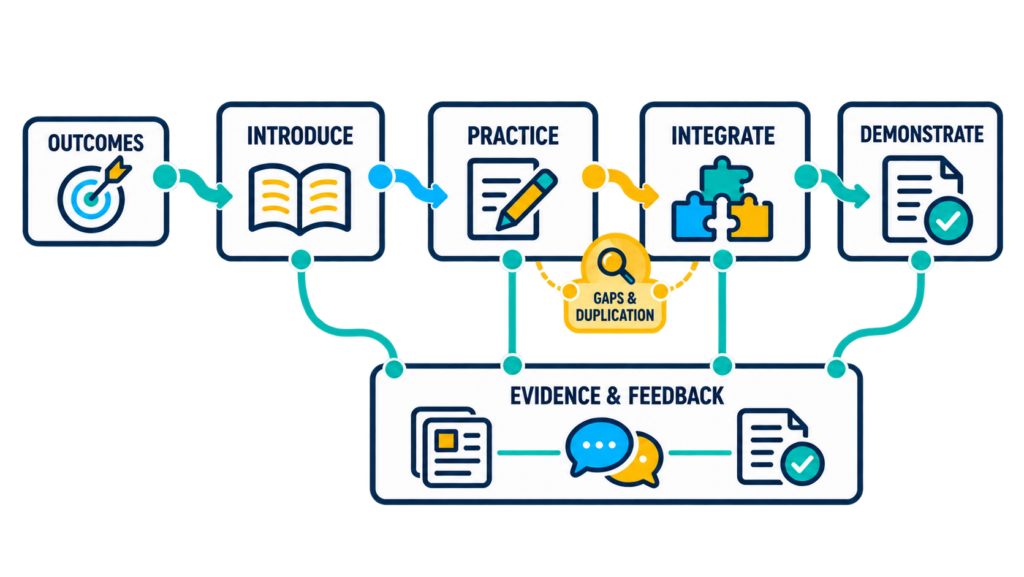
This module helps your team:
- Map important outcomes and capabilities across courses and experiences
- Connect curriculum markers to actual learner activities
- Identify gaps, bottlenecks, and unsupported expectations
- Distinguish productive reinforcement from accidental duplication
- Clarify how complexity, independence, integration, responsibility, and transfer develop
- Include relevant experiential, work-based, and co-curricular learning
- Examine variation across learner pathways and delivery formats
- Identify access conditions affecting essential learning
- Connect curriculum coverage to evidence and assessment
- Clarify ownership across courses, programs, and governance structures
- Identify questions requiring deeper investigation
- Develop an evidence-backed curriculum progression response
What should happen to each part of the learning pathway?
A curriculum review should lead to a deliberate response—not simply a denser map. The appropriate response depends on the intended outcome, learner pathway, available evidence, and consequences of changing the curriculum.
Confirm
Coverage and progression are credible.
Strengthen
Increase depth, practice, feedback, access, or support.
Connect
Build a more coherent sequence across learning experiences.
Add
Address a meaningful capability, context, developmental, or evidence gap.
Consolidate
Reduce repetition that adds no meaningful progression or value.
Investigate
Resolve uncertainty about experience, access, evidence, ownership, or consequences.
These categories structure curriculum judgment. They do not automatically determine course elimination, faculty responsibility, credit requirements, program quality, accreditation status, or learner capability.
What should a curriculum coverage and progression review examine?
The intended outcome
What should learners know, do, demonstrate, create, or become, and what level is expected by the end of the bounded pathway?
The learning experience
Where do learners encounter and practice the outcome? What activities, contexts, tools, relationships, and responsibilities are involved?
The progression
How do complexity, independence, quality, integration, responsibility, or transfer change across the sequence?
The evidence
What learner work, performance, observation, feedback, or result demonstrates what occurs at each stage?
The pathway
Which learners experience the sequence, what variations exist, and where do prerequisites, access conditions, or transitions affect participation?
The ownership
Who is responsible for each connection, who reviews the evidence, and who can authorize or sustain a change?
Trace how an outcome develops across the learner journey.
A useful curriculum review follows the learning rather than beginning and ending with the course catalog.
STEP 1
Define the outcome
Use the shared purpose, capability components, context, level, and evidence boundaries.
STEP 2
Identify the learning experiences
Locate the courses, assignments, projects, placements, activities, and other environments where learners may develop the outcome.
STEP 3
Describe what learners do
Clarify the actual activities, methods, decisions, practice, collaboration, creation, and feedback involved.
STEP 4
Map progression
Show what changes in complexity, independence, integration, quality, responsibility, context, or transfer.
STEP 5
Examine evidence and access
Determine what supports each connection and whether learners across relevant pathways can reach the essential experience.
STEP 6
Choose a response
Confirm, strengthen, connect, add, consolidate, or investigate each important part of the pathway.
The result is a curriculum progression model grounded in learner experience and evidence—not simply a record of where outcomes appear in official documents.
- Follow learning across the complete pathway
- Connect official mappings to actual learner activity
- Preserve progression, access, and evidence context
- Distinguish reinforcement from duplication
- Clarify responsibility for every connection
- Turn the map into a bounded improvement decision
FUTURE PRODUCT CONNECTION
Let curriculum connections remain visible as programs change.
Long term, TalentSync EDU could help learning organizations structure shared profiles for outcomes, capabilities, courses, programs, projects, credentials, and learning experiences.
A connected curriculum view could potentially show:
- Which outcomes and capabilities each experience supports
- What learners are expected to do
- The context and level of the learning
- Prerequisite and developmental relationships
- Where practice, feedback, and demonstration occur
- Which evidence supports each connection
- Where gaps and duplication emerge
- How different learner pathways vary
- Who owns or reviews each relationship
- When a curriculum connection was last confirmed
- What decisions or changes are under consideration
- How approved evidence connects to learner records
This would allow curriculum relationships to function as maintained institutional knowledge rather than a static spreadsheet reconstructed during each review cycle.
With the learner’s participation, relevant courses, experiences, activities, skills, capabilities, credentials, artifacts, feedback, and stories could also connect to TalentPass. The learner controls their TalentPass information and chooses when it is shared.
PRODUCT AND DECISION BOUNDARIES
A connected curriculum map supports judgment. It does not replace it.
TalentSync EDU and TalentPass should not be presented as:
- Automatically determining whether curriculum coverage is sufficient
- Proving that learning occurred because an outcome appears in a course
- Inferring capability from enrollment or completion alone
- Assigning definitive progression levels without evidence and review
- Automatically identifying the correct curriculum sequence
- Recommending course elimination without institutional judgment
- Treating all learner pathways as identical
- Converting every learning activity into formal evidence
- Awarding credit or credentials automatically
- Determining program quality or accreditation status
- Replacing faculty, curriculum bodies, assessors, advisors, or institutional leaders
- Making legal, regulatory, accreditation, licensing, or collective-bargaining determinations
- Providing the sole basis for a consequential decision
The product connection described here includes capabilities TalentSync EDU is designed to grow into through Launch Partnerships and funded implementation work.
The workshop can still clarify curriculum relationships, evidence needs, progression, responsibilities, and decision boundaries independently of future product adoption.
What to bring into the conversation
You do not need a perfect curriculum map or a complete inventory of every learning activity.
We begin with a bounded outcome, learner pathway, program, or sequence connected to the decision established through Learning Alignment Direction.
Useful inputs may include:
- Institutional, program, and course learning outcomes
- Outcome and capability definitions
- Existing curriculum maps
- Program plans and course sequences
- Course descriptions and syllabi
- Assignment and assessment examples
- Learning activities and instructional approaches
- Prerequisite and co-requisite requirements
- Capstone, project, research, and portfolio structures
- Internship, clinical, field, lab, studio, or work-based requirements
- Co-curricular and learner-support experiences
- Assessment results and examples of learner work
- Faculty, learner, alumni, employer, and supervisor feedback
- Transfer, prior-learning, and articulation practices
- Online, hybrid, campus, and location variations
- Course scheduling and availability information
- Known gaps, duplication, bottlenecks, or access concerns
- Curriculum ownership and approval practices
- Relevant accreditation, licensing, or professional expectations
The goal is not to map the entire institution in one session. The required Learning Alignment Direction module establishes the outcome, affected learning environment, evidence boundary, and decision this module should support.
What this module can help clarify
Where important learning occurs
Identify the courses, activities, projects, placements, and experiences that contribute meaningfully to priority outcomes and capabilities.
How learning is expected to progress
Clarify changes in complexity, independence, integration, responsibility, quality, context, and transfer.
Where gaps, duplication, and bottlenecks exist
Reveal unsupported expectations, missing developmental steps, avoidable repetition, fragile dependencies, and access barriers.
What response is appropriate
Organize evidence into options to confirm, strengthen, connect, add, consolidate, or investigate.
Final outputs depend on the modules selected and the alignment decision established through the workshop’s required Learning Alignment Direction module.
Where might the work lead next?
Questions institutions ask before beginning.
MAKE THE LEARNING PATH VISIBLE
Turn a collection of courses into a coherent path for capability development.
Connect outcomes to courses, activities, experiences, progression, access, and evidence—then address the gaps and duplication that matter.
This module is part of Gobekli’s configurable Learning Alignment Workshop. Explore the complete 12-module structure and identify the right starting point for your organization.