
LEARNING ALIGNMENT WORKSHOP
Make the Learning Journey Work as One Connected System
Connect what learners are meant to achieve with the courses, experiences, assessments, credentials, and pathways designed to get them there.

The parts of learning can look reasonable on their own—and still fail to work together.
Curriculum maps do not match the learner experience
Official maps show where learning should happen, but learners may encounter a different sequence of courses, activities, expectations, and support.
Courses contribute to outcomes inconsistently
Multiple courses may claim the same outcome while important capabilities receive little sustained attention or practice.
Assessments measure the wrong things
Assignments and examinations may evaluate what is convenient to grade rather than the learning the program intends to develop.
Prerequisites do not reflect actual readiness
Course requirements may follow historical sequencing without showing which knowledge or capabilities learners genuinely need next.
Advising and pathways send mixed signals
Degree plans, advising practices, catalogs, websites, and departmental guidance may describe different routes through the same learning experience.
Credits and learning do not transfer cleanly
Courses may appear equivalent by title or credit value while their outcomes, activities, evidence, and expectations remain difficult to compare.
Delivery varies across sites and partners
Learners may encounter materially different experiences across locations, modalities, instructors, clinical settings, or partner organizations.
Curriculum maps become obsolete
A one-time mapping exercise produces a static document that is difficult to maintain as outcomes, courses, requirements, and pathways change.
The problem is not a lack of curriculum information. It is the missing connection among the parts of the learning journey.
Most learning organizations already hold substantial information about what learners are expected to complete. Catalogs describe programs and courses. Curriculum maps connect courses to outcomes. Syllabi identify activities and assessments. Advising systems document pathways. Credential requirements define completion. Transfer agreements describe equivalencies.
These records can all be accurate while still failing to create a coherent learner experience.
To understand learning alignment, institutions need to connect:
- Institutional, program, course, and learner outcomes
- Knowledge, technical skills, human capabilities, and disciplinary practices
- Courses, learning activities, experiences, and assessments
- Prerequisites, sequencing, advising, and learner choices
- Credentials, credit, transfer, articulation, and external requirements
- Delivery across instructors, modalities, sites, and partners
- Evidence, ownership, governance, and change impact
Learning alignment is the deliberate connection of intended outcomes with the curriculum, activities, assessments, credentials, pathways, support, and operating conditions designed to help learners achieve them.
The goal is not to force every learner, instructor, course, or pathway into an identical model. It is to make meaningful relationships clear enough to support responsible educational decisions.
Start with the learning decision—not a predetermined map or technology.
The Learning Alignment Workshop is configured around a bounded institutional problem. Every engagement begins with the required Learning Alignment Direction foundation. Your institution then selects the modules most relevant to the outcomes, curriculum, assessments, pathways, credentials, delivery conditions, or decisions being examined.
Required
1. Establish the Learning Alignment Direction
Define the affected learners, intended outcome, learning environment, available evidence, alignment boundary, timeframe, and consequential decision.
Choose 2–3
2. Select the Problem Modules
Examine the outcome, curriculum, assessment, sequencing, pathway, credential, transfer, delivery, framework, or governance relationships surrounding the decision.
Outcome
3. Build a 30–90 Day Alignment Path
Leave with a focused response, relationship priorities, responsible owners, unresolved questions, and sequenced next steps.
A typical engagement combines the required foundation with two or three problem modules. Additional learner conversations, faculty review, partner participation, system analysis, accreditation interpretation, transfer review, or specialist involvement can be added when the decision requires it.
Learning alignment creates coherence—not conformity.
Explore the 12 Learning Alignment Workshop Modules
The modules connect outcomes, curriculum, activities, assessments, pathways, credentials, delivery, and governance. Institutions do not need to complete all 12. The workshop is configured around the learning-alignment decision that matters now.
DEFINE THE ALIGNMENT QUESTION
1. Learning Alignment Direction
Required. Establish the consequential learning outcome, affected learners, alignment boundary, available evidence, and decision the workshop must support.
2. Outcome & Capability Clarity
Clarify what learners are meant to know, do, demonstrate, create, or become—and where those expectations remain vague, overloaded, or inconsistent.
3. Curriculum Coverage & Progression
Examine where intended learning is introduced, practiced, reinforced, integrated, and demonstrated across the curriculum.
4. Learning Activities & Assessment Alignment
Determine whether learning activities and assessments provide appropriate opportunities to develop and demonstrate the intended outcomes.
CONNECT THE LEARNER JOURNEY
5. Prerequisites & Course Sequencing
Examine whether prerequisites, course order, transition points, and progression rules reflect the readiness learners actually need.
6. Learner Pathway, Advising & Goal Alignment
Connect program requirements, advising, learner choices, support, milestones, and individual goals into a clearer route through learning.
7. Credential Claims & Learning Requirements
Determine whether certificates, badges, degrees, licenses, and other recognitions accurately reflect the learning required to earn them.
8. Transfer & Articulation Alignment
Compare outcomes, activities, evidence, and expectations across institutions or programs to support responsible transfer and articulation decisions.
EXTEND, SUSTAIN & GOVERN
9. Experiential & Curricular Alignment
Connect internships, projects, clinical experiences, research, service learning, and other authentic experiences to curricular purpose and reviewed evidence.
10. Multi-Modal, Multi-Site & Partner Alignment
Examine whether learners receive an appropriately coherent experience across instructors, modalities, campuses, employers, and delivery partners.
11. Framework & Requirement Crosswalks
Relate institutional outcomes to accreditation expectations, professional standards, licensure requirements, transfer frameworks, or other external reference points.
12. Alignment Governance & Change Impact
Clarify ownership, decision rights, review cycles, change processes, and how modifications in one part of the learning system affect the others.
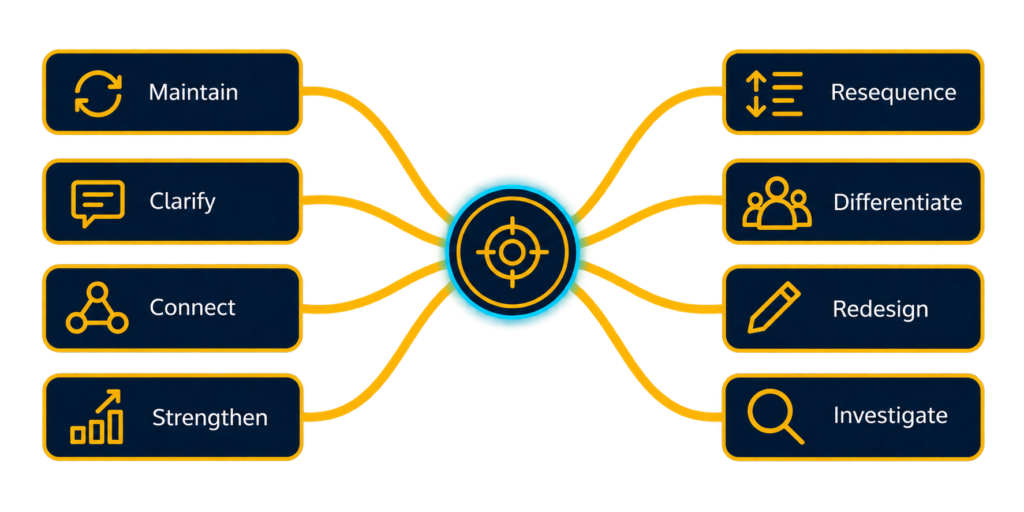
Turn alignment findings into an institutional response.
Maintain
Preserve relationships that are clear, purposeful, supported by evidence, and functioning appropriately within the broader learning journey.
Clarify
Make outcomes, requirements, responsibilities, terminology, or pathways easier for learners and institutional participants to understand.
Connect
Link relevant components that currently operate separately across courses, assessments, advising, credentials, systems, or organizational units.
Strengthen
Increase coverage, practice, evidence, consistency, or support where an important relationship exists but remains too weak.
Resequence
Change when learning, assessment, support, or recognition occurs to address readiness gaps, repetition, delay, or confusion.
Differentiate
Preserve meaningful variation across pathways, modalities, disciplines, and learner needs while maintaining a shared purpose.
Redesign
Substantively revise an outcome, course, activity, assessment, credential, pathway, or requirement that no longer works.
Investigate
Gather additional evidence or qualified review when the organization lacks enough information or authority to act responsibly.
These responses structure institutional discussion and judgment. They do not automatically determine curriculum changes, academic credit, transfer equivalency, accreditation compliance, credential eligibility, or learner progression.
How Your Workshop Is Configured:
-
1
Establish the Direction Use the required Learning Alignment Direction module to define the affected learners, consequential outcome, evidence boundary, and decision. -
2
Select the Connected Modules Choose the two or three modules needed to examine the relationships surrounding that decision. -
3
Bring Existing Evidence Begin with the outcomes, maps, assessments, requirements, pathway materials, policies, and observations the organization already has. -
4
Map Relationships & Build the Action Path Organize findings into alignment responses with owners, evidence needs, unresolved questions, and practical 30–90 day next steps.

Leave with more than a conversation.
Learning Alignment Decision Foundation
A bounded definition of the outcome, learners, evidence, relationships, and institutional decision guiding the engagement.
Alignment Landscape
A shared view of the courses, experiences, assessments, requirements, credentials, pathways, participants, and systems within scope.
Outcome & Capability Map
A clearer account of what learners are meant to know, do, demonstrate, create, or become.
Curriculum Coverage & Progression View
A map of where important learning is introduced, practiced, reinforced, integrated, demonstrated, duplicated, or missing.
Activity & Assessment Crosswalk
A structured comparison of intended outcomes, learning activities, assessment methods, evidence, and review.
Learner Pathway & Transition Findings
Identified strengths and gaps across prerequisites, advising, sequencing, transfer, delivery modes, and transition points.
Alignment Response Priorities
An evidence-backed set of maintain, clarify, connect, strengthen, resequence, differentiate, redesign, and investigate priorities.
30–90 Day Action Path
Defined ownership, immediate actions, evidence needs, specialist questions, dependencies, and next decision points.
Final outputs depend on the selected modules, available evidence, participants, and decision established through the required Learning Alignment Direction foundation.
The workshop supports institutional and human judgment. It does not automatically change curriculum, award credit, determine transfer, establish accreditation compliance, approve credentials, replace faculty governance, or make legal, accessibility, licensing, or regulatory determinations.

Connect the learning journey without forcing every experience to become the same.
Alignment does not require every course, instructor, pathway, learner, or institution to use an identical approach.
Different disciplines, communities, modalities, and learners may need different experiences. The purpose is to make those choices intentional and understandable—to show how each part contributes to what learners are meant to achieve.
The objective is coherence, not conformity.
Learner-Centered
Begin with the journey learners actually encounter, including decisions, transitions, expectations, and barriers that may not appear in a formal map.
Purpose-Connected
Connect learning to a defined educational purpose—not merely to an external framework or the latest market signal.
Evidence-Based
Support alignment claims with appropriate documentation, reviewed evidence, participant knowledge, and an honest account of uncertainty.
Human-Governed
Keep interpretation, curriculum decisions, academic standards, and professional judgment with authorized people and institutions.
When the workshop reveals relationships worth maintaining
Turn a one-time alignment review into living institutional visibility.
Optional Gobekli support can help institutions maintain the relationships among outcomes, courses, activities, assessments, credentials, pathways, programs, evidence, and decisions revealed through the workshop.
Workshop Findings
Define the alignment relationships, evidence, responsibilities, decisions, and boundaries that matter.
Connected Alignment Model
Structure relevant connections among outcomes, courses, activities, assessments, credentials, pathways, programs, and evidence.
Ongoing Change Visibility
Help authorized participants understand what may be affected when one part of the learning system changes.
Long term, TalentSync EDU could help institutions maintain shared profiles and relationships for outcomes, courses, programs, experiences, credentials, and pathways. A connected model could make it easier to examine coverage, progression, evidence, dependencies, and change impact without treating technology as the academic decision-maker.
This product connection includes capabilities TalentSync EDU is designed to grow into through Launch Partnerships and funded implementation work. A Gobekli setup is optional, and the Learning Alignment Workshop can be completed independently of future product adoption.
TalentPass is not designed for use by minors.
Questions institutional leaders ask before booking.
It is a configurable facilitated process that helps an institution connect intended outcomes with curriculum, activities, assessments, credentials, pathways, support, and operating conditions.
Every engagement begins with the required Learning Alignment Direction foundation. The institution then selects the problem modules most relevant to its decision.
The workshop is designed for colleges, universities, community colleges, adult and continuing education providers, workforce education organizations, and other institutions responsible for postsecondary or workforce-connected learning.
Participants may include learners, academic leaders, faculty, curriculum teams, assessment leaders, registrars, advisors, transfer specialists, institutional research, technology teams, employers, partners, and qualified specialists.
No. Every engagement begins with Learning Alignment Direction. Most institutions then select two or three additional modules connected to the decision established through that foundation.
The structure focuses the work rather than turning every engagement into a complete institutional redesign.
Learning alignment is the deliberate connection of intended outcomes with the curriculum, activities, assessments, credentials, pathways, support, and operating conditions designed to help learners achieve them.
It helps an organization understand whether the parts of a learning experience reinforce one another or create gaps, duplication, ambiguity, and conflicting expectations.
Curriculum alignment examines whether courses, content, activities, assessments, and progression contribute appropriately to the outcomes a program or institution intends.
A useful review considers depth, sequence, evidence, consistency, learner experience, and the relationships among the components.
No. Curriculum mapping is an important input, but a map may only document where outcomes, content, or assessments appear.
Learning alignment also examines prerequisites, advising, learner pathways, transfer, credentials, experiential learning, delivery variation, decision-making, and change impact. The map represents relationships; the alignment review supports a decision about them.
Constructive alignment is an educational design approach that connects intended learning outcomes with the activities through which learners develop that learning and the assessments through which it is demonstrated.
The workshop can examine these relationships while also considering the broader institutional systems surrounding them.
No. Different instructors, disciplines, modalities, and learner groups may require different methods. Meaningful variation can be an educational strength.
The purpose is to clarify shared outcomes and necessary relationships while preserving appropriate professional judgment and instructional choice.
Program Relevance asks whether the institution is offering the right learning for its mission, learners, communities, disciplines, and changing environment.
Learning Alignment asks whether outcomes, curriculum, experiences, assessments, credentials, and pathways work together coherently once that direction is established. Relevance helps determine the destination; alignment helps make the journey coherent.
Learning Alignment examines how the parts of the learning experience relate.
Learning Visibility & Credentialing examines whether the resulting learning and evidence can be seen, understood, recognized, and carried forward. Alignment makes the journey coherent; visibility makes achievement understandable and portable.
The workshop may help organize outcomes, curriculum relationships, assessments, evidence, responsibilities, and unresolved questions relevant to accreditation preparation.
It does not determine compliance, replace an accreditor’s review, or guarantee an outcome. Formal interpretations remain with the institution and appropriately qualified authorities.
No. Transfer and articulation decisions remain with authorized institutions and qualified academic decision-makers.
The workshop can help participants compare outcomes, activities, expectations, evidence, credit assumptions, and unresolved differences so those decisions are better informed.
No. Learning Alignment Direction establishes a bounded outcome, learner journey, transition, program area, or institutional decision to examine.
A focused review often produces more useful results than attempting to map every relationship at once.
Yes. The workshop clarifies the institution’s alignment problem, evidence, relationships, decisions, and action path independently of a product purchase.
If the organization identifies relationships worth maintaining over time, future product or implementation support can be considered separately.
Long term, TalentSync EDU could help institutions structure connected profiles for outcomes, courses, programs, activities, assessments, experiences, credentials, and pathways.
Those relationships could support coverage, progression, evidence, and change-impact visibility while leaving interpretation and academic decisions with authorized people. These capabilities are part of the direction TalentSync EDU is designed to grow into through Launch Partnerships and funded implementation work.
No. The workshop helps participants structure evidence, make relationships visible, identify misalignment, clarify alternatives, and organize a decision process.
Authorized academic leaders, faculty, governance bodies, and other qualified participants remain responsible for curriculum, assessment, credit, transfer, credential, and learner-progression decisions.
MAKE THE LEARNING JOURNEY COHERENT
Turn disconnected learning components into one decision-ready alignment picture.
Connect outcomes, curriculum, activities, assessments, credentials, pathways, transfer, and delivery around what learners are meant to achieve.
Configure the right combination of modules and leave with clearer relationships, response priorities, ownership, and a practical path forward.
In a free exploratory conversation, we will help identify the learning-alignment decision your institution needs to make and determine whether this workshop is the right starting point.
