
MEMBERSHIP VALUE WORKSHOP MODULE
Employer & Organizational Membership Value
The organization paying for membership and the people using it may ask different value questions. Clarify the benefits, evidence, and responsibilities that help both perspectives inform the decision.
Does this sound familiar?
The payer sees a bill without a clear benefit account
A manager or organizational sponsor is asked to renew without an understandable explanation of what the membership supports.
Users value benefits the sponsor rarely sees
People gain useful learning, guidance, or relationships, but those experiences remain disconnected from the organizational decision.
The sponsor’s purpose is assumed
Staff describe general membership benefits without clarifying why the paying organization chose to support membership.
One person’s activity represents the whole account
The organization judges a shared membership through its primary contact while other users and their experiences remain unclear.
Participation is presented as organizational impact
Attendance and resource use are reported as evidence of workforce or business improvement without enough context about what followed.
Renewal depends on a familiar champion
When a contact changes roles or leaves, the reasons for membership and the evidence supporting it become difficult to recover.
What is employer and organizational membership value?
Employer and organizational membership value concerns how membership serves an organization that pays or sponsors participation and the people who use the associated benefits.
The arrangement may involve a company membership, a shared organizational account, or employer support for individual memberships.
The paying organization may seek relevant knowledge, professional development, connections, representation, or support for a particular organizational need.
Users may value those benefits differently according to their responsibilities, interests, and circumstances.
This module examines one selected membership arrangement and connects the sponsor’s purpose, user experiences, intended benefits, available evidence, and decision responsibilities.
A shared membership needs more than one perspective on value.
An association may have a strong relationship with the person administering an organizational membership.
That contact may not be the person approving the budget or the person using most of the benefits.
A finance lead may ask why the expense remains relevant. A manager may want to understand what support the team receives. An individual user may value a professional resource or relationship that is difficult to summarize in an account report.
Those questions need to be connected without assuming they are interchangeable.
What did the organization intend to support? Who can use the membership? What became useful to them? What evidence is appropriate to the sponsor’s decision?
A useful review makes those relationships understandable and identifies what still needs clarification.
See the relationships behind organizational membership value.
Paying Organization
Reason for membership
Organizational priorities
Budget or sponsorship decision
Intended organizational benefit
Decision responsibility
People Using Membership
Eligible users
Roles and responsibilities
Individual purposes
Benefits used or needed
Perspectives still missing
Benefits and Support
Learning and resources
Expertise and guidance
Professional connections
Collective representation
Conditions affecting usefulness
Evidence and Interpretation
Access and participation records
User accounts
Relevant examples of application
Organizational observations
Limits on the conclusions
Decision and Continuity
Questions the sponsor needs answered
Account responsibilities
Appropriate sharing arrangements
Review timing
Handoffs when contacts change
A credible account connects organizational purpose and user value while preserving the distinction between access, use, and a wider organizational result.
How organizational membership value becomes difficult to explain
STAGE 1 — Membership begins with a broad expectation
The organization joins or sponsors participation with an informal understanding of the benefits it hopes to receive.
STAGE 2 — Administration becomes the main connection
The relationship centers on invoices, account contacts, eligibility, and renewals more than the purpose behind the arrangement.
STAGE 3 — Available activity stands in for value
Reports use attendance or benefit-use totals without enough context about who benefited or how the support related to organizational needs.
STAGE 4 — The decision loses its supporting account
A budget review or contact change exposes gaps in why membership matters, what users gain, and what should happen next.
An account report opens the value conversation.
An organizational membership report can answer an important question:
Which benefits were accessed through this arrangement?
A value review also asks why those benefits mattered, whose experience they reflect, and what they help explain about the paying organization’s purpose.
Questions that make the value clearer
Clarify the purpose behind the arrangement and the decision it is intended to support. Avoid assuming that the benefit list explains the sponsor’s priorities.
Identify eligible users, relevant roles, and the people whose experiences should inform the review. Distinguish the account contact from the wider user population.
Examine relevant learning, guidance, resources, relationships, or other support through appropriate user accounts and available evidence.
Trace the connection where evidence allows. Keep individual benefit distinct from claims about team or organizational results.
Identify the questions the sponsor needs answered and the level of detail suitable for sharing, without assuming access to every user’s activity or private account.
Identify a focused response concerning purpose, benefit fit, access, explanation, or continuity, with an owner and a way to review it.
A useful organizational membership review needs six forms of clarity.
Purpose
The paying organization can explain what it intends membership to support.
Users
The people covered by the arrangement and their relevant perspectives are understood.
Benefit
The account identifies what becomes useful to users and why it matters.
Connection
The relationship between user value and organizational purpose is examined.
Evidence
Information is interpreted at the scope it supports and shared appropriately.
Continuity
Responsibilities and review context can survive a change in contacts or decision-makers.
Organizational membership value people can assess
A useful account explains:
- Why the organization supports membership.
- Who is intended to benefit from the arrangement.
- Which benefits relate to their needs.
- What users report or demonstrate about usefulness.
- What that supports about organizational value.
- What decision or improvement comes next.
Sponsors and users can bring relevant perspectives to the same review.
Organizational membership value described through administration alone
The value becomes difficult to assess when it relies on:
- An invoice and a general benefit list.
- The primary contact’s experience alone.
- Unclear eligibility or user coverage.
- Attendance totals presented as organizational results.
- Private user information assumed to be available.
- A renewal decision without the original purpose or context.
The review identifies which relationships need clarification and which conclusions need better support.
The sponsor and the users can value the same membership differently.
A company pays for an association membership covering several employees.
The account contact receives renewal notices, while different employees use technical briefings, professional discussions, and reference resources.
The company’s sponsor wants to understand whether the arrangement remains relevant to a changing set of responsibilities.
The team selects one group of users and one intended benefit for review: access to professional information that helps them investigate unfamiliar questions.
Available records show attendance and resource access. Optional user feedback provides examples of information that helped clarify a question or identify a useful next step.
Those accounts do not establish that membership improved the company’s overall performance.
They do provide a more specific explanation of the support employees received.
The review also reveals that some intended users did not understand how to access the benefits.
The team develops an appropriate summary for the sponsor, assigns an access improvement, and records the purpose for the next review.
The resulting account connects user experience to the organizational decision while keeping broader outcome claims and individual sharing choices distinct.
Individual benefit can matter without becoming an organizational performance claim.
A person may gain useful understanding, professional support, or a relevant relationship through an employer-supported membership.
That benefit can be meaningful on its own.
The paying organization may consider it relevant to the support it wants to provide employees, even when there is no direct measure of a business result.
Where a stronger organizational claim is proposed, the review asks what additional evidence would be needed.
It does not convert every positive user experience into productivity, retention, or revenue improvement.
The account should explain the connection at the level the evidence supports.
A shared value account does not require unrestricted visibility into users.
An organizational sponsor may need an understandable explanation of how membership is serving its purpose.
Users may have reasonable expectations about which experiences, reflections, or professional interests remain private.
The review identifies the information needed for the decision and how it can be gathered and shared appropriately.
An aggregate account, an optional example, or a focused question may be more suitable than detailed individual activity records.
Small groups and distinctive examples may still reveal who contributed an account, so the sharing arrangement needs to be understood.
The aim is to support a useful decision with information that fits the purpose and the people involved.
THE MATCHING WORKSHOP MODULE
Module 9: Employer & Organizational Membership Value
This practical minicourse helps membership organizations clarify the benefits to a paying organization and the people using its membership, including how those perspectives inform the value decision.
Participants learn a repeatable review method, apply it to one selected membership arrangement, and identify whether the priority response concerns sponsor purpose, user benefit, evidence, explanation, or account continuity.
The exercise also defines the organizational relationships, user roles, benefit connections, sharing choices, and review responsibilities that a subsequent Gobekli configuration would need to support.
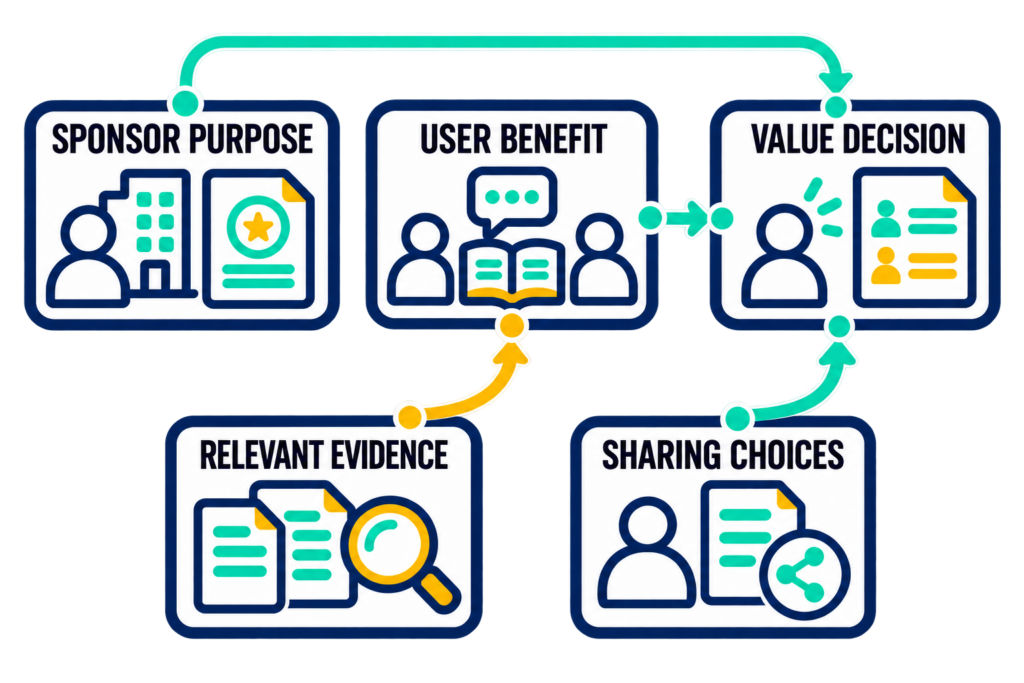
This module helps your team:
- Define the organizational membership question within scope.
- Clarify why the organization pays or sponsors participation.
- Identify the relevant decision-makers.
- Distinguish account contacts from benefit users.
- Identify intended users and their needs.
- Connect relevant benefits to those needs.
- Examine appropriate evidence of usefulness.
- Distinguish individual and organizational value.
- Define information suitable for the sponsor’s decision.
- Clarify review and contact-handoff responsibilities.
- Assign a focused improvement and validation plan.
- Outline a connected organizational membership configuration.
What should happen to each part of the membership arrangement?
The review leads to a deliberate response based on organizational purpose, user needs, relevant benefits, available evidence, and decision responsibilities.
Clarify
Make the sponsor’s purpose, intended users, and value question more specific.
Connect
Relate user needs and experiences to the benefits the arrangement is intended to provide.
Enable
Address unclear access or support where intended users cannot make appropriate use of benefits.
Substantiate
Build an account of usefulness that the available evidence can support.
Explain
Present relevant information in a form that helps the organizational decision-maker assess the arrangement.
Maintain
Preserve purpose, responsibilities, and review context when contacts or circumstances change.
These responses improve the arrangement and its value account. The paying organization remains responsible for its sponsorship and renewal decisions.
What should an employer and organizational membership value review examine?
The sponsorship purpose
What does the paying organization intend membership to support?
The user population
Who is covered, who participates, and whose experience is missing from the account?
The relevant benefits
Which offerings address the needs of those people or the organization?
The available evidence
What is known about access, use, usefulness, or application, and from which sources?
The value decision
What does the sponsor need to understand, and which conclusions does the evidence support?
The continuity
Who owns the account, review, and handoff when contacts or priorities change?
Trace one membership arrangement from sponsorship purpose to a clearer value decision.
Your team applies the method to the audience and value question established through Membership Value Direction.
STEP 1
Define the sponsor’s purpose
Select one arrangement and clarify why it is funded and which decision is within scope.
STEP 2
Identify users and perspectives
Distinguish the sponsor, administrator, intended users, and other relevant roles.
STEP 3
Connect benefits to needs
Examine which offerings are intended to support the organization and the people using membership.
STEP 4
Review the evidence
Distinguish access, participation, user accounts, application examples, and broader claims.
STEP 5
Build the decision account
Explain the relevant benefits, evidence, limitations, and unanswered questions in an appropriate form.
STEP 6
Assign and test the response
Choose an improvement, responsible owner, feedback approach, and review point.
The result is a draft Organizational Membership Value Map connecting sponsor purpose, user perspectives, relevant benefits, supporting evidence, decision questions, and assigned improvements.
FUTURE PRODUCT CONNECTION
Keep organizational membership connected to the people and purposes it serves.
A subsequent Gobekli configuration could help the membership organization maintain an understandable account of a sponsored or organizational membership arrangement.
TalentSync could connect organizational accounts to sponsor purposes, responsible contacts, user roles, relevant benefits, and review needs. TalentPass could help individuals organize membership-supported experiences and examples they choose to retain or share.
Pythia could help clarify a sponsor’s value question or assemble an explanation from the information and permissions in scope. Passport Pages could support agreed source connections and sharing arrangements.
A connected organizational membership review could potentially show:
- Which organization pays or sponsors participation.
- What purpose the arrangement is intended to serve.
- Who holds sponsorship and account responsibilities.
- Which people or roles are intended to benefit.
- What benefits relate to their needs.
- What access or participation records establish.
- What users choose to share about usefulness.
- What evidence supports the organizational value account.
- Which questions or access gaps remain.
- Who owns the next review or contact handoff.
The workshop produces a starting configuration brief: organizational accounts, sponsor purposes, affiliation and user relationships, benefit connections, source context, sharing choices, and review responsibilities.
Specific account structures, access arrangements, reporting, integrations, and product capabilities would be confirmed during solution planning.
PRODUCT AND DECISION BOUNDARIES
The payer’s perspective and the user’s perspective both need context.
The review helps the membership organization explain how a selected arrangement serves its intended purposes.
A later configuration should distinguish the paying organization, account administrator, individual users, and sources supporting each part of the value account.
Those relationships do not automatically establish a shared purpose or permission to disclose personal information.
The workshop and product connection do not establish:
- The same needs across all users.
- The account contact as a substitute for every user’s perspective.
- Benefit access as evidence of usefulness.
- Participation as proof of organizational improvement.
- Productivity, retention, or revenue effects without appropriate evidence.
- Employer ownership of every membership-related experience.
- Permission to share private individual information.
- A requirement for the sponsor to renew.
The membership organization remains responsible for its benefit commitments and value claims.
The organizational membership brief remains useful independently of future product adoption.
What to bring into the conversation
You do not need a complete organizational account-reporting system before beginning.
Start with one arrangement connected to the question established through Membership Value Direction.
Useful inputs may include:
- The selected membership or sponsorship arrangement.
- The sponsor’s stated purpose.
- Relevant organizational priorities.
- Decision-maker and account-contact roles.
- Eligibility or user-coverage information.
- Descriptions of relevant benefits.
- Available access and participation records.
- Appropriate user feedback or examples.
- Current reports provided to the sponsor.
- Known access or support gaps.
- Sharing expectations and source limitations.
- Review timing and contact-handoff responsibilities.
The aim is to examine one arrangement in sufficient detail to connect sponsor purpose and user benefit to a practical value decision.
What this module can help clarify
Why the organization supports membership
Clarify the sponsorship purpose and the decision the value account should inform.
Whom the arrangement serves
Connect intended users, their needs, and relevant benefits while keeping different perspectives visible.
What the evidence supports
Distinguish access, use, individual usefulness, and any supported connection to organizational value.
What to improve or investigate next
Develop an assigned response, proportionate validation plan, and starting configuration brief.
These outputs begin with the example reviewed during the module. Final scope depends on the selected modules, available information, and question established through Membership Value Direction.
Where might the work lead next?
Member Identity & Affiliation Clarity
Clarify organizational accounts, employers, individual users, and other relationships when the records do not clearly describe who is involved.
Dues, Tiers & Benefit Packaging
Examine how the membership arrangement is packaged when the next question concerns coverage, choices, or the benefits included.
Member Value Evidence & Renewal Conversations
Bring the relevant benefits and evidence into a clearer conversation when the sponsor is reviewing renewal.
Your team can combine this module with other parts of the Membership Value Workshop according to the value question established through Membership Value Direction.
Frequently asked questions
Questions organizations ask before beginning.
An arrangement in which an organization pays for membership, sponsors individual participation, or provides access to benefits for a defined group. The review clarifies the specific arrangement rather than assuming one model.
Yes. The exercise can examine the sponsor’s purpose and the individual’s experience while preserving the distinction between their roles and information.
They answer different questions. The sponsor makes a funding decision, while users can explain the relevance and usefulness of the benefits they experience. A useful account considers both.
Identify those roles separately. The review clarifies who administers membership, who uses it, and who needs information for the value decision.
Examine whether that matches the arrangement’s purpose and intended coverage. Low user numbers alone do not explain whether the membership is appropriate or useful.
Not necessarily. Begin with the sponsor’s purpose and the question under review. Any financial-return claim would need suitable evidence and assumptions beyond participation totals.
It may be part of what the employer intends to support. The review examines what is known about its usefulness without automatically claiming a wider performance result.
Make that perspective visible where appropriate. It may reveal a useful benefit, a difference in priorities, or a question to discuss in the next review.
Identify the specific gap and assign a response. A later engagement-focused review may be useful if the issue concerns onboarding, discovery, or participation support.
Information appropriate to the value question and the agreed sharing arrangement. The sponsor’s role does not automatically require detailed individual activity or private reflections.
No. They may help with some questions while leaving relevance or usefulness unclear. Small-group summaries can also reveal individual information, so context matters.
The review can identify the purpose, evidence, and responsibilities that should be preserved for a handoff. This helps the next contact understand the arrangement without relying only on personal memory.
That Member Intelligence module clarifies whom records describe and how people and organizations relate. This module examines the value the membership arrangement provides to those parties.
That module examines how membership choices and included benefits are structured and explained. This module examines sponsor and user value within a selected arrangement.
That module develops a broader value account for renewal. This module first clarifies the distinct organizational and user perspectives that should inform it.
The outputs can inform a configuration connecting organizational accounts, sponsor purposes, user roles, benefits, evidence, and review responsibilities. Specific capabilities and implementation requirements would be confirmed during scoping.
Your team will examine one arrangement and develop a draft Organizational Membership Value Map, an assigned improvement and validation plan, and starting configuration requirements. Wider implementation and outcome review continue afterward.
MAKE ORGANIZATIONAL MEMBERSHIP’S VALUE CLEAR
Connect the reason to pay with the value people receive.
Bring sponsor purpose, user experience, and appropriate evidence into an account that supports a clearer organizational membership decision.
This module is part of Gobekli’s configurable Membership Value Workshop.