
MEMBER INTELLIGENCE WORKSHOP MODULE
Member Identity & Affiliation Clarity
When your system says “member,” whom does it actually mean?
Clarify how individuals, member companies, employers, chapters, roles, and membership arrangements connect—so your team can interpret its records with confidence.
Module 2 · Member Intelligence Workshop
Does this sound familiar?
A company membership appears to describe everyone who works there
The organization holds membership, but records do not clearly show which people are contacts, representatives, participants, or members in their own right.
One person appears as several different members
A person has separate records through a chapter, an event, an employer, and an individual membership. Staff cannot readily tell which records describe the same person.
The main contact is treated as the whole relationship
A billing or administrative contact becomes the default representative of a member company, even when other people hold the relevant expertise or responsibility.
Job changes leave confusing affiliations behind
A person moves to a new employer, but the old organization, role, email address, or membership arrangement remains attached without a clear end date.
Chapter and national records tell different stories
Membership status, roles, and affiliations vary between local and central records. Teams lack a shared way to explain the differences.
Member counts depend on who prepares the report
One report counts organizations, another counts individuals, and another counts contacts or linked accounts. The same word describes different populations.
What is member identity and affiliation clarity?
Member identity clarity establishes whom or what a record describes.
Affiliation clarity establishes how that person or organization relates to other entities—and what those relationships mean.
A membership environment may include:
- Individuals.
- Member companies or other organizations.
- Employers and workplaces.
- Parent organizations and subsidiaries.
- Chapters, branches, and regional groups.
- Committees and professional communities.
- Membership holders and covered participants.
- Authorized representatives.
- Administrative, billing, and program contacts.
- Staff, volunteers, mentors, and elected leaders.
- Current and historical affiliations.
These distinctions matter because a person, an organization, a role, and a membership arrangement describe different things.
Member Identity & Affiliation Clarity helps participants make those differences explicit and apply them to one real membership arrangement.
The result is a clearer account of the people and organizations involved, how they connect, and what the available records can support.
One member record can hide several different relationships.
Consider a person listed under a member company.
They may be:
- Employed by that company.
- Designated as its primary contact.
- Authorized to represent it for a particular purpose.
- Eligible for certain benefits under its membership.
- An individual member separately.
- Affiliated with a local chapter.
- Serving on a committee in a personal capacity.
- A former employee whose historical contributions remain relevant.
Some relationships may be current while others have ended. Some may be confirmed, while others were inferred from an email address or inherited from an old record.
Before using the information, the organization needs to understand:
- Which entity each record describes.
- Whether multiple records refer to the same entity.
- Which relationships are actually recorded.
- What each relationship means.
- Which source supports it.
- When it applies.
- Who can confirm or correct it.
- What conclusions it permits.
Clear affiliations give member information the context needed for responsible interpretation.
Connect the person, the organization, and the arrangement.
People and Organizations
Individual identity
Organization identity
Distinct records and identifiers
Possible duplicate records
Parent and subsidiary distinctions
Affiliations and Roles
Employment relationships
Chapter participation
Committee roles
Organizational representation
Administrative responsibilities
Membership Arrangements
Membership holder
Membership category
Covered people or groups
Named representatives
Relevant conditions
Time and Evidence
Current or historical relationship
Effective dates
Supporting source
Confirmation status
Unresolved conflicts
Interpretation and Ownership
Meaning of each relationship
Appropriate reporting unit
Who can confirm or correct
Questions requiring review
Next action and responsibility
A useful member picture preserves the distinction between who someone is, whom they are connected to, and what each connection establishes.
How membership records become difficult to interpret
STAGE 1 — A record is created for an immediate task
Someone registers, pays, attends, joins a chapter, or becomes a company contact.
STAGE 2 — Additional relationships accumulate
The same person takes on new roles, changes employers, participates through another group, or appears in a different system.
STAGE 3 — Labels begin carrying several meanings
“Member,” “contact,” “representative,” and “organization” are used inconsistently or stored in fields that cannot express the distinctions.
STAGE 4 — Decisions inherit the ambiguity
Teams struggle to determine whom to contact, how to count the population, which affiliation is current, or what a record actually establishes.
“Connected to a member company” leaves important questions unanswered.
An organizational connection can be useful without establishing individual membership, representation authority, or eligibility for every benefit.
A productive review asks what the connection means for the particular decision.
“Jordan belongs to Northline” could mean:
“Jordan is currently employed by Northline, serves as its training contact, and participates in the regional chapter. Northline holds the organizational membership. Jordan’s individual membership status has not been confirmed.”
That description separates several relationships that a single company field cannot explain.
The affiliation review should clarify:
Determine whether the record represents an individual, an organization, a group, a membership arrangement, or a role assignment. Identify where a record combines several of these.
Examine the available identifiers and supporting context. Record possible matches separately from confirmed matches, especially where names, shared addresses, or email changes create uncertainty.
Distinguish employment, membership, chapter affiliation, representation, and administrative responsibility. Use relationship names that people across the organization can interpret consistently.
Identify the membership holder, category, scope, and relevant conditions. Clarify which people are named or covered and which questions require confirmation from the arrangement’s owner.
Record whether it is current, historical, temporary, pending, or otherwise limited. Identify dates or confirmation points that matter to the intended use.
Identify the person, organizational representative, chapter owner, membership team, or other appropriate source responsible for resolving uncertainty.
Examine identity and affiliation across six dimensions.
Entity
Identify the distinct person, organization, group, or arrangement represented by the record.
Relationship
Describe how the entities connect using a clear and consistent meaning.
Role
Clarify the responsibility or capacity in which a person participates.
Membership Scope
Identify who holds the membership and what the relevant arrangement covers.
Time and Source
Preserve when the relationship applies and the information supporting it.
Confirmation
Identify who can verify, correct, or resolve the relationship and its interpretation.
A connection should support a specific interpretation.
What a clearly described relationship can establish
Depending on its source and scope, it may show:
- A person’s reported current employer.
- The organization holding a membership.
- A designated administrative contact.
- A confirmed chapter affiliation.
- A named committee role.
- A representative’s stated responsibility.
- A historical relationship relevant to earlier activity.
- Coverage under a documented membership arrangement.
The interpretation should remain tied to the relationship’s actual meaning.
What may require separate confirmation
The same connection may leave unresolved:
- Whether the person is an individual member.
- Whether every employee is covered.
- Whether a contact can act on the organization’s behalf.
- Whether a role is still current.
- Whether access should continue after a job change.
- Whether chapter participation establishes national membership.
- Whether two similar records describe the same person.
- Whether a parent organization’s arrangement includes a subsidiary.
These questions should be recorded and routed to the appropriate owner.
A job change can affect several records without changing the person.
Imagine Jordan, a training manager at Northline, who also serves on an association committee and participates in a regional chapter.
Northline holds the organizational membership. Jordan is its training contact and uses a company email address for event registration.
Jordan then moves to another employer.
The association may need to:
- Confirm the end of the Northline employment relationship.
- Identify Northline’s new training contact.
- Record Jordan’s new employment information if provided.
- Determine which membership-related arrangements need review.
- Preserve Jordan’s earlier participation in its original context.
- Confirm whether the committee role continues.
- Maintain the chapter relationship if it remains applicable.
- Review whether a new registration record belongs to the same person.
Overwriting the company field would leave several questions unanswered. Creating an entirely new person record could separate Jordan from relevant history.
The exercise maps the person and the relationships separately, then records what has changed, what continues, and what requires confirmation.
Count the population you actually mean.
A membership report should state what it counts.
The number of member organizations, individual members, named representatives, covered participants, active contacts, and chapter affiliations may all be useful. They describe different populations.
This module helps participants define the unit relevant to the selected decision and identify where overlapping affiliations could lead to double counting.
For example, one person may appear in three chapters and represent a member company while remaining one individual. Whether each affiliation should also be counted depends on the reporting question.
Deeper analysis of who is represented—and whose perspective is missing—belongs in Member Segmentation & Representation Gaps when needed.
Clarify the relationship before connecting more systems.
Connecting platforms can make an unclear affiliation easier to distribute.
Before deciding how records should synchronize, establish what each important field or relationship means. A “company contact” in one system may describe something different from a “member representative” in another.
This module defines the selected identities and affiliations.
Fragmented Member Data & System Connections can then examine how the relevant systems should exchange or reference that information. Member Intelligence Governance & Currency can address ongoing maintenance and review.
THE MATCHING WORKSHOP MODULE
Module 2: Member Identity & Affiliation Clarity
This practical minicourse helps membership teams learn a repeatable method for distinguishing people, organizations, roles, affiliations, and membership arrangements.
Participants apply the method to one real example: a corporate membership, chapter relationship, employer change, representative arrangement, or confusing set of records.
They map the entities and relationships, examine the supporting sources, identify unresolved interpretations, and assign the next steps needed to clarify the picture.
The exercise also establishes the relationship definitions a subsequent Gobekli configuration would need to preserve.
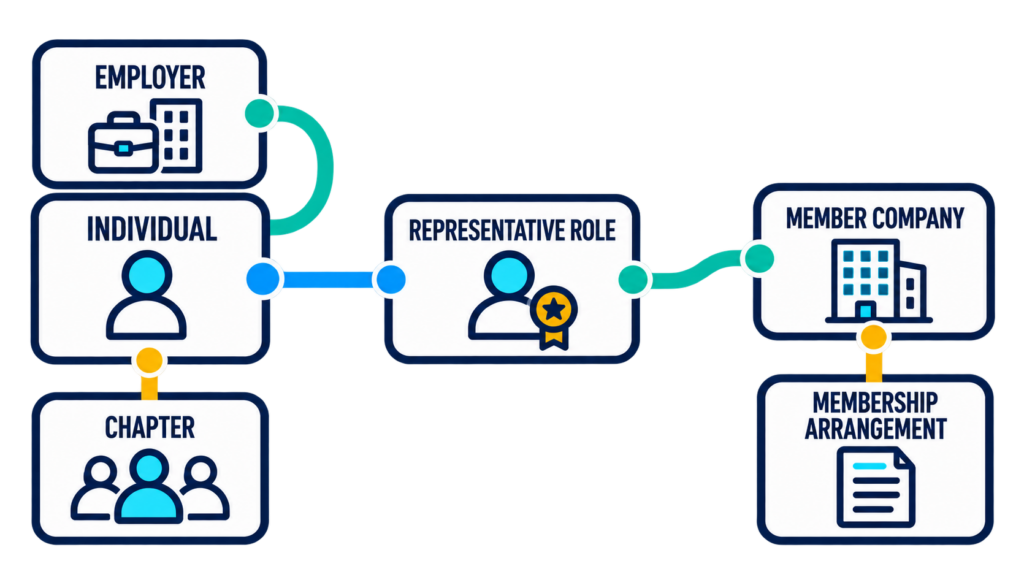
This module helps your team:
- Identify whom or what each selected record describes.
- Distinguish individuals from organizations and membership arrangements.
- Separate contact responsibilities from representation roles.
- Clarify employment, chapter, committee, and other affiliations.
- Identify the membership holder and relevant coverage questions.
- Recognize possible duplicate or conflicting records.
- Preserve current and historical relationship context.
- Record the source and confirmation status of important affiliations.
- Define the population being counted or examined.
- Identify who can resolve uncertain relationships.
- Develop a focused clarification and follow-up plan.
- Outline a potential identity and affiliation configuration.
What should happen when an affiliation is unclear?
The workshop records proposed actions and their owners; changes to operational records follow the organization’s review process.
Distinguish the Entities
Separate the person, organization, group, role, and membership arrangement involved.
Clarify the Relationship
Define what the affiliation means and which interpretation it supports.
Confirm the Connection
Identify an appropriate source or responsible person who can verify the relationship.
Review Possible Duplicates
Examine whether records describe the same entity before recommending any consolidation.
Preserve the History
Record ended or changed relationships without losing the context of earlier participation.
Route the Unresolved Question
Assign questions about representation, coverage, access, or record ownership to the appropriate decision-maker.
Several responses may apply to the same example. The workshop records proposed actions and their owners; changes to operational records follow the organization’s review process.
What should a member identity and affiliation review examine?
The Entities
Which distinct people, organizations, groups, and arrangements appear in the selected records?
The Relationship Meanings
How are they connected, and do teams interpret those connections consistently?
The Roles and Membership Scope
Who holds the membership, who participates, and in what capacity?
The Time and Evidence
When does each relationship apply, which source supports it, and what remains uncertain?
The Operational Consequences
How could ambiguity affect communication, reporting, service routing, or interpretation of the membership arrangement?
The Ownership and Next Step
Who can resolve each question, what correction is proposed, and what should the future configuration preserve?
Learn the method. Map one membership arrangement clearly.
Bring one example where your team has difficulty explaining whom the records describe or how the people and organizations connect.
STEP 1
Select the arrangement and its use
Identify the membership relationship or record problem to examine. Connect it to the decision established through Member Intelligence Direction.
STEP 2
Separate the entities
List the distinct people, organizations, chapters, groups, and membership arrangements. Mark records that may refer to the same entity.
STEP 3
Name the relationships and roles
Map employment, membership, representation, contact, chapter, committee, and other relevant connections. Define what each relationship means.
STEP 4
Add source and time context
Record the available source, effective period, confirmation status, and known conflicts for each important relationship.
STEP 5
Examine consequences and assign clarification
Identify how uncertainty affects the selected decision. Record who can confirm the relationship and what proposed correction or review is needed.
STEP 6
Outline the configuration
Specify the entity profiles, relationship types, role assignments, membership references, source links, and review needs a future implementation would have to support.
Participants leave with a Member Identity & Affiliation Map, a list of unresolved questions and proposed corrections, and a starting configuration brief.
The map distinguishes confirmed relationships from assumptions and preserves the context needed to interpret them.
- Select the arrangement and its use.
- Separate the entities.
- Name the relationships and roles.
- Add source and time context.
- Examine consequences and assign clarification.
- Outline the configuration.
FUTURE PRODUCT CONNECTION
Give every member relationship a clear place and meaning.
The workshop identifies the entities and relationships that need to remain understandable across the membership environment.
A potential TalentSync configuration could connect individual and organizational profiles with explicit affiliations, role assignments, membership context, and relevant source records.
Where appropriate, TalentPass could allow an individual to maintain personal experience and affiliation information and choose what to share into that organizational context.
The starting configuration brief could identify:
- Individual profiles: the people involved and references to the records that describe them.
- Organizational profiles: member companies, employers, parent organizations, subsidiaries, or other relevant entities.
- Group relationships: chapters, committees, regional groups, and professional communities.
- Affiliation types: clearly defined connections such as employed by, affiliated with, or participating through.
- Role assignments: responsibilities such as billing contact, program contact, committee member, or authorized representative.
- Membership context: the holder, category, applicable scope, and references to the arrangement that establishes it.
- Source references: where each important relationship came from and how it can be checked.
- Time context: current and historical affiliations, relevant dates, and transitions.
- Review needs: possible duplicate identities, conflicting relationships, and questions awaiting confirmation.
- Member contributions: information a person chooses to provide or correct, with organizational review where required.
For example, the initial configuration might focus on member companies and their designated contacts. A later scope could add chapter affiliations or other relationships once their meanings and ownership are established.
The brief provides a practical basis for assessing available capabilities, integration needs, and implementation effort.
PRODUCT AND DECISION BOUNDARIES
Keep identity, affiliation, authority, and eligibility distinct.
A connected configuration should preserve the difference between:
- Identifying the same person and formally verifying identity.
- Recording employment and establishing individual membership.
- Listing a contact and authorizing representation.
- Recording chapter participation and establishing another membership status.
- Showing an affiliation and granting access.
- Recording a membership arrangement and deciding how its terms apply.
- Suggesting a possible duplicate and approving a record merge.
- Updating a current relationship and rewriting historical context.
- Member-provided information and information confirmed by an organization.
Membership owners and other authorized roles retain responsibility for interpreting their arrangements and approving consequential changes.
Product availability, configuration requirements, integrations, and any additional development would be confirmed during scoping.
The workshop produces a useful relationship map and clarification plan independently of product adoption.
What to bring into the conversation
Begin with one arrangement that staff find difficult to explain consistently.
A useful starting question is: “Who is the member here, how are these people connected, and what does each relationship actually establish?”
Useful inputs may include:
- A small set of representative or de-identified records.
- Membership categories and descriptions.
- An example organizational membership arrangement.
- Definitions of primary, billing, program, or representative contacts.
- Chapter or branch membership structures.
- Relevant parent and subsidiary relationships.
- Examples of possible duplicate records.
- A recent employer or role change.
- Existing individual and organizational identifiers.
- Source-system field definitions.
- Current practices for confirming affiliations.
- Examples of conflicting membership reports.
- People responsible for the selected records and arrangement.
- The organizational decision this review should support.
The required Member Intelligence Direction module establishes the purpose and boundary for this exercise.
A complete membership database or a finished integration plan is not required.
What this module can help your team produce
A Member Identity & Affiliation Map
A structured view of the people, organizations, groups, roles, and membership arrangements involved in the selected example.
A Relationship Definition Brief
Clear meanings for the important affiliations, including what each relationship establishes and which questions require separate confirmation.
A Clarification and Follow-Up Plan
A list of uncertain identities, conflicting affiliations, proposed corrections, relevant sources, responsible people, and review actions.
A Starting Configuration Brief
An outline of the profiles, relationship types, role assignments, membership references, source connections, and time context a subsequent Gobekli implementation would need.
These outputs begin with the arrangement examined during the module. Final scope depends on the available records, relevant participants, and decision established through Member Intelligence Direction.
Where might the work lead next?
Clarifying identities and affiliations may reveal reporting, integration, or maintenance questions that require deeper work.
Member Segmentation & Representation Gaps
Examine how clearly defined member populations appear in your evidence and whose experience may still be missing.
Fragmented Member Data & System Connections
Determine how systems can connect relevant records while preserving the meaning of identities, affiliations, and membership arrangements.
Member Intelligence Governance & Currency
Establish how important identities and relationships are maintained, reviewed, and updated as circumstances change.
Questions about wider peer relationships and community connections may lead to Member Relationships & Network Visibility. Questions about appropriate disclosure and access may lead to Member Consent, Sharing & Trust.
Frequently asked questions
Questions membership organizations ask before beginning.
It establishes whom or what a record describes and how that entity relates to others. The module distinguishes individuals, organizations, roles, groups, and membership arrangements so the information can be interpreted consistently.
No. The workshop examines record meaning, possible identity matches, affiliations, and supporting sources. It does not perform formal identity verification or establish that a person has passed a particular verification process.
A person may appear in several records created for different purposes. Those records may describe event participation, employment, chapter affiliation, or membership. The review examines which records belong to the same person and what each contributes.
It separates the organization holding membership from its employees, contacts, representatives, and other participants. It also identifies which relationships and conditions need to be understood when interpreting the arrangement.
That depends on the organization’s membership arrangements and definitions. The workshop records the applicable structure and identifies where coverage or status needs confirmation. Employment alone should not be used to assume an unspecified membership relationship.
Record the capacity in which each person acts. A billing contact, program contact, and authorized representative may have different responsibilities. Those roles should be distinguishable even when one person holds several.
Yes. The map can represent multiple affiliations with their own meanings, time periods, and conditions. The review also considers how those overlapping relationships should be interpreted for the selected decision.
Examine the employment relationship and any connected roles or membership arrangements separately. Some relationships may end, some may continue, and some require confirmation. Earlier participation should retain its appropriate historical context.
The workshop can identify possible duplicates and develop a review plan. Operational consolidation requires appropriate confirmation, source-system checks, and approval through the organization’s process.
Record the conflict, the sources, and the relevant dates. Identify who can determine which relationship applies for the intended use. The review may find that the systems describe different roles or time periods rather than a simple error.
Yes. It helps define whether a report counts individuals, organizations, contacts, covered participants, or affiliations. It also identifies overlapping relationships that may affect how the population should be counted.
This module establishes the basic identity and affiliation structure: who the entities are and what formal or operational relationships mean. Network Visibility examines broader connections among members, such as collaboration, peer relationships, introductions, or knowledge exchange.
This module clarifies what the selected records and relationships mean. System Connections examines where relevant information resides and how it could connect across platforms. Clear definitions provide a foundation for that work.
Include the people who understand the selected membership arrangement and its records. This may involve membership operations, organizational account managers, chapter staff, systems owners, and relevant members or company representatives.
The reviewed example identifies the individual and organizational profiles, affiliation types, role assignments, membership references, sources, and time context that need to stay connected. Those requirements become the starting point for implementation scoping.
No. The relationship map, definitions, and clarification plan can improve work using existing systems. A Gobekli configuration is a possible continuation when its available capabilities fit the agreed scope.
Participants leave with a map of the selected identities and affiliations, definitions for the important relationships, unresolved questions and assigned follow-up, and a starting configuration brief.
KNOW WHOM YOUR RECORDS DESCRIBE
Make the relationships behind membership clear.
Distinguish people, organizations, roles, and membership arrangements. Leave with a focused affiliation map, a clarification plan, and a practical foundation for connected member information.
This module is part of Gobekli’s configurable Member Intelligence Workshop. Begin with Member Intelligence Direction, then select the modules that address your organization’s particular challenges.