
AN ORGANIZATIONAL GROWTH & EXPANSION WORKSHOP MODULE
Founder Dependency:
When Growth Still Runs Through One Person
Founders often carry the relationships, judgment, context, authority, and problem-solving ability that allowed the organization to succeed.
But as the organization grows, that concentration can become a constraint.
Decisions wait. Teams escalate routine questions. Customers expect founder involvement. Important knowledge remains difficult to access. The founder works harder while the organization becomes less able to operate without them.
Does this sound familiar?
Every important decision reaches the founder
Teams have responsibility for execution but still need founder approval before acting on consequential—or sometimes routine—questions.
The founder remains the organizational memory
Customer history, strategic reasoning, relationship context, exceptions, commitments, and lessons learned remain concentrated in one person’s head.
Work slows when the founder is unavailable
Projects, approvals, negotiations, hiring decisions, customer responses, and internal problem-solving stall when the founder is overloaded or focused elsewhere.
Leadership roles exist without real authority
Executives and managers hold senior titles but cannot make decisions, commit resources, resolve conflicts, or change priorities independently.
Customers and partners expect direct access
Important external relationships remain attached to the founder rather than supported by durable organizational ownership.
Delegation creates more review work
The founder assigns tasks but continues to review every detail, answer recurring questions, correct incomplete context, and intervene when expectations are unclear.
What is founder dependency?
Founder dependency exists when important organizational work, decisions, relationships, knowledge, authority, or confidence remain concentrated in a founder beyond what the organization can sustainably support.
The dependency may involve:
- Strategic decisions
- Routine operational approvals
- Customer and partner relationships
- Product or service knowledge
- Financial judgment
- Hiring and personnel decisions
- Quality standards
- Institutional history
- Informal exceptions
- Conflict resolution
- Sales and negotiation
- Access to systems or information
- Cultural interpretation
- External credibility
Founder involvement is not automatically a problem. Founders may continue to provide distinctive strategic judgment, product vision, market credibility, relationships, or leadership that the organization should preserve.
The problem begins when the organization cannot distinguish where founder involvement creates unique value from where it compensates for missing roles, unclear authority, unavailable context, weak processes, or insufficient organizational capability.
The problem is not that the founder is involved. It is that the organization cannot operate without them.
Many attempts to address founder dependency begin with generic advice:
The founder needs to delegate more.
But delegation alone does not create organizational capacity.
A founder may hand off a task while still retaining:
- The information required to perform it
- The authority required to make decisions
- The relationships required to gain cooperation
- The judgment required to handle exceptions
- The credibility required to influence stakeholders
- The systems access required to complete the work
- The responsibility for correcting the result
- The consequences if something goes wrong
In that situation, the task has moved, but the dependency has not.
The goal is to determine where founder involvement remains valuable, where dependency creates risk or delay, and what the organization must build before responsibility can move responsibly.
See the complete dependency
not just the founder’s workload.
Work
- Recurring activities
- Exception handling
- Customer commitments
- Internal problem-solving
- Quality review
- Crisis response
Decisions and Authority
- Required approvals
- Resource commitments
- Priority changes
- Hiring decisions
- Commercial terms
- Escalation rights
Knowledge and Context
- Strategic reasoning
- Institutional history
- Customer expectations
- Informal exceptions
- Product knowledge
- Lessons learned
Relationships and Trust
- Customers
- Investors
- Partners
- Employees
- Advisors
- Industry networks
Organizational Support
- Clear ownership
- Role capability
- Decision rights
- Accessible information
- Operating processes
- Evidence and feedback
Founder dependency becomes visible when leaders connect the work to the decisions, context, relationships, authority, and organizational support required to carry it successfully.
How founder dependency takes hold
STAGE 1
The founder solves whatever matters most
Early in the organization’s development, speed and survival reward direct founder involvement across customers, products, hiring, finance, operations, and strategy.
STAGE 2
Informal patterns become operating expectations
Employees learn which questions must reach the founder, customers learn to request founder involvement, and decisions follow relationships rather than defined roles.
STAGE 3
Growth increases the number of dependencies
More people, customers, products, locations, commitments, and exceptions create additional work that still relies on the same source of judgment or authority.
STAGE 4
The founder becomes the constraint
The organization’s decision capacity, response time, leadership development, and growth become limited by one person’s attention and availability.
Reducing founder dependency requires more than freeing up time.
An overloaded calendar is often the visible symptom. The underlying dependency may sit elsewhere.
A useful review must ask:
Identify recurring activities, decisions, approvals, escalations, customer interactions, reviews, exceptions, and crises that require founder participation.
Determine whether the dependency comes from distinctive judgment, retained authority, unavailable information, unclear roles, stakeholder preference, insufficient capability, or organizational habit.
Surface the history, assumptions, relationships, standards, exceptions, commitments, and strategic reasoning other people need to act responsibly.
Clarify which decisions others are formally or informally prevented from making, including limits related to money, customers, people, priorities, quality, and risk.
Identify the role definition, capability, information, systems access, relationships, decision rules, feedback, and escalation paths required for someone else to carry the responsibility.
Preserve the areas where founder judgment, relationships, vision, credibility, or accountability remain genuinely distinctive and consequential.
What must become visible before responsibility can move
Recurring founder-dependent work
Identify activities, approvals, questions, meetings, interventions, and exceptions that repeatedly consume founder attention.
The reason for the dependency
Distinguish unique founder value from missing context, unclear authority, weak role design, capability gaps, stakeholder expectations, or habit.
The consequences of delay
Understand which customers, employees, projects, revenue commitments, risks, or operating decisions are affected when the founder cannot respond.
The conditions required for transfer
Define the knowledge, authority, relationships, capability, systems, feedback, and support another owner would need.
The appropriate founder role
Clarify where the founder should continue to lead, contribute, approve, advise, or remain informed.
Evidence of successful transition
Determine how the organization will know that responsibility has moved without sacrificing quality, trust, speed, or strategic intent.
Unstructured founder control
Founder involvement may remain concentrated through:
- Routine approvals
- Informal decision rules
- Direct customer escalation
- Private institutional knowledge
- Personal access to critical relationships
- Repeated correction of delegated work
- Unclear leadership authority
- Participation in every important meeting
- Final review of low-consequence decisions
- Responsibility that moves back under pressure
This pattern can protect quality in the short term while preventing the organization from developing independent operating capacity.
Intentional founder contribution
A scalable approach clarifies:
- Where founder judgment remains distinctive
- Which decisions the founder retains
- Which decisions others can make
- What information the founder receives
- When escalation is appropriate
- How strategic intent is communicated
- Who owns important relationships
- How quality is evaluated
- What support new owners receive
- How the transition will be reviewed
The founder remains influential without becoming the required pathway for every result.
Not every founder responsibility should be transferred.
Some responsibilities may remain with the founder because they involve:
- Board or investor accountability
- Legal or fiduciary authority
- Distinctive market relationships
- Foundational product or mission decisions
- Major capital commitments
- Company-defining risk
- Strategic transactions
- Public representation
- Irreplaceable expertise
- A temporary transition condition
Other responsibilities may remain with the founder only because the organization has not built a credible alternative. Each dependency should be evaluated according to the work, consequences, available capability, required authority, transition risk, and value of changing it.
Preserving founder influence does not require preserving every founder dependency.
The review should avoid two automatic conclusions:
- The founder must keep everything important
- The founder must delegate everything operational
The goal is not founder absence. It is intentional founder involvement supported by an organization capable of carrying the rest.
Preserve the founder’s value
without preserving every dependency.
Build ownership around the work the organization must carry.
WORKSHOP MODULE DETAILS
Module 2: Founder Dependency & Decision Bottlenecks
This module identifies where organizational work, relationships, context, authority, approvals, and exception handling remain concentrated in founders or a small leadership group.
Participants examine what depends on founder involvement, why the dependency exists, what consequences it creates, and what the organization would need before responsibility could move safely.
The objective is not indiscriminate delegation. It is to preserve distinctive founder contribution while building organizational ownership around work that should no longer depend on one person.
This module helps your team:
- Map recurring founder-dependent work
- Identify decisions and approvals that create delay
- Surface knowledge and context held by the founder
- Reveal relationships that lack organizational ownership
- Distinguish founder value from organizational dependency
- Clarify retained and distributed decision rights
- Define conditions required for responsible transfer
- Identify capability and leadership gaps
- Establish escalation and feedback expectations
- Develop an evidence-backed transition response
What should happen to each founder dependency?
Not every dependency requires the same response. The organization should consider the value of founder involvement, the consequences of delay, the capability of potential owners, and the risk of changing the arrangement.
Retain
Preserve distinctive founder responsibility involving judgment, authority, accountability, expertise, or relationships that should remain with the founder.
Delegate
Move execution with appropriate expectations, resources, authority, information, and escalation conditions.
Distribute
Create shared organizational ownership rather than moving the dependency to a single replacement bottleneck.
Document
Make strategic reasoning, history, standards, exceptions, commitments, and other essential context accessible.
Redesign
Change the workflow, role, approval, meeting, system, or operating process rather than transferring the current task unchanged.
Investigate
Resolve uncertainty about the work, consequences, authority, capability, relationship risk, or appropriate future owner.
These categories structure leadership discussion. They do not automatically determine who should receive authority, how an employment role should change, or whether a founder should withdraw from a consequential responsibility.
What should a founder-dependency review examine?
The work
What activity, decision, approval, relationship, exception, or result currently depends on the founder?
The cause
Does the dependency exist because of distinctive value, retained authority, missing information, unclear ownership, limited capability, stakeholder preference, or habit?
The consequences
What happens to speed, quality, customers, employees, revenue, risk, or execution when the founder is unavailable?
The potential owner
Which person, role, team, system, or external partner could carry part or all of the responsibility?
The operating conditions
What context, capability, authority, access, relationships, resources, decision rules, feedback, and support would successful ownership require?
The evidence
What would demonstrate that the transition is working and identify when founder involvement or another intervention is still required?
Build capacity around the work—not simply distance from the founder.
A durable transition changes the organization surrounding the responsibility. It does not merely assign the same task to a different person.
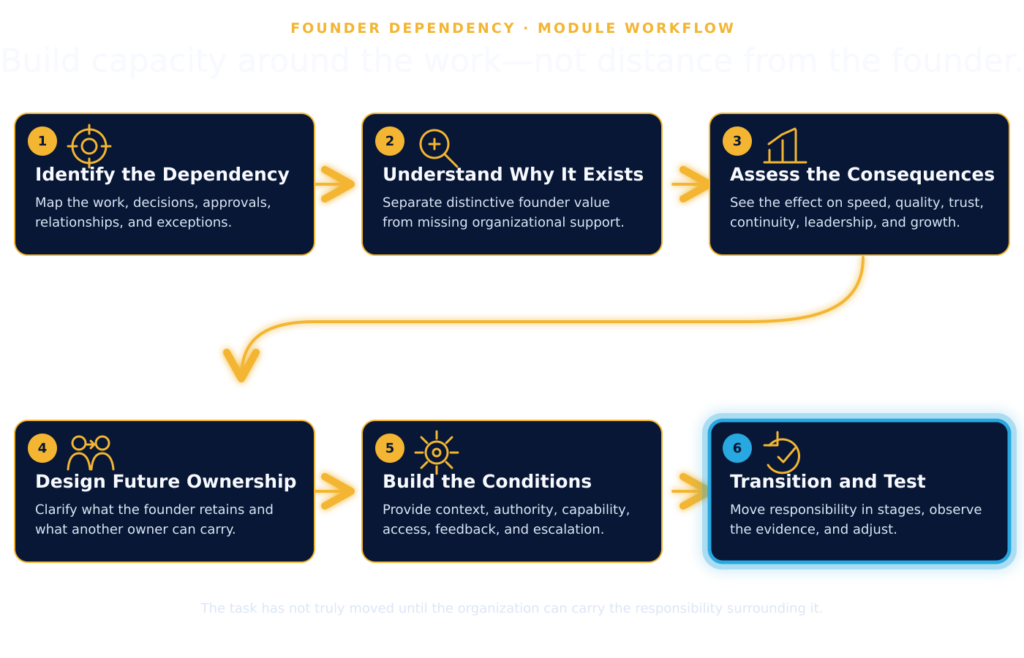
STEP 1
Identify the dependency
Map the recurring work, decisions, approvals, relationships, questions, and exceptions that require founder involvement.
STEP 2
Understand why it exists
Determine whether the founder contributes distinctive value or compensates for missing capability, context, authority, ownership, confidence, or operating structure.
STEP 3
Assess the consequences
Examine the effect on speed, quality, revenue, customer trust, leadership development, employee autonomy, continuity, and growth.
STEP 4
Design the future ownership
Clarify what the founder should retain and what another person, role, team, system, or partner could own.
STEP 5
Build the operating conditions
Provide the knowledge, authority, relationships, capability, systems access, resources, decision rules, escalation paths, and feedback required.
STEP 6
Transition and test
Move responsibility in bounded stages, observe the evidence, address gaps, and adjust founder involvement according to actual results.
A durable transition changes the organization surrounding the responsibility. It does not merely assign the same task to a different person.
- Connect work to the authority it requires
- Transfer context with responsibility
- Introduce relationships before ownership changes
- Set explicit escalation conditions
- Test the transition with evidence
- Avoid creating a replacement bottleneck
FROM PERSONAL KNOWLEDGE TO ORGANIZATIONAL VISIBILITY
Make the work, capability, and ownership surrounding the dependency visible.
TalentSync can help an organization structure information about the work and people connected to a founder dependency.
This visibility can help leaders understand whether the organization already has relevant capability, where support is missing, and what evidence should guide a transition conversation.
Depending on the available product configuration and evidence, the organization may examine:
- Roles and organizational relationships
- Activities connected to important outcomes
- Active capabilities already used in the work
- Relevant capabilities that may be available elsewhere
- Capability or responsibility gaps
- Experience and evidence associated with potential owners
- Team and workflow relationships
- Organizational profiles relevant to the transition
- Areas requiring additional information or human review
TalentSync does not independently determine who should receive authority or replace the founder. Organizational leaders remain responsible for interpreting the evidence and managing the transition.
PRODUCT AND DECISION BOUNDARIES
Organizational visibility supports leadership judgment. It does not replace it.
The module and supporting technology should not be presented as:
- Automatically identifying the founder’s replacement
- Determining who is ready for promotion
- Measuring all founder contribution
- Capturing every form of tacit knowledge
- Guaranteeing successful delegation
- Eliminating key-person risk
- Making employment or personnel decisions
- Assigning legal or fiduciary authority
- Replacing founder, board, or executive judgment
- Providing the sole basis for restructuring a role or team
The process helps leaders structure work, dependencies, evidence, ownership conditions, and transition questions.
Employment, legal, fiduciary, financial, privacy, cybersecurity, succession, governance, and other questions may require qualified specialist review.
What to bring into the conversation
You do not need a complete process library, succession plan, or record of every founder decision.
We begin with the work, observations, evidence, and operating artifacts the organization already has.
Useful inputs may include:
- Founder calendars and recurring meetings
- Approval requests and decision logs
- Escalation examples
- Current organizational charts
- Role descriptions
- Responsibility or authority matrices
- Customer and partner ownership information
- Strategic plans and operating priorities
- Workflow or process documentation
- Standard operating procedures
- Hiring and leadership plans
- Project delays and recurring blockers
- Customer or employee feedback
- Systems access and information dependencies
- Known succession or continuity concerns
- Founder and leadership observations
- Delegated work that returned to the founder
The Growth Direction foundation establishes the outcome, affected work, timeframe, evidence, and organizational decision this module should support.
What this module can help clarify
Where the organization depends on the founder
Identify the work, decisions, relationships, approvals, knowledge, and exception handling that rely on founder involvement.
Why each dependency exists
Distinguish distinctive founder value from missing capability, authority, context, ownership, confidence, or operating support.
Which responsibilities should change
Determine where founder involvement should be retained, delegated, distributed, documented, redesigned, or investigated.
What responsible ownership requires
Define the capabilities, authority, information, relationships, systems, resources, escalation paths, and feedback needed for a transition.
Final outputs depend on the modules selected and the organizational decision established through the workshop’s required Growth Direction foundation.
Where might the work lead next?
Questions leaders ask before booking.
Founder dependency exists when important work, decisions, relationships, knowledge, authority, or organizational confidence remain concentrated in a founder beyond what the organization can sustainably support.
No. Founders may provide distinctive strategic judgment, relationships, expertise, credibility, vision, or accountability. It becomes a problem when the organization cannot operate, decide, learn, or grow at the required speed without disproportionate founder involvement.
Indicators include decisions waiting for approval, recurring escalations, projects slowing during founder absences, senior leaders lacking practical authority, customers insisting on founder access, and delegated responsibilities repeatedly returning to the founder.
No. Delegation fails when the recipient lacks the necessary authority, information, capability, relationships, resources, systems access, decision rules, or organizational support.
Not automatically. The objective is intentional involvement. Some decisions should remain with the founder; others reach the founder only because decision rights and escalation conditions are unclear.
Identify the strategic reasoning, customer history, decision patterns, standards, exceptions, commitments, relationships, and lessons others need. Transfer may require documentation, observation, shared work, introductions, feedback, mentoring, and practice.
It can, but moving every dependency to one executive may create a new bottleneck. The response should follow the work rather than assume one person must replace the founder.
Not necessarily. A COO may be appropriate when the organization has defined a coherent operating responsibility, authority, outcomes, interfaces, and capability requirements.
No. TalentSync can organize relevant information about roles, activities, capabilities, experience, evidence, relationships, and gaps. Leaders remain responsible for succession, authority, and personnel decisions.
Every engagement begins with Growth Direction. This module is selected when growth depends on distributing work, knowledge, relationships, approvals, or authority concentrated in a founder or small leadership group.
LET THE ORGANIZATION CARRY MORE OF THE ORGANIZATION
Preserve the founder’s value without making every result depend on them.
Connect founder-dependent work to the knowledge, authority, relationships, capability, systems, and ownership required to carry it—then build a responsible transition path.
This module is part of Gobekli’s configurable Organizational Growth & Expansion Workshop.
