
ORGANIZATIONAL GROWTH & EXPANSION PROBLEM
Growth Hiring Sequence & Readiness:
Stop Hiring Roles Before the Organization Is Ready
Growth creates legitimate pressure to add people. New customers, markets, contracts, locations, products, and operating commitments can all require additional capacity.
But a hiring plan is not simply a list of positions the organization hopes to fill.
Roles must enter the organization in an order that reflects the work, its dependencies, available leadership, operating infrastructure, and credible evidence of demand.
Does this sound familiar?
Every department says its role is urgent
Leaders receive competing headcount requests without a shared method for comparing importance, timing, and dependency.
Hiring follows the loudest problem
The organization opens roles in response to immediate pressure rather than the sequence required to build sustainable capacity.
Roles are approved before the work is clear
Recruiting begins with a familiar title or assumed need that has not been connected to specific outcomes and activities.
New hires arrive without enough support
Managers, systems, processes, access, information, or decision rights are not ready when the person starts.
Hiring plans assume the forecast is certain
Roles are committed too early even when revenue, funding, contracts, expansion milestones, or workload remain uncertain.
Critical enabling roles are hired too late
Delivery capacity is added before the leadership, operations, systems, recruiting, finance, or coordination needed to support it.
What is growth hiring sequence and readiness?
Growth hiring sequence and readiness is the process of determining when roles should be added, what must exist before each hire begins, and how multiple hiring decisions depend on one another.
A growth hiring sequence connects proposed roles to the organizational outcome, work, evidence of demand, capabilities, role dependencies, receiving manager and team, operating infrastructure, budget, recruiting lead time, and consequences of hiring too early or too late.
A role may be strategically important without being ready to open today. Another role may appear less visible but need to come first because it creates the foundation required by several later hires.
The problem is not simply how many people to hire. It is what the organization must be ready to absorb.
Headcount plans often present roles as independent additions. In practice, they form an operating sequence.
Sales capacity may create demand delivery teams cannot support. A new location may require leadership, systems access, regulatory preparation, and administrative support before frontline hiring. A senior leader needs meaningful authority and a defined mandate before building a team.
A hiring sequence turns separate requisitions into a coordinated growth plan.
See the complete hiring sequence
not just the headcount list.
Growth Demand
- Revenue and customer commitments
- New markets and locations
- Products and services
- Contracts and funding
- Capacity constraints
Work and Capability
- Required outcomes
- Critical activities
- Capability gaps
- Work volume and timing
- Quality requirements
Role Dependencies
- Leadership and management
- Upstream and downstream roles
- Cross-functional coordination
- Decision rights
- Required internal expertise
Operating Readiness
- Processes and workflows
- Systems and access
- Data and information
- Budget and workspace
- Onboarding support
Hiring Decision
- Hire now
- Prepare before opening
- Sequence after another role
- Phase with demand
- Pause or reconsider
- Investigate further
A growth hiring plan becomes decision-useful when demand, work, capabilities, dependencies, operating readiness, and timing can be examined together.
How growth hiring gets out of sequence
STAGE 1
Growth creates pressure
A funding event, contract, expansion, sales target, acquisition, new product, or workload increase creates visible demand.
STAGE 2
Departments translate pressure into titles
Teams request familiar roles based on local needs, previous structures, or whoever appears overloaded.
STAGE 3
Hiring decisions are made independently
Roles are approved without a shared view of dependencies, management capacity, operating readiness, or alternatives.
STAGE 4
New capacity creates new friction
People arrive before the work, authority, systems, processes, managers, or adjacent roles are ready to support them.
A role should pass a readiness review before recruiting begins.
A requisition turns an organizational assumption into an active search. Once recruiting starts, teams invest time, candidates make decisions, and the organization becomes increasingly committed to the role as defined.
Before opening the position, leaders should understand the evidence, work, sourcing choice, prerequisites, dependencies, and consequences of changing the timing.
Identify the customer, operational, strategic, financial, or workforce condition creating the need. Distinguish confirmed demand from forecasts and assumptions.
Define the outcomes, activities, recurring responsibilities, decisions, relationships, and operating conditions involved.
Determine whether the capability should instead be mobilized internally, developed, contracted, partnered, automated, or redesigned.
Clarify management, authority, systems, processes, data, tools, budget, access, onboarding, and cross-functional support.
Identify whether this role enables, manages, coordinates, supplies, or receives work from other proposed hires.
Examine the consequences of hiring early, hiring late, delaying the role, or proceeding under a different growth scenario.
An approved role is not necessarily a ready role
Demand-ready
Credible evidence shows the work or capability will be needed within the relevant hiring horizon.
Work-ready
The outcomes, activities, workload, operating context, and important interfaces are sufficiently clear.
Role-ready
Responsibilities, authority, prerequisites, success evidence, and boundaries support recruiting.
Manager-ready
A responsible manager has the time, authority, context, and capacity to select, onboard, and support the hire.
System-ready
Required tools, information, processes, permissions, workspace, and infrastructure are available or scheduled.
Sequence-ready
The organization knows what must happen before the hire, what follows it, and what could change the timing.
Hiring for speed
May emphasize requisitions opened, time to fill, rapid expansion, immediate workload relief, or positions promised in a plan.
Hiring for readiness
Examines demand, work, role clarity, management capacity, dependencies, infrastructure, lead time, and timing consequences.
Enabling roles
Create leadership, systems, coordination, recruiting, compliance, finance, or operating capacity that later hires may require.
Delivery roles
Create customer, production, revenue, service, or execution capacity. Their timing should reflect what the organization can support.
Hire in the order
growth requires.
Connect every role to real demand, dependencies, and organizational readiness.
WORKSHOP MODULE DETAILS
Module 9: Growth Hiring Sequence & Readiness
This module helps participants translate anticipated growth into an evidence-backed sequence of hiring decisions.
The workshop examines which roles are required, what demand supports them, how they depend on one another, and what must be prepared before recruiting or onboarding begins.
The objective is not to produce the largest possible headcount plan. It is to establish a realistic path for adding the right capacity at the right time.
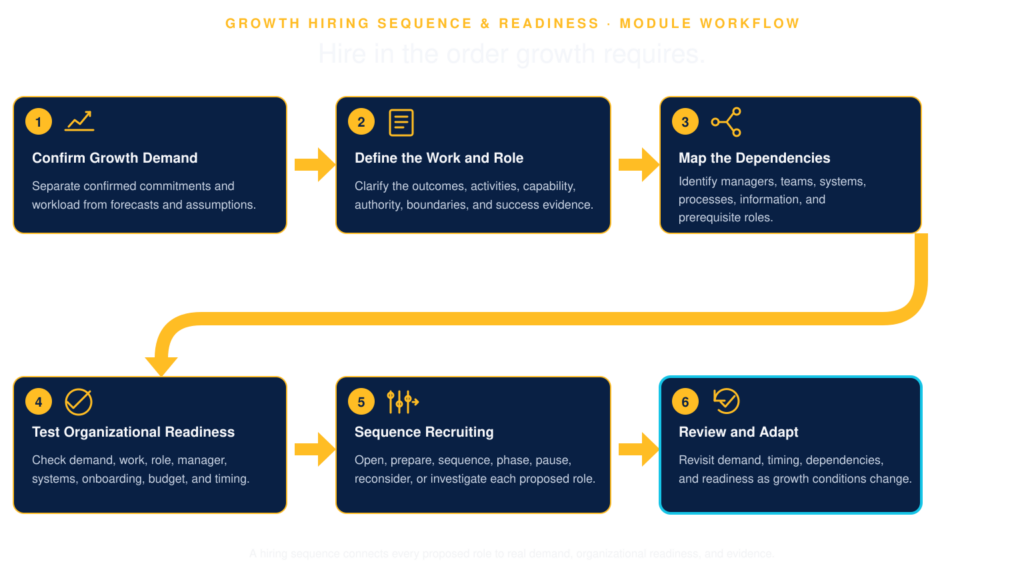
This module helps your team:
- Connect proposed hiring to specific growth outcomes
- Distinguish confirmed demand from assumptions
- Clarify the work and capabilities behind proposed roles
- Test whether hiring is the appropriate sourcing response
- Identify enabling and delivery-role dependencies
- Examine management and onboarding capacity
- Reveal systems, process, data, and access requirements
- Sequence recruiting around realistic lead times
- Establish readiness conditions and decision triggers
- Build an evidence-backed growth hiring sequence
What should happen next for each proposed role?
A proposed role should not move forward solely because it appears in a budget, forecast, organization chart, or investor plan. The next step should reflect demand, clarity of work, readiness, dependencies, timing, and the consequences of waiting.
Open
Begin recruiting now because the work, demand, role, support, and timing are sufficiently clear.
Prepare
Complete role design, management, systems, process, budget, onboarding, or operating preparation first.
Sequence
Move after another hire, decision, capability, system, location, contract, or milestone.
Phase
Add capacity as defined demand thresholds are reached rather than through one fixed commitment.
Pause
Do not open the role yet because evidence or organizational capacity does not support it.
Reconsider
Evaluate internal mobilization, development, contracting, partnership, automation, redesign, or another response.
Investigate
Resolve uncertainty about demand, work, capability, cost, timing, dependencies, or operating readiness.
These categories support workforce planning and human decision-making. They do not automatically approve a requisition, select a candidate, or determine an employment outcome.
What should a growth hiring review examine?
The demand
What growth event, customer commitment, workload, operating condition, or organizational outcome creates the need?
The work
Which outcomes, activities, decisions, relationships, and responsibilities require additional capacity or capability?
The role
Are authority, boundaries, prerequisites, interfaces, and success evidence understood?
The dependencies
Which managers, teams, roles, systems, processes, information, facilities, vendors, or decisions must be available?
The timing
When is the capability needed, how long will recruiting and onboarding take, and what should trigger action?
The consequences
What happens if the organization hires too early, hires too late, changes the sequence, or does not add the role?
Use TalentSync Recruiter when the role is ready to enter hiring.
TalentSync Recruiter can help carry a defined and authorized role into a structured recruiting workflow.
The process begins with the hiring team’s need and the evidence developed through growth planning, capability sourcing, and role design.
STEP 1
Clarify the opportunity
Translate the role description and hiring-team context into a structured Opportunity Profile.
STEP 2
Structure the requirements
Organize requirement summaries, competencies, prerequisites, Talent Attributes, ARC Requests, skills, credentials, and questions.
STEP 3
Confirm prerequisites
Review which conditions are genuinely required before candidates provide deeper evidence.
STEP 4
Invite relevant candidates
Share the opportunity through a public link, existing pipeline, or established sourcing process.
STEP 5
Develop decision-useful evidence
Use TalentPass to confirm relevant background, experience, skills, credentials, and accomplishments.
STEP 6
Support human review
Review standardized profiles, identify gaps, ask follow-up questions, and make the hiring decision.
TalentSync Recruiter helps structure the transition from a ready role to candidate evidence. Recruiters and hiring teams remain responsible for interpretation, communication, selection, and the final decision.
- Carry ready roles into structured opportunities
- Confirm requirements and prerequisites
- Invite relevant candidates
- Develop reusable candidate evidence
- Support transparent human review
- Preserve responsibility for final decisions
FROM HEADCOUNT PLAN TO TALENTSYNC SETUP
Let the hiring sequence become part of the organization’s operating view.
A static headcount plan may show the proposed role, department, budget, target date, and approval status.
That information is useful, but it does not fully explain how the role fits into the organization.
A TalentSync setup can connect a proposed role to outcomes, workflows, activities, capabilities, management relationships, teams, dependencies, systems, internal talent, gaps, recruiting evidence, readiness conditions, and review points.
The hiring plan becomes more than a forecast. It becomes part of a living view of how the organization intends to grow.
PRODUCT AND DECISION BOUNDARIES
Structured evidence supports hiring decisions. It does not replace them.
TalentSync and TalentPass should not be presented as:
- Automatically determining which roles should be approved
- Predicting future workforce demand with certainty
- Selecting the “best” candidate
- Predicting who will succeed
- Producing a definitive culture match
- Eliminating bias
- Making legal or compliance determinations
- Replacing recruiter, manager, finance, HR, or leadership judgment
- Providing the sole basis for an employment decision
- Guaranteeing a particular business outcome
The workflow helps leaders structure demand, work, capability, dependencies, readiness, and candidate evidence.
Employment, privacy, accessibility, cybersecurity, procurement, labor, finance, licensing, and other questions may require qualified specialist review. TalentPass is not designed for use by minors.
What to bring into the conversation
You do not need a perfect workforce forecast or a finalized organization chart.
We begin with the growth plans, role requests, operating evidence, and organizational knowledge already available.
Useful inputs may include:
- Business and growth plans
- Revenue, funding, contract, or expansion milestones
- Current organization charts
- Proposed future organization structures
- Headcount plans and budgets
- Open and planned requisitions
- Departmental hiring requests
- Workforce demand projections
- Workload and capacity information
- Role descriptions
- Capability gaps
- Management spans and workloads
- Recruiting lead-time information
- Onboarding plans
- Systems and process roadmaps
- Facility or location plans
- Known role dependencies
- Turnover, vacancy, and retention information
- Assumptions about timing and demand
The Growth Direction module establishes the consequential outcome, affected work, evidence, and organizational boundary the hiring sequence should support.
What this module can help clarify
Which roles are truly ready
Identify positions with credible demand, defined work, appropriate support, and sufficient readiness to begin recruiting.
What must happen first
Reveal the roles, decisions, systems, processes, managers, capabilities, and milestones that create prerequisites.
How hiring should be sequenced
Organize roles around dependencies, lead times, demand triggers, and consequences of early or late hiring.
Which roles require another response
Surface needs that should be prepared, phased, paused, reconsidered, or investigated before hiring.
Final outputs depend on the modules selected and the growth decision established through the workshop’s required Growth Direction module.
Where might the work lead next?
Questions leaders ask before booking.
A growth hiring plan connects proposed hires to business demand, defined work, capability needs, role dependencies, management capacity, operating readiness, recruiting lead times, and decision triggers.
Hiring readiness describes whether the organization has enough clarity, evidence, support, and operating preparation to begin recruiting for a role responsibly.
Consider the organizational outcome, urgency, capability importance, consequences of delay, recruiting lead time, management capacity, and dependencies between roles.
Not universally. The decision should follow dependency, workload, lead time, risk, and the consequences of being unprepared.
Work backward from when the capability must become operational, including role design, approval, search, selection, notice periods, onboarding, and time to productivity.
Separate confirmed demand from assumptions and establish explicit triggers such as signed contracts, funding milestones, workload thresholds, or sustained sales performance.
A headcount plan describes intended additions. A hiring sequence explains the order, dependencies, and readiness conditions required to make those additions work.
No. A role may be approved in principle while its responsibilities, manager, systems, prerequisites, onboarding, location, or timing still require preparation.
TalentSync can organize outcomes, work, roles, capabilities, dependencies, systems, talent, and evidence. People remain accountable for deciding whether, when, and how to hire.
Every engagement begins with Growth Direction. Growth Hiring Sequence & Readiness is selected when the organization must determine which roles to add, when recruiting should begin, what must exist first, and how hiring decisions fit together.
HIRE IN THE ORDER GROWTH REQUIRES
Turn a list of proposed roles into a hiring sequence the organization can support.
Connect each hire to real demand, defined work, role dependencies, management capacity, operating readiness, and credible evidence—then move forward when the conditions are right.
This module is part of Gobekli’s configurable Organizational Growth & Expansion Workshop. Explore the complete 12-module structure and identify the right starting point for your organization.
