
A LEARNING VISIBILITY & CREDENTIALING WORKSHOP MODULE
Learning Visibility Direction:
Start With the Learning Decision That Matters
Institutions often begin with a credential, learner record, portfolio, prior-learning process, or technology platform.
But the right solution depends on who needs to see learning, what they need to understand, and which decision that evidence must support.
This module establishes that direction before the institution chooses a system or redesigns a process.
Does this sound familiar?
The institution starts with a technology
Teams begin with a wallet, credential platform, portfolio, learner record, taxonomy, or integration before defining the decision it must support.
Visibility means something different to everyone
Learners, faculty, advisors, registrars, employers, technology teams, and leaders need different views of the same learning.
The scope expands to every learner record
A focused question grows into an attempt to connect every course, credential, system, skill, experience, and audience at once.
Available data defines the learner
The institution focuses on grades, credits, completions, and records it already holds while important experience and evidence remain outside the picture.
Learners enter after the design is settled
People are asked to use or react to a new process without helping define what they need to understand, control, correct, or share.
The work produces architecture but no decision
Teams document systems, standards, and possibilities without agreeing on the first practical learning-visibility outcome.
What is Learning Visibility Direction?
Learning Visibility Direction is the process of defining the decision that better-connected learning evidence must support before an institution redesigns a process, Profile, credential, learner record, integration, or technology environment.
It creates the required foundation for the Learning Visibility & Credentialing Workshop by identifying:
- The learner population and experience being examined
- The institutional problem or opportunity prompting the work
- The consequential learner or institutional outcome at stake
- The audiences that need to understand or use the learning
- The experiences, activities, capabilities, assessments, evidence, and credentials that may matter
- The systems and people that currently hold parts of the picture
- The learner-control, permission, verification, and sharing boundaries involved
- The decision that must become clearer
- The assumptions, constraints, and missing evidence that remain
- The additional workshop modules needed for deeper investigation
The goal is not to design the complete future system in the first conversation. It is to establish a bounded, evidence-seeking direction that the institution can responsibly act upon.
The problem is not a shortage of learner information. It is a shortage of decision structure.
Institutions may already hold transcripts, grades, course outcomes, assessments, advising notes, credentials, portfolios, employment information, transfer records, and other learner data. Learners may hold additional evidence in résumés, work products, licenses, military records, community experience, personal files, and previous institutions.
Each record can be accurate while the complete learning picture remains difficult to discover, interpret, connect, or use.
A transcript may support an official academic purpose but reveal little about the activities behind a course. A badge may identify an achievement without carrying the evidence an employer wants to understand. A portfolio may contain rich work products while remaining disconnected from institutional records. An aggregate dashboard may help a program leader while giving the learner no useful view of their own development.
A strong direction connects the person, purpose, audience, evidence, systems, permissions, and decision before choosing the solution.
See the complete learning-visibility decision—not just the records.
The Trigger
- Prior learning remains hidden
- Learners cannot see development
- Credentials lack context
- Employers cannot interpret records
- Evidence is fragmented
- A new initiative is proposed
The Outcome
- Recognition of prior learning
- Clearer learner progress
- Better advising
- Transfer or continuation
- Applied-learning visibility
- Employer understanding
The Boundary
- A learner population
- A course or program
- A PLA process
- A credential or record
- A project or cohort
- A defined decision horizon
The Evidence & Audiences
- Experiences and activities
- Capabilities and skills
- Assessments and work products
- Credentials and verification
- Learners and evaluators
- Advisors, partners, and employers
The Decision Structure
- Learner agency and consent
- Institutional responsibility
- Systems and standards
- Known constraints
- Evidence gaps
- Appropriate next step
Learning visibility becomes decision-useful when the person, purpose, evidence, audience, systems, permissions, and responsibility for acting can be understood together.
How learning-visibility initiatives lose direction
STAGE 1
A real visibility problem appears
Learners, faculty, advisors, employers, or institutional leaders identify learning that cannot be discovered, interpreted, recognized, shared, or used.
STAGE 2
A solution category becomes the project
The conversation shifts toward credentials, records, portfolios, taxonomies, dashboards, integrations, or platforms before the decision is bounded.
STAGE 3
Audiences and requirements multiply
Different stakeholders introduce additional learners, processes, evidence, systems, standards, permissions, and desired outcomes.
STAGE 4
The institution cannot identify the first useful result
The initiative produces plans or technical possibilities but lacks a shared outcome, accountable owner, evidence boundary, or practical next decision.
What decision must better learning visibility actually support?
“We need to make learning visible” is an important ambition, but it is too broad to guide a responsible institutional response.
A useful direction identifies whose learning must become more understandable, for what purpose, to which audience, using what evidence, and what decision or action should improve.
The institution may need to determine:
Clarify which experiences may be relevant, what evidence could support them, and how the learner enters an appropriate institutional process.
Determine which activities, capabilities, evidence, assessments, credentials, and progress should become understandable to the learner.
Define the appropriate view for PLA, advising, transfer, projects, program progress, continuing education, or employment.
Identify what authorized institutional users need to understand across a bounded group without erasing individual context.
Examine which assertions, criteria, activities, assessments, work products, and verification should remain connected.
Clarify learner access, consent, correction, portability, institutional responsibility, standards, integrations, and governance.
What makes a learning-visibility question usable?
Learner-centered
The question begins with a defined learner population and preserves the learner’s role in understanding, correcting, permissioning, and using their information.
Purpose-specific
The intended use—such as PLA, advising, progress, transfer, program review, or employment—is explicit.
Evidence-seeking
The question distinguishes records and assertions from the experiences, activities, assessments, work products, and verification that support them.
Audience-aware
The institution defines who needs to understand what, why they need it, and what they should not automatically receive.
Bounded
The population, process, Profile, evidence, systems, timeframe, and decision are limited enough to examine responsibly.
Actionable
The work has an owner, plausible responses, decision rights, and a clear understanding of what happens after the evidence is considered.
An unbounded visibility initiative
An unbounded initiative may attempt to:
- Create one complete record for every purpose
- Connect every system before proving a useful use case
- Serve learners, faculty, advisors, administrators, and employers identically
- Collect information without defining access or control
- Treat credentials, Profiles, portfolios, and transcripts as interchangeable
- Resolve academic, technical, legal, and governance questions simultaneously
The result may be ambitious but difficult to implement, govern, or use.
A decision-bounded visibility initiative
A decision-bounded initiative clarifies:
- The learners and outcome at stake
- The specific use case or decision
- The evidence relationships that matter
- The audiences and appropriate views
- The systems and people involved
- Learner agency, permission, and correction
- Institutional responsibilities and constraints
- The first result worth implementing
The boundary creates a stable starting point from which connected problems can be investigated.
Visible to whom—and for what purpose?
Learning should not simply become visible to everyone.
A learner may need a broad and evolving personal view of their own experiences, capabilities, evidence, credentials, interests, and goals.
A faculty evaluator reviewing a prior-learning claim may need evidence related to a specific area of learning. An advisor may need a progress Profile that helps structure a conversation about what has been demonstrated, what is developing, and what may require additional attention. A program leader may need an authorized view of patterns across a course, project, cohort, or program. An employer may need a learner-selected Profile containing experiences and evidence relevant to an opportunity.
These are not identical views, even when they draw from some of the same connected information.
Learning Visibility Direction identifies who the intended audience is, what that audience needs to understand, why the information is relevant, what evidence supports the view, who controls or authorizes access, what information should remain outside the view, and what decision the audience remains responsible for making.
Visibility should support appropriate understanding. It should not become unrestricted disclosure.
Bring learners and evidence holders into the question—not only the rollout.
Learning visibility crosses academic, operational, technical, and personal boundaries.
Depending on the decision, relevant participants may include learners, faculty, prior-learning evaluators, registrars, advisors, career services, assessment and curriculum teams, program leaders, institutional research, technology and data teams, credential and portfolio administrators, transfer partners, employers and workforce partners, accessibility, privacy, legal, or compliance specialists, and authorized institutional decision-makers.
Participation does not give every person the same authority or access.
The foundation distinguishes the people represented in the evidence, the people who hold relevant knowledge, the people responsible for academic or professional interpretation, the people responsible for systems and implementation, the people affected by the eventual decision, and the people authorized to decide.
This prevents consultation from being mistaken for permission, expertise from being mistaken for authority, or technical access from being mistaken for appropriate use.
Start with the learner and the decision
before the records begin to multiply.
Give every selected module one shared foundation.
THE REQUIRED STARTING MODULE
Module 1: Learning Visibility Direction
Every Learning Visibility & Credentialing Workshop begins with this module.
Participants translate a broad concern, learner need, institutional initiative, or technology proposal into a bounded learning-visibility decision that the remaining workshop must support.
The module does not design the complete solution or predetermine which product should be used. It establishes the shared Decision Foundation used to configure the modules that follow.
This module helps your team:
- Clarify why better learning visibility is needed now
- Define the learner population and consequential outcome
- Identify the decision or use case the work must support
- Distinguish the complete learner story from a purpose-specific view
- Identify intended audiences and appropriate access boundaries
- Map the experiences, evidence, credentials, and records that may matter
- Identify systems, people, and processes holding parts of the picture
- Surface assumptions, constraints, permissions, and evidence gaps
- Clarify institutional ownership and decision rights
- Identify questions requiring specialist review
- Select the additional workshop modules required
- Define the first useful result and a practical workshop outcome
What must be established before the deeper work begins?
The Learning Visibility Decision Foundation gives every later module one common point of reference. It does not determine whether evidence is valid, award credit, or authorize disclosure. It structures the relationships and decisions the institution must examine.
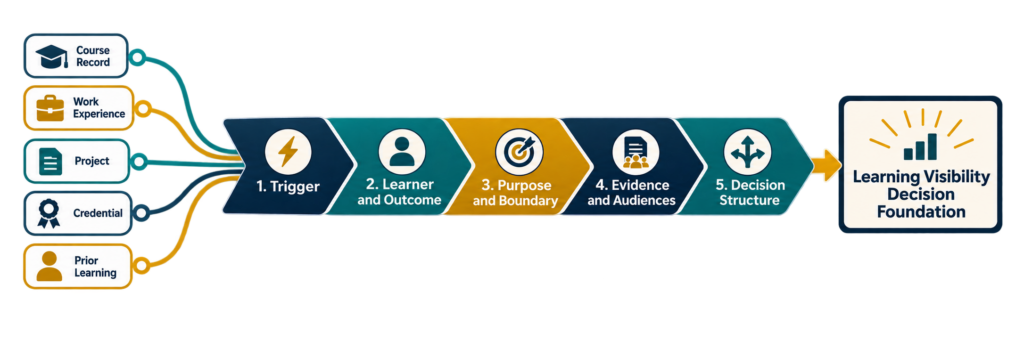
Trigger
Why is better visibility being considered now? Identify the learner need, institutional concern, opportunity, initiative, or proposed technology.
Learner & Outcome
Whose learning is involved, and what consequential result should improve?
Purpose & Boundary
Which process, Profile, credential, group, program, population, or decision horizon is in scope?
Evidence & Audience
What should become understandable, to whom, and what evidence or context would make it useful?
Systems & Responsibility
Where do the relevant pieces currently live, and who owns the process, interpretation, access, and decision?
Constraints & Path
What is known, assumed, restricted, or missing—and which additional modules or specialist reviews are required?
The Decision Foundation is not a universal learner model or final technology architecture. It establishes a focused structure through which evidence, agency, institutional requirements, constraints, and tradeoffs can be interpreted.
What should the foundation examine first?
The initiating signal
What cannot currently be discovered, understood, recognized, connected, shared, or used—and who experiences the problem?
The learner and outcome
Which learners, experiences, transitions, opportunities, or institutional responsibilities make the problem consequential?
The intended use
What conversation, process, decision, or action should better visibility support?
The relevant evidence
Which experiences, activities, capabilities, assessments, credentials, records, work products, and verification may be material?
The current environment
Which people, systems, processes, standards, permissions, and institutional rules shape what is currently possible?
The unresolved questions
Which assumptions, missing perspectives, access questions, contradictions, or specialist issues could change the direction?
From a broad visibility concern to a bounded decision
Learning Visibility Direction creates a disciplined path from the first signal to a shared Decision Foundation.
The process keeps the learner, purpose, evidence, audience, systems, permissions, and decision ownership connected.
STEP 1
Clarify the trigger
State what is currently difficult to discover, understand, recognize, connect, share, or use.
STEP 2
Define the learner and outcome
Identify the population involved and the consequential result the institution wants to protect or improve.
STEP 3
Name the purpose and audience
Specify the process or decision and who needs an appropriate view of the learning.
STEP 4
Map evidence and the current environment
Identify the relevant records, evidence, credentials, systems, people, and process boundaries.
STEP 5
Test agency, assumptions, and constraints
Make learner control, access, correction, verification, uncertainty, and specialist questions explicit.
STEP 6
Configure the workshop path
State the bounded decision, first useful result, responsible owners, and additional modules required.
The result is not a predetermined credential, Profile, integration, or product recommendation. It is a shared, evidence-seeking foundation for the institutional and human judgments that follow.
- Keep the learner and consequential outcome visible
- Connect evidence to a bounded purpose
- Distinguish records, assertions, and supporting context
- Make agency, permissions, and constraints explicit
- Assign process and decision ownership
- Carry one foundation into every selected module
FROM DIRECTION TO CONFIGURATION
The decision determines which modules come next.
The complete Learning Visibility & Credentialing Workshop includes 12 modules, but every institution does not need every module at equal depth.
The required Learning Visibility Direction module establishes the path.
The foundation may lead into modules addressing:
- Prior Learning Discovery
- PLA Evidence & Recognition Readiness
- Student Learning Visibility
- Connected Learning Evidence & Context
- Purpose-Built Learner Profiles
- Course, Cohort & Program Visibility
- Projects, Teams & Work-Based Learning
- Credentials & Comprehensive Learner Records
- Employer-Readable Learning Profiles
- Learner-Controlled Sharing & Portability
- Systems, Standards & Visibility Governance
Module selection follows the decision.
The list should not become a technology checklist performed identically for every institution.
PRODUCT, SPECIALIST, AND DECISION BOUNDARIES
A structured workshop supports institutional and learner judgment. It does not replace it.
The Learning Visibility & Credentialing Workshop should not be presented as:
- Automatically awarding credit for prior learning
- Determining academic equivalency or competency
- Verifying every learner assertion
- Guaranteeing transfer, recognition, employment, or employer acceptance
- Replacing faculty, evaluator, registrar, or advisor judgment
- Replacing the SIS, LMS, credential platform, portfolio, or official institutional record
- Giving institutions unrestricted access to learner-controlled information
- Reducing a learner to one score, Profile, credential, or record
- Making accreditation, privacy, accessibility, legal, or compliance determinations
- Predetermining that Gobekli or any technology is the appropriate response
The workshop helps participants define the learner, purpose, evidence, audiences, systems, permissions, responsibilities, and decision involved.
Questions involving academic policy, accreditation, licensure, legal obligations, privacy, accessibility, cybersecurity, procurement, records retention, identity, standards implementation, financial aid, transfer, or employment may require review by qualified specialists.
What to bring into the conversation
You do not need a complete learner-record architecture, perfect data, or agreement about the eventual solution.
We begin with the learning-visibility concern, opportunity, process, or decision the institution is already facing.
Useful inputs may include:
- The learner population or use case under consideration
- Descriptions of the current visibility problem
- Existing transcripts and learner records
- Program and course learning outcomes
- Assessment and rubric information
- Credential, badge, and certificate examples
- Prior-learning policies and process materials
- Portfolio or work-product examples
- Advising, transfer, or career-service workflows
- Learner and alumni observations
- Employer or partner feedback
- SIS, LMS, portfolio, credential, and integration diagrams
- Data dictionaries or skills frameworks
- Identity, consent, sharing, correction, and retention practices
- Accessibility requirements
- Known evidence or verification gaps
- Current ownership and decision rights
- Relevant strategic initiatives
- Earlier recommendations or pilots
- Questions or disagreements the workshop must resolve
Incomplete, disconnected, or conflicting information is acceptable. The module is designed to identify what is known, what remains assumed, and which missing evidence could materially affect the decision.
What this module can help clarify
Why visibility matters now
Connect the initiating signal to a meaningful learner, academic, transfer, workforce, program, or institutional outcome.
What is—and is not—in scope
Establish a workable boundary around the learner population, use case, evidence, audiences, systems, and decision horizon.
Whose perspectives and responsibilities matter
Identify learners, evidence holders, evaluators, authorized users, process owners, decision-makers, and specialist contributors.
What the remaining workshop must resolve
Define the decision, available evidence, important assumptions, material gaps, constraints, first useful result, and modules required.
The Direction module also establishes the shared vocabulary and boundaries used throughout the selected modules. Final findings depend on available evidence, stakeholder participation, specialist review, and the institution’s formal decision processes.
Where might the work lead next?
Learning Visibility Direction establishes the population, purpose, evidence boundary, audiences, and decision the work must support.
Once that foundation is clear, the institution can select the modules that address the specific visibility problem it has uncovered.
Prior Learning Discovery
Find where learners’ previous education, employment, military service, community participation, and lived experience remain invisible or disconnected from institutional processes.
Student Learning Visibility
Help learners, advisors, faculty, and support teams understand learning across courses, projects, experiences, and other parts of the learner journey.
Credentials & Comprehensive Learner Records
Determine how credentials and learner records should represent learning clearly, connect evidence appropriately, and serve their intended audiences.
Systems, Standards & Visibility Governance
Clarify how systems, standards, permissions, ownership, and governance must work together to sustain learning visibility responsibly.
Questions institutions ask before beginning.
Learning Visibility Direction is the required starting module of Gobekli’s Learning Visibility & Credentialing Workshop. It defines the learner population, consequential outcome, purpose, audiences, evidence boundary, systems, permissions, constraints, decision, and deeper modules required.
A credential platform, learner record, portfolio, wallet, taxonomy, integration, or Profile can serve different purposes. Beginning with direction helps the institution define what should become more understandable, to whom, and what decision or action should improve.
Yes. Every engagement begins with Learning Visibility Direction so the selected modules share one learner population, purpose, evidence boundary, audience, decision, and definition of a useful outcome.
Learning visibility is the ability to connect a person’s learning, experiences, activities, capabilities, evidence, assessments, and credentials well enough for an appropriate audience to understand and use them responsibly.
No. The goal is not necessarily one institutional database. Relevant and trusted pieces can remain distributed while becoming appropriately connected for a particular Profile, process, conversation, or decision.
That depends on the purpose. The learner may need a broad personal view, while an evaluator, advisor, program leader, transfer partner, or employer may need a narrower authorized view. Visibility should not mean unrestricted disclosure.
No. A Profile is a purpose-specific view assembled from relevant evidence. One connected body of learning may support different Profiles for PLA, progress, transfer, projects, programs, further education, and employment.
No. It can help define discovery, evidence, communication, routing, and Profile needs. Authorized institutional evaluators remain responsible for equivalency, competency, and credit decisions.
No. The module examines the institution’s existing environment and identifies what information exists, where it resides, what is missing, and which relationships may be needed.
Participation depends on the decision and may include learners, faculty, PLA evaluators, registrars, advisors, career services, assessment, program leaders, institutional research, technology teams, credential administrators, employers, transfer partners, and authorized decision-makers.
It should be narrow enough to support a coherent decision while retaining dependencies that could materially change the outcome. A boundary may identify a population, process, course, program, Profile, credential, group, audience, or decision horizon.
The difference becomes part of the design. The module identifies each audience’s purpose, the evidence it needs, appropriate permissions, and whether separate purpose-built Profiles or views are required.
The institution can still establish direction. The module separates what is known, inferred, assumed, unavailable, or in need of verification and identifies which gaps could materially change the decision.
Gobekli may become an optional implementation path when the decision calls for learner-controlled TalentPass information, TalentSync EDU group views, a connected Talent Tree, purpose-built Profiles, Pythia-guided discovery, Passport Pages, STAMP-based relationships, credentials, or integrations. Product capabilities and implementation scope must be evaluated separately.
No. The workshop establishes a decision and response path. Gobekli is one possible continuation when its available capabilities match the approved scope.
It produces a Learning Visibility Decision Foundation: a defined trigger, learner population, consequential outcome, purpose, audience, evidence boundary, current environment, responsibilities, constraints, evidence gaps, first useful result, and configured workshop path.
It is the required starting module. The Decision Foundation it creates establishes the shared learner population, purpose, evidence boundary, audiences, constraints, and decision used to select and guide the additional modules.
START WITH THE LEARNING DECISION
Make the right learning visible before choosing how to connect it.
Define the learner population, purpose, audiences, evidence, systems, permissions, constraints, and decision the institution must support.
Learning Visibility Direction is the required starting module in Gobekli’s configurable Learning Visibility & Credentialing Workshop.
