
ABOUT GOBEKLI / MARKET POSITION
Gobekli’s market position
in AI agents and personal AI
Connect agents to visible roles, accountable people, and the outcomes of their work.
TalentSync is designed as a primary workspace for understanding and redesigning human–agent teams: roles, dependencies, decision owners, approval points, and outcomes. Pythia provides guided participation. Model hosting and agent execution remain in the selected runtime.
The relationship Gobekli is designed to improve
An agent can be technically well governed while the team still lacks a shared understanding of who owns its work, where people must intervene, and whether automation has created hidden effort elsewhere.
Enterprise human–agent workflow design is a primary launch use case. The SaaS direction makes those configurations accessible to individual leaders, smaller teams, and consultants.
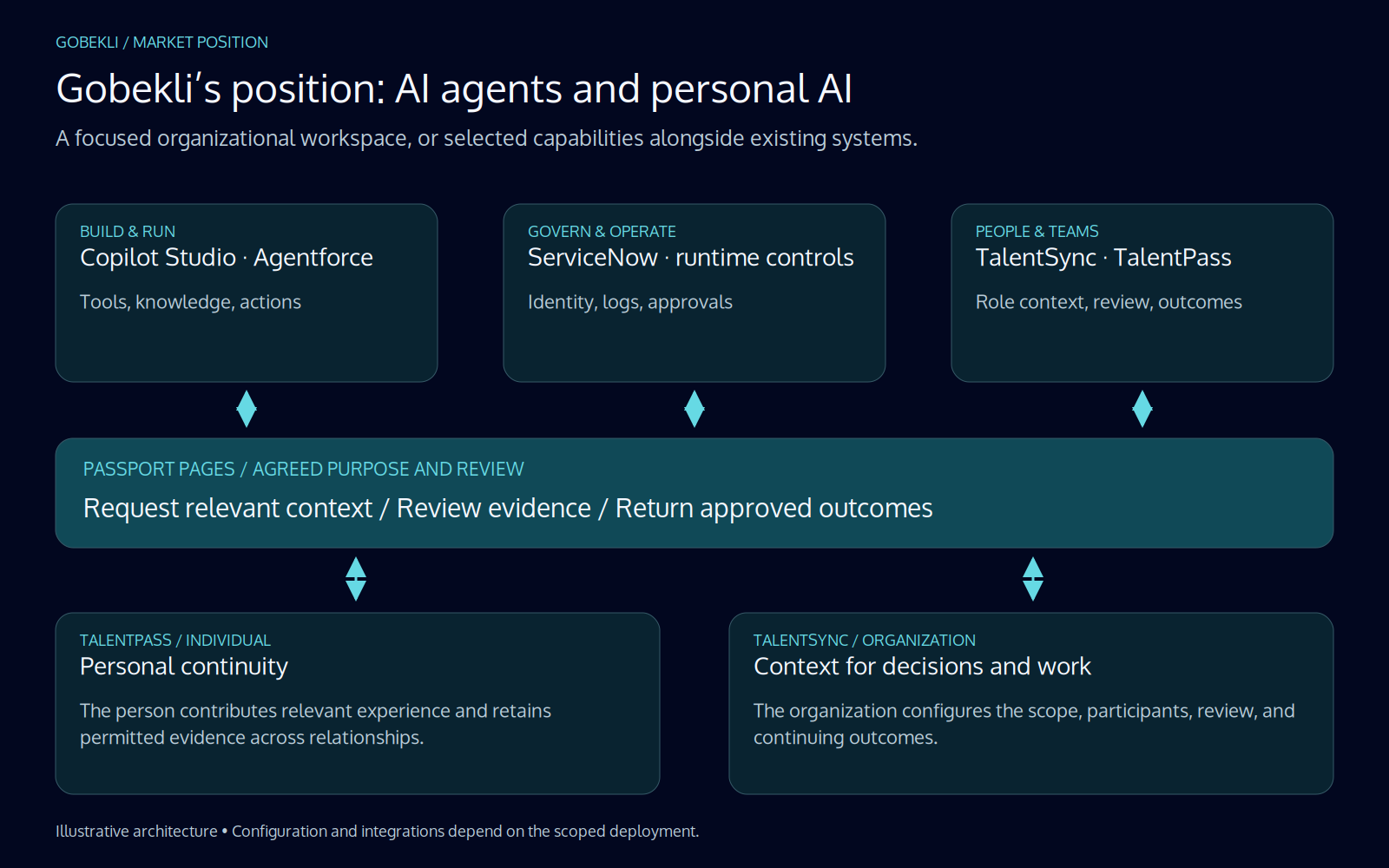
Illustrative configuration. Open the diagram to view it full size.
Where we overlap—and what we add
Agent platforms already support approvals, identity, tracing, evaluations, and governance. Gobekli overlaps in context, guided assistance, and review design. Its proposed distinction is connecting those technical controls with participant-reviewed team context and person-side continuity across relationships.
A Passport Page describes the agreed relationship. Runtime permissions, credentials, action blocking, and revocation must be implemented and tested in the execution system. Agents are represented as systems in assigned roles, not as human employees.
The value exchange with existing providers
These are proposed configurations based on public product descriptions. Named providers are not presented as partners, and a listed exchange is not a claim of an available connector.
| Platform or infrastructure | Its established contribution | Proposed Gobekli contribution | Lightest useful configuration |
|---|---|---|---|
| Microsoft Copilot Studio | Agent authoring, knowledge connections, and actions | Connect an agent to reviewed team responsibilities and escalation expectations | One agent-role Passport Page; execution stays in Copilot Studio |
| Salesforce Agentforce | Agents connected to CRM data and business actions | Collect participant review of a customer-service handoff and its effects | One review exchange attached to a service workflow |
| ServiceNow AI Agents | Agents operating in enterprise workflows with platform governance | Connect operational ownership, affected teams, and feedback across a change | Selected workflow Profiles alongside the existing platform |
| Anthropic agent guidance | Composable workflow and agent design patterns; this is guidance, not a marketplace | Use clear role and review context around an implementation based on these patterns | Document and test one human handoff |
Technical observability is not the same as organizational visibility
| Agent question | Agent platform can establish | Gobekli can connect |
|---|---|---|
| What is it? | Model, configuration, version, runtime, tools, instructions, and technical identity. | The purpose-specific role through which people and an organization encounter it. |
| What can it access and do? | Credentials, permissions, tools, APIs, data, actions, triggers, and technical guardrails. | Why those permissions are appropriate for this relationship, who approved them, and whose work or data is affected. |
| Where does it work? | Configured processes, channels, applications, events, tasks, and agent-to-agent handoffs. | Its visible position in the team, role, workflow, dependencies, human handoffs, and organizational outcome. |
| Who is accountable? | Admins, builders, operators, logs, policies, and escalation controls. | Named sponsor, operational owner, affected participants, reviewers, decision rights, and unresolved responsibility gaps. |
| What did it produce? | Outputs, tool calls, traces, citations where available, evaluations, errors, and system actions. | How the output was reviewed, used, changed work, affected people, and contributed to a real outcome. |
| Should it continue? | Performance, cost, latency, reliability, safety, and technical evaluation. | Human experience, trust, role quality, adoption, hidden work, exceptions, organizational value, and redesign needs. |
The Passport Page becomes the agent’s relationship contract
An agent Passport Page can define the agent’s purpose, assigned role, sponsor, accountable owner, affected people, permitted tools and data, workflow triggers, constraints, required approvals, escalation path, expected outputs, provenance, version, runtime, evaluation, outcomes, and incidents.
Different Passport Pages can describe the same underlying agent’s role and agreed boundaries in different relationships. The connected runtime must enforce actual access, approval, and action controls. An agent assisting an individual, supporting a recruiter, participating in a team, or acting inside a public service should not inherit one unlimited identity or permission set.
What becomes visible in a human-agent team
The goal is not merely an inventory of bots. It is an intelligible operating model for how human and machine contributions fit together.
Roles and boundaries
Which work belongs to a person, an agent, a system, or a shared handoff—and which responsibilities cannot be delegated.
Handoffs and dependencies
Where context enters or disappears, who waits for whom, which outputs become inputs, and what breaks when an agent fails.
Approval and judgment
Where a person must review, interpret, authorize, correct, appeal, or communicate a decision.
Hidden and changed work
New verification, exception handling, prompt work, data preparation, emotional labor, and coordination created by automation.
Evidence and provenance
What came from a person, agent, external source, credential, or system—and how it was transformed before use.
Outcomes and redesign
Whether the hybrid workflow improved quality, time, access, trust, safety, workload, capability, and organizational results.
Design boundaries for a Human Intelligence Layer
| Boundary | Gobekli position |
|---|---|
| Agents are not people | Represent agents as systems in assigned roles. Do not give them human employment status, personal identity, consent, dignity, or moral standing by UI metaphor. |
| Inference is not truth | Keep inferred context distinguishable from person-contributed, organization-contributed, observed, and verified information. |
| Assistance is not authority | An agent may prepare or recommend without becoming the authoritative issuer, decision-maker, accountable owner, or voice of the person. |
| Visibility is not surveillance | Expose agent participation and workflow effects while minimizing unrelated personal monitoring and retaining purpose-specific boundaries. |
| Automation is not adoption | Evaluate workload, trust, access, exceptions, capability, and outcomes—not deployment counts alone. |
| Human review must be real | Define who can understand, challenge, correct, stop, or escalate consequential agent behavior. |
Configure the role that creates value
| Configuration | Gobekli scope | What stays with the customer or partner |
|---|---|---|
| Primary organizational workspace | TalentSync is designed as a primary workspace for understanding and redesigning human–agent teams: roles, dependencies, decision owners, approval points, and outcomes. Pythia provides guided participation. Model hosting and agent execution remain in the selected runtime. | Authoritative records, specialized execution, and institutional decision rights |
| Companion to an existing platform | Selected Profiles and participant review around an agreed workflow or decision | The partner’s primary product, data responsibilities, and customer experience |
| Focused Passport Page exchange | One request, evidence review, approved response, or authorized recognition flow | The broader operating workflow and any existing system of record |
Organization size does not determine the configuration. Enterprise collaboration guides design and launch; commercial off-the-shelf SaaS is the product direction for leaders and smaller teams to configure these capabilities themselves.
A practical exchange to test
A service team introduces an agent that drafts resolutions. TalentSync maps where the agent contributes, which employee reviews an exception, and who owns the final decision. A Passport Page describes the relationship and references the runtime configuration. The team reviews whether faster drafting actually reduced rework or merely moved it to reviewers.
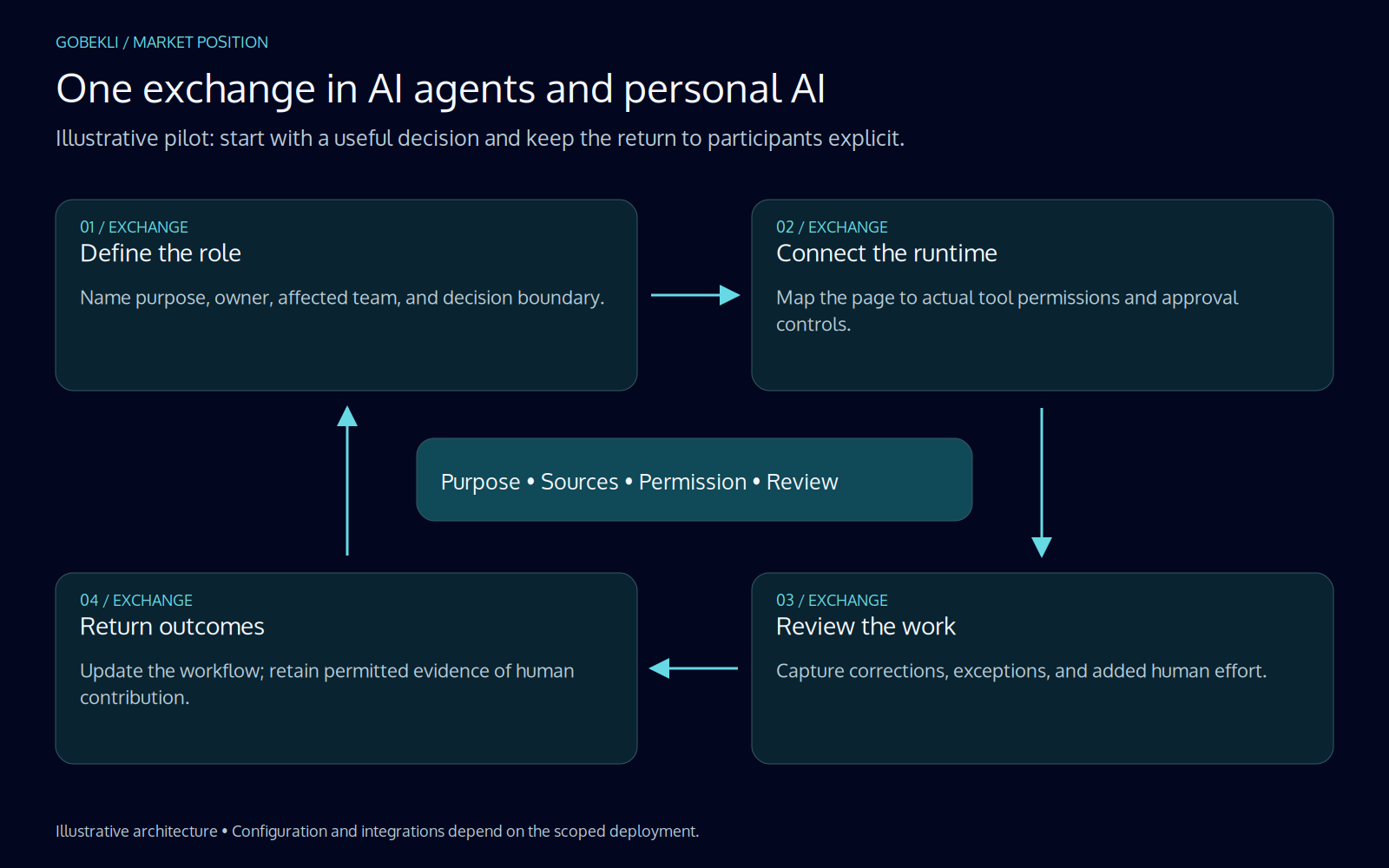
Illustrative configuration. Open the diagram to view it full size.
What would make a partnership worthwhile
The commercial test is whether this exchange improves a real decision or outcome enough to justify integration and review effort. A partner can retain its specialized product while testing better contextual evidence and a useful return to participants.
| Pilot question | Measure |
|---|---|
| Does the exchange help? | Review time and rework per case |
| Does review change the result? | Unowned handoffs or escalation failures |
| Is participation worth the effort? | Participant-reported hidden work |
| Does value continue after the transaction? | Percentage of tested actions respecting agreed approval boundaries |
Agree a baseline, review period, named decision owner, and stop-or-expand criteria. Record corrections and disagreements, not just successful exchanges. These are proposed measures, not reported customer results.
What must be agreed before connecting
A Passport Page describes the agreed relationship. Runtime permissions, credentials, action blocking, and revocation must be implemented and tested in the execution system. Agents are represented as systems in assigned roles, not as human employees.
Define the purpose, participants, identity mapping, sources, permitted recipients, available interfaces, reviewer or issuer, retention, correction path, and the outcome returned. Product capability and implementation support must be confirmed for the selected deployment.
Continue across the market map
No market operates alone. These adjacent pages show how the same Human Intelligence Layer connects different systems and relationships. Return to the complete market-position map.
AI Transformation
See where Gobekli complements this market, where it overlaps, and what relationship problem remains unresolved.
HR & Talent Management
See where Gobekli complements this market, where it overlaps, and what relationship problem remains unresolved.
Opportunity Networks
See where Gobekli complements this market, where it overlaps, and what relationship problem remains unresolved.
Research and product availability
Primary-source review: September 18, 2026. Provider descriptions establish their advertised scope. Gobekli’s proposed contribution and partner benefits are our analysis, not claims endorsed by those providers.
- Microsoft Copilot Studio — Agent authoring, knowledge connections, and actions.
- Salesforce Agentforce — Agents connected to CRM data and business actions.
- ServiceNow AI Agents — Agents operating in enterprise workflows with platform governance.
- Anthropic agent guidance — Composable workflow and agent design patterns; this is guidance, not a marketplace.
This page describes product scope and direction. TalentPass is in public beta; TalentSync and the exchanges described here are developing through scoped work unless explicitly marked available. Review current product availability.
Choose a useful starting scope
Bring one organizational decision, workflow, or exchange. We can define where TalentSync should lead, where it should complement your systems, and what the participants should receive.
