
MEMBERSHIP VALUE WORKSHOP MODULE
Member Expertise & Business Exchange Value
An introduction creates a possibility. Examine how shared knowledge, referrals, and collaboration become useful to members—and what expectations and evidence make that value understandable.
Does this sound familiar?
Connections are counted as results
The organization reports introductions, referrals, or meetings without knowing whether they addressed a relevant need.
Members enter with different expectations
One person expects informal guidance, another anticipates paid work, and neither understands what has been offered.
The expertise does not fit the question
A connection is based on a broad title or category without enough context about the experience needed.
Useful contributions remain invisible
A member helps someone avoid a mistake, clarify a decision, or improve an approach, but that value never appears in the program’s account.
Commercial success stories carry too much weight
A contract or partnership is attributed to membership without enough information about the introduction, subsequent work, and other contributing factors.
The organization does not know what followed
Staff arrange an exchange but lack an appropriate way to learn whether it was useful, stalled, or required another kind of support.
What is member expertise and business exchange value?
Member expertise and business exchange value concerns what people gain when membership helps them share knowledge, make relevant referrals, or collaborate around a defined need.
The exchange may involve practical guidance, professional insight, a supplier introduction, a potential client conversation, or work on a shared problem.
Value may arise through a clearer decision, useful information, access to relevant help, a collaboration, or a commercial outcome.
Different exchanges require different expectations. An informal conversation, a referral, and a paid engagement should not be treated as the same arrangement.
This module examines one selected exchange offering and the relationship among member purpose, relevant expertise, expectations, what followed, and the organization’s contribution.
A useful exchange connects the right help to a recognizable need.
An association may describe access to its member network as a major benefit.
A member may need something more specific: someone who understands a problem, a relevant service provider, or a potential collaborator.
The connection becomes useful when the need and the offer are sufficiently clear.
What experience is relevant? What help is being requested? Is the exchange informal, reciprocal, or commercial? What happens after the introduction?
Those questions shape both the member experience and the value the organization can explain.
A useful review follows one exchange far enough to identify what it helped make possible and what remains uncertain.
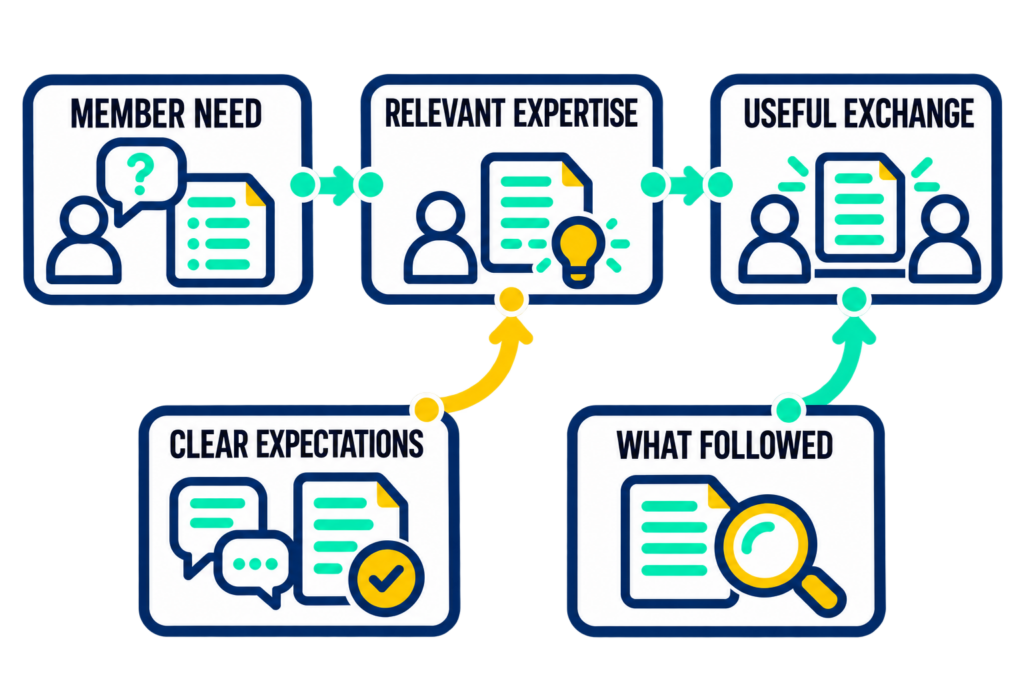
See the relationships behind useful member exchange.
Member Need
Question or problem
Intended benefit
Relevant circumstances
Type of help sought
Conditions affecting usefulness
Relevant Expertise
Experience related to the need
Knowledge or service offered
Context and limitations
Availability and willingness
Information supporting relevance
Exchange Expectations
Purpose of the introduction
Informal or commercial basis
Scope of the requested help
Responsibilities and next steps
Sharing and follow-up choices
What Followed
Conversation or advice
Decision clarified
Referral pursued
Collaboration explored
Agreement or work undertaken
Evidence and Contribution
Record of support provided
Member accounts
Appropriate confirmation
Other contributing factors
Limits of the value claim
A credible account connects the exchange to a specific need and preserves the distinction between an introduction, useful help, and a later outcome.
How exchange value becomes difficult to explain
STAGE 1 — Access to the network becomes a broad promise
The organization describes member connections as a source of expertise, referrals, and business opportunity.
STAGE 2 — Exchange activity becomes the main record
Reports capture directory listings, introductions, meetings, or referrals more consistently than their relevance or usefulness.
STAGE 3 — Selected success stories explain the benefit
A collaboration or transaction becomes the main account of value, with limited context about what happened along the way.
STAGE 4 — Improvement becomes difficult to direct
The organization cannot easily distinguish a poor fit, unclear expectations, missing follow-up, or a useful exchange that produced no commercial transaction.
An introduction is an opportunity to examine.
An exchange report can answer an important question:
Who was connected through the organization?
A value review also asks what help was sought, why the connection was relevant, what each person understood, and what became useful afterward.
Questions that make the value clearer
Define the question, problem, or opportunity and the circumstances that made particular expertise or support relevant.
Identify the experience, knowledge, service, or relationship supporting the introduction. Record uncertainty where the fit has not been established.
Clarify whether the exchange concerned informal guidance, a referral, reciprocal help, exploratory collaboration, or a potential commercial engagement.
Distinguish contact, conversation, useful advice, further exploration, an agreement, and work undertaken. Keep unobserved steps visible as unknown.
Examine appropriate member accounts and other sources without assuming that the organization caused every subsequent result.
Identify a change to relevance, expectations, preparation, handoffs, or follow-up, with an owner and a way to review it.
A useful exchange-value review needs six forms of clarity.
Need
The exchange addresses a question or purpose the member recognizes.
Relevance
The expertise or connection relates to the circumstances of that need.
Expectations
Participants understand the nature and scope of the proposed exchange.
Follow-through
The account distinguishes what happened after the connection and what remains unknown.
Contribution
The organization’s role is understandable alongside the work of the participants and other factors.
Boundary
Claims and follow-up remain consistent with the evidence and the participants’ choices.
Exchange value members can understand
A useful account explains:
- What need the exchange addresses.
- Why the connection may be relevant.
- What help is being offered or requested.
- What each participant can expect next.
- What became useful afterward.
- What evidence supports the organization’s contribution.
Members can decide whether to proceed and understand what the arrangement involves.
Exchange value described through connections alone
The value becomes difficult to assess when it relies on:
- Network size without relevant context.
- Referral totals without information about fit.
- Introductions with unclear expectations.
- Every conversation treated as a business lead.
- Transactions attributed entirely to membership.
- Missing follow-up treated as proof of no value.
The review identifies which relationships need clarification and which conclusions need better support.
An exchange can be valuable without producing a contract.
A trade association connects a member facing an operational problem with another member who has handled a similar situation.
The program’s reporting categories focus on business referrals and contracts generated.
The team selects this exchange route for review.
It discovers that the initial request concerned a practical question, while the receiving member understood the introduction as a possible sales opportunity.
After clarifying expectations, the participants have a short exploratory conversation.
The requesting member reports that the discussion helped identify questions to ask before choosing a solution. The other member explains the limits of the informal help and offers a separate conversation if paid support becomes relevant.
No contract follows during the period reviewed.
The team records the reported decision support separately from any commercial outcome and identifies the initial expectation gap.
It improves the introduction brief and adds an optional question about what became useful.
The resulting account captures a contribution the earlier reporting approach would have missed, while leaving any later transaction as a separate question.
Knowledge exchange and commercial exchange need clear expectations.
Members may contribute expertise for different reasons and under different arrangements.
Some offer a brief peer conversation. Others provide professional services. Some are exploring a reciprocal collaboration.
An introduction should give participants enough context to understand what is being proposed.
It should also leave room to clarify scope, decline, or agree on a different arrangement.
The review examines where assumptions about free advice, paid work, reciprocity, or availability could undermine the exchange.
Clear expectations help the organization support useful connections and describe its role accurately.
The organization’s contribution is one part of what followed.
Membership may make a relevant introduction possible or provide the setting in which a collaboration begins.
Participants still contribute their own expertise, effort, judgment, and resources.
A later agreement may also depend on pricing, timing, suitability, prior relationships, or other conditions.
The review identifies the specific support the organization provided and what appropriate evidence says about its usefulness.
A member account can help explain that contribution without establishing that membership caused the entire result.
Where the connection remains uncertain, the team records the question and selects a proportionate way to investigate it.
THE MATCHING WORKSHOP MODULE
Module 7: Member Expertise & Business Exchange Value
This practical minicourse helps membership organizations examine how knowledge exchange, referrals, and collaboration create useful value for members, with clear expectations and appropriate evidence of what followed.
Participants learn a repeatable review method, apply it to one selected exchange offering, and identify whether the priority response concerns need, relevance, expectations, follow-through, or the account of value.
The exercise also defines the exchange records, expertise context, participant choices, source relationships, and responsibilities that a subsequent Gobekli configuration would need to support.
This module helps your team:
- Define the exchange-value question within scope.
- Identify the relevant member population.
- Clarify the need or purpose behind an exchange.
- Describe the expertise or help being offered.
- Examine the basis for a relevant connection.
- Distinguish informal and commercial expectations.
- Clarify responsibilities after an introduction.
- Trace what happened after the exchange.
- Recognize useful value beyond transactions.
- Examine evidence of the organization’s contribution.
- Assign a focused improvement and validation plan.
- Outline a connected exchange-value configuration.
What should happen to each part of the exchange?
The review leads to a deliberate response based on the member need, relevance of the connection, participant expectations, and available evidence.
Clarify
Make the request, offer, and intended benefit more understandable.
Connect
Improve the basis for relating a need to relevant experience, expertise, or services.
Agree
Help participants establish the scope and nature of the proposed exchange.
Support
Address preparation, handoffs, unanswered questions, or a stalled next step.
Substantiate
Build an appropriate account of what became useful and the organization’s contribution.
Redirect
Identify another route when the connection or proposed arrangement does not fit.
These responses improve the exchange offering. Participants remain responsible for deciding whether and how to proceed.
What should an expertise and business exchange value review examine?
The need
What question, problem, or opportunity was the exchange intended to address?
The fit
What experience or offering made the connection relevant, and what remained uncertain?
The expectations
What help did participants understand was being requested or offered?
The subsequent steps
What contact, guidance, exploration, collaboration, or agreement followed?
The contribution
What supports the account of membership’s role, and which other factors matter?
The improvement
What should change, who can act, and what evidence would help assess the response?
Trace one exchange offering from member need to useful value.
Your team applies the method to the audience and value question established through Membership Value Direction.
STEP 1
Define the exchange purpose
Select one offering and identify the member need and intended benefit within scope.
STEP 2
Examine the connection’s relevance
Identify the experience, knowledge, service, or relationship that supports the proposed fit.
STEP 3
Clarify expectations
Describe the nature of the exchange, requested help, responsibilities, and next step.
STEP 4
Trace what followed
Distinguish observed activity, member accounts, agreements, and missing information.
STEP 5
Assess the value and contribution
Explain what became useful and what the evidence supports about the organization’s role.
STEP 6
Assign and test the response
Choose an improvement, responsible owner, appropriate feedback, and review point.
The result is a draft Exchange Value & Contribution Map connecting member need, relevant expertise, expectations, subsequent steps, supporting evidence, and assigned improvements.
FUTURE PRODUCT CONNECTION
Keep member exchange connected to need, expectations, and useful follow-through.
A subsequent Gobekli configuration could help the organization maintain an understandable account of the exchanges it supports.
TalentSync could connect requests and exchange offerings to relevant expertise, responsible contacts, introduction context, and review needs. TalentPass could help members describe experience and the help they are willing to offer, with control over what they share.
Pythia could help clarify a request, prepare questions, or explain why a connection may be relevant using the information and permissions in scope. Passport Pages could support agreed source connections and sharing arrangements.
A connected exchange-value review could potentially show:
- What need a member wants to address.
- What expertise or help is being offered.
- What information supports the relevance of a connection.
- Whether participants are willing and available.
- What expectations have been clarified.
- What introduction or support the organization provided.
- Who is responsible for the next step.
- What participants choose to report about the exchange.
- What evidence supports an account of useful value.
- Which questions or improvements require follow-through.
The workshop produces a starting configuration brief: requests, expertise descriptions, exchange types, participant choices, introduction records, follow-up states, source context, and responsible roles.
Specific discovery, matching, referral, integration, and follow-up capabilities would be confirmed during solution planning.
PRODUCT AND DECISION BOUNDARIES
A relevant connection leaves room for an informed choice.
The review helps the organization improve its exchange offering and explain its contribution.
A later configuration should distinguish a suggested connection, an accepted introduction, useful guidance, an exploratory discussion, and an agreement between participants.
Each step has its own meaning and may require different information.
The workshop and product connection do not establish:
- Expertise based only on a job title.
- Suitability based only on membership.
- Availability or willingness without confirmation.
- An obligation to provide free advice.
- A referral as a guarantee of service quality.
- A conversation as a completed transaction.
- Membership as the sole cause of a business outcome.
- Permission to collect or share confidential commercial details.
The organization remains responsible for its exchange commitments and public value claims.
The exchange-value brief remains useful independently of future product adoption.
What to bring into the conversation
You do not need complete referral or transaction tracking before beginning.
Start with one exchange offering connected to the question established through Membership Value Direction.
Useful inputs may include:
- The audience and member need within scope.
- Descriptions of the selected exchange offering.
- Example requests or referral purposes.
- Relevant expertise or service descriptions.
- Introduction criteria or staff guidance.
- Participant expectations and communication.
- Available records of exchanges supported.
- Appropriate member feedback.
- Known examples of what followed.
- Current claims about exchange value.
- Sharing preferences and source limitations.
- Program owners and relevant member perspectives.
The aim is to trace one exchange route in sufficient detail to explain its contribution and identify a practical improvement or validation need.
What this module can help clarify
What the exchange is intended to support
Connect the selected offering to a defined member need and useful benefit.
How relevance and expectations fit together
Describe the expertise, proposed help, participant understanding, and responsibilities within scope.
What value the evidence supports
Distinguish introductions, useful guidance, collaborations, transactions, and the organization’s contribution.
What to improve or investigate next
Develop an assigned response, proportionate validation plan, and starting configuration brief.
These outputs begin with the example reviewed during the module. Final scope depends on the selected modules, available information, and question established through Membership Value Direction.
Where might the work lead next?
Member Expertise & Hidden Capability
Clarify relevant experience and capabilities when the organization lacks enough information to understand who could provide useful help.
Peer Connections & Community Belonging
Examine the participation experience when members need clearer routes into introductions, relationships, and community interaction.
Member Value Evidence & Renewal Conversations
Connect the exchange’s contribution to a broader account of membership value when the next question concerns renewal.
Your team can combine this module with other parts of the Membership Value Workshop according to the value question established through Membership Value Direction.
Frequently asked questions
Questions organizations ask before beginning.
Useful knowledge, guidance, referrals, or collaboration that membership helps make possible in relation to a defined need. The review examines what became useful and the evidence supporting that account.
No. An exchange may clarify a decision, provide practical insight, or help members explore a shared problem without producing paid work.
Yes. Select a manageable example and examine the need, relevance, expectations, subsequent steps, and organization’s contribution.
Yes, when the question concerns the exchanges it is intended to support. A listing or directory visit alone leaves the usefulness of a later connection unresolved.
It may provide useful access. The review also examines whether it was relevant and what it helped participants do, without assuming a later result.
Clarify what help is requested and how the receiving member understands the proposed exchange. Participants can then agree whether an informal conversation or another arrangement is appropriate.
Examine how the offering is described and how scope is established. Willingness to join a network should not be treated as unlimited availability to provide unpaid help.
Compare the need and circumstances with the experience or service offered, then use appropriate participant feedback. A broad category or title may be insufficient.
Examine whether another useful result occurred, such as a clearer decision or a relevant next step. A lack of commercial activity does not explain the exchange’s value on its own.
Record the relationship to the exchange with appropriate sources and context. A sequence of events alone does not establish that membership caused the whole outcome.
Not necessarily. Collect only information appropriate to the question and the participants’ choices. An account of usefulness may not require commercial details.
Record the result as unknown. Review whether the request is proportionate and understandable without interpreting silence as either success or failure.
That Member Intelligence module examines what is known about relevant experience and capabilities. This module examines the value created when expertise is exchanged around a need.
That Member Engagement module examines routes into relationships and participation. This module follows selected exchanges to understand their usefulness and contribution.
That module focuses on an individual’s career purpose and opportunity route. This module focuses on knowledge exchange, referrals, and collaboration among members or businesses.
The outputs can inform a configuration connecting member needs, relevant expertise, expectations, introductions, and appropriate follow-up. Specific capabilities and implementation requirements would be confirmed during scoping.
Your team will examine one exchange offering and develop a draft Exchange Value & Contribution Map, an assigned improvement and validation plan, and starting configuration requirements. Wider implementation and outcome review continue afterward.
MAKE MEMBER EXCHANGE’S CONTRIBUTION CLEAR
Show what useful connections help members accomplish.
Connect shared expertise, referrals, and collaboration to a defined need, clear expectations, and an account the evidence can support.
This module is part of Gobekli’s configurable Membership Value Workshop.