
MEMBER ENGAGEMENT WORKSHOP MODULE
Peer Connections & Community Belonging
Being a member does not always mean knowing someone to turn to or finding a place to contribute. Create clearer routes into introductions, useful peer interaction, and continuing community participation.
Does this sound familiar?
Introductions depend on insiders
Members with established relationships find relevant people. Others struggle to know whom to approach.
Directories become dead ends
Members can browse names and profiles without understanding who welcomes contact or how to begin.
First conversations stall
An introduction happens, but participants lack a shared purpose, useful context, or an agreed next step.
Familiar voices dominate
Established participants shape discussions while newcomers struggle to enter, contribute, or be acknowledged.
Community spaces feel empty
Groups and platforms exist, but members encounter little guidance, facilitation, or response when they participate.
Connections end with the event
Members meet briefly without an appropriate route to reconnect, return, or contribute together.
What are peer connections and community belonging?
Peer connections are relationships through which members exchange experience, ask questions, offer support, explore shared interests, or contribute to a common purpose.
Community belonging concerns whether members experience a place for themselves within the group: they can participate, be heard, understand expectations, and contribute in ways that are recognized.
A directory, introduction, or group membership can create an opportunity for connection. The relationship develops through what people choose to do together.
This module examines the route from an initial reason to connect through to useful interaction and an appropriate continuation.
It focuses on the conditions an organization can support while leaving members free to choose their relationships and level of involvement.
An introduction needs somewhere useful to go.
An organization may bring members together because they share a profession, interest, location, challenge, or experience.
That connection provides a starting point. Participants may still need to understand why they are meeting, what they can ask or offer, and what happens next.
A newcomer may hesitate to enter a discussion where everyone appears to know one another. An experienced member may welcome a specific question but have little capacity for open-ended requests.
A practical review connects the reason for meeting to the expectations, facilitation, and choices that make interaction workable for both people.
See the complete route into peer participation.
Member Purpose
Questions and interests
Experience to exchange
Support being sought
Contributions being offered
Participation preferences
Introductions and Entry
Relevant people or groups
Willingness to connect
Useful introduction context
Entry routes and expectations
Welcoming contacts
Peer Interaction
Shared questions or activities
Conversation structure
Reciprocity and boundaries
Facilitation and response
Different ways to participate
Community Participation
Group purpose and norms
Opportunities to be heard
Recognition of contributions
Host and member roles
Routes for newcomers
Continuation and Support
Mutual next steps
Return opportunities
Follow-up choices
Questions or concerns
Community responsibility
Peer participation becomes easier to support when introductions, interaction, contribution, and continuation are connected.
How communities become difficult to enter
STAGE 1 — A group forms around shared interests
Members begin exchanging ideas, helping one another, and developing familiar ways of participating.
STAGE 2 — Relationships and customs become established
Regular participants know whom to approach, how discussions work, and where decisions or opportunities emerge.
STAGE 3 — New members encounter unstated expectations
Newcomers see the group but may not understand how to enter a conversation, request help, or offer a contribution.
STAGE 4 — Participation concentrates among familiar people
The organization continues inviting members into a space whose practical entry routes remain unclear.
A connection count does not explain the relationship.
A community report can answer an important question:
How many members joined, attended, posted, or exchanged contact details?
A peer participation review also examines whether members could begin a useful interaction, contribute appropriately, and choose what happened afterward.
The review should clarify:
Identify a question, shared interest, experience exchange, or contribution that gives the interaction a purpose.
Examine willingness, availability, contact preferences, and what each person understood about the request.
Review the introduction, shared context, conversation prompt, activity, or facilitation available.
Look at how newcomers enter, how contributions receive a response, and whether participation depends on unstated knowledge or confidence.
Trace any agreed next step, return opportunity, group activity, or member-chosen conclusion.
Identify the host, facilitator, coordinator, or existing concern route responsible for support.
A useful peer experience supports six conditions.
Purpose
Members understand why they are connecting and what they might ask, offer, or explore.
Willingness
People can choose whether to participate and set appropriate limits on contact.
Entry
Newcomers can understand how to join the interaction without relying on insider knowledge.
Reciprocity
The experience makes room for different contributions without assuming equal time, expertise, or immediate exchange.
Recognition
Questions and contributions receive an appropriate response, helping members understand that their participation matters.
Continuation
Members can choose a useful next step, return to the community, or end the interaction without an assumed ongoing obligation.
Supported connection
An introduction can lead somewhere useful when it includes:
- A clear reason for connecting.
- Willing participants.
- Relevant context shared appropriately.
- A manageable first interaction.
- Understandable expectations and boundaries.
- An optional route to continue.
The organization helps people begin while allowing the relationship to develop through their choices.
Unstructured exposure
Putting people in the same space can leave members with:
- No clear reason to approach someone.
- Uncertainty about whether contact is welcome.
- Vague requests for time or advice.
- Conversations dominated by established participants.
- Little response to an initial contribution.
- Pressure to maintain a connection that does not fit.
The review identifies where practical structure would make participation easier.
A shared challenge can provide a useful first conversation.
An association wants members managing small teams to exchange practical experience.
It has a member directory and an online discussion group, but newcomers rarely initiate contact. Staff repeatedly introduce people they already know.
The team selects one route to examine: a member seeking advice about a difficult delegation problem.
Participants review how that member could express the question, find a willing peer or relevant group, and enter a focused conversation.
They clarify what the introduction should explain, how a host could help the conversation begin, and what follow-up would be optional.
The response may be a small, facilitated peer conversation with a clear purpose and a route to return. It does not require a new platform or an organization-wide matching program.
Belonging develops through the experience of participation.
A welcome message can invite someone into a community. Their subsequent experience helps them decide whether it is a place where they can participate.
Do people respond to their question? Are expectations understandable? Can they contribute without already holding a recognized role? Is there room for different levels of experience and different ways of taking part?
The review examines those practical conditions alongside members’ own accounts.
It does not assign a belonging score from attendance, posting frequency, or the number of connections someone has.
Some members prefer occasional, focused interaction. Others want sustained involvement. Both can be valid ways to participate.
Hosts need a clear role in helping the community work.
Staff, volunteers, chapter leaders, and peer facilitators may each help members enter and participate.
Their responsibilities can include explaining group purpose, welcoming newcomers, prompting useful discussion, acknowledging contributions, and directing questions or concerns.
Those responsibilities need realistic time and boundaries.
The review clarifies what hosts are expected to do, what support they receive, and where responsibility passes to another person or process.
When the experience requires a formal mentoring relationship, detailed volunteer role, or broader chapter operating arrangement, the corresponding module can extend the work.
THE MATCHING WORKSHOP MODULE
Module 5: Peer Connections & Community Belonging
This practical minicourse helps membership organizations create clearer routes into introductions, useful peer interaction, and continuing community participation.
Participants learn a repeatable review method, apply it to one selected peer experience, and identify whether the priority response concerns purpose, entry, introductions, facilitation, contribution, or continuation.
The exercise also defines the member context, connection preferences, community roles, interaction opportunities, and responsibilities that a subsequent Gobekli configuration would need to support.
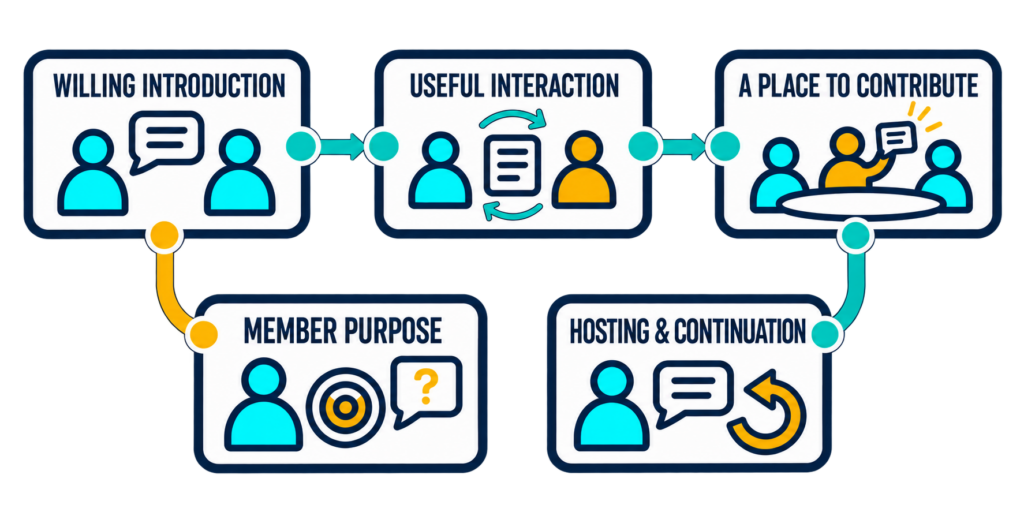
This module helps your team:
- Define the purpose of one peer experience.
- Identify whom the interaction could serve.
- Clarify what members want to ask or contribute.
- Examine willingness and contact preferences.
- Review introductions and newcomer entry.
- Identify unstated participation expectations.
- Examine conversation and facilitation needs.
- Create understandable ways to contribute.
- Clarify host and support responsibilities.
- Establish optional routes to continue or return.
- Develop a focused peer participation brief.
- Outline a connected community configuration.
What should happen to each part of the peer experience?
The review leads to a deliberate response based on the purpose of the interaction, the members involved, and the conditions affecting participation.
Confirm
Retain an experience with a clear purpose and a workable route into participation.
Clarify
Explain expectations, contact preferences, contribution options, or the next step.
Introduce
Create an appropriate connection between willing members or a relevant group.
Facilitate
Provide the structure or hosting needed for useful interaction.
Support
Address entry difficulties, unanswered contributions, or requests for help.
Reconsider
Change or conclude an arrangement that lacks a useful purpose, willing participants, or adequate support.
These responses guide the design of the experience. They do not determine whom members should befriend or require an introduction to become an ongoing relationship.
What should a peer connection and belonging review examine?
The purpose
What question, interest, exchange, or contribution gives members a reason to interact?
The participants
Who could benefit or contribute, and what preferences, availability, and boundaries apply?
The introduction
How do members find a willing person or group, understand the invitation, and begin?
The interaction
What conversation, activity, facilitation, and participation expectations support a useful experience?
The continuation
How can members reconnect, return, contribute differently, or choose to conclude the interaction?
The ownership
Who welcomes participants, hosts the experience, handles questions, and supports the people carrying those responsibilities?
Trace one introduction into a useful peer experience.
Your team applies the method to one peer interaction or community entry route established through Member Engagement Direction.
STEP 1
Define the purpose
Identify the member population, shared question, support need, or contribution within scope.
STEP 2
Examine the participants
Review whom the experience could serve, whether contact is welcome, and what members need to understand before joining.
STEP 3
Follow the entry route
Trace how a member reaches an introduction or group, receives context, and begins participating.
STEP 4
Examine the interaction
Review the activity, facilitation, contribution routes, expectations, and support available.
STEP 5
Choose a response
Confirm, clarify, introduce, facilitate, support, or reconsider the parts of the experience that need attention.
STEP 6
Assign and test the change
Identify the owner, proposed improvement, member feedback needed, continuation choices, and starting configuration requirements.
The result is a draft Peer Participation Map connecting member purpose, willing introductions, interaction, contribution, support, and optional continuation.
FUTURE PRODUCT CONNECTION
Keep introductions connected to purpose and participation.
A subsequent Gobekli configuration could help the organization connect member-selected context to peer opportunities, groups, and community responsibilities.
TalentSync could relate peer experiences to their purposes, participation expectations, hosts, support contacts, and continuation routes.
TalentPass could help members express relevant interests, experience, goals, and willingness to connect. Pythia could help clarify what someone wants to ask or contribute and explain an available peer opportunity using the information and permissions in scope. Passport Pages could support agreed source and sharing connections.
A connected peer participation view could potentially show:
- What purpose a member wants to explore.
- What experience or contribution they choose to share.
- Whether and how they welcome contact.
- Which peer opportunity or group could be relevant.
- What participants should expect.
- Who can make or support an introduction.
- What activity helps the interaction begin.
- Who hosts the experience and handles questions.
- What continuation choices are available.
- Where member feedback identifies an entry or participation difficulty.
The workshop produces a starting configuration brief: the selected member context, connection preferences, opportunity and group profiles, host roles, sharing arrangements, and participation relationships needed to support the experience.
Specific discovery, suggestions, introductions, messaging, community-platform connections, and workflows would be confirmed during solution planning.
PRODUCT AND DECISION BOUNDARIES
Connected communities depend on willing participation.
Shared interests or experience may provide a reason to consider an introduction without establishing compatibility, trust, availability, or a desire for contact.
A later configuration should distinguish a suggested connection, permission to introduce, an interaction that occurred, and a relationship members choose to continue.
The workshop and product connection do not establish:
- Permission to share contact details based only on membership.
- Willingness to help based only on someone’s expertise.
- Compatibility or trust from similar profiles.
- Belonging inferred from attendance or posting activity.
- An obligation to continue after an introduction.
- Automatic resolution of community concerns or interpersonal difficulties.
Group expectations, support arrangements, and existing concern routes remain part of organizational responsibility.
The workshop can clarify the peer experience and its responsibilities independently of future product adoption.
What to bring into the conversation
You do not need a complete network map or a new community platform.
Begin with one peer experience or community entry route connected to the participation challenge established through Member Engagement Direction.
Useful inputs may include:
- The purpose of the selected group or interaction.
- Current introduction or welcome messages.
- Relevant directory or community entry points.
- Member questions about meeting peers.
- Examples of conversation prompts or activities.
- Feedback from newcomers and regular participants.
- Contact and participation preferences.
- Group expectations and contribution routes.
- Host, facilitator, and support responsibilities.
- Existing follow-up or return opportunities.
- A community lead and member perspective.
- The owner of a proposed improvement.
The aim is to examine one experience in sufficient detail to make a practical change. The foundation module establishes the population, purpose, evidence, and boundaries for that work.
What this module can help clarify
Why members connect
Identify a useful purpose for the interaction and what participants may want to ask, exchange, or contribute.
How members enter
Clarify willingness, introductions, newcomer guidance, and the expectations needed to begin.
What sustains participation
Identify useful interaction, facilitation, recognition, support, and optional continuation.
What should change next
Develop an assigned improvement and test plan, supported by a starting configuration brief.
Final outputs depend on the modules selected and the participation challenge established through the workshop’s required Member Engagement Direction module.
Where might the work lead next?
Mentoring & Peer Support Participation
Develop a more structured support relationship when members need defined roles, preparation, and an agreed purpose over time.
Events & Year-Round Participation
Connect introductions made during events to useful opportunities for members to interact again.
Volunteer & Leadership Participation
Create clearer roles and support when members want to contribute through hosting, facilitation, service, or leadership.
Explore the full Member Engagement Workshop to combine this module with the other parts of the participation experience that need attention.
Frequently asked questions
Questions organizations ask before beginning.
They are relationships through which members exchange experience, ask questions, offer support, explore interests, or contribute together. The module examines how the organization helps those interactions begin and develop appropriately.
It concerns whether members experience a place for themselves within the group: they can participate, be heard, understand expectations, and find ways to contribute. The review uses members’ accounts alongside the practical conditions of participation.
An event may provide the selected example, but the module also applies to online groups, peer circles, introductions, chapter communities, and other settings where members interact.
No. The exercise can begin with an existing meeting, introduction process, discussion group, or staff-supported connection. Technology requirements follow from the experience the team decides to support.
Yes. Review how a member would move from finding someone in the directory to understanding whether contact is welcome and beginning a useful interaction.
Start with a credible shared purpose, relevant member-selected context, and willingness to connect. Similar profiles alone do not establish that an introduction is appropriate or wanted.
Examine what regular participants already know and make essential expectations visible. A welcoming contact, a manageable first contribution, or a facilitated introduction may help.
Review how discussions are structured, how hosts invite different contributions, and what members report about participation. The response may involve facilitation, smaller interactions, alternative contribution routes, or clearer expectations.
No. Members may prefer occasional questions, focused exchanges, or sustained involvement. The experience should support useful choices without treating frequent participation as the only valid outcome.
Clarify what participants agreed to and whether further help is wanted. An introduction should not automatically create an ongoing obligation or an open-ended reminder sequence.
That depends on the purpose and setting. The module identifies the role, expectations, capacity, and support needed, whether a staff member, volunteer, chapter leader, or peer carries it.
Examine whether members can enter, understand the purpose, participate, receive an appropriate response, and choose what happens next. Participation records can support the review, while member feedback helps explain usefulness and belonging.
Network visibility examines existing relationships and gaps in what the organization knows. This module focuses on creating and supporting the experiences through which members begin or develop connections.
This module addresses introductions, general peer interaction, and community entry. Mentoring and peer support examines more structured support arrangements with defined roles, preparation, and expectations over time.
The review should identify the appropriate support or concern route and who is responsible for responding. The workshop can clarify those handoffs, but it does not replace the organization’s processes for addressing individual concerns.
The outputs can inform a configuration connecting member-selected context, willingness to connect, peer opportunities, groups, host roles, support, and continuation. Specific capabilities and implementation requirements would be confirmed during scoping.
Your team will review one bounded experience and develop a draft peer participation map, assigned improvement and test plan, and starting configuration brief. Wider rollout and ongoing operation are subsequent steps.
MAKE CONNECTION EASIER TO BEGIN
Help members find people to learn with and a place to contribute.
Connect introductions to useful interaction, clear expectations, and opportunities to return on terms that work for members.
This module is part of Gobekli’s configurable Member Engagement Workshop.