
MEMBER INTELLIGENCE WORKSHOP MODULE
Member Goals, Needs & Career Transitions
Your records show where members are. Do you understand where they want to go?
Connect member goals, changing circumstances, career transitions, and unmet needs into a clearer foundation for decisions about whom to support and what to examine next.
Module 3 · Member Intelligence Workshop
Does this sound familiar?
Members with the same job title need different things
One wants to advance, another wants to change direction, and another wants to become more effective in the role they already hold.
Needs become visible after an important transition
A member takes on management responsibilities, changes sectors, returns to work, or starts a business before the organization understands what support might matter.
Program choices stand in for member goals
Attendance at an event or enrollment in a course is treated as an explanation of what the member wants to achieve.
The requested solution becomes the assumed need
Members ask for training, mentoring, or networking, but the organization has not examined the situation behind the request.
Member circumstances change while profiles remain the same
Information collected at joining continues to shape decisions long after goals, responsibilities, or priorities have shifted.
The organization knows what it offers more clearly than whom it helps
Programs and benefits are well documented, but their connection to particular member goals and circumstances is difficult to explain.
What does it mean to understand member goals and needs?
A member’s goal describes something they want to achieve, explore, improve, or contribute.
A need describes a condition, resource, capability, connection, or form of support relevant to that goal.
A career transition changes the context in which the person is working toward it.
Relevant transitions may include:
- Entering a profession.
- Moving into a first supervisory or management role.
- Changing employers, sectors, or specialties.
- Returning after time away.
- Moving between employment and independent work.
- Starting or expanding a business.
- Taking on new technology or responsibilities.
- Pursuing a qualification or professional recognition.
- Moving into leadership, mentoring, or advisory work.
- Reducing paid work or preparing for retirement.
Goals can also involve professional confidence, community contribution, peer connection, stability, or more sustainable working arrangements.
Member Goals, Needs & Career Transitions helps participants examine these connections without assuming that a membership category, job title, or activity record explains the whole picture.
A stated interest is the beginning of the conversation.
A member who selects “leadership development” may be preparing to supervise colleagues, improve an existing team, take on a volunteer role, or explore whether management is right for them.
The same interest can point to different goals and needs.
Before deciding what it means, the organization may need to understand:
- What the member is trying to achieve.
- Why it matters now.
- What has changed or may change.
- What relevant experience they already have.
- What feels difficult or uncertain.
- What they have already tried.
- Which circumstances affect their options.
- What kind of progress would be useful.
- Which support they are seeking.
- What the organization is positioned to address.
This context helps participants distinguish the member’s desired outcome from an initial request for a particular program or benefit.
It also reveals where the organization needs further information before choosing a response.
Connect the goal to the circumstances behind it.
Member Goals
Desired progress
Professional interests
Personal priorities
Contribution ambitions
Questions being explored
Transition Context
Current situation
Recent or expected change
New responsibilities
Relevant experience
Timing and urgency
Needs and Conditions
Knowledge or capability
Practical guidance
Relevant relationships
Access and feasibility
Unresolved uncertainty
Evidence and Interpretation
Member-stated information
Supporting examples
Participation context
Staff observations
Assumptions to confirm
Decision and Follow-Through
Organizational relevance
Priority questions
Further member input
Responsible people
Next review point
A useful understanding connects what the member wants with the situation they face and the decision the organization is preparing to make.
How member needs become detached from their context
STAGE 1 — A member expresses an interest
The person selects a topic, attends an event, asks a question, or describes a concern.
STAGE 2 — The interest becomes a category
A field, tag, or report records the topic while leaving out the goal, circumstances, and timing behind it.
STAGE 3 — Decisions rely on the category
Teams use the label to interpret demand or select possible responses without checking what it means for different members.
STAGE 4 — The response fits some members and misses others
The organization offers something relevant to the topic, but its purpose, level, timing, or format does not match the circumstances of everyone included.
“They want more training” leaves the desired progress unclear.
A request for training may reflect a knowledge gap, a need for supervised practice, uncertainty about expectations, or a desire to meet peers facing similar responsibilities.
Each interpretation suggests different questions.
“Members want management training” can become:
“Members entering their first supervisory role want to handle difficult team conversations more confidently. We need to understand their experience, the situations they encounter, and the support they have already tried before selecting a response.”
That statement connects a population, a goal, and an uncertainty. It provides a stronger basis for investigation.
The review should clarify:
Use the member’s own description where available. Distinguish an intended outcome from a topic of interest, a program request, or an expectation someone else has assigned.
Identify a current or anticipated transition, responsibility, opportunity, or difficulty. Record whether the goal is immediate, exploratory, or longer term.
Examine relevant background, existing resources, and steps already taken. Avoid assuming that everyone approaching the same transition starts from the same place.
Identify the obstacle or uncertainty as specifically as the evidence allows. Separate member-described needs from explanations the organization has inferred.
Describe a meaningful next step or change in the member’s situation. The answer may involve a decision, greater confidence, practical capability, a connection, or clearer options.
Connect the findings to the workshop’s agreed purpose. Identify which questions would affect a program, service, partnership, or further research decision.
Examine goals and needs across six dimensions.
Desired Progress
Clarify what the member wants to achieve, explore, maintain, or contribute.
Starting Point
Understand the relevant experience, responsibilities, and resources already in place.
Transition
Identify what is changing and how that change affects the member’s situation.
Obstacles and Conditions
Examine what makes progress difficult and which circumstances shape the available options.
Evidence
Distinguish member statements, supporting examples, observations, and unconfirmed interpretations.
Timing
Record when support or further understanding would be useful and when the information should be revisited.
Similar goals can call for different kinds of support.
What members may have in common
A group may share:
- A transition into management.
- Interest in a professional qualification.
- A wish to develop a business.
- A need to adapt to changing work.
- Interest in contributing expertise.
- A desire for stronger professional connections.
- Uncertainty about a possible career direction.
- A goal of remaining effective in an existing role.
These shared purposes can provide a useful starting point for examining needs.
What may differ within the group
Members may have different:
- Prior experience and preparation.
- Immediate responsibilities.
- Confidence and familiarity.
- Employer or peer support.
- Time and scheduling constraints.
- Access to relevant opportunities.
- Preferred ways of learning or connecting.
- Definitions of a useful next step.
The review preserves differences that could materially affect the organization’s decision.
Three new managers may need three different next steps.
Imagine an association examining support for members entering their first management role.
One member has years of technical experience but has never supervised others. They want practical help with delegation and feedback.
A second has led teams informally and wants to understand what changes when they become responsible for performance decisions.
A third is still considering management and wants a realistic picture of the work before pursuing promotion.
All three could select “leadership development.” Their immediate needs differ.
Participants examine:
- What each person is trying to achieve.
- Whether the transition has happened or is being considered.
- What relevant experience already exists.
- Which uncertainties matter most.
- What evidence supports the interpretation.
- Which differences should influence the organizational response.
The output is a clearer needs picture. It may support further investigation of learning, mentoring, peer exchange, or career exploration without deciding prematurely that one program fits everyone.
Let members describe success in their own terms.
Professional advancement is one possible goal.
Members may also want to deepen their expertise, remain effective through change, contribute to their community, improve working relationships, sustain a business, or find a more manageable way to work.
The review should distinguish the member’s stated priorities from organizational assumptions about what progress ought to mean.
Where goals are exploratory or conflicting, record that uncertainty. A useful outcome may be helping the organization understand what members need to explore before they choose a direction.
Information about personal circumstances should remain proportionate to the agreed purpose and appropriate for the member to share.
Record when the understanding applies.
A goal shared at joining may no longer describe the member’s priorities.
A transition can create an immediate need that becomes less relevant later. A longer-term ambition may remain useful even while the person’s next step changes.
For the selected example, participants record when information was provided, what situation it described, and what event or review point might make an update useful.
Designing ongoing refresh processes across the membership belongs in Member Intelligence Governance & Currency when deeper work is needed.
THE MATCHING WORKSHOP MODULE
Module 3: Member Goals, Needs & Career Transitions
This practical minicourse helps membership teams learn a repeatable method for understanding what members are working toward and what makes progress difficult.
Participants apply the method to one defined population or transition using available member input, examples, and relevant records.
They distinguish goals from requested solutions, examine starting conditions, identify meaningful differences, and record the questions that must be answered before the organization selects a response.
The exercise also identifies the goal, experience, transition, and needs relationships a subsequent Gobekli configuration would need to support.
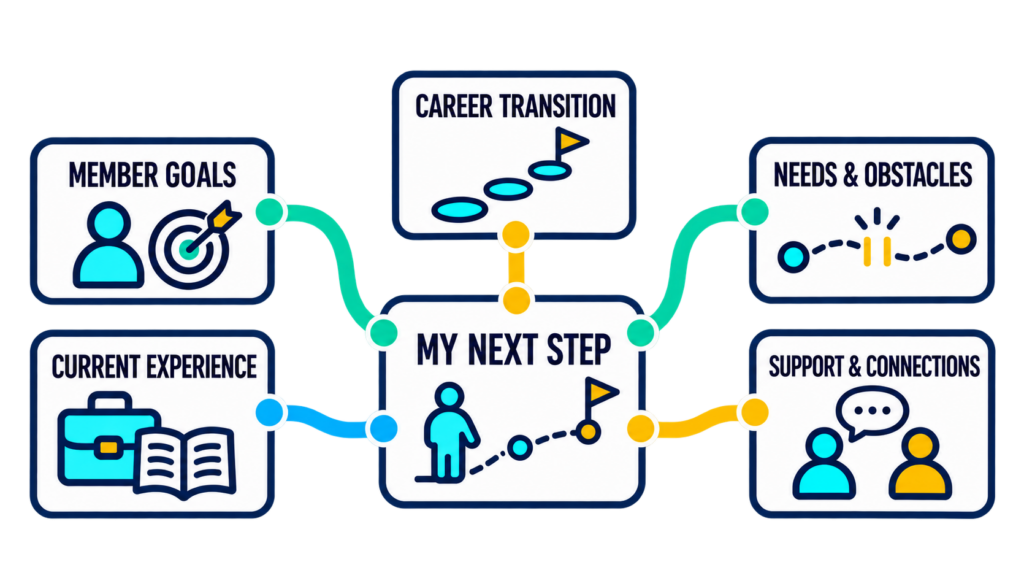
This module helps your team:
- Define the member population and transition being examined.
- Capture goals in language that preserves member meaning.
- Distinguish desired progress from interest in a particular offering.
- Identify relevant starting experience and existing support.
- Examine what makes progress difficult.
- Recognize differences within apparently similar member groups.
- Separate stated needs from organizational interpretations.
- Record timing, uncertainty, and information gaps.
- Identify where further member input is needed.
- Connect the findings to an organizational decision.
- Develop a focused needs brief and next-step plan.
- Outline a potential goals and needs configuration.
What should happen when a member need becomes clearer?
The module develops understanding and a decision-ready brief.
Clarify the Goal
Confirm the progress the member is seeking before interpreting a topic or request.
Examine the Starting Point
Identify relevant experience, existing resources, and steps already taken.
Distinguish the Need
Separate the underlying obstacle or uncertainty from a suggested solution.
Recognize Meaningful Differences
Record where members sharing a goal face circumstances that may require different consideration.
Seek Further Input
Identify the questions that require direct member explanation or broader evidence.
Route the Finding
Bring the needs brief to the people responsible for the relevant program, service, partnership, or research decision.
The module develops understanding and a decision-ready brief. Designing the resulting offer or participation experience can follow through the appropriate workshop or organizational process.
What should a member goals and needs review examine?
The Goal
What does the member want to achieve, explore, improve, maintain, or contribute?
The Situation
What responsibilities, experience, and current conditions shape that goal?
The Transition
What is changing, and why does that change matter to the member now?
The Need
What obstacle, uncertainty, capability, resource, or connection affects progress?
The Evidence
What did members actually describe, what has been observed, and what remains an interpretation?
The Organizational Decision
Which findings matter to the agreed decision, and what must be clarified before selecting a response?
Learn the method. Build one member needs picture.
Bring one population, transition, or recurring member concern relevant to the decision established through Member Intelligence Direction.
STEP 1
Define the population and decision
Identify which members and circumstances are within scope. State the organizational choice that better understanding should support.
STEP 2
Capture the goals
Review available member statements and examples. Record desired progress separately from topics, program requests, or organizational assumptions.
STEP 3
Describe the starting point and transition
Identify relevant experience, responsibilities, existing support, and the change creating the need.
STEP 4
Examine obstacles and meaningful differences
Map what appears to make progress difficult. Distinguish shared needs from differences that could affect the response.
STEP 5
Check the evidence and priority questions
Mark what is member-stated, observed, inferred, or unknown. Identify which uncertainties require further input before the organization decides.
STEP 6
Develop the brief and configuration outline
Document the findings, responsible people, next questions, and review point. Identify the profiles and relationships a future implementation would need to preserve.
Participants leave with a Member Goals & Needs Brief, a map of relevant transition context, priority questions for further investigation, and a starting configuration brief.
The output preserves uncertainty and avoids presenting a small set of examples as a complete account of the membership.
- Define the population and decision.
- Capture the goals.
- Describe the starting point and transition.
- Examine obstacles and meaningful differences.
- Check the evidence and priority questions.
- Develop the brief and configuration outline.
FUTURE PRODUCT CONNECTION
Keep member goals connected to the context that makes them meaningful.
The workshop identifies what a useful configuration would need to preserve about member goals, starting experience, transitions, needs, and timing.
A potential TalentPass experience could help members explore and organize their own goals and relevant experience, with Pythia supporting guided reflection and clarification.
Members could choose what to share into an appropriate TalentSync context. The organizational view would be designed around the agreed purpose and the information needed for that decision.
The starting configuration brief could identify:
- Goal profiles: the progress members describe in their own terms.
- Experience context: relevant roles, activities, capabilities, and background the member chooses to include.
- Transition relationships: how a new responsibility, career move, or anticipated change connects to the goal.
- Needs and obstacles: member-described challenges, available support, and unresolved questions.
- Guided discovery: prompts that help clarify goals and circumstances without forcing members into a predetermined pathway.
- Purpose-specific sharing: the information appropriate for the organizational use the member is participating in.
- Group views: relevant similarities and differences among participating members, interpreted with attention to coverage and limits.
- Source context: whether information was stated by a member, observed elsewhere, or proposed for confirmation.
- Time and review: when the information applies and when an update may be useful.
- Decision follow-through: the people responsible for reviewing findings and determining the next step.
For example, an initial configuration might focus on members moving into management and the goals they choose to share for professional development planning.
The implementation brief would identify the initial population, useful profile, organizational audience, review responsibilities, and criteria for determining whether the configuration helps.
PRODUCT AND DECISION BOUNDARIES
Keep member goals, inferred needs, and organizational choices distinct.
A connected configuration should preserve the difference between:
- A member’s stated goal and a goal assigned by someone else.
- Interest in a topic and a demonstrated capability gap.
- Participation in a program and the reason for participating.
- A requested solution and the underlying need.
- A career transition and an assumption about readiness.
- A pattern among participants and a conclusion about all members.
- Exploring an option and committing to a pathway.
- Sharing relevant context and disclosing a complete personal history.
- Organizing information and deciding what the organization should offer.
Members retain agency over the goals they describe and the personal information they choose to share. Organizational teams remain responsible for interpreting evidence and making decisions within their roles.
Product availability, configuration requirements, integrations, and any additional development would be confirmed during scoping.
The workshop produces a useful needs brief and action path independently of product adoption.
What to bring into the conversation
Begin with one recurring request, transition, or member population that your team wants to understand more clearly.
A useful starting question is: “What are these members trying to achieve, what is changing for them, and what do we need to understand before choosing a response?”
Useful inputs may include:
- The decision established through Member Intelligence Direction.
- A definition of the selected member population.
- Relevant member survey responses.
- Interview or conversation notes.
- Recurring questions received by staff.
- Member-stated goals or interests.
- Descriptions of relevant career transitions.
- Examples of requested programs or support.
- Participation records with their known limitations.
- Relevant descriptions of existing offerings.
- Information about support members already use.
- Known differences within the selected population.
- Questions that existing evidence cannot answer.
- People responsible for interpreting findings and deciding next steps.
Use summaries or de-identified examples where individual details are unnecessary. Mark composite examples clearly and identify what would need confirmation through actual member input.
A complete member survey or detailed personal profile is not required to begin.
What this module can help your team produce
A Member Goals & Needs Brief
A clear account of the desired progress, relevant needs, and organizational questions associated with the selected member population.
A Transition and Context Map
A structured view of starting experience, changing responsibilities, available support, timing, and meaningful differences.
An Evidence and Follow-Up Plan
A record of member-stated information, observations, assumptions, missing perspectives, and priority questions with assigned next steps.
A Starting Configuration Brief
An outline of the goal profiles, experience context, transition relationships, needs information, sharing choices, and review points a subsequent Gobekli implementation would need.
These outputs begin with the population and examples examined during the module. Final scope depends on the available evidence, relevant participants, and decision established through Member Intelligence Direction.
Where might the work lead next?
Understanding goals and transitions may reveal a need for deeper listening, better representation, or a clearer picture of members’ existing capabilities.
Member Listening & Feedback Intelligence
Develop a focused approach to gathering and interpreting the member input needed to resolve the priority questions.
Member Segmentation & Representation Gaps
Examine whose goals and circumstances appear in the available evidence and which member perspectives remain underrepresented.
Member Expertise & Hidden Capability
Clarify the experience and capabilities members already bring so needs are interpreted in relation to their actual starting point.
Findings may also inform the Member Engagement Workshop when the next question concerns participation, or the Membership Value Workshop when the organization is deciding how its offerings should address member needs.
Frequently asked questions
Questions membership organizations ask before beginning.
It examines what members want to achieve, the circumstances and transitions shaping those goals, and the needs the organization should understand before choosing a response.
A goal describes desired progress. A need describes something relevant to making that progress, such as practical guidance, capability, a connection, or clearer information. The relationship should be examined in context.
Examples include entering a profession, taking on management, changing sectors, returning to work, becoming independent, starting a business, or moving toward advisory work or retirement. A transition may be underway or still being considered.
No. Some members are exploring options or trying to understand a changing situation. The review can identify the questions they need to explore without forcing an early commitment.
No. Goals may involve deeper expertise, professional stability, stronger relationships, community contribution, business sustainability, or remaining effective in a current role.
Those records can provide context, but they rarely establish the reason for participating. The review distinguishes activity evidence from member-stated goals and identifies what needs confirmation.
Record the request and examine the desired outcome behind it. Understanding why someone wants training, mentoring, or networking helps the organization evaluate which response may be appropriate.
Preserve the differences that matter to the decision. Prior experience, responsibilities, available support, and timing can make apparently similar members’ situations quite different.
This module structures the question: how goals, transitions, circumstances, and needs connect. Listening & Feedback examines how to gather and interpret member input systematically when additional evidence is needed.
Expertise & Hidden Capability examines what members already know and can contribute. This module examines what they are working toward and what affects their progress. Existing capability can provide important starting context.
Changing Work examines external shifts affecting the membership and the needs they may create. This module focuses on members’ own goals, circumstances, and transitions. The two may connect when external changes alter individual priorities.
It produces a needs brief that can inform that decision. Detailed offer design, value questions, or participation planning can follow through the appropriate workshop or organizational process.
Record that limitation and avoid treating the findings as representative of everyone. The review may identify a need for targeted listening or the Member Segmentation & Representation Gaps module.
Include people who understand the selected member population and the decision under consideration. This may involve membership teams, program leaders, research staff, career or professional development teams, and relevant members.
It identifies the goals, experience, transitions, needs, source context, sharing choices, and review points that should remain connected. These requirements become the starting point for assessing a potential TalentPass and TalentSync configuration.
No. The needs brief, context map, and follow-up plan can be used with existing tools and processes. A Gobekli implementation is a possible continuation when its available capabilities fit the agreed needs.
Participants leave with a focused Member Goals & Needs Brief, a transition and context map, priority evidence questions and assigned follow-up, and a starting configuration brief.
UNDERSTAND THE PROGRESS MEMBERS WANT TO MAKE
Connect member needs to the lives and goals behind them.
Clarify what members are working toward, what is changing, and what makes progress difficult. Leave with a focused needs brief and a clearer basis for your next decision.
This module is part of Gobekli’s configurable Member Intelligence Workshop. Begin with Member Intelligence Direction, then select the modules that address your organization’s particular challenges.